

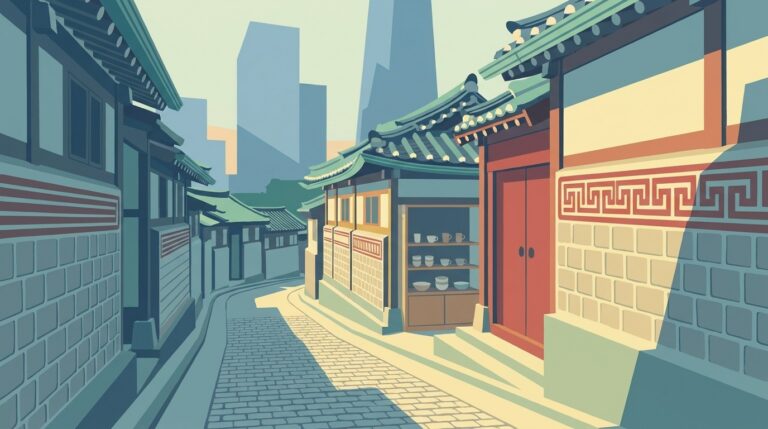
When Cool Alleys Lose Their Charm: Talking Gentrification in Seoul Like a Local
Phase 1: Empathy (Opening Story)
안녕하세요! 매일한글 에디터입니다. (Hello! This is your Daily Hangul editor.)
Picture this: Two years ago, you wandered through the rusted iron workshops of Mullae-dong or the quiet brick residential lanes of Seongsu-dong. Hidden behind an unassuming steel door, you stumbled upon a sunlit indie ceramics atelier where a young potter served you aromatic filter coffee in a handmade mug. It felt like uncovering a quiet Seoul secret—a vibrant pulse of young artists reclaiming neglected corners.
Fast forward to last weekend. You eagerly took your friends back to that exact spot, only to find the potter gone. In its place stood a neon-drenched, three-story corporate cosmetic pop-up store blasting high-energy EDM, surrounded by a two-hour queue of selfie-snapping tourists. The rent had doubled, then tripled, pushing out the very creators who gave the street its soul.
If you have ever felt that bittersweet pinch in Garosu-gil, Gyeongnidan-gil, Yeonnam-dong, or Seongsu-dong, you have witnessed 젠트리피케이션 (gentrification) firsthand. In Korean, this heartbreaking shift has a profoundly poetic and tragic name: 둥지 내몰림 (being pushed out of one’s nest). Talking about urban shifts, runaway rents, and neighborhood identity is a milestone for B2 learners. This guide gives you the nuanced, authentic vocabulary to discuss real social issues with your Korean friends beyond basic textbook phrases.
Phase 2: 3 Key Expressions Deep Dive
1. 둥지 내몰림 현상 (Dungji naemollim hyeonsang)
- Pronunciation: [Dung-ji nae-mol-lim hyeon-sang] (Think: “Doong-jee” like a soft bird’s nest, followed by “neh-mol-leem hyun-sahng”)
- Meaning: Literal: “Nest eviction phenomenon” | Actual Nuance: Gentrification—specifically the tragic displacement of pioneering artists and small business owners when big capital invades.
- K-Culture Moment: You will hear this phrase constantly in Korean investigative journalism, urban design podcasts, and social-commentary dramas whenever historic neighborhoods transform overnight into sterile commercial strips.
- Editor’s Insight: While Korean media originally borrowed “젠트리피케이션” (gentrification), the National Institute of Korean Language championed “둥지 내몰림.” The metaphor of a bird having its warm nest destroyed touches a deep emotional chord in Korean culture, where a storefront is not just property, but a craftsperson’s sanctuary.
- Situation Spectrum: Casual ⚠️ | Semi-formal ✅ | Formal ✅
- 🤔 Think About It: In English, “gentrification” traces back to the landed “gentry” (social class). In Korean, “둥지” focuses on the vulnerability of the home being destroyed. How does this difference change who we empathize with?
2. 임대료가 천정부지로 치솟다 (Imdaeryoga cheonjeongbujiro chisotda)
- Pronunciation: [Im-dae-ryo-ga cheon-jeong-bu-ji-ro chi-sot-da] (Rhythm: Im-dae-ryo-ga / cheon-jeong-bu-ji-ro / chi-sot-da)
- Meaning: Literal: “Commercial rents shoot up without knowing where the ceiling is.” | Actual Nuance: Commercial rent skyrocketing uncontrollably.
- K-Culture Moment: In the hit webtoon and drama adaptation Itaewon Class, when a ruthless conglomerate buys out a tiny pub’s building and spikes the lease to crush them, this exact Hanja idiom describes the crisis.
- Editor’s Insight: “천정부지” (天井不知: ceiling + top + not knowing) is a sophisticated B2-level idiom. Use it whenever inflation, ticket prices, or housing costs rise so steeply that the “roof” seems non-existent.
- Situation Spectrum: Casual ⚠️ | Semi-formal ✅ | Formal ✅
- 🤔 Think About It: Notice the verb “치솟다” (to soar/surge violently) rather than just “오르다” (to rise). It expresses both vertical velocity and emotional indignation.
3. 골목상권의 개성이 사라지다 (Golmoksanggwon-ui gaeseong-i sarajida)
- Pronunciation: [Gol-mok-sang-gwon-ui gae-seong-i sa-ra-ji-da] (Pronounce “ui” smoothly as “eh”)
- Meaning: Literal: “The individuality of the alley commercial district disappears.” | Actual Nuance: The unique, indie vibe of an artistic neighborhood being sanitized by homogenous corporate chains.
- K-Culture Moment: A popular phrase used by Korean travel vloggers revisiting Garosu-gil and lamenting that every unique vintage boutique has been replaced by flagship telecom and franchise cosmetic shops.
- Editor’s Insight: “골목상권” (alleyway business district) holds immense cultural pride in Korea. Unlike wide Western boulevards, Korea’s most beloved urban culture thrives in narrow, pedestrian-only residential alleys (골목길).
- Situation Spectrum: Casual ✅ | Semi-formal ✅ | Formal ✅
- 🤔 Think About It: Why do Koreans use “개성” (individuality/personality), a word normally reserved for humans, to describe retail streets?
Phase 3: Textbook Korean vs Real Korean
Situation 1: Explaining why your favorite cafe suddenly vanished
- 📖 교과서 한국어: “그 카페는 임대료가 너무 비싸져서 다른 지역으로 이전했습니다.” (Geu kapeneun imdaeryoga neomu bissajyeoseo dareun jiyeogeuro ijeonhaetseumnida. / “That cafe relocated to another area because the rent became excessively expensive.”)
- 🗣️ 진짜 한국어: “거기 월세 감당 안 돼서 결국 딴 데로 뺐대요.” (Geogi weolse gamdang an dwaeseo gyeolguk ttan dero ppaetdaeyo. / “They couldn’t handle the monthly rent, so they ended up pulling out to somewhere else.”)
- 💡 왜 다를까?: In real conversations, natives rarely say “이전했습니다” (relocated). Instead, they say “가게를 빼다” (to pull/move a shop out) and “월세 감당이 안 되다” (cannot bear/handle the rent).
Situation 2: Expressing disappointment over a gentrified alley filled only with chains
- 📖 교과서 한국어: “이 골목은 대기업 상업화가 많이 진행되었습니다.” (I golmogeun daegieop sang-eophwaga mani jinhaengdoeeotseumnida. / “This alley has undergone significant commercialization by large corporations.”)
- 🗣️ 진짜 한국어: “여기도 이제 대기업 팝업만 들어오고 완전 특색 없어졌어요.” (Yeogido ije daegieop pabeopman deureo-ogo wanjeon teuksaek eopseojyeosseoyo. / “Now only corporate pop-ups enter here too, and it completely lost its unique charm.”)
- 💡 왜 다를까?: Natural B2 phrasing avoids academic jargon like “상업화가 진행되다” in everyday speech. Koreans say “특색 없어졌다” (it became flavorless/lost distinctiveness) to convey true emotional disappointment.
Phase 4: K-Culture Deep Dive & Non-Verbal Manners
4-1. Nunchi (눈치) & Non-Verbal Etiquette in Transforming Alleys
When you visit independent leather workshops, micro-roasteries, or indie bookstores in Seongsu or Mullae, shop owners often balance pride in their craft with immense anxiety over lease renewals.
* The Empathetic Nod (공감의 끄덕임): If an artisan mentions they must relocate soon, avoid asking direct financial questions like “월세 얼마 올랐어요?” (How much did rent go up?). This violates private boundaries. Instead, furrow your brow slightly, click your tongue gently in sympathy (a soft “아이고…”), and nod slowly.
* Respecting the Space: Never enter an indie workshop purely to shoot TikToks or Instagram Reels without ordering a drink or asking permission: “사진 몇 장 찍어도 괜찮을까요?” (Sajin myeot jang jjigeodo gwaenchaneulkkayo? / “May I take a few photos?”). Local creators in gentrifying areas frequently suffer from “photo tourists” who consume the atmosphere without spending a single won.
4-2. Cultural Code: The Sacred Value of “골목” (Golmok)
In Korean urban consciousness, the golmok (골목, back-alley) is historically communal. It is where neighbors dried red peppers, watched each other’s children, and shared warm side dishes (반찬). When local creators entered places like Euljiro (“Hipjiro”), they revitalized this nostalgic DNA. Gentrification in Korea is painful not just economically, but socially: it wipes out the communal jeong (정) that makes Korean alleyways feel alive, replacing warm neighbors with fleeting commercial tenants.
Phase 5: Real-Life Roleplay Scenario
- Location: A cozy indie bookshop and pottery studio tucked inside a 1970s brick alley in Mullae-dong.
- Characters: You (an admiring frequent customer) and Min-woo (민우), a 30-something ceramic artist and shop owner who is boxing up his handmade cups.
Turn 1
You: 🎭 (Looking around at the cardboard boxes with surprise)
안녕하세요, 사장님! 혹시 가게 정리하시는 중인가요?
(Annyeonghaseyo, sajangnim! Hoksi gage jeongnihasineun jung-ingayo?)
“Hello, boss! By any chance, are you packing up the shop?”
Turn 2
Min-woo: 🎭 (Smiles wistfully, wiping dust off a tape dispenser)
아, 네… 이번 달까지만 영업하고 다른 동네로 옮기게 됐어요.
(A, ne… Ibeon dal-kkajiman yeong-eophago dareun dongnero olmgige dwaesseoyo.)
“Ah, yes… We’re only operating until the end of this month and moving to another neighborhood.”
Turn 3
You: 🎭 (Genuinely crestfallen, stepping closer)
헐, 정말요? 여기 골목 분위기랑 너무 잘 어울려서 제 아지트였는데 아쉬워요.
(Heol, jeongmalyo? Yeogi golmok bunwigirang neomu jal eoullyeoseo je ajiteuyeonneunde aswiwoyo.)
“Oh no, really? This matched the alley’s vibe so well and was my favorite hideout. I’m so sad to hear that.”
Turn 4
Min-woo: 🎭 (Sighs softly, looking toward the bustling main alley outside)
방송 타고 유동 인구가 늘어나니까, 건물주가 재계약 때 월세를 두 배나 올려달라더라고요.
(Bangsong tago yudong inguga neureonanikka, geonmuljuga jaegye-yak ttae weolsereul du baena ollyeodalladeoragoyo.)
“Since it appeared on TV and foot traffic surged, the building owner asked to double the rent upon lease renewal.”
Turn 5
You: 🎭 (Nodding emphatically with deep empathy)
아이고, 둥지 내몰림 현상이 여기까지 왔군요. 감당하기 진짜 힘드셨겠어요.
(Aigo, dungji naemollim hyeonsang-i yeogikkaji watgunyo. Gamdanghagi jinjja himdeusyeotgetseoyo.)
“Oh gosh, gentrification reached all the way here too. It must have been truly impossible to bear.”
Turn 6
Min-woo: 🎭 (Nods gratefully at your understanding)
맞아요. 처음에 허름한 골목 들어와서 고생할 땐 거들떠도 안 보더니… 참 씁쓸하네요.
(Majayo. Cheo-eume heoreumhan golmok deureowaseo gosaenghal ttaen geodeultteodo an bodeoni… Cham sseupsseulhaneyo.)
“Exactly. When we first moved into this shabby alley and struggled, nobody even glanced our way… It leaves quite a bitter taste.”
Turn 7
You: 🎭 (Taking out your smartphone with an encouraging smile)
새로 이전하시는 곳은 어디인가요? 위치 바뀌어도 꼭 다시 찾아갈게요!
(Saero ijeonhasineun goseun eodi-ingayo? Wichi bakkwieodo kkok dasi chajagalgeyo!)
“Where are you relocating to? Even if the location changes, I will definitely visit you again!”
Turn 8
Min-woo: 🎭 (Face brightening with warm gratitude)
고마워요! 인스타그램에 새로 오픈할 작업실 주소 공지해 둘 테니 꼭 놀러 와요.
(Gomaweoyo! Inseutageuraeme saero opeunhal jageopsil juso gongjihae dul teni kkok nolleo wayo.)
“Thank you! I’ll post the address of our new studio on Instagram, so please come by!”
🔀 Interactive Choice Point: How will you close the conversation?
- Option A: “건물주들도 양심이 있어야죠. 인스타 팔로우하고 새 매장 오픈하면 바로 달려갈게요!” (Landlords should have a conscience too. I’ll follow your Instagram and rush over as soon as the new spot opens!)
👉 Feedback (Best): Perfect balance of empathetic validation and loyal customer solidarity. Min-woo will remember you warmly. - Option B: “차라리 대출을 더 받아서 버텨보시는 건 어때요?” (Why don’t you take out more loans and try to hold out?)
👉 Feedback (Bad): Extremely insensitive. Incurring massive debt against predatory rent hikes is financially ruinous for indie artisans. - Option C: “네, 안녕히 계세요.” (Yes, goodbye.)
👉 Feedback (Risk): Abrupt and cold. It cuts off the warm rapport built throughout the conversation.
Phase 6: 10-Second Emotion Shadowing Drill
Practice these lines aloud using the emotion signposts and breath pauses (/):
[🥺 진심 어린 아쉬움과 공감 (Heartfelt sorrow & empathy)]
“여기만의 감성이 / 정말 좋았는데 / 없어진다니 너무 아쉬워요.”
(Yeogiman-ui gamseong-i / jeongmal joanneunde / eopseojindani neomu aswiwoyo.)
“The unique vibe here was so special / it’s so heartbreaking that it’s disappearing.”-
[😤 부당함에 대한 안타까운 분노 (Righteous frustration at injustice)]
“동네를 기껏 살려놓으니까 / 임대료를 이렇게 올리는 건 / 솔직히 너무하네요.”
(Dongnereul gikkeot sallyeonoeunikka / imdaeryoreul ireoke ollineun geon / soljiki neomuhaneyo.)
“After they worked so hard to revive the neighborhood / raising the rent like this / is frankly way too harsh.” -
[💪 따뜻한 응원과 연대감 (Warm cheer & solidarity)]
“어디로 옮기시든 / 사장님 센스는 그대로니까 / 전 꼭 다시 찾아올게요!”
(Eodiro olmgisideun / sajangnim senseuneun geudaeronikka / jeon kkok dasi chajaolgeyo!)
“Wherever you move / your artistic taste remains the same / so I will definitely come find you!”
Phase 7: K-Culture Mini Dictionary
-
핫플레이스 (Hat-peulleiseu – “Hot Place”)
English: Trendy hotspot.
Usage: Refers to buzzy neighborhoods driven by social media. When an alley becomes a “핫플” (shortened slang), foot traffic surges, inevitably triggering gentrification. -
로컬 크리에이터 (Rokeol Keurieiteo – “Local Creator”)
English: Independent neighborhood artisans, chefs, and curators.
Usage: A term celebrating entrepreneurs who weave local heritage, regional architecture, and indie aesthetics into their craft rather than replicating generic franchises. -
팝업스토어 (Pab-eop Seuto-eo – “Pop-up Store”)
English: Temporary brand promotional space.
Usage: Major corporations now rent prime retail spots in Seongsu for just 2–4 weeks at astronomical rates, pricing out long-term local tenants. -
상생 (Sangsaeng – “Mutual Coexistence / Symbiosis”)
English: Win-win living together.
Usage: The civic buzzword across Korea. It refers to building owners, district governments, and indie creators collaborating on rent caps to keep neighborhoods authentic.
Phase 8: Survival Kit for Travelers
Top 3 Survival Phrases
- “혹시 인스타그램 계정 있으세요?”
(Hoksi inseutageuraem gyejeong isseuseyo?)
Pro Tip: Independent Korean shops constantly post sudden moving announcements, temporary hours, and pop-up locations on Instagram first. - “이 근처로 이전하시는 건가요?”
(I geuncheoro ijeonhasineun geon-gayo?)
Pro Tip: Shows thoughtful concern if you notice boxes packed up inside a beloved shop. - “골목 안쪽에 숨은 로컬 매장 추천해 주실 수 있나요?”
(Golmok anjjoge sumeun rokeol maejang chucheonhae jusil su innayo?)
Pro Tip: Perfect question to ask indie baristas to bypass overcrowded corporate spots.
Editor’s Travel Note: Exploring Seoul’s Living Alleys
- Navigate Smart: Avoid solely following viral short-form videos. Use 네이버 지도 앱 다운로드 to save independent bookmarks, or inspect municipal alley revitalization programs via 스마트서울맵 골목상권 둘러보기.
- Local Spending: When exploring districts like Seongsu or Mullae, pay with credit cards or local district vouchers (like Seoul Sarang Pay) directly at mom-and-pop shops. Supporting independent ateliers ensures your travel dollars sustain real neighborhood residents.
Phase 9: Going Deeper (한 발 더 깊이)
In modern Korean urban development, speed is often celebrated as efficiency—a legacy of Korea’s rapid post-war economic miracle (한강의 기적). Yet this very hyper-speed has turned neighborhood culture into disposable commodities. When an old alley transforms into a commercial backdrop, the deep communal bonds of jeong (정) dissolve into transactional retail. True travel is not just photographing trendy facades; it is recognizing the human stories and resilience behind the counter.
💬 Your Turn: Have you experienced “둥지 내몰림” (gentrification) in your own hometown or favorite travel destination? How do you say this in your language, and how do you support your local indie spots? Share your thoughts below in the comments!
Phase 10: FAQ & Common Mistakes
Q: Can I use the English loanword “젠트리피케이션” with native speakers?
A: Absolutely! Most Koreans in their 20s to 50s understand “젠트리피케이션.” However, using “둥지 내몰림” (nest eviction) will showcase your intermediate B2 mastery and demonstrate an emotional understanding of the human cost involved.
Q: Why do Korean pop-up stores open for only one or two weeks?
A: Global fashion and entertainment brands treat Seongsu-dong as an open-air testing ground for Gen Z trends. They can afford paying astronomical daily rental fees solely for marketing buzz, which unintentionally drives baseline rents sky-high for ordinary yearly leases.
Q: Is talking about commercial rent considered rude in Korea?
A: It depends on the nuance! Inquiring directly about an owner’s specific monthly payment (“월세 몇 백 내세요?”) is invasive. However, discussing general rent hikes (“요즘 이 골목 임대료가 많이 올랐죠?”) is a very common, empathetic topic of everyday social conversation in Korea.
🚨 Common Mistakes Alert
- Mistake: Saying “가게가 죽었어요” to mean a store closed down.
Correct Action: Say “가게가 문을 닫았어요” (The shop closed its doors) or “폐업했어요” (It went out of business). Animals and humans die (죽다), but businesses close. - Mistake: Confusing “임대인” (Landlord) with “임차인” (Tenant).
Correct Action: Remember: “임대인” (owner who leases out) vs “임차인” (renter who pays lease). To stay casual, simply say “건물주” (building owner) and “세입자 / 사장님” (tenant / shopkeeper). - Mistake: Using “핫플레이스” dismissively in front of an indie artisan.
Correct Action: Many serious creators feel “핫플” reduces their life’s work to a superficial photo op. Praise their “정성” (heartfelt craftsmanship) and “개성” (individuality) instead.
Phase 11: Action Mission & Engagement
- 🥉 Bronze Level: Read the 3 sentences in Phase 6 out loud three times, matching the vocal emotion markers.
- 🥈 Silver Level: Find an indie Korean cafe or creative brand on Instagram and leave an encouraging Korean comment: “늘 응원합니다! 조만간 꼭 방문할게요!” (Always cheering for you! I’ll visit soon!)
- 🥇 Gold Level: During your next trip to Seoul, strike up a conversation with an indie cafe or shop owner in a quiet alley using Phase 5’s vocabulary!
- 🎮 K-Culture Mission: Watch Episode 10 of Itaewon Class (or an urban documentary on YouTube) and spot every time they use “월세” (monthly rent) or “재계약” (lease renewal)!
Phase 12: Interactive Quiz Challenge
Test your intermediate Korean comprehension! Click the arrows to reveal the answers.
Question 1. Situational Judgment
Your favorite handcrafted bakery in Yeonnam-dong announced it is closing due to landlord rent demands. Which comment sounds the most natural, empathetic, and culturally thoughtful?
* A) “더 큰 대기업 프랜차이즈로 바꿔보세요!”
* B) “둥지 내몰림 때문에 고생 많으셨어요. 이전하셔도 꼭 찾아갈게요!”
* C) “어차피 요즘 빵집은 유행 지나면 다 망해요.”
🔍 Check Answer & Explanation
Answer: B
Explanation: Option B demonstrates genuine empathy using our key phrase “둥지 내몰림” (nest eviction) and promises continued customer loyalty. Option A and C are rude and dismissive.
Question 2. Fill-in-the-Blank
Complete the sentence with the appropriate idiom meaning “skyrocketing without a ceiling”:
“유동 인구가 많아지자 상가 임대료가 ____________ 치솟았다.”
🔍 Check Answer & Explanation
Answer: 천정부지로 (cheonjeongbujiro)
Explanation: “천정부지로 치솟다” is the exact set phrase used to describe runaway price inflation and rent hikes with no upper limit.
Question 3. Cultural True or False
“In Korean culture, the term ‘골목’ (alleyway) simply means a narrow road for cars to pass through and carries no emotional or communal significance.”
* True
* False
🔍 Check Answer & Explanation
Answer: False
Explanation: 골목 (golmok) represents the historic heart of community, neighborly warmth (jeong), and grassroots culture in Korea. It is considered a living cultural ecosystem, which is why gentrification is mourned so deeply.







