

Master Your Korean Performance Review: Pitching Goals Like an Insider
Phase 1: Empathy (Story-driven Opening)
안녕하세요! 매일한글 에디터입니다. (Hello! This is your Daily Hangul editor!)
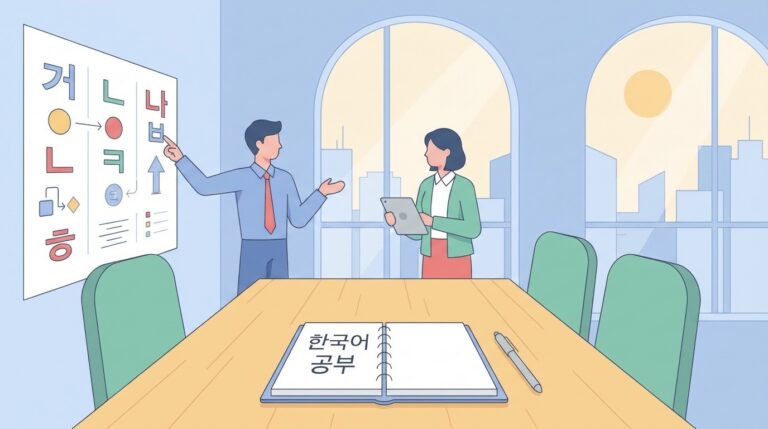
Picture this: You are sitting in a sleek glass conference room overlooking Teheran-ro in Gangnam. Across from you sits your team lead (팀장님 – timjangnim), holding your mid-year evaluation form. If you’ve watched dramas like Misaeng (Incomplete Life) or Agency, you know this exact tension. Your boss takes a sip of their Iced Americano and asks, “So, what are your core plans for the second half of the year?”
Your heart races. In your native language, you could easily explain how you want to automate spreadsheets, build data dashboards, and eliminate repetitive tasks. But in Korean, you worry: Will I sound too arrogant if I boast about tech skills? Or will I sound too passive if I use textbook Korean? Many of our intermediate learners share this exact frustration—they have the technical competence, but struggle to frame their ambitions in a way that resonates with Korean corporate culture.
This guide is crafted directly from real corporate coaching feedback. By mastering today’s phrase, you won’t just survive your 1-on-1 evaluation; you will project strategic initiative, technological savvy, and collective team commitment.
Phase 2: Core Expressions Deep Dive
1. 역량을 높이다 (Yeongnyang-eul nop-i-da)
- Pronunciation: [Yeong-nyang-eul no-pi-da] (Think of ‘Yeong’ like ‘young’ without the w-glide, and ‘nyang’ rhymes with the Korean currency ‘won-yang’ sound).
- Meaning: Literally “raise one’s capacity/competence” vs Nuanced: “level up professional skillsets / upskill.”
- K-Culture Moment: Seen frequently in career pivot dramas like Start-Up, where developers discuss leveling up backend capabilities.
- Editor’s Insight: While students often default to “공부하다” (to study) or “배우다” (to learn), using 역량을 높이다 shifts your image from a passive student to an active, self-driven professional.
- Situation Spectrum: Casual 🚫 | Semi-formal ⚠️ | Formal ✅
- 🤔 Think About It: Why does Korean corporate culture emphasize individual upskilling explicitly tied to team utility rather than pure personal interest?
2. 업무 자동화 범위를 넓히다 (Eommu jadonghwa beom-wi-reul neolpida)
- Pronunciation: [Eom-mu ja-dong-hwa beom-wi-reul neol-pi-da] (Eom sounds like ‘umbrella’ without ‘brella’; neol sounds like ‘null’ with a soft l).
- Meaning: Literally “widen the scope of task automation” vs Nuanced: “expand automated workflows to free up high-value time.”
- K-Culture Moment: Think of Search: WWW when tech managers present operational efficiency overhauls.
- Editor’s Insight: In Korean offices, efficiency is deeply prized under the “빨리빨리” (fast-fast) ethos. Pairing 업무 자동화 (workflow automation) with 범위를 넓히다 shows visionary thinking rather than just fixing a one-off spreadsheet.
- Situation Spectrum: Casual 🚫 | Semi-formal ⚠️ | Formal ✅
- 🤔 Think About It: How does pitching automation demonstrate respect for your colleagues’ workload in a collective work environment?
3. ~하는 것이 목표입니다 (~haneun geosi mokpyoimnida)
- Pronunciation: [~ha-neun geo-si mok-pyo-im-ni-da] (Mok rhymes with ‘choke’ with a crisp k; pyo is like ‘pure’ without the r).
- Meaning: Literally “Doing [X] is the goal” vs Nuanced: “My clear, targeted objective is to [X].”
- K-Culture Moment: The textbook climax line in any evaluation meeting or job interview scene across K-dramas.
- Editor’s Insight: Using “~하고 싶어요” (I want to do…) sounds like a personal wish list. “~하는 것이 목표입니다” sounds accountable, measurable, and business-ready.
- Situation Spectrum: Casual 🚫 | Semi-formal ⚠️ | Formal ✅
- 🤔 Think About It: In your culture, do you state goals as personal desires or corporate commitments? How does language shape accountability?
Phase 3: Textbook Korean vs Real Korean
Situation 1: Expressing the desire to learn new tools
- 📖 교과서 한국어 (Textbook):
저는 하반기에 데이터 분석을 열심히 공부하겠습니다.
(Jeoneun habanggie deiteo bunseog-eul yeolsimhi gongbuhagessseumnida – I will study data analysis hard in the second half.) - 🗣️ 진짜 한국어 (Real Workplace):
하반기에는 데이터 분석 툴 활용 역량을 높여보고자 합니다.
(Habanggieneun deiteo bunseok tul hwaryong yeongnyang-eul nop-yeobogoja hamnida – In the second half, I aim to enhance my capability in leveraging data analytics tools.) - 💡 왜 다를까? (Why the difference?):
In business Korean, “공부하다” (to study) sounds academic. Professionals use 활용 역량을 높이다 (boost practical utilization competencies) to signal ROI on their learning.
Situation 2: Proposing workflow improvements
- 📖 교과서 한국어 (Textbook):
컴퓨터로 일을 더 빨리 끝내겠습니다.
(Keompyuteoro ireul deo ppalli kkeunnaegessseumnida – I will finish work faster with a computer.) - 🗣️ 진짜 한국어 (Real Workplace):
반복 업무를 자동화하여 업무 효율성을 극대화하겠습니다.
(Banbok eommureul jadonghwahayeo eommu hyoyulseong-eul geukdaehwahagessseumnida – I will automate repetitive tasks to maximize operational efficiency.) - 💡 왜 다를까? (Why the difference?):
Corporate reviews reward systemic improvement. Describing work as 반복 업무 자동화 (automating repetitive tasks) highlights structural problem-solving rather than just working faster.
Phase 4: K-Culture Deep Dive & Non-verbal Manners
4-1. 눈치 (Nunchi) & Review Manners
During an evaluation with a Korean supervisor, non-verbal cues carry as much weight as spoken grammar:
1. The Posture of Open Attention: Keep both feet flat on the floor, spine straight, with your hands loosely clasped on the table or resting on your evaluation folder. Avoid leaning back in the chair, which can be interpreted as defensive or disinterested.
2. Eye Contact & Nodding (Gogae Kkeudeog-im): Constant, unblinking eye contact can feel confrontational in Korean hierarchy. Aim for a 70/30 balance: maintain respectful eye contact while your manager speaks, nod slightly (끄덕끄덕) to signal comprehension, and glance at your review sheet when phrasing your goal statement.
3. Holding Documents: Always handle your review sheets or tablet with both hands when passing or referencing them.
4-2. Cultural Code: The Growth Mindset (성장형 인재)
In South Korea’s hyper-competitive knowledge economy, companies treasure what they call 성장형 인재 (growth-oriented talent). Korean managers value employees who proactively identify inefficiencies and upgrade themselves without being spoon-fed. By articulating that you will acquire data skills to automate workflows, you demonstrate both individual self-development (자기계발) and collective organizational benefit (조직 기여).
Phase 5: Real-World Roleplay Scenario
Setting: 3:00 PM in Conference Room B. Min-woo (팀장님 – Team Leader) is reviewing your mid-year self-evaluation dossier.
- Turn 1 (팀장님): 지난 상반기 동안 프로젝트 진행하느라 고생 많았어요. 전반적인 성과는 만족스럽습니다.
(Jinan sangbanggi dongan peurojekteu jinhaenghaneura gosaeng manasseoyo. Jeonbanjeogin seonggwaneun manjokseureopseumnida.)
“You worked hard running projects in the first half. Overall results have been very satisfying.”
🎭 Looking over your KPI metrics with a warm, approving smile. -
Turn 2 (You): 좋게 평가해 주셔서 감사합니다, 팀장님. 팀원분들이 많이 도와주신 덕분입니다.
(Joke pyeong-gahae jusyeoseo gamsahamnida, timjangnim. Timwonbundeuri mani dowajusin deokbunimnida.)
“Thank you for the positive evaluation, Team Lead. It was only possible thanks to the team’s support.”
🎭 Lightly bowing head, keeping hands clasped gracefully on the desk. -
Turn 3 (팀장님): 자, 그럼 이제 하반기 계획에 대해 이야기해 볼까요? 특별히 집중하고 싶은 분야가 있나요?
(Ja, geureom ije habanggi gyehoege daehae iyagihae bolkkayo? Teukbyeolhi jipjunghago sipeun bunyaga innayo?)
“Well, shall we discuss plans for the second half? Is there any specific area you’d like to focus on?”
🎭 Clicking pen, leaning forward with genuine interest. -
Turn 4 (You): 네, 하반기에는 데이터 분석 툴 활용 역량을 높여서 업무 자동화 범위를 넓히는 것이 목표입니다.
(Ne, habanggieneun deiteo bunseok tul hwaryong yeongnyang-eul nop-yeoseo eommu jadonghwa beom-wi-reul neolpineun geosi mokpyoimnida.)
“Yes, in the second half, my goal is to level up my data analytics tool competency and expand workflow automation.”
🎭 Speaking with clear tone, making steady and confident eye contact. -
Turn 5 (팀장님): 데이터 툴이라… 구체적으로 어떤 툴을 염두에 두고 있죠?
(Deiteo turira… Guchejeog-euro eotteon tureul yeomdue dugo itjyo?)
“Data tools… What specific tools do you have in mind?”
🎭 Nodding thoughtfully while jotting notes. -
Turn 6 (You): 파이썬과 SQL을 활용하여 주간 리포트 작성을 자동화하고, 분석 시간을 단축해 보고 싶습니다.
(Paisseon-gwa SQL-eul hwaryonghayeo jugan ripoteu jakseong-eul jadonghwahago, bunseok siganeul danchukhae bogo sipseumnida.)
“I would like to use Python and SQL to automate our weekly reports and reduce data analysis turnaround time.”
🎭 Pointing briefly to the quarterly workflow chart on your printed evaluation sheet. -
Turn 7 (팀장님): 아주 좋은 방향이네요. 우리 팀 리포팅 프로세스가 개선되면 리소스 절약이 많이 되겠어요. 회사 교육비 지원도 신청해 봐요.
(Aju joeun banghyang-ineyo. Uri tim ripoting peuroseseuga gaeseondoemyeon risoseu jeoryag-i mani doegesseoyo. Hoesa gyoyukbi jiwondo sincheonghae bwayo.)
“That is an excellent direction. Streamlining our team’s reporting process will save tremendous resources. Consider applying for company educational subsidy too.”
🎭 Smiling brightly and checking off the growth objective box. -
Turn 8 (You): 조언해 주셔서 감사합니다! 적극적으로 실행해서 팀 성과에 기여하겠습니다.
(Joeonhae jusyeoseo gamsahamnida! Jeokgeukjeog-euro silhaenghayeo tim seonggwa-e giyeohagessseumnida.)
“Thank you for the advice! I will proactively execute this and contribute to our team’s performance.”
🎭 Bowing respectfully with a confident, energetic smile.
🔀 Interactive Decision Point
If the Team Lead asks: “자동화 과정에서 오류가 나면 어떡하죠? (What if errors happen during automation?)”
* Choice A: “제가 컴퓨터를 잘 아니까 걱정 안 하셔도 됩니다.” (Don’t worry, I know computers well.)
* Feedback: ❌ Bad. Sounds cocky and dismissive of operational risk.
* Choice B: “초기에는 기존 수작업 검수와 병행하여 안정성을 철저히 확보하겠습니다.” (Initially, I will run it in parallel with manual checks to ensure complete stability.)
* Feedback: 🏆 Best! Demonstrates risk mitigation, reliability, and business maturity.
* Choice C: “오류가 나면 그때 가서 팀원들에게 물어보겠습니다.” (If errors happen, I will ask team members then.)
* Feedback: ⚠️ Risk. Suggests lack of foresight and dumping sudden burdens onto colleagues.
Phase 6: 10-Second Emotion Shadowing Drill
Practice breathing and cadence with natural pause breaks (/):
[🤝 겸손하지만 자신감 넘치게]
하반기에는 / 데이터 분석 툴 활용 역량을 높여서 / 업무 자동화 범위를 넓히는 것이 / 목표입니다.
(Habanggieneun / deiteo bunseok tul hwaryong yeongnyang-eul nop-yeoseo / eommu jadonghwa beom-wi-reul neolpineun geosi / mokpyoimnida.)-
[💡 논리적이고 차분하게]
반복 업무 프로세스를 개선하여 / 팀 전체의 리소스를 / 아끼겠습니다.
(Banbok eommu peuroseseureul gaeseonhayeo / tim jeonche-ui risoseureul / akkigessseumnida.) -
[🔥 열정적이고 든든하게]
적극적으로 실행해서 / 팀 성과에 실질적으로 / 기여하겠습니다.
(Jeokgeukjeog-euro silhaenghayeo / tim seonggwa-e siljiljeog-euro / giyeohagessseumnida.)
Phase 7: K-Culture Mini Dictionary
- 인사평가 (Insa-pyeong-ga) | Performance Review / Personnel Evaluation
- Usage: The formal corporate evaluation cycle, typically divided into mid-year (상반기) and end-of-year (하반기).
- 역량 강화 (Yeongnyang ganghwa) | Competency Enhancement / Upskilling
- Usage: A buzzword in corporate reports, personal goal sheets, and executive presentations indicating deliberate skill acquisition.
- 업무 자동화 (Eommu jadonghwa) | Workflow Automation
- Usage: Widely used in modern Korean tech and office environments to refer to automating repetitive spreadsheets, ERP entries, or bot triggers.
- 팀 기여도 (Tim giyeodo) | Team Contribution Margin
- Usage: The degree to which your individual work benefits the group. In Korea, individual brilliance is evaluated in conjunction with team harmony.
Phase 8: Expat & Professional Survival Kit
Top 3 Survival Phrases
- 피드백 주신 부분 반영하겠습니다. (Pideubaek jusin bubun banyeonghagessseumnida.)
- Meaning: “I will incorporate the feedback you provided.”
- Pro Tip: Use this whenever your manager offers constructive criticism. It shows coachability instantly.
- 진행 상황 정기적으로 공유드리겠습니다. (Jinhaeng sanghwang jeong-gijeog-euro gong-yudeurigessseumnida.)
- Meaning: “I will regularly share status updates with you.”
- Pro Tip: Banishes managerial anxiety before it starts.
- 추가로 보완할 점이 있을까요? (Chugaro bowanhal jeomi isseulkkayo?)
- Meaning: “Is there anything additional I should refine or supplement?”
- Pro Tip: Signals that you strive for excellence, not mere completion.
Editor’s Professional Note
Navigating Korean corporate platforms is crucial for benchmark setting. If you want insight into how Korean employees talk about salary, performance ratings, and reviews, download the community app through the [블라인드 직장인 커뮤니티 앱 다운로드 가이드] to explore real corporate discussions, or check hiring trends on the [원티드 커리어 채용 플랫폼 탐색] for industry-standard skill benchmarks. Also, remember to sync meetings using your company’s Dooray or Naver Works calendar system.
Phase 9: A Step Deeper (한 발 더 깊이)
In Western corporate settings, individual self-promotion is often rewarded with direct phrasing (“I drove this project; I expanded this metric”). In a Korean organizational context, however, raw self-assertion can sometimes create friction. The cultural ideal is 겸손한 야망 (humble ambition): a subtle synthesis where you acknowledge collective support (덕분에) while asserting ambitious technical targets (역량을 높여 기여하겠습니다). Framing personal upskilling through workflow automation is the golden mean—it honors personal excellence while gifting saved time back to the collective team.
💬 Your Turn: How does stating future professional goals in your home country differ from the Korean focus on team utility and collective efficiency? Share your perspective in the comments!
Phase 10: FAQ & Avoiding Misunderstandings
Q: Can I use “~하고 싶습니다 (~hago sipseumnida)” instead of “~하는 것이 목표입니다”?
A: While “~하고 싶습니다” (I want to…) is grammatically polite, in an official performance review it can sound like a personal wish rather than an accountable business commitment. Stick to “~하는 것이 목표입니다” or “~해 보고자 합니다” to convey professional intent.
Q: Is it okay to mention personal study, like learning English or taking an MBA?
A: Only if it directly benefits your current or prospective role within the company. In Korean reviews, explicitly connect personal learning to departmental output (e.g., “To improve global partner communication, I am upskilling…”).
Q: How do I reply if my manager sets an unrealistically high goal?
A: Don’t answer with a direct “No” (안 됩니다). Use the softening strategy: “현재 리소스로는 다소 빠듯할 수 있으나, 우선순위를 조정하여 최선의 방안을 찾아보겠습니다” (With current resources it may be tight, but I will adjust priorities and seek the best solution).
🚨 Common Mistakes Warning Board
- Mistake: Using “공부하겠습니다” (I will study).
- Correct Action: Replace with “역량을 강화하겠습니다” (I will enhance my competency).
- Mistake: Forgetting to thank the team when receiving praise.
- Correct Action: Say “팀원분들이 도와주신 덕분입니다” (It was thanks to the team’s help) before accepting the compliment.
- Mistake: Framing automation as “doing less work myself.”
- Correct Action: Frame it as “리소스를 절약하여 고부가가치 업무에 집중하기 위함” (Saving resources to focus on high-value tasks).
Phase 11: Action Missions
- 🥉 Bronze Mission (Solo Practice): Stand before a mirror and record yourself saying the core sentence with confident posture and a slight bow at the end.
- 🥈 Silver Mission (Journaling & Social Share): Write your own second-half goal in Korean in the comments below using the pattern:
[하반기에는 _____ 역량을 높여서 _____ 범위를 넓히는 것이 목표입니다]. - 🥇 Gold Mission (Real Life Application): Use this exact phrasing during your actual 1-on-1 performance review or coffee chat with your Korean mentor/manager.
- 🎮 K-Culture Mission: Watch Episode 3 of Misaeng or Episode 5 of Start-Up and note down how characters pitch their technical capabilities to their superiors.
Phase 12: Interactive Quiz Challenge
Question 1 (Situation Judgment): During your review, your team lead compliments your past quarter. What is the most culturally adept first reaction?
– A) 당연합니다. 제가 야근을 많이 했습니다. (Of course. I worked lots of overtime.)
– B) 좋게 봐주셔서 감사합니다. 팀원분들이 도와주신 덕분입니다. (Thank you for viewing it favorably. It’s thanks to my team’s support.)
– C) 다음 분기에는 인센티브를 더 많이 받고 싶습니다. (Next quarter I want a bigger incentive bonus.)
Question 2 (Fill in the Blanks): Complete the professional goal statement:
하반기에는 데이터 분석 툴 활용 ______을/를 높여서 업무 자동화 ______을/를 넓히는 것이 목표입니다.
Question 3 (True or False): In a Korean performance interview, maintaining continuous, unblinking eye contact without nodding is seen as a sign of deep respect.
– (True / False)
👉 Click here to reveal answers & explanations!
Answers & Explanations:
1. Answer: B.
Explanation: Acknowledging team members first (덕분에) demonstrates the virtue of modest ambition highly cherished in Korean corporate teams.
2. Answer: 역량 (Competency) / 범위 (Scope).
Full Sentence: 하반기에는 데이터 분석 툴 활용 역량을 높여서 업무 자동화 범위를 넓히는 것이 목표입니다.
3. Answer: False.
Explanation: Unbroken, unblinking eye contact without nodding can feel confrontational or stiff. A respectful gaze paired with light nodding (끄덕끄덕) shows attentiveness and humility.







