

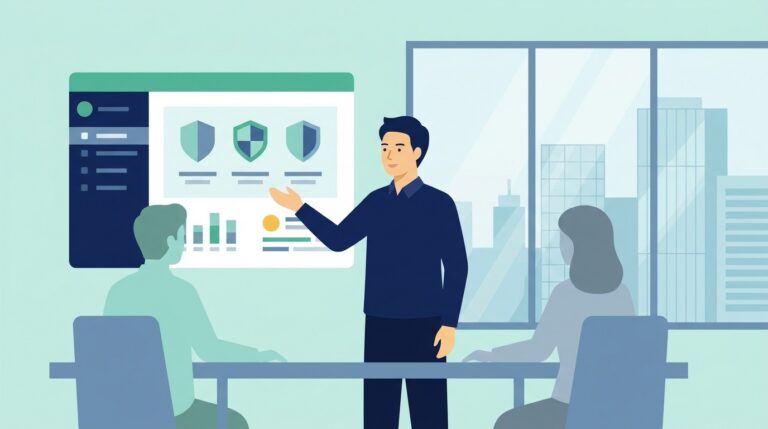
Phase 1: 공감 (스토리 몰입형 오프닝)
안녕하세요! 매일한글 에디터입니다.
Imagine this: You are sitting in an ultra-sleek, glass-walled conference room in Pangyo—Korea’s bustling Silicon Valley. The vibe is straight out of a high-stakes K-Drama like Search: WWW or Start-Up. Outside, colleagues are sipping iced Americanos, but inside, the tension is thick. The annual ISMS (Information Security Management System) audit is just two weeks away. The lead compliance auditor adjusts his glasses, flips open a clipboard, and asks the dreaded question: “What happens to a developer’s database credentials the second they transfer teams or tender their resignation?”
If your mind instantly scrambles for how to explain complex offboarding automation pipelines without sounding like an automated translation bot, take a deep breath! Many intermediate (B2) Korean learners freeze up when navigating technical corporate vocabularies. Explaining enterprise security protocols isn’t just about translating English technical jargon word-for-word; it requires speaking with professional authority, precision, and the nuanced politeness expected in modern Korean corporate environments.
Today, we are mastering an essential, career-defining sentence that our community of foreign tech leads in Seoul requested most: “퇴사자나 부서 이동자의 사내 시스템 및 DB 접근 권한은 인사 발령 당일에 즉시 회수되도록 자동화 프로세스를 구축했어요” (We automated offboarding so system and database access rights are revoked immediately on the day an employee leaves or transfers). By the end of this guide, you will be able to ace security inspections, impress your timjangnim (team lead), and speak Korean tech policy with absolute confidence!
Phase 2: 핵심 표현 3선 심층 분석
1. 퇴사자나 부서 이동자의 사내 시스템 및 DB 접근 권한은 인사 발령 당일에 즉시 회수되도록 자동화 프로세스를 구축했어요.
- Pronunciation: Toesaja-na buseo idongja-ui sanae siseutem mit dibi jeopgeun gwonhan-eun insa ballyeong dangil-e jeuksi hoesudoedorok jadonghwa peuroseseu-reul guchukhaesseoyo. (Sound analogy: Think of toesa like saying “toe-sah”, and hoesudoedorok like “hway-sue-dway-doe-rock” with crisp, clipped vowels).
- Meaning: Literal: “For leavers or department movers, internal system and DB access rights, on the HR announcement day, so that they are retrieved immediately, we built an automated process.” / Real Nuance: “We built an automated pipeline ensuring that system and DB credentials for departed or transferred staff are revoked immediately on the effective transfer date.”
- K-Culture Moment: In workplace dramas like Misaeng, personnel announcements (insa ballyeong) dictate everything from seat relocations to dramatic access badge revocations.
- Editor’s Insight: Notice the passive construction 회수되도록 (so that it is revoked/retrieved) paired with 구축했어요 (we constructed/built). In Korean IT culture, stating that a process is automated (자동화 구축) sounds far more reliable than saying “I manually deleted them.”
- Situation Spectrum: Casual 🚫 | Semi-formal ⚠️ | Formal ✅ (Perfect for internal meetings, audit reports, and technical presentations).
- 🤔 Think About It: Why does Korean office culture use 회수 (retrieval/taking back) rather than 삭제 (deletion) for privileges? In Korean corporate logic, permissions are loans granted by the enterprise, not personal possessions.
2. 이번 ISMS 정기 보안 감사를 대비해서 개인정보 처리방침 개정안을 사전 점검하고 있습니다.
- Pronunciation: Ibeon ISMS jeonggi boan gamsa-reul daebihaeseo gaeinjeongbo cheoribangchim gaejeong-an-eul sajeon jeomgeomhago itseumnida. (Sound analogy: daebihaeseo flows like “deh-bee-heh-saw”, sounding proactive and sharp).
- Meaning: Literal: “Preparing for this regular ISMS security audit, we are pre-inspecting the personal information processing policy revision.” / Real Nuance: “We are proactively reviewing our updated Privacy Policy in preparation for the upcoming routine ISMS security audit.”
- K-Culture Moment: Seen in Agency (대행사), where high-stakes internal audits test whether departments followed regulatory guidelines to the letter before public release.
- Editor’s Insight: 사전 점검 (pre-inspection) is the ultimate magic word to show diligence (nunchi + proactiveness). Using the formal ending -고 있습니다 demonstrates steady, ongoing compliance.
- Situation Spectrum: Casual 🚫 | Semi-formal ⚠️ | Formal ✅ (Standard phrasing for executive briefings).
- 🤔 Think About It: In your native culture, do you treat policy updates as a purely legal routine or a company-wide collective defense against audits?
3. 권한 오남용을 방지하기 위해 접근 로그를 실시간으로 모니터링하고 철저히 격리 조치했습니다.
- Pronunciation: Gwonhan onamyong-eul bangjihagi wihae jeopgeun rogeu-reul silsigan-euro monitoringhago cheoljeohi gyeokni jochihaesseumnida. (Sound analogy: Gyeokni sounds like “gyung-nee” due to Korean nasalization rules!).
- Meaning: Literal: “In order to prevent abuse of authority, monitoring access logs in real-time, we took thorough isolation measures.” / Real Nuance: “To prevent privilege escalation and unauthorized misuse, we monitor access logs in real time and have enforced strict privilege isolation.”
- K-Culture Moment: Think of cybersecurity thrillers like Ghost (유령), where forensic teams isolate compromised endpoints before leaks spread.
- Editor’s Insight: 오남용 (misuse & abuse) and 격리 조치 (isolation action) show advanced (B2-C1) register. It conveys that your system doesn’t wait for accidents to happen—it contains them.
- Situation Spectrum: Casual 🚫 | Semi-formal ⚠️ | Formal ✅ (Ideal for risk management and post-incident reports).
- 🤔 Think About It: Combining two distinct negative terms into one compound (오용 = misuse, 남용 = abuse -> 오남용) is typical of Korean legal & technical terminology.
Phase 3: 교과서 한국어 vs 진짜 한국어
Situation 1: Explaining that access has been removed
- 📖 교과서 한국어 (Textbook Style): 퇴사한 직원의 시스템 권한을 삭제했습니다. (Toesahan jigwon-ui siseutem gwonhan-eul sakjehaesseumnida. – I deleted the resigned employee’s system permissions.)
- 🗣️ 진짜 한국어 (Real Tech Office Style): 퇴사자 권한은 발령 즉시 자동으로 칼같이 회수되게 연동해 뒀어요. (Toesaja gwonhan-eun ballyeong jeuksi jadong-euro kalgachi hoesudoege yeondonghae dwoesseoyo. – Leaver permissions are synced to be revoked automatically and strictly on the spot upon official announcement.)
- 💡 왜 다를까?: Native Korean engineers prefer the idiomatic adverb 칼같이 (knife-sharp / strictly punctual) and the operational verb 연동하다 (interlock/sync API) to highlight robust automation rather than manual deletion.
Situation 2: Confirming preparedness for an audit
- 📖 교과서 한국어 (Textbook Style): 저희는 보안 감사를 철저하게 준비하고 있습니다. (Jeohuineun boan gamsa-reul cheoljeohage junbihago itseumnida. – We are thoroughly preparing for the security audit.)
- 🗣️ 진짜 한국어 (Real Tech Office Style): 이번 ISMS 감사에서 지적 사항 안 나오게 로그랑 방침 빈틈없이 다 털어서 점검 중이에요. (Ibeon ISMS gamsa-eseo jijeok sahang an naoge rogeurang bangchim binteum-eopsi da teoreoseo jeomgeom jung-ieyo. – We are going through our logs and policies with a fine-tooth comb so we don’t get any non-conformity flags during the ISMS audit.)
- 💡 왜 다를까?: While formal presentations require standard language, internal discussions among colleagues utilize energetic idioms like 빈틈없이 털다 (scouring thoroughly without gaps) and avoiding 지적 사항 (audit findings/deficiency notes).
Phase 4: K-Culture 딥다이브 & 비언어적 매너
4-1. 눈치(Nunchi) & Non-Verbal Posture in Security Audits
In a Korean corporate security audit, your physical composure speaks before your code does. When presenting to external auditors or C-suite executives:
* Two-Handed Handover: Always hand printouts, system architectures, or authentication tablets using both hands, slightly bowing your head.
* Neutral, Defensible Eye Contact: Maintain calm eye contact when listening to an auditor’s inquiry. Nod slightly (끄덕임) to show comprehension before answering. Never interrupt an auditor while they are citing a compliance clause.
* The “Pangyo Posture”: In modern Korean tech companies, confidence is shown through calm, data-backed articulation rather than aggressive debate. Use words ending in -했습니다 or -조치 완료했습니다 (Action complete) rather than ambiguous statements like ~인 것 같아요 (I think it might be…).
4-2. Cultural Code: Why Korean Companies are Hyper-Sensitive to ISMS & PIPA
In South Korea, data privacy is not treated as mere corporate bureaucracy. The Personal Information Protection Act (개인정보 보호법, PIPA) is globally recognized as one of the world’s strictest privacy laws, alongside the EU’s GDPR. Moreover, achieving and maintaining ISMS-P (Information Security & Personal Information Management System) certification is a legal prerequisite for major platforms (Kakao, Naver, Coupang, Toss).
A breach or a failed audit doesn’t just mean fines—it results in public corporate apologies (대국민 사과문) broadcast across nationwide news. Therefore, the moment someone leaves the company (퇴사), their access must vanish instantly. Automated offboarding protects both the company and the individual from legal liability.
Phase 5: 실전 롤플레이 시나리오
- Setting: The 7th-floor conference room of an IT enterprise in Pangyo. Auditor Park (a meticulous ISMS certifier) is reviewing offboarding access controls alongside Manager Min-jun and you (DevOps/Security Engineer).
- 박 감사관 (Auditor Park): [🎭 돋보기안경을 고쳐 쓰며 감사 체크리스트를 넘긴다] 부서 이동자나 퇴사자 계정 권한 관리는 어떻게 통제하고 계십니까?
(Buseo idongja-na toesaja gyejeong gwonhan gwalli-neun eotteoke tongjehago gyesimnikka?)
“How do you govern and control account permissions for personnel transfers and resignations?” -
민준 팀장 (Manager Min-jun): [🎭 긴장된 표정으로 침을 꿀꺽 삼키며 당신을 바라본다] 아, 그 부분은 이번 분기에 저희가 시스템 개편을 진행했는데요. 엔지니어님, 설명 부탁드립니다.
(A, geu bubun-eun ibeon bungi-e jeohuiga siseutem gaeComplexity-reul jinhaenghaenneundeyo. Enjinieo-nim, seolmyeong butakdeurimnida.)
“Ah, for that matter, we overhauled our system this quarter. Lead Engineer, please explain.” -
나 (You): [🎭 태블릿 화면을 띄워 대시보드 로그를 정중히 가리키며] 네, 퇴사자나 부서 이동자의 사내 시스템 및 DB 접근 권한은 인사 발령 당일에 즉시 회수되도록 자동화 프로세스를 구축했어요.
(Ne, toesaja-na buseo idongja-ui sanae siseutem mit dibi jeopgeun gwonhan-eun insa ballyeong dangil-e jeuksi hoesudoedorok jadonghwa peuroseseu-reul guchukhaesseoyo.)
“Yes, we automated offboarding so system and database access rights are revoked immediately on the day an employee leaves or transfers.” -
박 감사관 (Auditor Park): [🎭 눈썹을 치켜세우며 의심스러운 눈빛으로] 즉시 회수된다고요? 수동 승인 절차 없이 HR 데이터와 다이렉트로 연동된다는 말씀인가요?
(Jeuksi hoesudoendagoyo? Sudong seung-in jeolcha eopsi HR deiteo-wa da-irekteu-ro yeondongdoendaneun malsseum-ingayo?)
“Revoked immediately? Are you saying it syncs directly with HR data without manual approval steps?” -
나 (You): [🎭 신뢰감 있는 차분한 목소리로 고개를 끄덕이며] 맞습니다. 인사 시스템의 발령 배치(Batch) 작업이 실행되는 순간 권한이 박탈되며, 관리자에게 실시간 알림이 발송됩니다.
(Matseumnida. Insa siseutem-ui ballyeong baechi jag-eob-i silhaengdoeneun sungan gwonhan-i baktaldoemyeo, gwanrija-ege silsigan allim-i balsongdoemnida.)
“Correct. The moment the HR system’s appointment batch job executes, permissions are stripped, and real-time alerts are sent to administrators.” -
민준 팀장 (Manager Min-jun): [🎭 안도하며 살짝 미소를 짓는다] 지난달 정기 인사 이동 때도 누락 없이 전원 권한 회수 완료되었습니다.
(Jinandat jeonggi insa idong ttaedo nurak eopsi jeonwon gwonhan hoesu wanryodoeeosseumnida.)
“During last month’s regular personnel reshuffle, all permissions were revoked without a single omission.” -
박 감사관 (Auditor Park): [🎭 볼펜으로 체크리스트 항목에 ‘적합’ 체크를 하며] 훌륭하군요. 휴먼 에러를 방지하는 아주 모범적인 ISMS 통제 사례입니다.
(Hullyunghagunyo. Hyumeon ereo-reul bangjihaneun aju mobeomjeog-in ISMS tongje sarye-imnida.)
“Impressive. That is an exemplary ISMS control case that prevents human error.” -
나 (You): [🎭 두 손을 모으고 가볍게 목례하며] 감사합니다. 개인정보 처리방침 개정 조항에도 해당 자동화 기준을 명시해 두었습니다.
(Gamsahamnida. Gaeinjeongbo cheoribangchim gaejeong johang-edo haedang jadonghwa gijun-eul myeongsihae duoesseumnida.)
“Thank you. We have also specified this automation standard in the revised clauses of our Privacy Policy.”
🔀 인터랙티브 분기점 (Interactive Choice)
When Auditor Park asked about the sync mechanism in Turn 4, what if you had answered differently?
- Option A: “어… 인사팀에서 보통 퇴사하고 며칠 뒤에 슬랙으로 메일 주면 제가 수동으로 지워요.” (Uh… usually when HR slacks me a few days after someone leaves, I manually delete it.)
- Feedback [❌ BAD]: Instant non-conformity flag (결함 지적). Waiting a few days for manual ticket processing violates ISMS access control criteria!
- Option B: “퇴사자나 부서 이동자의 사내 시스템 및 DB 접근 권한은 인사 발령 당일에 즉시 회수되도록 자동화 프로세스를 구축했어요.” (We automated offboarding so system and database access rights are revoked immediately on the day an employee leaves or transfers.)
- Feedback [🌟 BEST]: Flawless! Demonstrates technical automation, eliminates human error, and uses refined professional Korean terminology.
- Option C: “보안은 완벽하니까 걱정 안 하셔도 됩니다. 시스템이 알아서 잘합니다.” (Security is perfect, so don’t worry. The system takes care of itself.)
- Feedback [⚠️ RISK]: High risk of provoking the auditor. In Korean audit culture, vague overconfidence without evidentiary documentation (증적 자료) invites aggressive cross-examination.
Phase 6: 10초 감정 섀도잉 드릴
Practicing rhythm and breath control is essential for sounding authoritative in meetings. Pause at the slashes (/).
- [💼 단호하고 신뢰감 넘치게 / Firm & Confident]
퇴사자나 / 부서 이동자의 / 사내 시스템 및 DB 접근 권한은 / 인사 발령 당일에 / 즉시 회수되도록 / 자동화 프로세스를 구축했어요.
(Toesaja-na / buseo idongja-ui / sanae siseutem mit dibi jeopgeun gwonhan-eun / insa ballyeong dangil-e / jeuksi hoesudoedorok / jadonghwa peuroseseu-reul guchukhaesseoyo.) -
[🛡️ 침착하고 꼼꼼하게 / Calm & Diligent]
이번 ISMS 보안 감사를 대비해서 / 개인정보 처리방침 개정안을 / 사전에 철저히 / 점검하고 있습니다.
(Ibeon ISMS boan gamsa-reul daebihaeseo / gaeinjeongbo cheoribangchim gaejeong-an-eul / sajeon-e cheoljeohi / jeomgeomhago itseumnida.) -
[🤝 안도하며 정중하게 / Relieved & Courteous]
권한 오남용을 방지하기 위해 / 실시간 모니터링 로그를 / 감사팀에 제출 완료했습니다.
(Gwonhan onamyong-eul bangjihagi wihae / silsigan monitoring rogeu-reul / gamsatim-e jechul wanryohaesseumnida.)
Phase 7: K-Culture 미니 사전 (핵심 키워드 4개)
-
인사 발령 (Insa ballyeong)
Meaning: Official Personnel Appointment / Transfer Notice.
Office Insight: In Korea, corporate reshuffles happen routinely (e.g., 정기 인사 in December or January). System rights, team Slack channels, and corporate card limits shift immediately on the date written in the 인사 발령 decree. -
회수 (Hoesu)
Meaning: Revocation, Recall, Retrieval.
Office Insight: While 삭제 (sakje) means permanently deleting an object or account, 회수 refers to reclaiming access badges, corporate assets, or database permissions. -
개인정보 처리방침 (Gaeinjeongbo cheoribangchim)
Meaning: Privacy Policy (Personal Information Handling Policy).
Office Insight: Under Korean PIPA, any update to data retention or third-party provisioning requires a statutory notification (개정 공지) to all users at least 7 to 30 days prior. -
증적 자료 (Jeungjeok jaryo)
Meaning: Audit Evidence / Compliance Documentation.
Office Insight: The holy grail during an audit. Korean auditors will constantly demand: “관련 증적 자료 제출해 주세요” (Please submit the documentary evidence). It includes timestamped log screenshots, approval receipts, and configuration exports.
Phase 8: 여행자를 위한 생존 키트
Even if you aren’t an engineer presenting an audit, working expats in Korea deal with sudden IT access changes when changing jobs or remote offices!
- Top 3 Expat Survival Expressions:
- 퇴사 처리가 완료되면 계정이 언제 비활성화되나요? (Toesa cheoriga wanryodoemyeon gyejeong-i eonje bihwal-seonghwadoenayo?)
“When offboarding is finalized, when will my account be deactivated?” - 부서 이동 때문에 사내 포털 권한 변경 신청서를 올렸습니다. (Buseo idong ttaemune sanae poteol gwonhan byeongyeong sincheongseo-reul ollyeosseumnida.)
“I have submitted a portal access change request due to my internal department transfer.” - 보안 프로그램 설치 오류가 발생해서 로그인이 안 됩니다. (Boan peurogeuraem seolchi oryuga balsaenghaeseo rogeu-in-i an doemnida.)
“A security software installation error occurred, so I cannot log in.”
- 퇴사 처리가 완료되면 계정이 언제 비활성화되나요? (Toesa cheoriga wanryodoemyeon gyejeong-i eonje bihwal-seonghwadoenayo?)
- Editor’s Note for Working Nomads & Expats:
When setting up your workstation in Korea, you’ll frequently interact with enterprise verification portals. If you ever need to retrieve official employment proofs or digital government ID cards, make sure you look up the 정부24 전자증명서 발급 서비스 공식 포털 안내 on your mobile browser. Navigating official Korean security software requires understanding the difference between personal authentication (간편인증) and corporate security keys!
Phase 9: “한 발 더 깊이” (생각 질문)
In traditional Korean society, relationships are guided by 정 (Jeong – affectionate bonding) and communal loyalty. Leaving a team (퇴사) historically carried an emotional weight of separation. However, in contemporary digital Korea, this sentiment is balanced by uncompromising institutional rigor (공과 사의 구별 – distinguishing public duty from private matters).
When permissions are revoked instantly (즉시 회수) on the transfer day, it is not an insult or a personal slight against a departing colleague. Rather, automation acts as a protective shield: it frees colleagues from the social awkwardness of having to ask, “Hey, can you please stop logging into our staging database?” The system enforces boundary harmony without human friction.
💬 Your Turn: In your home country’s corporate culture, are offboarding controls seen as a sign of distrust or a basic administrative protocol? Share your experience in the comments below!
Phase 10: FAQ & 오해 방지 (FAQ Schema)
Q: Can I use ‘계정을 지웠어요’ instead of ‘권한을 회수했어요’?
A: While colleagues will understand what you mean, saying 계정을 지웠어요 (I deleted the account) sounds colloquial and potentially destructive. In enterprise audits, databases, and logs, accounts are usually deactivated (비활성화) or their access permissions are reclaimed (권한 회수), not completely deleted, because history logs must be retained for compliance.
Q: What is the exact difference between ‘인사 이동’ and ‘인사 발령’?
A: 인사 이동 (Insa idong) refers to the general movement or rotation of staff between departments. 인사 발령 (Insa ballyeong) is the official, binding executive announcement or order issued by HR. Therefore, automation triggers on the legal day of the decree: 인사 발령 당일.
Q: Why do Korean privacy policies always have an ‘개정 공지’ (Revision Notice)?
A: South Korea’s Personal Information Protection Commission legally mandates that companies notify users well ahead of any modifications to personal data policies. Skipping this announcement can subject an enterprise to heavy regulatory sanctions during ISMS reviews.
🚨 흔한 실수 (Common Mistakes) 경고판!
- Mistake 1: Saying “퇴직자” in everyday modern tech talks. While grammatically correct, 퇴사자 is the standard, preferred modern term for resigning corporate staff.
- Mistake 2: Mixing up 수거 (collecting trash/physical recyclables) with 회수 (revoking privileges/recalling digital assets). Never say 권한을 수거했어요!
- Mistake 3: Using informal polite style (-요) directly to external ISMS state certifiers. Always default to the formal -하십시오 / -ㅂ니다 ending when answering auditor questions directly.
Phase 11: 액션 미션 & 참여 유도
- 🥉 Bronze Mission (Solo Practice): Read our core sentence aloud 5 times, focusing on smoothly transitioning from 회수되도록 to 구축했어요 without stumbling.
- 🥈 Silver Mission (Community): Leave a comment below introducing your current job title and one system tool you use using Korean: “저는 [직책]이고, 사내 시스템으로 [도구명]을 사용해요!”
- 🥇 Gold Mission (Real Life): Next time you attend an IT stand-up or send a technical email in Korean, replace “권한 삭제” with 권한 회수 조치.
🎮 K-Culture Mission: Watch Episode 1 of the drama Misaeng (미생) or Start-Up. Pay attention to how characters greet each other when personnel announcements (발령) are pinned to the company intranet board!
Phase 12: 인터랙티브 퀴즈 챌린지
Test how audit-ready your Korean is!
1. [상황 판단] You are explaining to an ISMS auditor that access privileges are removed automatically. Which phrase sounds most professional?
* (A) 퇴사자 계정은 제가 생각날 때마다 삭제하고 있습니다.
* (B) 퇴사자나 부서 이동자의 접근 권한은 인사 발령 당일에 즉시 회수되도록 자동화 프로세스를 구축했습니다.
* (C) 저희 회사는 사이가 좋아서 퇴사자도 시스템 권한을 유지합니다.
2. [빈칸 채우기] Fill in the blanks:
“권한 ( )을 방지하기 위해 접근 로그를 실시간으로 모니터링합니다.”
(Hint: The compound word for misuse and abuse)
3. [True / False 문화 퀴즈]
In Korean corporate practice, revoking credentials on the exact day of transfer is considered rude and shows a lack of Jeong (정).
* (True / False)
🔍 Click to reveal answers & explanations!
- Answer: (B). Option A sounds unprofessional and manual; Option C is a massive security compliance violation!
- Answer: 오남용 (Onamyong). This intermediate technical compound merges 오용 (misuse) and 남용 (abuse).
- Answer: False. Immediate automated revocation is considered standard, professional risk governance and protects both the departing employee and the company from liability!







