

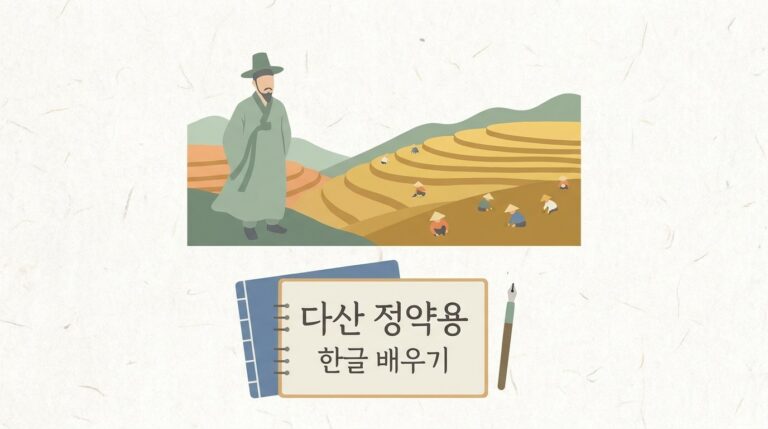
Phase 1: Empathy (Immersive Storytelling Opening)
안녕하세요! 매일한글 에디터입니다. Have you ever watched a gripping period K-drama—perhaps something like The Red Sleeve or Six Flying Dragons—and wondered why the characters are constantly shouting about land reform, peasant registers, and royal grain stores? Or maybe you were sitting in a high-level academic seminar or reading an editorial in a Korean newspaper, and the author suddenly dropped the phrase “경자유전 (Gyeongjayujeon: land to the tillers)” to critique modern real estate speculation in Seoul. You recognized the individual Hanja roots, but the profound philosophical weight and socioeconomic gravity flew right past you.
Many of our advanced C2 learners tell us: “I can discuss international politics and modern K-pop economics easily, but the moment native Koreans bring up Late Joseon Silhak (Practical Learning) or Dasan Jeong Yak-yong’s statecraft, I feel like an absolute beginner.” It’s a common frustration! You aren’t just learning vocabulary; you are engaging with the foundational intellectual DNA of modern Korea’s pursuit of social and economic justice. In this masterclass, we will explore Dasan Jeong Yak-yong’s revolutionary agrarian manifesto—the ‘Yeojeonron’ (閭田論)—and arm you with the sophisticated, C2-level vocabulary and discourse patterns required to discuss institutional reform, economic equity, and historical philosophy with native scholars, intellectuals, and colleagues like a true insider.
Phase 2: In-Depth Analysis of 3 Key Expressions
1. 경자유전의 원칙 (Gyeongjayujeon-ui wonchik)
- Pronunciation: [Gyeongjayujeon-ui wonchik] (Think: gyuhng-ja-yu-jeon-ui won-chik)
- Meaning: “The principle of the land belonging to the tiller.” (Literal: Tillers have fields; Nuance: The absolute ethical baseline that capital or speculative ownership should never supersede actual productive labor).
- K-Culture Moment: Often invoked in Korean legislative hearings, current affairs debates, and socio-economic documentaries when critiquing corporate land accumulation or modern agricultural zoning violations.
- Editor’s Insight: While rooted in ancient East Asian thought, Jeong Yak-yong revitalized this concept into a practical institutional mechanism. Today, it is even enshrined in Article 121 of the South Korean Constitution. Using this in formal intellectual conversations signals exceptional cultural literacy.
- Situation Spectrum: Casual: 🚫 | Semi-formal: ⚠️ | Formal: ✅
- 🤔 Think About It: Does your native culture frame land as an unalienable public resource tied to labor, or primarily as private property to be freely traded for capital appreciation?
2. 노동에 따른 공평한 분배 (Nodong-e ttareun gongpyeonghan bunbae)
- Pronunciation: [Nodong-e ttareun gongpyeonghan bunbae] (Think: no-dong-eh dda-leun gong-pyeong-han boon-bae)
- Meaning: “Equitable distribution strictly proportional to labor invested.”
- K-Culture Moment: In modern Korean corporate culture debates—such as performance-based bonus allocations (성과급) or profit-sharing discussions—intellectual commentators frequently draw historical parallels to this Silhak ethos.
- Editor’s Insight: Notice the crucial nuance: Dasan was not proposing indiscriminate egalitarian communism; his Yeojeonron allocated grain based precisely on the number of days registered in the village work log (yeo). It was a proto-meritocratic agrarian collective.
- Situation Spectrum: Casual: ⚠️ | Semi-formal: ✅ | Formal: ✅
- 🤔 Think About It: In English debates, we often contrast “equality of outcome” versus “equality of opportunity.” Which category does Jeong Yak-yong’s system better fit?
3. 시대를 앞서간 혜안 (Sidae-reul apseogan hye-an)
- Pronunciation: [Sidae-reul apseogan hye-an] (Think: shi-dae-reul ap-suh-gan hyeh-an)
- Meaning: “Prescient foresight far ahead of one’s century/era.”
- K-Culture Moment: Used by cultural commentators and historians when analyzing historical pioneers, visionary directors (like Bong Joon-ho before his global breakthrough), or institutional reformers who challenged their times.
- Editor’s Insight: 혜안 (慧眼) implies spiritual and intellectual discernment, elevated beyond mere intelligence (지능) or simple planning (계획). When coupled with 시대를 앞서간, it marks the pinnacle of scholarly praise.
- Situation Spectrum: Casual: 🚫 | Semi-formal: ✅ | Formal: ✅
- 🤔 Think About It: How do native English speakers honor historical thinkers whose radical proposals were tragically ignored by contemporary rulers?
Phase 3: Textbook Korean vs. Real Native Korean
Situation 1: Praising an 18th-century reform proposal during an academic symposium
- 📖 교과서 한국어: 정약용의 생각은 매우 새롭고 좋았습니다. (Jeong Yak-yong-ui saenggak-eun maeu saeropgo joatsseumnida. / Jeong Yak-yong’s idea was very new and good.)
- 🗣️ 진짜 진짜 한국어: 당대의 봉건적 모순을 정면으로 타파하고자 한 파격적인 개혁안이었습니다. (Dangdae-ui bonggeonjeok mosun-eul jeongmyeon-euro tapahagoja han pagyeokjeogin gaehyeogan-ieosseumnida. / It was an unprecedented reform proposal aimed at head-on dismantling the feudal contradictions of his era.)
- 💡 왜 다를까?: C2 speakers avoid rudimentary qualifiers like “좋았다” (was good) or “새로웠다” (was new), replacing them with precise historiographical terminology such as “봉건적 모순 타파” (overcoming feudal contradictions) and “파격적 개혁안” (unprecedented reform plan).
Situation 2: Emphasizing the link between historical thought and contemporary socioeconomic issues
- 📖 교과서 한국어: 옛날 사상을 지금도 배울 수 있습니다. (Yennal sasang-eul jigeumdo bae-ul su isseumnida. / We can still learn old thought today.)
- 🗣️ 진짜 한국어: 다산의 실학 정신은 현대 사회의 양극화와 불평등을 성찰하는 데 유효한 나침반이 되어 줍니다. (Dasan-ui silhak jeongsin-eun hyeondae sahoe-ui yanggeukhwa-wa bulpyeongdeung-eul seongchalhaneun de yuhyohan nachimban-i doe-eo jumnida. / Dasan’s Silhak ethos serves as a potent compass for reflecting upon polarization and inequality in contemporary society.)
- 💡 왜 다를까?: Educated Korean discourse relies heavily on evocative metaphors (“유효한 나침반”, an effective compass) coupled with analytical vocabulary (“양극화”, socioeconomic polarization) to bridge traditional history and modern policy.
Phase 4: K-Culture Deep Dive & Non-Verbal Manners
4-1. Nunchi & Intellectual Debate Manners (눈치와 경청의 미학)
When participating in formal intellectual discussions or Korean graduate seminars on Joseon history:
* The Deferential Incline (겸허한 경청의 자세): Avoid leaning back with folded arms when challenging an interlocutor’s interpretation of Silhak texts. Keep both hands resting on the table or your notebook, maintaining gentle eye contact, and nodding thoughtfully (끄덕임) while the other speaker develops their thesis.
* The Nuanced Refutation: Never dismiss an argument bluntly with “틀렸습니다” (You are wrong). Instead, deploy the courteous scholarly buffer: “선생님의 견해도 일리가 있습니다만, 다산의 여전론을 당대 수취 체제의 한계라는 맥락에서 본다면…” (Your perspective certainly has merit, yet if we examine Dasan’s Yeojeonron within the context of the contemporary tax system’s structural limits…).
4-2. Cultural Code Analysis: The Spirit of Gangjin (강진 유배길과 다산초당)
In popular historical fiction and travel documentaries (such as KBS’s Historic Special or MBC historical retrospectives), Jeong Yak-yong’s eighteen years in exile at Gangjin, Jeollanam-do, are framed not as personal defeat, but as the heroic crucible of modern Korean practical philosophy. His deep solidarity with the starving tenant farmers of southern Joseon directly informed the pragmatic compassion of Mokminsimseo (Admonitions on Governing the People) and Gyeongseyupyo (Design for Good Governance). Understanding this geographical and emotional narrative is indispensable for understanding the moral tone of modern Korean political progressivism.
Phase 5: Real-World Roleplay Scenario
Setting: A prestigious academic salon held at a renovated traditional Hanok library in Bukchon, Seoul. You are discussing Joseon political economy with Professor Han Min-woo, an eminent economic historian.
- 교수님 (Prof. Han): 이번 학술 심포지엄에서 다산 정약용의 토지 개혁론을 주제로 다루신다고 들었습니다. 서구의 근대 경제 사상과 비교했을 때 어떤 점이 가장 두드러지던가요? (I heard you are addressing Dasan Jeong Yak-yong’s land reform theories at this symposium. Compared to Western modern economic thought, what stands out most?)
- 나 (Learner):
🎭 공손하게 고개를 끄덕이며 진중한 어조로다산이 제시한 ‘여전론’은 단순히 토지를 재분배하는 차원을 넘어, 경자유전의 원칙을 제도화하려 했다는 점에서 독보적입니다. (Dasan’s ‘Yeojeonron’ goes beyond mere land redistribution; it is exceptional in that it attempted to institutionalize the land-to-the-tiller principle.) - 교수님 (Prof. Han): 흥미롭군요. 하지만 18세기 조선의 엄격한 신분제 사회에서 공동 노동과 일수 기준 분배가 과연 현실적으로 실현 가능했을까요? (Interesting. But in the rigid estate-based society of 18th-century Joseon, could communal labor and labor-day-based distribution realistically have been actualized?)
- 나 (Learner):
🎭 학술적 근거를 제시하듯 손바닥을 살짝 펴 보이며물론 당대 지배층인 양반 사대부들의 반발로 실현되기는 어려웠을 것입니다. 그러나 그가 지적한 양반 계층의 유휴화와 농민의 몰락 문제는 당대의 구조적 모순을 정확히 꿰뚫은 것이었죠. (Of course, realization would have been difficult due to resistance from the ruling Yangban literati. However, the idle parasitism of the aristocracy and the impoverishment of peasants that he highlighted directly identified the structural contradictions of that era.) - 교수님 (Prof. Han): 정곡을 찔렀군요. 그렇다면 그 사상이 오늘날 현대 한국 사회에 던지는 함의는 무엇이라고 보십니까? (You hit the nail on the head. Then what implication do you think that thought poses for modern Korean society today?)
- 나 (Learner):
🎭 눈을 마주치며 단호하면서도 깊이 있는 어조로불로소득에 의한 자산 불평등이 심화되는 현대 사회에서, 노동의 가치를 최우선으로 둔 다산의 혜안은 여전히 유효한 경종을 울리고 있습니다. (In a modern society where asset inequality driven by unearned income deepens, Dasan’s foresight, which placed the supreme value on human labor, continues to sound a potent alarm.) - 교수님 (Prof. Han):
🎭 흡족한 미소를 지으며 차를 권한다아주 탁월한 통찰입니다! 다산의 실용주의가 단순한 과거의 유물이 아님을 정확히 파악하고 계시네요. (A truly outstanding insight! You accurately grasp that Dasan’s pragmatism is far from a mere relic of the past.) - 나 (Learner):
🎭 두 손으로 찻잔을 받으며 가볍게 목례한다과찬이십니다, 교수님. 다산 선생의 저술을 읽을수록 그 통찰의 깊이에 경탄하게 됩니다. (You flatter me, Professor. The more I read Dasan’s writings, the more astonished I become by the depth of his insight.)
🔀 Interactive Decision Point
After Prof. Han asks Turn 5 (“What implications does it pose for modern Korean society?”), which response showcases flawless C2 cultural and academic fluency?
- Option A: “부동산 투기하는 사람들을 다 감옥에 보내야 한다는 뜻입니다.” (It means all real estate speculators should be sent to prison.)
- Option B: “불로소득에 의한 자산 불평등이 심화되는 현대 사회에서, 노동의 가치를 최우선으로 둔 다산의 혜안은 여전히 유효한 경종을 울리고 있습니다.” (In a modern society where asset inequality driven by unearned income deepens, Dasan’s foresight, which placed the supreme value on human labor, continues to sound a potent alarm.)
- Option C: “옛날 농사 방식이니까 지금 한국의 최첨단 IT 산업에는 사실 아무 쓸모가 없습니다.” (Since it’s an old farming method, it is actually useless for Korea’s cutting-edge modern IT industry.)
Feedback:
* Option A (Bad): Overly combative, simplistic, and unrefined. Lacks the scholarly balance expected at C2.
* Option B (Best): Masterfully balances historical philosophy with institutional critique using refined intellectual vocabulary (불로소득, 경종을 울리다).
* Option C (Risk): Fails to appreciate the metaphorical and ethical continuity of philosophical thought; sounds culturally dismissive.
Phase 6: 10-Second Emotion Shadowing Drill
Train your intonation and intellectual cadence by shadowing these authentic rhythmic chunks:
[🧐 진중하고 학구적인 무게감으로]
경자유전의 / 대원칙은 / 단순한 토지 개혁을 넘어, / 사회적 정의를 확립하려는 / 시대적 열망이었습니다.
(Gyeongjayujeon-ui / daewonchik-eun / dansunhan toji gaehyeok-eul neomeo, / sahoejeok jeong-ui-reul hwakriphananeun / sidaejeok yeolmang-ieosseumnida.)-
[💡 깊은 탄복과 경외감을 담아]
일한 날수만큼 / 수확을 나눈다는 발상은, / 당대의 한계를 뛰어넘은 / 실로 놀라운 혜안이었습니다.
(Ilhan nalsumankeum / suhwak-eul nanundaneun balsang-eun, / dangdae-ui hangye-reul ttwieoneomeun / sillo nolla-un hye-an-ieosseumnida.) -
[🏛️ 단호하고 명확한 논조로]
실사구시의 정신이야말로 / 공리공론에 빠진 사회를 구원할 / 유일한 해법이었습니다.
(Silsagusi-ui jeongsin-iyamallo / gong-rigongron-e ppajin sahoe-reul guwonhal / yu-ilhan haebeop-ieosseumnida.)
Phase 7: K-Culture Mini Dictionary
- 여전론 (Yeojeonron) [Yeo-jeon-ron]: Dasan’s visionary collective village agrarian proposal. One ‘Yeo’ (閭) comprised roughly 30 households managing a communal field; output was distributed after grain tax strictly based on days worked recorded by an elected village leader (Yeojang).
- 실사구시 (Silsagusi) [Sil-sa-gu-si]: “Seeking truth from empirical facts.” A core motto of Silhak opposing hollow Neo-Confucian metaphysical debates in favor of evidence-based statecraft.
- 이용후생 (Iyonghusaeng) [I-yong-hu-saeng]: “Promoting abundant welfare through the practical utility of technology and tools.” Advocated developing commerce, manufacturing, and agricultural machinery to enrich everyday citizens’ livelihoods.
- 목민관 (Mokmingwan) [Mok-min-gwan]: “The shepherd-official (magistrate) caring for the people.” Today, Korean journalists frequently use this term to refer to elected provincial governors, city mayors, or district heads who possess impeccable public integrity.
Phase 8: Traveler’s Survival Kit
Survival TOP 3 Expressions for Cultural Sites
- 이곳 다산초당의 역사적 보존 상태가 매우 훌륭하네요.
- Igot Dasanchodang-ui yeoksajeok bojeon sangtaega maeu hullyunghaneyo.
- Pro Tip: Use this when admiring Dasan Chodang in Gangjin or his birthplace in Namyangju. Cultural curators will immediately treat you to an in-depth tour.
- 선생께서 유배 기간 동안 집필하신 저술 목록을 볼 수 있을까요?
- Seonsaengkkeseo yubae gigan dong-an jippilhasin jeosul mongnok-eul bol su isseulkkayo?
- Pro Tip: High-register question to museum docents that reveals academic seriousness.
- 목민심서 원본 판본이나 영인본이 전시되어 있습니까?
- Mokminsimseo wonbon panbon-ina yeong-inbon-i jeonsidoeeo itsseumnikka?
- Pro Tip: Asking for original woodblocks (wonbon panbon) or facsimile editions (yeong-inbon) instantly establishes research-grade Korean fluency.
Editor’s Travel Note
- Sites to Visit: Make a pilgrimage to Dasan Heritage Site (다산유적지) in Namyangju (accessible via the Gyeongui-Jungang Line to Ungilsan Station, followed by a short local bus or taxi). For the ultimate experience, travel south to Dasan Chodang (다산초당) in Gangjin, Jeollanam-do.
- Essential Digital Toolkit: Book high-speed KTX tickets directly via the official KorailTalk app download and explore historical walking routes utilizing the Naver Map navigation application.
Phase 9: “한 발 더 깊이” (Reflective Philosophical Question)
In Late Joseon society, land was not merely an asset class; it was the sacred convergence of human sustenance, ancestral continuity, and ethical rulership. Jeong Yak-yong perceived that when land became a vehicle for parasitic rentierism (불로소득), the moral compact between state and citizen disintegrated. Centuries later, modern South Korea’s intense societal anxieties surrounding metropolitan apartment prices and urban real estate speculation still whisper this ancient truth. The collective longing for “경자유전” endures in the Korean subconscious as a benchmark of genuine civil fairness.
💬 Your Turn: How does your home country balance the freedom of private property accumulation against the social mandate for equitable land access? Share your thoughts in Korean in the comments below!
Phase 10: FAQ & Avoiding Misconceptions
Q: Was Dasan Jeong Yak-yong a proto-Marxist communist because of his communal land proposals in Yeojeonron?
A: Absolutely not. While Yeojeonron proposed collective village ownership, distribution of produce was strictly proportional to actual days worked (노동 일수), maintaining clear individual incentives. Furthermore, Dasan later adapted this ideal into his more pragmatic Jeongjeonron (well-field compromise) in Gyeongseyupyo, realizing that radical communalization faced insurmountable historical resistance.
Q: Why do Korean intellectuals continually cite ‘Mokminsimseo’ when discussing contemporary political corruption?
A: Mokminsimseo (목민심서) represents Korea’s definitive ethics manual for public civil servants. Its central thesis—that public office exists solely to alleviate the suffering of the common people (애민정신) and that even a single grain of grain taken unjustly is a crime—remains the baseline moral metric against which modern Korean politicians are judged.
Q: What is the linguistic difference between ‘실학’ (Silhak) and general ‘실용주의’ (Pragmatism)?
A: ‘실용주의’ translates Western philosophical pragmatism (like that of William James or John Dewey) or everyday practicality. ‘실학’ is a specific, capital-H historical movement within 17th-to-19th-century Joseon Confucianism that broke away from abstract Neo-Confucian dogmatism (성리학) to focus on concrete socio-economic administrative reform.
🚨 Common Mistakes Alert
- Confusing ‘공평’ (Fairness/Equity) with ‘평등’ (Blanket Equality): In Dasan’s writings, gongpyeong denotes fairness aligned with labor contribution, not identical universal handouts. Using them interchangeably blunts your analytical precision.
- Mispronouncing ‘실사구시’: Often learners pronounce each syllable disconnectedly. The natural liaison rolls fluidly as [실싸구시 (Sil-ssa-gu-si)].
- Over-casualizing the honorific title for Dasan: In scholarly contexts, never refer to him simply as “정약용이”; always append his title or pen name: “정약용 선생” or “다산 선생”.
Phase 11: Action Missions & Engagement
- Bronze Mission (Solo Mastery): Practice recording yourself reading the Phase 6 Shadowing Drills 3 times, paying close attention to the dramatic pauses at the slashes (
/). - Silver Mission (Social Sharing): Post a short reflection on social media or in our study community about modern economic fairness using the expression: “다산의 혜안은 현대 사회에도 유효한 경종을 울립니다.”
- Gold Mission (Real-World Application): Attend a Korean museum lecture, book club, or university forum and ask the presenter a question using “경자유전의 원칙” in reference to social inequality.
- 🎮 K-Culture Mission: Watch an episode of a Joseon-era historical documentary or drama featuring local magistrates. Spot whether the protagonist acts as a true “목민관” (Mokmingwan) or a corrupt official abusing his post!
Phase 12: Interactive Quiz Challenge
1. Situational Judgment Quiz:
You are participating in a scholarly panel discussion on historical economic justice. A fellow panelist argues that Joseon intellectuals were detached from the realities of the working peasantry. Which retort demonstrates peak C2 eloquence?
* (A) 그건 틀린 생각입니다. 조선 사람들도 똑똑했습니다.
* (B) 다산 정약용 선생의 여전론만 살펴보더라도, 노동에 기반한 분배 원칙을 통해 농민의 현실을 구제하려 한 시대를 앞서간 혜안을 엿볼 수 있습니다.
* (C) 옛날 역사책을 다시 읽고 오시는 것이 좋을 것 같습니다.
2. Fill-in-the-Blank:
“다산의 개혁 사상은 당대 양반 계층의 부당한 토지 겸병을 비판하며, 밭을 가는 농민만이 토지를 소유해야 한다는 [ ]의 원칙을 확립하고자 했습니다.”
3. True or False:
Jeong Yak-yong’s Yeojeonron decreed that all villagers should receive identical shares of harvest regardless of how many days they farmed. (True / False)
👉 Click here to reveal Answers & Explanations (정답과 해설 보기)
- Answer: (B)
- Explanation: Option (B) deploys sophisticated vocabulary (여전론, 노동에 기반한 분배 원칙, 시대를 앞서간 혜안) to deliver a respectful, scholarly, and deeply substantive counterargument. Options (A) and (C) are emotionally blunt and stylistically elementary.
- Answer: 경자유전 (Gyeongjayujeon)
- Explanation: The cardinal principle that farmland must belong to those who cultivate it.
- Answer: False
- Explanation: Crucially, Yeojeonron calculated each household’s grain share based on the official tally of labor days worked (일한 날수), rewarding industry and penalizing aristocratic absenteeism!
- Explanation: Crucially, Yeojeonron calculated each household’s grain share based on the official tally of labor days worked (일한 날수), rewarding industry and penalizing aristocratic absenteeism!







