

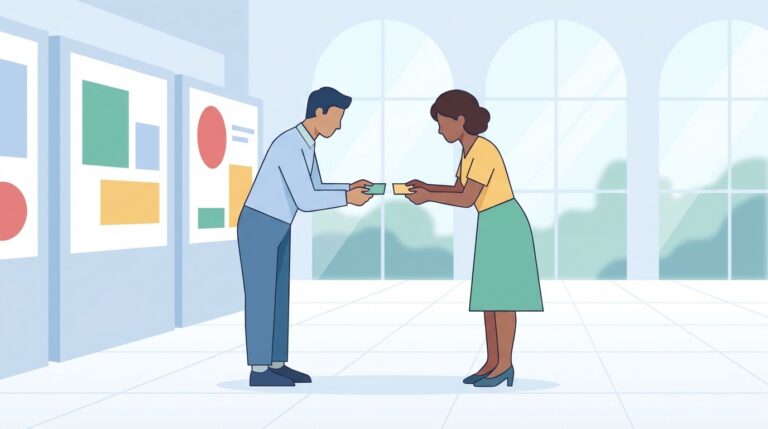
Turn Conference Small Talk into Real Research Collabs: A Guide to Networking in Korean
Phase 1: Empathy (Opening Story)
안녕하세요! 매일한글 에디터입니다. (Hello! This is your Daily Hangul editor.)
Picture this: You are standing in the bustling hall of COEX in Seoul or BEXCO in Busan. The air is hummed with scientific debate, the smell of fresh drip coffee, and hundreds of poster boards lined up neatly under glowing fluorescent lights. You just wrapped up an intense five-minute pitch of your poster. A fellow researcher from KAIST or Seoul National University nods deeply, pushes up their glasses, and asks an insightful question about your methodology. You hit it off instantly—ideas are bouncing back and forth, and you realize your data complements their computational model perfectly.
Then comes that dreaded awkward pause. You want to stay in touch, swap papers, and possibly collaborate on a future grant. But how do you bridge the gap between academic chit-chat and an enduring professional relationship without sounding either uncomfortably rigid like a 1980s grammar textbook or overly casual like you’re asking them out for drinks in Hongdae? Many international scholars tell me: “I knew all the technical nouns in Korean, but when it came to exchanging business cards and suggesting a follow-up email, my brain completely froze!”
Networking in Korean academia relies on a delicate balance of deep respect, humble initiative, and genuine intellectual enthusiasm. Master this dance, and you will not only expand your international network but also unlock doors to collaborative papers, invited talks, and lifelong academic friendships. Let’s break down the exact phrases, cultural nuances, and body language to make you unforgettable at your next Korean conference!
Phase 2: Core 3 Expressions Deep Dive
1. 명함 한 장 건네 드려도 될까요? (Myeongham han jang geonne deulyeodo doelkkayo?)
- Pronunciation: [Myeong-ham han jang geon-ne deu-ryeo-do doel-kka-yo?] (Sound analogy: Think of “Myeong” like ‘young’ with an M, and “doelkkayo” rhyming with a soft ‘del-car-yo’)
- Meaning: Literally “May I hand over one sheet of my name card?” / Nuance: “Could I offer you my business card? / I’d love to exchange cards if you don’t mind.”
- K-Culture Moment: Just like when ambitious founders hand out cards during networking mixers in tech K-Dramas like Start-Up, offering your card first signals humility and eagerness to connect rather than demanding theirs.
- Editor’s Insight: Asking permission before handing over a card softens the interaction. Instead of the blunt “명함 주세요” (Give me your card), phrasing it as giving your card creates zero pressure while inviting reciprocity.
- Situation Spectrum:
- Casual: 🚫
- Semi-formal: ✅
- Formal: ✅
- 🤔 Think About It: Why does Korean culture favor asking to give your own card rather than directly requesting the other person’s contact info? How does this reflect the concept of giving face (체면)?
2. 학회 끝나고 관련 최신 논문 메일로 공유해 드릴게요. (Hakhoe kkeutnago gwanryeon choesin nonmun meillo gong-yuhyeo deurilgeyo.)
- Pronunciation: [Hak-hoe kkeut-na-go gwan-ryeon choe-sin non-mun me-il-lo gong-yu-hae deu-ril-ge-yo.] (Sound analogy: “Choesin” sounds like ‘chway-sheen’, meaning the latest/newest)
- Meaning: Literally “After the conference ends, I will share the related latest papers via email.” / Nuance: “I’ll be sure to email you some recent relevant literature once the conference wraps up.”
- K-Culture Moment: Seen frequently in medical and legal dramas like Hospital Playlist, where researchers bond over shared publications and follow up right after symposium breaks.
- Editor’s Insight: The ending
-ㄹ게요(-lgeyo) expresses a gentle, proactive promise. It implies a service done out of mutual respect, signaling that you treat them as an intellectual peer rather than just a casual acquaintance. - Situation Spectrum:
- Casual: ⚠️ (Use -ㄹ게 with close peers)
- Semi-formal: ✅
- Formal: ✅
- 🤔 Think About It: In Western academic networking, saying “I’ll email you” can sometimes be a polite throwaway comment. In Korea, promising to send literature creates an implicit pact (약속) that sets the stage for genuine follow-through.
3. 기회가 된다면 공동 연구 가능성도 열어두고 싶습니다. (Gihwaega doendamyeon gongdong yeon-gu ganeungseongdo yeoreodugo sipseumnida.)
- Pronunciation: [Gi-hoe-ga doen-da-myeon gong-dong yeon-gu ga-neung-seong-do yeo-reo-du-go sip-seum-ni-da.] (Sound analogy: “Gong-dong” sounds like a rhythmic gong strike, denoting shared/joint effort)
- Meaning: Literally “If an opportunity arises, I would like to keep open the possibility of joint research.” / Nuance: “I’d love to explore the potential for collaborative research down the road.”
- K-Culture Moment: In high-stakes boardroom or laboratory negotiations, Korean professionals prefer opening the door softly with “가능성을 열어두다” (leaving possibilities open) rather than immediately proposing a hard contract.
- Editor’s Insight: The phrase “열어두고 싶습니다” (I want to keep it open) avoids being overbearing. It demonstrates ambition while leaving comfortable breathing room for the other party to evaluate their lab’s capacity.
- Situation Spectrum:
- Casual: 🚫
- Semi-formal: ⚠️
- Formal: ✅
- 🤔 Think About It: Why is indirect suggestion prized over direct propositioning in Korean professional circles? Notice how this protects both parties from the embarrassment of an outright rejection.
Phase 3: Textbook Korean vs. Real Korean
Situation 1: Asking to stay connected at a poster board
- 📖 Textbook Korean: 연락처를 주십시오. (Yeonrakcheoreul jusipsio. – “Give me your contact details.”)
- 🗣️ 진짜 한국어 (Real Korean): 혹시 괜찮으시다면 명함 한 장 교환할 수 있을까요? (Hoksi gwaenchaneusidamyeon myeongham han jang gyohwanhal su isseulkkayo? – “If it’s alright with you, could we perhaps exchange business cards?”)
- 💡 왜 다를까? (Why is it different?): The textbook version sounds demanding, almost like an immigration officer asking for your passport! Adding “혹시 괜찮으시다면” (If you don’t mind / By any chance) buffers the request with polite consideration.
Situation 2: Following up via email after the symposium
- 📖 Textbook Korean: 저는 지난번에 만난 연구자입니다. (Jeoneun jinanbeone mannan yeonguja-imnida. – “I am the researcher you met last time.”)
- 🗣️ 진짜 한국어 (Real Korean): 지난주 [학술대회명] 포스터 세션에서 [연구 주제] 관련해서 말씀 나누었던 [본인 이름]입니다. (Jinanju [haksuledahoemyeong] poseuteo sesyeoneseo [yeon-gu juje] gwanryeonhaeseo malsseum nanueotdeon [bon-in ireum]imnida. – “This is [Your Name], whom you spoke with regarding [research topic] during the poster session at [Conference Name] last week.”)
- 💡 왜 다를까? (Why is it different?): Korean academic emails demand clear contextualization right off the bat. Establishing the shared memory (인연) right in the opening line ensures your email doesn’t get swept into the spam folder.
Phase 4: K-Culture Deep Dive & Non-Verbal Manners
4-1. Nunchi & Business Card Gestures (명함 예절)
In Korean academic and business culture, a person’s business card is considered an extension of their physical presence and professional dignity. How you handle it speaks louder than your H-index!
1. The Two-Handed Handover: Always present your card with both hands, holding it by the top corners so your fingers do not cover your name or title. Turn it so the recipient can read it right-side up.
2. The Bow and Gaze: Lower your head slightly in a courteous nod (목례). Make warm eye contact before looking down at their card.
3. The 5-Second Study Rule: When receiving their card, take it with both hands, read the person’s name and affiliation carefully for at least 5 seconds, and murmur: “아, [소속 대학/연구원]의 [이름] 박사님이시군요” (Ah, so you are Dr. [Name] from [Institute]). Never shove the card straight into your back pocket! Keep it resting on your poster table or in a cardholder during the remainder of the conversation.
4-2. The Coffee Transition Culture (커피 한잔의 미학)
In Korean academia, fruitful collaborations rarely start with formal grant applications—they begin over an iced Americano (아아 – Ah-Ah). If an academic discussion at a poster board goes well, you will often hear: “혹시 로비에서 커피 한잔하시면서 조금 더 이야기 나눌까요?” (Shall we grab a cup of coffee in the lobby and talk a bit more?). Accepting this invitation is a clear green light that mutual interest is genuine!
Phase 5: Real-World Roleplay Scenario
Setting: Session break at the annual Korean Society of Artificial Intelligence Conference held at COEX, Seoul.
Characters:
* Dr. Min (민 박사): Senior Principal Researcher at a prestigious national institute.
* Alex (알렉스): That’s you! A visiting researcher presenting novel multi-modal learning data.
민 박사: 발표 잘 들었습니다. 데이터 전처리 방식이 저희 랩실 접근법과 맞닿아 있어서 흥미롭네요.
(Balpyo jal deureotseumnida. Deiteo jeoncheori bangsigi jeohui raepsil jeopgeunbeopgwa matdaa isseoseo heungmiromneyo.)
(I enjoyed your presentation. Your data preprocessing methodology aligns closely with our lab’s approach, which is very interesting.)
🎭 [고개를 끄덕이며 메모 수첩을 닫는다 / Nods approvingly and closes his notebook]
알렉스: 좋게 봐주셔서 감사합니다! 민 박사님 연구팀의 최근 논문도 정말 인상 깊게 읽었습니다.
(Joke bwa-jusyeoseo gamsahamnida! Min bak-sanim yeon-gutim-ui choegeun nonmundo jeongmal insang gipge ilgeotseumnida.)
(Thank you for the kind words! I also read your team’s recent paper with great impression.)
🎭 [밝은 미소를 지으며 양손을 가지런히 모은다 / Smiles warmly, hands neatly folded in front]
민 박사: 아, 그러셨군요. 혹시 이 데이터셋 파이프라인 관련해서 후속 실험도 계획 중이신가요?
(A, geureosyeotgunyo. Hoksi i deiteoset paipeurain gwanryeonhaeseo husok silheomdo gyehoek jung-isinkayo?)
(Ah, is that so? By any chance, are you planning follow-up experiments on this dataset pipeline?)
🎭 [호기심 어린 눈빛으로 포스터 그래프를 가리킨다 / Points to a graph on the poster with curiosity]
알렉스: 네, 모델 경량화 파트를 보완하는 중입니다. 괜찮으시다면 명함 한 장 건네 드려도 될까요?
(Ne, model gyeongryanghwa pateureul bowanhaneun jung-imnida. Gwaenchaneusidamyeon myeongham han jang geonne deulyeodo doelkkayo?)
(Yes, we are refining the model lightweighting component. If you don’t mind, may I offer you my business card?)
🎭 [명함 케이스에서 두 손으로 명함을 꺼내 정중히 내민다 / Pulls card from case and presents it politely with both hands]
민 박사: 아, 물론이죠! 제 명함도 여기 있습니다. 알렉스 연구원님, 연구 결이 저희와 아주 잘 맞네요.
(A, mollon-ijyo! Je myeonghamdo yeogi isseumnida. Alex yeon-gu-won-nim, yeon-gu gyeori jeohuiwa aju jal matneyo.)
(Oh, of course! Here is my card as well. Researcher Alex, your research direction matches ours remarkably well.)
🎭 [두 손으로 명함을 교환하며 허리를 15도 숙인다 / Swaps cards with both hands, bowing slightly at 15 degrees]
알렉스: 감사합니다. 학회 끝나고 관련 최신 논문과 전처리 코드 링크를 메일로 공유해 드릴게요.
(Gamsahamnida. Hakhoe kkeutnago gwanryeon choesin nonmungwa jeoncheori kodeu ringkeureul meillo gong-yuhyeo deurilgeyo.)
(Thank you. Once the conference concludes, I’ll share the latest paper and our preprocessing code links via email.)
🎭 [받은 명함을 정중히 양손으로 쥐고 시선을 맞춘다 / Holds the received card respectfully with both hands and maintains eye contact]
민 박사: 좋습니다. 코드 확인해 보고 저희 팀 데이터와 교차 검증해 볼 수 있겠네요.
(Jotsseumnida. Kodeu hwaginhae bogo jeohui tim deiteowa gyocha geomjeunghae bol su itgetneyo.)
(Sounds great. Once I check the code, we might even cross-validate it with our team’s data.)
🎭 [만족스러운 표정으로 미소를 짓는다 / Smiles with a satisfied expression]
알렉스: 기회가 된다면 공동 연구 가능성도 열어두고 싶습니다. 조만간 메일로 인사드리겠습니다!
(Gihwaega doendamyeon gongdong yeon-gu ganeungseongdo yeoreodugo sipseumnida. Jomangan meillo insadeurigetseumnida!)
(If the opportunity allows, I’d truly love to explore joint research possibilities. I will be in touch via email soon!)
🎭 [깍듯하게 목례하며 명함을 가슴 높이에 소중히 둔다 / Bows courteously, holding the card at chest height]
🔀 Interactive Choice Point
Dr. Min says: “연구 결이 저희와 아주 잘 맞네요” (Your research aligns very well with ours). How do you seize this moment?
- Choice A: “맞아요! 당장 다음 달부터 저희 랩실이랑 같이 논문 쓰시죠! 계약서 준비할까요?” (Exactly! Let’s write a paper together starting next month! Should I prepare a contract?)
- Feedback [Bad ❌]: Whoa, slow down! Academic collaborations in Korea build on mutual rapport and steady trust. Pushing for immediate commitments or contracts right at a poster session will frighten colleagues away.
- Choice B: “과찬이십니다. 학회 끝나고 보충 자료를 메일로 보내드릴 테니, 기회가 된다면 공동 연구 가능성도 열어두고 싶습니다.” (You flatter me. I’ll email you supplementary materials after the conference, and if the opportunity arises, I’d love to explore joint research.)
- Feedback [Best ✨]: Perfect! You show modesty, provide actionable follow-up, and suggest collaboration in a professional, pressure-free manner.
- Choice C: “네, 알겠습니다. 나중에 심심하시면 제 이메일로 연락 한번 주세요.” (Yeah, got it. If you’re bored later, drop me an email sometime.)
- Feedback [Risk ⚠️]: Using “심심하시면” (if you’re bored) in a professional setting sounds flippant and dismissive of the professor’s time and prestige.
Phase 6: 10-Second Emotion Shadowing Drill
Practice reading these sentences aloud, pausing at / and channeling the designated emotional state:
[🤝 정중하고 신뢰감 있게 / Respectful and confident]
“혹시 괜찮으시다면 / 제 명함 한 장 / 건네 드려도 될까요?”
(Hoksi gwaenchaneusidamyeon / je myeongham han jang / geonne deulyeodo doelkkayo?)-
[💡 지적인 열정을 담아 / Full of intellectual enthusiasm]
“학회 일정이 끝나는 대로 / 저희 팀의 최신 논문 링크를 / 메일로 공유해 드리겠습니다.”
(Hakhoe iljeongi kkeutnaneun daero / jeohui tim-ui choesin nonmun ringkeureul / meillo gong-yuhae deurigetseumnida.) -
[🌱 진중하고 열린 태도로 / Sincere and forward-looking]
“좋은 기회가 닿는다면 / 교수님 연구실과 / 공동 연구 가능성도 / 활짝 열어두고 싶습니다.”
(Joeun gihwaega danneundamyeon / gyosunim yeon-gusilgwa / gongdong yeon-gu ganeungseongdo / hwaljjak yeoreodugo sipseumnida.)
Phase 7: K-Culture Mini Dictionary
-
공동 연구 (Gongdong yeon-gu) [Noun]
- Definition: Joint research / collaborative study.
- Real-world context: The golden standard of institutional partnerships. Proposing “공동 연구” carries much higher prestige than simply asking to share code or borrow lab equipment.
- 명함 교환 (Myeongham gyohwan) [Noun]
- Definition: The formal exchange of business cards.
- Real-world context: In Korea, this is not a casual hand-off; it is a ritualized professional introduction marking the official birth of a working relationship.
- 포스터 세션 (Poseuteo sesyeon) [Noun]
- Definition: Conference poster session.
- Real-world context: While podium presentations are formal, the poster session is where true networking flourishes in Korean symposia over coffee and snacks.
- 팔로업 메일 (Pallo-eop meil) [Noun]
- Definition: Follow-up email.
- Real-world context: Koreans expect this email within 24 to 48 hours following the encounter while the conference excitement is still fresh.
Phase 8: Survival Kit for Visiting Researchers
Survival Expressions TOP 3
- “발표 자료 요약본을 혹시 받아볼 수 있을까요?”
(Balpyo jaryo yoyakboneul hoksi badabol su isseulkkayo?)- Pro Tip: Use this when visiting someone else’s poster; it flatters the presenter and opens an avenue to swap emails.
- “실례지만 성함과 소속을 다시 한번 여쭤봐도 될까요?”
(Sillyejiman seonghamgwa sosogeul dasi hanbeon yeojjwobwado doelkkayo?)- Pro Tip: A lifesaver when you forgot to grab their card or didn’t catch their name clearly amidst ambient conference noise.
- “오늘 귀한 피드백 주셔서 진심으로 감사드립니다.”
(Oneul gwihan pideubaek jusyeoseo jinsimeuro gamsadeurimnida.)- Pro Tip: Say this as they prepare to leave your poster board. It leaves a lasting impression of academic gratitude.
Editor’s Travel Note
Navigating academic conference mega-venues like COEX (Seoul) or EXCO (Daegu) can be overwhelming. Avoid relying on global map apps, which often lack accurate indoor layouts for Korean convention centers. Make sure to download the 네이버 지도 앱 다운로드 before your flight for precise gate-by-gate transit directions and venue maps. Furthermore, keep an electronic version of your business card or a dedicated QR code on your phone lock screen as a backup in case you run out of printed cards!
Phase 9: “한 발 더 깊이” (Deep Cultural Reflection)
In Korean society, academic and professional relationships are deeply rooted in the concept of 인연 (In-yeon)—the invisible karmic thread that brings people across each other’s paths. Unlike transactional networking where the sole question is “What can you do for me right now?”, networking in Korean academia prioritizes long-term affinity, mutual academic lineage (학맥), and shared respect. Even if an immediate project does not materialize from your poster conversation, planting the seed of courtesy leaves the door permanently ajar for peer reviews, symposium invitations, or postdoctoral fellowships years later.
💬 Your Turn: Have you ever attended an academic conference in another country? How does exchanging contact info in your culture differ from the formal two-handed Korean card exchange? Drop your thoughts in the comments below!
Phase 10: FAQ & Avoiding Misunderstandings
Q: Can I give my business card with one hand if my other hand is holding poster handouts?
A: Try to avoid this whenever possible! If your hands are full, quickly set your flyers down on the poster table first. If you truly must use one hand, support your right elbow or forearm lightly with your left hand. This gesture still communicates respect and prevents you from appearing aloof.
Q: How long should I wait before sending the follow-up email with my literature links?
A: The sweet spot is between 24 and 48 hours after the conference concludes. If you send it immediately while they are rushing to the next plenary talk, it might get buried. If you wait more than a week, the vivid memory of your poster conversation will have faded.
Q: Is it okay to suggest “공동 연구” (joint research) to a senior professor when I am still a student?
A: Absolutely! As long as you frame it politely with conditional clauses like “기회가 된다면 가능성을 열어두고 싶습니다” (If the opportunity arises, I’d like to leave possibilities open). Korean professors appreciate passionate, ambitious scholars who display intellectual drive while showing proper deference to seniority.
🚨 흔한 실수 (Common Mistakes) Warning Board
- ❌ Mistake 1: Writing notes directly on the person’s business card in front of their eyes.
- 👉 Correct Action: Wait until they walk away before jotting down details on the back of the card, or write your notes in your personal notebook instead.
- ❌ Mistake 2: Addressing a Korean professor as “당신” (Dangsin) or by their first name.
- 👉 Correct Action: Always use their title and family name + honorific suffix: e.g., 김 교수님 (Professor Kim) or 박 박사님 (Dr. Park).
- ❌ Mistake 3: Saying “연락해요” (Keep in touch!) to a senior researcher.
- 👉 Correct Action: That is informal banmal-adjacent phrasing! Use “다음에 또 인사드리겠습니다” (I look forward to greeting you again next time).
Phase 11: Action Missions & Cultural Challenge
- 🥉 Bronze Mission (Solo Practice): Stand before a mirror with your business card. Practice presenting it with both hands while smoothly pronouncing: “명함 한 장 건네 드려도 될까요?” three times without hesitating.
- 🥈 Silver Mission (Social / Email Draft): Write out a mock Korean follow-up email draft of 4 sentences referencing a recent paper you admire and mentioning “공동 연구 가능성을 열어두고 싶습니다.”
- 🥇 Gold Mission (Real-world Execution): At your next lab meeting, seminar, or international meetup, greet a Korean scholar using two-handed etiquette and follow up within 48 hours!
- 🎮 K-Culture Media Hunt: Watch Episode 1 or 2 of the K-Drama Start-Up (스타트업). Look closely at how the characters exchange cards at Sandbox networking events. Notice their hand placement, bows, and eye contact!
Phase 12: Interactive Quiz Challenge
Test your conference mastery before heading to the convention center!
1. Situational Judgment: You had a fantastic 10-minute technical discussion with a senior researcher at your poster. How should you transition into staying connected?
* (A) “야, 우리 번호 교환하자!” (Hey, let’s swap numbers!)
* (B) “명함 한 장 건네 드려도 될까요? 관련 최신 문헌을 메일로 공유해 드리고 싶습니다.” (May I offer you my business card? I’d love to share recent relevant literature via email.)
* (C) “지금 당장 제 논문 인용해 주실 수 있나요?” (Can you cite my paper right this second?)
2. Fill-in-the-Blank: Complete the polite proposal for future collaboration:
“기회가 된다면 교수님 연구팀과 _____ 연구 가능성도 열어두고 싶습니다.”
* (A) 단독 (Dandok – Solo)
* (B) 비밀 (Bimil – Secret)
* (C) 공동 (Gongdong – Joint/Collaborative)
3. True or False: In Korea, immediately slipping a received business card into your back pants pocket is considered totally fine as long as you smiled.
* (A) True
* (B) False
🔍 Click here to reveal answers and explanations!
- Question 1 Answer: (B)
- Explanation: Option B exhibits flawless professional etiquette—asking permission to offer your card and providing immediate intellectual value by sharing papers.
- Question 2 Answer: (C) 공동
- Explanation: “공동 연구” (Gongdong yeon-gu) is the accurate academic terminology for collaborative research.
- Question 3 Answer: (B) False
- Explanation: Stashing someone’s card into your back pocket (or sitting on it!) is considered disrespectful to their professional identity. Keep it on the desk or hold it respectfully!
- Explanation: Stashing someone’s card into your back pocket (or sitting on it!) is considered disrespectful to their professional identity. Keep it on the desk or hold it respectfully!







