

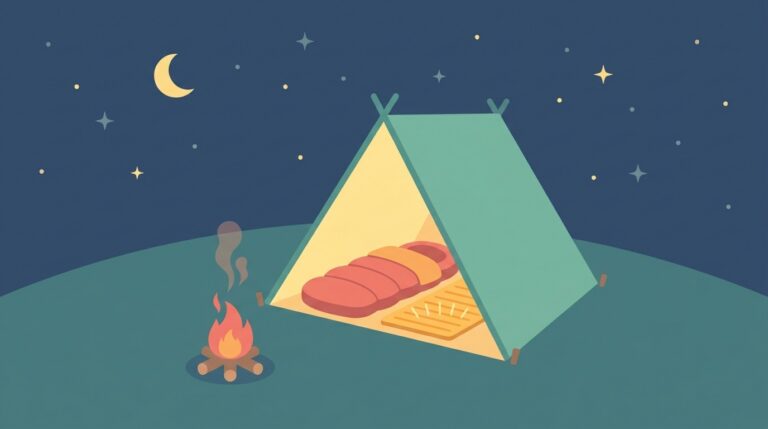
Stay Cozy at Korean Glamping: How to Sleep Soundly with Heated Mats and Fire Gazing
Phase 1: 공감 (Story Immersion Opening)
안녕하세요! 매일한글 에디터입니다.
Have you ever pictured yourself under the crisp, starry Korean night sky, surrounded by pine trees, roasting sweet potatoes, only to suddenly freeze—literally—with worry: Wait, will I turn into an icicle inside a tent tonight?
If you have watched K-variety shows like In the SOOP or Hospital Playlist Camping, you might have noticed something fascinating: Korean celebrities wake up inside outdoor tents looking ridiculously refreshed, snug, and glowing. The secret isn’t magic; it is Korea’s ultimate outdoor superpower—the legendary combination of a plush sleeping bag and the miraculous 전기장판 (jeongijangpan, electric heating mat).
Many beginner Korean learners tell me, “Editor, I went glamping in Gapyeong, but when morning came, I didn’t know how to tell my host that I actually slept so warm and peacefully! I just said ‘잠 잤어요’ (I slept).” What a missed opportunity! Today, we will transform your outdoor adventures with authentic A2-level Korean expressions that will let you request extra heating comfortably, compliment your campsite host, and share your cozy memories like a real local insider. Let’s dive into the warm world of Korean camping!
Phase 2: 핵심 표현 3선 심층 분석 (Top 3 Core Expressions)
1. 따뜻한 침낭과 전기장판이 켜져 있어서 밤에도 춥지 않게 푹 잤어요.
- Pronunciation: [Ttatteut-han chim-nang-gwa jeon-gi-jang-pan-i kyeo-jyeo iss-eo-seo bam-e-do chup-ji an-ge puk jass-eo-yo]
(Sound tip: “Ttatteut” sounds like the crisp pop of warm toast, and “puk” drops softly like your head sinking into a feather pillow!) - Meaning: “Thanks to the warm sleeping bag and the electric mat being turned on, I slept deeply through the night without feeling cold at all.”
- K-Culture Moment: This is the exact phrase cast members say on 2 Days & 1 Night when they win the indoor/outdoor tent challenge and rave about their restorative sleep to the production crew.
- Editor’s Insight: Notice the mini-word 푹 (puk). It expresses deep, uninterrupted, highly restorative sleep. Saying “푹 잤어요” (Puk jasseoyo) carries ten times more emotional satisfaction than just “잘 잤어요” (Jal jasseoyo).
- Situation Spectrum: Casual ⚠️ | Semi-formal ✅ | Formal ✅
- 🤔 Think About It: Koreans prioritize floor warmth over ambient air temperature. How does your culture typically stay warm outdoors compared to this ground-up heating philosophy?
2. 전기장판 온도 좀 올려도 돼요?
- Pronunciation: [Jeon-gi-jang-pan on-do jom ol-lyeo-do dwae-yo?]
(Sound tip: “Jom” softens the request, sounding like a polite “a little bit” in English.) - Meaning: “May I raise the temperature of the electric mat a bit?”
- K-Culture Moment: You will hear this in glamping resorts when friends snuggle inside their canvas tent before bed, adjusting the temperature dial for maximum coziness.
- Editor’s Insight: In Korea, asking permission with ~도 돼요? (~do dwaeyo?) is an A2 learner’s best friend. Adding 좀 (jom) prevents you from sounding demanding and instantly conveys Korean modesty and politeness.
- Situation Spectrum: Casual ⚠️ | Semi-formal ✅ | Formal ✅
- 🤔 Think About It: Notice how Korean uses softening adverbs like jom rather than rigid corporate formulas to show genuine respect.
3. 불멍 하면서 힐링했어요.
- Pronunciation: [Bul-meong ham-yeon-seo hil-ling-haess-eo-yo]
(Sound tip: “Bul” means fire, “meong” sounds like daydreaming into space.) - Meaning: “I healed and recharged while spacing out watching the campfire.”
- K-Culture Moment: Every Korean camping vlog on YouTube features a 10-minute segment titled simply “Bulmeong Time” with ambient crackling firewood sounds.
- Editor’s Insight: 불멍 (Bulmeong) is a modern compound slang formed from 불 (fire) + 멍때리다 (to space out / zone out). Pairing it with 힐링 (healing) describes the quintessential Korean mindful relaxation trend.
- Situation Spectrum: Casual ✅ | Semi-formal ✅ | Formal ⚠️
- 🤔 Think About It: Why do you think modern, fast-paced Korean society created a special word specifically for zoning out in front of nature?
Phase 3: 교과서 한국어 vs 진짜 한국어 (Textbook vs. Real Korean)
Situation 1: Describing a cozy, deep sleep
- 📖 교과서 한국어 (Textbook):
어젯밤에 텐트 안에서 잠을 잘 잤습니다. (Eojetbam-e tenteu an-eseo jam-eul jal jassseumnida.)
“Last night, I slept well inside the tent.” - 🗣️ 진짜 한국어 (Real-life):
등이 따뜻해서 꿀잠 잤어요! (Deung-i ttatteut-haeseo kkuljam jasseoyo!)
“My back was so warm, I got total honey-sleep!” - 💡 왜 다를까? (Why is it different?):
Textbooks teach generic phrases, but Koreans instinctively mention their 등 (deung – back) because of their ancient underfloor heating heritage. Plus, 꿀잠 (kkuljam – honey sleep) is the go-to native word for sweet, deep sleep!
Situation 2: Asking the campsite manager about tent heating
- 📖 교과서 한국어 (Textbook):
난방 기기가 정상 작동합니까? (Nanbang gigiga jeongsang jakdonghamnikka?)
“Is the heating equipment operating normally?” - 🗣️ 진짜 한국어 (Real-life):
전기장판 따뜻하게 잘 들어와요? (Jeongijangpan ttatteut-hage jal deureowayo?)
“Does the electric heating mat warm up nicely?” - 💡 왜 다를까? (Why is it different?):
In everyday Korean conversation, power or heat “enters” (들어오다 – deureooda). Asking if heat “comes in well” sounds infinitely more natural than querying machine functionality.
Phase 4: K-Culture 딥다이브 & 비언어적 매너 (Deep Dive & Non-Verbal Manners)
4-1. 눈치 (Nunchi) & Camper Gestures
When sharing a glamping tent or Korean-style heated floor with Korean friends, always practice gentle 눈치 (nunchi – situational awareness):
* The Two-Hand Floor Pat: When testing if the mat is warm, place both palms flat against the bedding, smile, and say: “와, 벌써 따뜻해요!” (Wa, beolsse ttatteut-haeyo! – Wow, it’s already warm!)
* Dial Courtesy: Never crank the electric mat dial to the maximum high level (고온 – go-on) without checking with tent-mates. Say softly: “온도 조금만 올려도 괜찮을까요?” (Ondo jogeumman ollyeodo gwaenchaneulkkayo?).
* Shoe Etiquette at Glamping: Even in luxury safari tents with wooden platforms, always take off outdoor boots before stepping onto the sleeping carpet or electric mat area.
4-2. Cultural Code: The Ondol Legacy Meets “Bulmeong”
Korea’s obsession with heated sleeping mats is rooted in centuries-old 온돌 (Ondol) culture—traditional stone-flue underfloor heating. While Western campers bundle up with thick outer sleeping bags on cots to insulate from chilly air, Koreans heat the ground underneath them first.
Combined with 불멍 (Bulmeong – campfire trance), outdoor glamping in Korea has transformed from rustic survival into sensory comfort therapy. You spend the dusk hours staring peacefully into glowing flames with hot cocoa, and the night hours cradled in radiant ground warmth.
Phase 5: 실전 롤플레이 시나리오 (Real-Life Roleplay Scenario)
- Setting: A picturesque riverside glamping site in Gapyeong (가평). Morning sunlight is filtering through the tent canvas.
- Characters:
- Minji (민지): The friendly campsite manager bringing morning drip coffee.
- Alex (알렉스): You, an eager camping enthusiast visiting Korea.
민지: 알렉스 씨, 좋은 아침이에요! 어젯밤에 춥지 않았어요?
(Alex-ssi, joeun achim-ieyo! Eojetbam-e chupji anasseoyo?)
“Good morning, Alex! Wasn’t it cold last night?”
🎭 행동 지문: [따뜻한 커피 컵을 건네며 다정하게 묻는다 / Handing over a hot cup of coffee with a warm smile]
알렉스: 좋은 아침이에요! 걱정해 주셔서 감사해요.
(Joeun achim-ieyo! Geokjeonghae jusyeoseo gamsahaeyo.)
“Good morning! Thank you for worrying about me.”
🎭 행동 지문: [두 손으로 컵을 공손히 받으며 / Receiving the cup politely with both hands]
민지: 텐트 안이 밤에는 꽤 쌀쌀했을 텐데요.
(Tenteu an-i bam-eneun kkwae ssalssalhaesseul tendeyo.)
“The inside of the tent must have been quite chilly during the night.”
알렉스: 아니에요! 따뜻한 침낭과 전기장판이 켜져 있어서 밤에도 춥지 않게 푹 잤어요.
(Anieyo! Ttatteut-han chimnang-gwa jeongijangpan-i kyeojyeo isseoseo bam-edo chupji ange puk jasseoyo.)
“Not at all! Thanks to the warm sleeping bag and the electric mat turned on, I slept soundly without being cold!”
🎭 행동 지문: [만족스러운 표정으로 엄지를 살짝 세운다 / Flashing a satisfied smile with a slight thumbs-up]
민지: 다행이네요! 온도는 딱 맞았어요?
(Dahaeng-ineyo! Ondo-neun ttak majasseoyo?)
“What a relief! Was the temperature just right?”
알렉스: 네, 등이 정말 따뜻해서 꿀잠 잤어요.
(Ne, deung-i jeongmal ttatteut-haeseo kkuljam jasseoyo.)
“Yes, my back was so warm that I slept like a baby.”
민지: 어제 장작불로 불멍도 하셨죠?
(Eoje jangjakbul-ro bulmeong-do hasyeotjyo?)
“You also enjoyed campfire gazing yesterday, right?”
알렉스: 네! 장작 타는 소리 들으면서 완전 힐링했어요.
(Ne! Jangjak taneun sori deureumyeonseo wanjeon hil-ling-haesseoyo.)
“Yes! Listening to the crackling firewood, it was pure healing.”
🎭 행동 지문: [상쾌하게 기지개를 켜며 활짝 웃는다 / Stretching refreshedly and smiling brightly]
🔀 인터랙티브 분기점 (Interactive Decision Point)
Imagine Minji asks you before bedtime: “혹시 밤에 추우면 어떡하죠? (What if it gets cold at night?)” How do you respond?
- Option A: “전기장판 켜는 법 알려주시면 따뜻하게 잘 잘게요!”
(If you show me how to turn on the electric mat, I’ll sleep nice and warm!)
👉 Feedback (Best! ⭐⭐⭐): Polite, proactive, and uses cheerful natural tone. Minji will happily demonstrate the temperature dial. - Option B: “방이 너무 춥습니다. 히터 더 주세요.”
(The room is too cold. Give me more heaters.)
👉 Feedback (Risk ⚠️): Grammatically correct, but sounds blunt and commanding for an outdoor campsite context. - Option C: “몰라요. 그냥 잘게요.”
(I don’t know. I’ll just sleep.)
👉 Feedback (Bad 🚫): Abrupt, dismissive, and shuts down communication awkwardly.
Phase 6: 10초 감정 섀도잉 드릴 (10-Second Emotion Shadowing Drill)
Practice these lines out loud! The slashes (/) represent natural pauses for breath and rhythm.
[😊 감사하고 상쾌하게 / Grateful & Refreshed]
따뜻한 침낭 덕분에 / 밤에도 춥지 않게 / 푹 잤어요!
(Ttatteut-han chimnang deokbune / bam-edo chupji ange / puk jasseoyo!)-
[😴 나른하고 포근한 미소로 / Cozy & Sweetly sleepy]
전기장판이 켜져 있어서 / 등이 따뜻해서 / 완전 꿀잠 잤어요.
(Jeongijangpan-i kyeojyeo isseoseo / deung-i ttatteut-haeseo / wanjeon kkuljam jasseoyo.) -
[🔥 아늑하고 평온하게 / Cozy & Peaceful Campfire Vibe]
타닥타닥 장작불 보면서 / 불멍 제대로 / 힐링했어요.
(Tadaktadak jangjakbul bomyeonseo / bulmeong jedaero / hil-ling-haesseoyo.)
Phase 7: K-Culture 미니 사전 (Mini Dictionary)
- 전기장판 (Jeon-gi-jang-pan) | Electric heating mat
A portable heated mattress pad essential for Korean winters, student studio apartments, and glamping trips. - 불멍 (Bul-meong) | Fire-gazing trance
The zen practice of clearing one’s mind while quietly watching burning flames during camping. - 꿀잠 (Kkul-jam) | Honey-sleep (deep restorative sleep)
A compound of 꿀 (honey) and 잠 (sleep), widely used on social media to describe uninterrupted, sweet rest. - 차박 (Cha-bak) | Car-camping
The wildly popular Korean trend of turning personal SUVs into mini mobile bedrooms equipped with sleeping mats.
Phase 8: 여행자를 위한 생존 키트 (Traveler’s Survival Kit)
Survival Phrases TOP 3
- 등유 난로 냄새 안 나게 환기해 주세요.
(Deung-yu nallo naemsae an nage hwang-gihae juseyo.)
Pro Tip: Kerosene heaters keep big tents toasty, but remember ventilation safety! - 장작 한 장작(묶음) 더 살 수 있나요?
(Jangjak han mukkeum deo sal su innayo?)
Pro Tip: Campfire logs are usually sold in bundles (묶음 – mukkeum) for around 10,000 to 12,000 KRW. - 온수 잘 나와요?
(Onsu jal nawayo?)
Pro Tip: Essential when checking out communal campsite shower stalls on chilly mornings!
Editor’s Travel Note 💡
Planning a scenic getaway outside Seoul? Download Korean navigation tools via the 네이버 지도 앱 다운로드 page for detailed glamping search results and bus routes that global map services often miss. Also, when booking glamping during autumn or spring, check the amenity list for words like 바닥난방 (floor heating) or 개별 바비큐 (private BBQ)!
Phase 9: 한 발 더 깊이 (One Step Deeper)
To understand Korean outdoor culture, you have to understand the emotional depth of 온기 (ongi – warmth). In Korea, providing warmth is one of the most fundamental expressions of 정 (Jeong – affection and care). When a host checks your electric mat temperature or asks if you slept cold, they aren’t just doing customer service; they are extending genuine communal hospitality. Bodily warmth and emotional comfort are deeply intertwined in the Korean psyche.
💬 Your Turn: Have you ever experienced an electric heating mat or an Ondol floor? How did it feel compared to regular air heaters? Drop your thoughts in the comments below!
Phase 10: FAQ & 흔한 실수 예방 (FAQ Schema)
Q: What is the grammatical difference between “잘 잤어요” and “푹 잤어요”?
A: While 잘 잤어요 (jal jasseoyo) simply means “I slept well,” 푹 잤어요 (puk jasseoyo) emphasizes depth, quality, and unbroken rest without tossing and turning. Native speakers almost always use “푹 잤어요” after a tiring day.
Q: Can I use “불멍” in professional or formal settings?
A: It is conversational slang! While completely harmless and used widely in casual media, in very formal business writing you would say 모닥불을 바라보며 휴식하다 (resting while viewing a campfire).
Q: What does “-게” do in “춥지 않게”?
A: The suffix -게 (-ge) transforms descriptive adjectives into adverbs meaning “in a manner of…”. So 춥지 않다 (not cold) becomes 춥지 않게 (without being cold / not coldly).
🚨 흔한 실수 (Common Mistakes) 경고판
| Foreign Learner’s Mistake | Why It Sounds Awkward | Correct Action (올바른 표현) |
|---|---|---|
| 침대판 켜주세요 | “침대판” is an unnatural direct translation of bed pad. | Say: 전기장판 켜주세요 (Jeongijangpan kyeojuseyo). |
| 불을 멍청하게 봤어요 | Misinterpreting “멍” as “멍청하다 (foolish/stupid)”. | Say: 불멍 했어요 (Bulmeong haesseoyo). |
| 감기 없게 잤어요 | Literal translation of “slept without catching a cold”. | Say: 춥지 않게 푹 잤어요 (Chupji ange puk jasseoyo). |
Phase 11: 액션 미션 & 참여 유도 (Action Missions)
- 🥉 Bronze Mission (Self-Drill): Say the sentence “따뜻한 침낭과 전기장판 덕분에 푹 잤어요!” three times with a contented morning face.
- 🥈 Silver Mission (Social Connection): Leave a comment under your favorite Korean creator’s camping reel or vlog saying: “저도 캠핑 가서 불멍 하고 싶어요! (I want to go camping and do campfire gazing too!)”.
- 🥇 Gold Mission (Real Life): When visiting Korea, book a glamping site in Gapyeong or Gangwon-do, and say “등이 따뜻해서 꿀잠 잤어요” to the owner during morning checkout!
- 🎮 K-Culture Mission: Watch an episode of JTBC’s Camping Vibes (갬성캠핑) or BTS In the SOOP, spot someone turning on an electric pad, and celebrate spotting the cultural habit in the wild!
Phase 12: 인터랙티브 퀴즈 챌린지 (Interactive Quiz Challenge)
Test what you learned today before you go pack your backpack!
1. [상황 판단] You wake up at a campsite and your friend asks if you were chilly. What is the most natural reply?
* (A) 전기장판이 꺼져서 아주 더웠어요.
* (B) 따뜻한 침낭 덕분에 춥지 않게 푹 잤어요.
* (C) 불멍을 먹어서 배가 불러요.
2. [빈칸 채우기] Fill in the blank:
장작불을 보면서 멍하니 쉬는 것을 “___”(이)라고 불러요.
3. [True / False] 문화 퀴즈:
In Korean tents, people usually keep their dirty outdoor boots on while resting on top of the electric heating mat.
👉 Click to reveal answers & explanations!
- Answer: (B)
Explanation: (B) correctly expresses that you slept deeply without getting cold thanks to the warm sleeping bag! (A is contradictory; C makes no sense because you can’t eat bulmeong). - Answer: 불멍 (Bulmeong)
Explanation: 불 (fire) + 멍때리다 (spacing out) = 불멍! - Answer: False (X)
Explanation: Koreans treat heated floor surfaces as living and sleeping areas; outdoor footwear must always be removed to maintain cleanliness and respect.







