

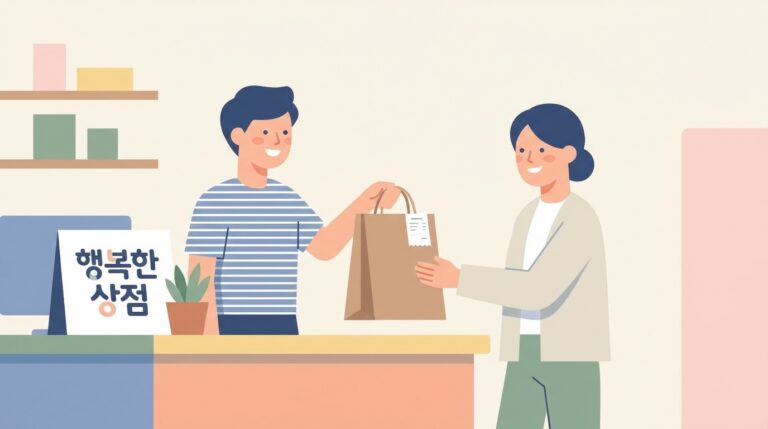
Phase 1: 공감 (Story-Driven Opening)
안녕하세요! 매일한글 에디터입니다. Have you ever felt that spike of anxiety holding a shopping bag in Hongdae or Seongsu? You bought a gorgeous sweater yesterday, but at your hotel, you realized the size was too tight. You have your receipt, but your mind races: ‘Will the clerk think I am troublesome?’ Nobody wants to feel like a difficult customer. But when the friendly clerk inspects your receipt and happily brings you the perfect size with a warm smile, sweet relief washes over you! You want to say more than a flat ‘Thank you.’ You want to say: ‘Thank you for handling the exchange so kindly!’ Today, we will master warm, natural phrases that turn a stressful exchange into a wonderful cultural connection.
Phase 2: 핵심 표현 3선 심층 분석 (Deep Dive into Core Expressions)
1. 친절하게 교환해 주셔서 감사합니다 (Chin-jeol-ha-ge gyo-hwan-hae ju-syeo-seo gam-sa-hap-ni-da)
- Pronunciation: [Chin-jeol-ha-ge gyo-hwan-hae ju-syeo-seo gam-sa-hap-ni-da] (Sounds like: “Chin-jawl-ha-geh gyo-hwan-hae joo-shuh-saw gahm-sah-hahm-nee-dah”)
- Meaning: Literal: “Because you exchanged it kindly, I thank you” | Actual Nuance: “Thank you so much for handling this exchange so kindly and patiently!”
- K-Culture Moment: You often see this in heartwarming K-dramas when the humble main character visits a local shop, receives warm service, and bows with a radiant smile of appreciation.
- Editor’s Insight: Simply saying “감사합니다” (Gamsahamnida) is polite, but adding “친절하게” (chin-jeol-ha-ge = kindly) acknowledges the clerk’s personal effort. Retail staff in busy shopping districts handle hundreds of customers; this compliment instantly makes their day.
- Situation Spectrum: Casual: 🚫 | Semi-formal: ⚠️ | Formal: ✅
- 🤔 Think About It: In English, we usually just say “Thanks, have a good one!” How does explicitly commenting on someone’s kindness (“친절하게”) reflect the Korean cultural emphasis on emotional consideration and mutual care?
2. 번거롭게 해드려서 죄송해요 (Beon-geo-rop-ge hae-deu-ryeo-seo joe-song-hae-yo)
- Pronunciation: [Beon-geo-rop-ge hae-deu-ryeo-seo joe-song-hae-yo] (Sounds like: “Buhn-gaw-rohp-geh hae-deu-ryaw-saw jweh-song-hae-yo”)
- Meaning: Literal: “I am sorry for making things cumbersome for you” | Actual Nuance: “Sorry for the extra hassle / trouble!”
- K-Culture Moment: Think of a slice-of-life scene where a character hands back a receipt to correct a billing error or swap an item, ducking their head sheepishly.
- Editor’s Insight: This phrase is the ultimate social lubricant in Korean service culture. It is not an admission of guilt or fault; rather, it is a graceful way of saying: “I recognize this took extra steps for you, and I appreciate your time.”
- Situation Spectrum: Casual: ⚠️ | Semi-formal: ✅ | Formal: ✅
- 🤔 Think About It: Why does Korean etiquette place such high value on apologizing for causing inconvenience, even when you are exercising a normal consumer right like an exchange?
3. 덕분에 잘 입을게요 (Deok-bun-e jal ib-eul-ge-yo)
- Pronunciation: [Deok-bun-e jal ib-eul-ge-yo] (Sounds like: “Dawk-boon-eh jahl eeb-eul-geh-yo”)
- Meaning: Literal: “Thanks to you, I will wear it well” | Actual Nuance: “I’m going to really enjoy wearing this, thanks to your help!”
- K-Culture Moment: The classic shopping montage conclusion where the protagonist clutches their shopping bag happily and bids farewell to the boutique owner.
- Editor’s Insight: “덕분에” (deok-bun-e) translates to “thanks to you” or “because of your grace.” Pairing it with “잘 입을게요” (for clothing) or “잘 쓸게요” (jal sseul-ge-yo, for general items/cosmetics) shifts the focus from a cold monetary transaction to a warm personal gift.
- Situation Spectrum: Casual: ⚠️ | Semi-formal: ✅ | Formal: ✅
- 🤔 Think About It: When you tell a store clerk “I will wear it well thanks to you,” how does that build a sense of community warmth rather than just a customer-seller barrier?
Phase 3: 교과서 한국어 vs 진짜 한국어 (Textbook vs. Real Korean)
Situation 1: Asking if an exchange is possible at the counter
- 📖 교과서 한국어: “이 물건을 다른 사이즈로 교환해 주시겠습니까?” (I mul-geon-eul da-reun sa-i-jeu-ro gyo-hwan-hae ju-si-get-seum-ni-kka? – “Would you please exchange this item for another size?”)
- 🗣️ 진짜 한국어: “저기요, 영수증 있는데 사이즈 교환 좀 될까요?” (Jeo-gi-yo, yeong-su-jeung inn-neun-de sa-i-jeu gyo-hwan jom doel-kka-yo? – “Excuse me, I have the receipt, could I possibly exchange this size?”)
- 💡 왜 다를까? Textbook forms with
-주시겠습니까?sound like an official military request or a corporate contract. Native speakers soften the question using “저기요” (excuse me) and “좀 될까요?” (could it work out a little?), which sounds humble and approachable.
Situation 2: Wrapping up the transaction with heartfelt thanks
- 📖 교과서 한국어: “교환해 주신 것에 대해 대단히 감사드립니다.” (Gyo-hwan-hae ju-sin geot-e dae-hae dae-dan-hi gam-sa-deu-rim-ni-da. – “I offer you immense gratitude regarding exchanging it.”)
- 🗣️ 진짜 한국어: “친절하게 처리해 주셔서 감사해요! 수고하세요!” (Chin-jeol-ha-ge cheo-ri-hae ju-syeo-seo gam-sa-hae-yo! Su-go-ha-se-yo! – “Thank you so much for taking care of it so kindly! Have a wonderful day!”)
- 💡 왜 다를까? Koreans combine natural conversational honorifics with the iconic daily farewell “수고하세요!” (keep up the good work / take care). It instantly creates a pleasant, upbeat atmosphere.
Phase 4: K-Culture 딥다이브 & 비언어적 매너 (Deep Dive & Non-Verbal Manners)
4-1. 눈치 (Nunchi) & Gestures
- The Two-Handed Handover (두 손 건네기): When handing over your receipt, card, and the clothing item, always use two hands. Alternatively, support your right forearm or elbow with your left hand. Tossing or sliding receipts across the counter with one hand is seen as rude.
- The Polite Bow (목례): You do not need a dramatic 90-degree bow! A slight 15-to-30-degree nod-bow while uttering “감사합니다” (Gamsahamnida) shows deep respect.
- Eye Contact: Keep soft, respectful eye contact. Staring intently can feel confrontational in Korean culture, while looking down completely can seem distant. A warm smile and a soft gaze are ideal.
4-2. Cultural Code: The ‘Sunhan-mat’ (Sweet) Customer
In Korea, retail workers are famously sensitive to customer attitudes because they often deal with stressed, impatient shoppers (sometimes called “진상” / jinsang, difficult customers). When a customer comes in with a neat receipt, keeping tags intact, and speaks politely, store clerks are known to become extra attentive. In K-beauty shops like Olive Young, polite demeanor might even earn you extra free sample masks (사은품 / 덤)!
Phase 5: 실전 롤플레이 시나리오 (Real-Life Roleplay Scenario)
- Setting: A minimalist fashion boutique in Seongsu-dong called ‘Studio Seoul’. Soft indie-pop is playing in the background.
- Characters:
- Alex: A foreign traveler holding a neatly folded shirt in a paper shopping bag.
- Min-ji: A stylish, friendly store staff member standing behind the wooden counter.
- Turn 1 (Alex):
저기요, 안녕하세요! 어제 산 옷인데 사이즈 교환 좀 될까요?
(Jeo-gi-yo, an-nyeong-ha-se-yo! Eo-je san os-in-de sa-i-jeu gyo-hwan jom doel-kka-yo?)
“Excuse me, hello! I bought this yesterday, could I possibly exchange the size?”
🎭 행동 지문: [Hands over the paper bag and receipt with both hands, smiling gently] -
Turn 2 (Min-ji):
네, 고객님! 영수증 확인해 드릴게요. 라지(L) 사이즈로 바꿔 드릴까요?
(Ne, go-gaek-nim! Yeong-su-jeung hwag-in-hae deu-ril-ge-yo. Ra-ji sa-i-jeu-ro ba-kkwo deu-ril-kka-yo?)
“Yes, valued customer! Let me check your receipt. Would you like me to switch it to size Large?”
🎭 행동 지문: [Scans the barcode on the receipt and checks the price tag on the shirt] -
Turn 3 (Alex):
네, 맞아요. 번거롭게 해드려서 죄송해요.
(Ne, maj-a-yo. Beon-geo-rop-ge hae-deu-ryeo-seo joe-song-hae-yo.)
“Yes, that’s right. Sorry for giving you extra trouble!”
🎭 행동 지문: [Nods slightly with a courteous, apologetic expression] -
Turn 4 (Min-ji):
아니에요, 괜찮습니다! 잠시만 기다려 주세요. 새 제품으로 가져다드릴게요.
(A-ni-e-yo, gwaen-chan-seum-ni-da! Jam-si-man gi-da-ryeo ju-se-yo. Sae je-pum-eu-ro ga-jyeo-da-deu-ril-ge-yo.)
“Not at all, it’s completely fine! Please wait just a moment. I will bring you a fresh piece.”
🎭 행동 지문: [Walks swiftly to the back storage and returns with the new size] -
Turn 5 (Alex):
확인해 주셔서 감사합니다!
(Hwag-in-hae ju-syeo-seo gam-sa-hap-ni-da!)
“Thank you for checking it for me!”
🎭 행동 지문: [Checks the size label and nods in satisfaction] -
Turn 6 (Min-ji):
교환 완료되었습니다. 영수증 다시 쇼핑백에 넣어드렸어요!
(Gyo-hwan wan-ryo-doe-eoss-seum-ni-da. Yeong-su-jeung da-si syo-ping-bae-ge neo-eo-deu-ryeoss-eo-yo!)
“The exchange is complete. I put your updated receipt back in the shopping bag!”
🎭 행동 지문: [Hands over the bag with two hands, bowing slightly] -
Turn 7 (Alex):
친절하게 교환 처리해 주셔서 정말 감사합니다! 덕분에 잘 입을게요.
(Chin-jeol-ha-ge gyo-hwan cheo-ri-hae ju-syeo-seo jeong-mal gam-sa-hap-ni-da! Deok-bun-e jal ib-eul-ge-yo.)
“Thank you so much for handling the exchange so kindly! I’ll wear it well thanks to you.”
🎭 행동 지문: [Takes the bag with both hands and bows at a polite 30-degree angle] -
Turn 8 (Min-ji):
감사합니다, 고객님! 서울 여행 즐겁게 하세요, 수고하세요!
(Gam-sa-hap-ni-da, go-gaek-nim! Seo-ul yeo-haeng jeul-geop-ge ha-se-yo, su-go-ha-se-yo!)
“Thank you, customer! Enjoy your trip in Seoul, have a wonderful day!”
🎭 행동 지문: [Waves with a delighted, bright smile]
🔀 인터랙티브 분기점 (Interactive Branching Decision)
At Turn 7, Min-ji has just handed you the fresh item. How do you respond?
- Option A: Say “친절하게 교환해 주셔서 감사합니다! 수고하세요!” with a respectful bow.
👉 [Best Choice]: You leave an unforgettable impression as a thoughtful visitor. The staff feels recognized for their kindness and will warmly greet you whenever you return! - Option B: Grab the shopping bag with one hand, give a silent nod, and immediately walk out while staring at your phone.
👉 [Bad Choice]: While not a crime, it comes off cold and indifferent in Korean service spaces where verbal closure is valued. - Option C: Give a thumbs up and say “고마워, 친구!” (Gomawo, chingu! – “Thanks, friend!”).
👉 [Risk Choice]: Using casual language (반말 / banmal) to a store employee sounds impolite and jarring, even if meant affectionately.
Phase 6: 10초 감정 섀도잉 드릴 (10-Second Emotion Shadowing Drill)
Practice these lines focusing on the pause marks (/) and emotional tone indicators:
[🥺 Polite and apologetic]
번거롭게 해드려서 / 죄송해요.
(Beon-geo-rop-ge hae-deu-ryeo-seo / joe-song-hae-yo.)
“Sorry / for giving you extra trouble.”-
[😊 Warm and deeply grateful]
친절하게 / 교환해 주셔서 / 정말 감사합니다!
(Chin-jeol-ha-ge / gyo-hwan-hae ju-syeo-seo / jeong-mal gam-sa-hap-ni-da!)
“Thank you so much / for exchanging this / so kindly!” -
[✨ Bright and enthusiastic]
덕분에 / 예쁘게 잘 입을게요!
(Deok-bun-e / ye-ppeu-ge jal ib-eul-ge-yo!)
“Thanks to you / I will wear it beautifully!”
Phase 7: K-Culture 미니 사전 (Mini Dictionary)
- 교환 (Gyo-hwan) | Exchange | Swapping an purchased item for another size, color, or different item of equal value.
- 환불 (Hwan-bul) | Refund | Canceling the purchase entirely and getting your payment returned to your original payment method.
- 영수증 (Yeong-su-jeung) | Receipt | Your golden ticket in Korean retail! Without this paper or app voucher, exchanges are rarely granted.
- 결제 취소 (Gyeol-je chwi-so) | Payment Cancellation | The technical step where a cashier voids the card transaction before running the new total.
Phase 8: 여행자를 위한 생존 키트 (Traveler’s Survival Kit)
Top 3 Survival Phrases
- 영수증 여기 있어요. (Yeong-su-jeung yeo-gi iss-eo-yo.)
Meaning: “Here is the receipt.”
Pro Tip: Hand it over immediately before stating your request so the clerk can look up the purchase policy in advance. - 혹시 다른 색상으로 교환될까요? (Hok-si da-reun saek-sang-eu-ro gyo-hwan-doel-kka-yo?)
Meaning: “By any chance, could I exchange this for a different color?”
Pro Tip: The magic word “혹시” (hok-si = by any chance) softens requests and makes you sound super polite. - 차액 결제할게요. (Cha-aek gyeol-je-hal-ge-yo.)
Meaning: “I will pay the price difference.”
Pro Tip: Essential if you are swapping for a more expensive piece.
Editor’s Travel Note
Before heading shopping, make sure you download the Naver Map application to easily locate flagship store customer service counters. If you need immediate text translation at the counter, install the Papago translation app. Remember that big chains like Olive Young allow digital app receipts, but small boutiques in areas like Ikseon-dong or Yeonnam-dong usually require the original paper slip. Keep all tags attached!
Phase 9: “한 발 더 깊이” (Deep Dive Reflection)
In Korean society, daily interactions are held together by an unspoken current of “배려” (Baeryeo – mutual consideration). Unlike Western transactional settings where saying a casual “Thanks!” is customary, Korean service interactions recognize the emotional and physical labor of the worker. When you thank a clerk for handling an exchange kindly, you are affirming their humanity and hard work in a bustling city. It transforms a routine counter exchange into a moment of genuine warmth.
💬 Your Turn: Have you ever felt nervous asking for an exchange or refund in another country? Which of today’s phrases will you practice saying first on your next shopping spree in Seoul? Let us know in the comments below!
Phase 10: FAQ & 오해 방지 (FAQ Schema & Common Mistakes)
Q: Can I exchange an item in Korea if I lost the paper receipt?
A: Most Korean boutiques strictly require the physical paper receipt or an authorized digital membership purchase record. However, if you paid by card, some larger department stores or chains can look up your approval number (승인번호 / seung-in-beon-ho). Always keep your paper receipts tucked into your wallet just in case!
Q: How long do I have to request a product exchange or refund in Korea?
A: The standard retail policy across Korea is usually within 7 to 14 days from the date of purchase. For sale items, seasonal clearance, or white/knit garments, some stores enforce a strict “No Exchange/No Refund” (교환 및 환불 불가) policy, which will usually be printed at the bottom of your receipt.
Q: Is saying “수고하세요” (Su-go-ha-se-yo) rude to older staff?
A: “수고하세요” literally means “keep working hard.” While it is a standard, friendly parting greeting to retail staff, cashiers, and taxi drivers, you should avoid saying it to social superiors, boss figures, or elders in formal settings. In retail shops, however, saying it with a warm smile when leaving is widely appreciated.
🚨 흔한 실수 (Common Mistakes) 경고판
- Mistake: Saying casual “고마워요” (Gomawoyo) instead of “감사합니다” (Gamsahamnida).
Correct Action: In service encounters, stick to formal-polite “감사합니다” to show respect to staff. - Mistake: Sliding or flipping cards and receipts across the counter with one hand.
Correct Action: Hand items over using both hands or support your right wrist with your left hand. - Mistake: Cutting off the price tags (가격표 / 택) before trying on clothes at the hotel.
Correct Action: If the tag is detached, Korean stores will almost certainly deny an exchange. Keep tags intact until you are 100% sure you are keeping the item!
Phase 11: 액션 미션 & 참여 유도 (Action Missions)
- 🥉 Bronze Mission (Solo Practice): Stand in front of your mirror and practice saying: “친절하게 교환해 주셔서 감사합니다!” 5 times while practicing a natural 15-degree nod-bow.
- 🥈 Silver Mission (Community Share): Write down your favorite phrase from today in your Korean study notebook, take a photo, and share it on Instagram tagging
@DailyHangulwith your pronunciation voice note! - 🥇 Gold Mission (Real-Life Mastery): The next time you visit a Korean convenience store, grocery shop, or retail outlet, thank the cashier using “친절하게 처리해 주셔서 감사합니다! 수고하세요!”
- 🎮 K-Culture Mission: Watch an episode of a modern slice-of-life K-drama (like Business Proposal or Hometown Cha-Cha-Cha). Watch closely whenever a character interacts with a neighborhood store owner. Notice their body language when they say goodbye!
Phase 12: 인터랙티브 퀴즈 챌린지 (Interactive Quiz Challenge)
Question 1: Situational Judgment
You bought a jacket yesterday at a shop in Myeongdong, but the sleeves are too short. You bring the receipt and jacket back to the store. What is the most polite and natural way to open the conversation?
* A) “빨리 라지 사이즈로 바꿔 주세요.” (Change this quickly to large size.)
* B) “저기요, 영수증 있는데 사이즈 교환 좀 될까요?” (Excuse me, I have the receipt, could I possibly exchange the size?)
* C) “이 옷 마음에 안 들어서 환불할래.” (I don’t like these clothes, I wanna refund.)
Question 2: Fill in the Blank
Complete the sentence to say: “Thank you for handling the exchange so kindly!”
“친절하게 교환 ________ 주셔서 감사합니다!”
* A) 먹어 (meog-eo)
* B) 봐 (bwa)
* C) 처리해 (cheo-ri-hae)
Question 3: Cultural Manners (True / False)
True or False: In Korea, it is considered polite to hand your credit card and receipt across the counter using only your right index finger and thumb without making eye contact.
👉 Click here to reveal answers and explanations
- Question 1 Answer: B
Explanation: Option B uses the respectful “저기요” and softening ending “-좀 될까요?”, which sounds considerate and native. Option A sounds demanding and bossy, while Option C uses impolite informal speech (반말). - Question 2 Answer: C (처리해)
Explanation: “처리하다” means to handle, process, or take care of a matter. “처리해 주셔서” means “for handling it for me.” - Question 3 Answer: False
Explanation: Always hand over cards, receipts, and products using both hands (or supporting your right forearm) along with a slight nod to display good etiquette!







