

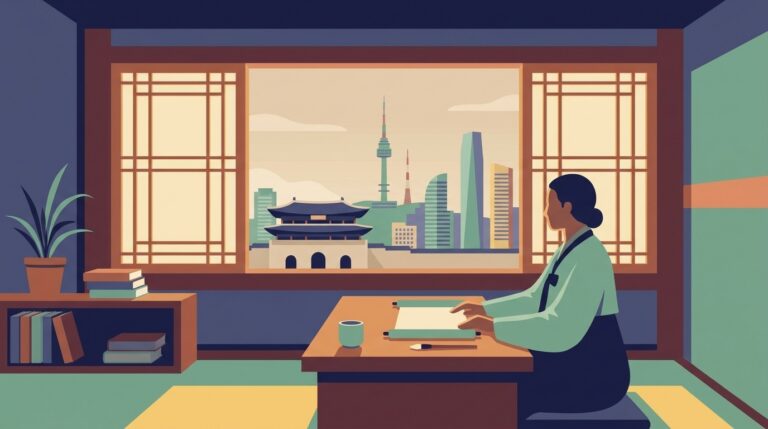
Phase 1: Empathy (Story Immersion Opening)
안녕하세요! 매일한글 에디터입니다. (Hello! This is your Daily Hangul editor!)
Imagine you are sitting in a quiet, book-lined traditional cafe in Insadong, Seoul, having tea with Korean graduate students or cultural critics. The conversation inevitably shifts to a newly released historical blockbuster or a hit period drama like Mr. Sunshine or 1987. While novice learners might simply comment on the thrilling plot or the actor’s tears, you want to articulate why a historical event from a century ago feels so shockingly urgent on the streets of Seoul today. You know what you want to convey in your native language: Benedetto Croce’s famous philosophical maxim that all history is contemporary history—that the past is never inert dust, but a living narrative continuously summoned to answer the crises and identity questions of the present. Yet, searching for the right Korean vocabulary at an intellectual C2 level leaves you stranded between rigid dictionary definitions and everyday slang.
Mastering the Korean language of historiography, collective memory, and critical philosophy isn’t just about sounding prestigious; it is your passport into the deepest layers of Korean cultural consciousness. South Korea’s contemporary debates—from public memorials in Gwanghwamun to heated debates on social media about colonial legacy and democratic movements—are rooted in this exact dialectic. Based on years of mentoring advanced international researchers and foreign correspondents, this guide equips you with the exact phrases, cultural nuances, and discourse strategies needed to navigate the politics of memory with native elegance and philosophical depth.
Phase 2: Deep Dive into 3 Core Expressions
1. 새롭게 호출되다 (Saeropge hochuldoeda)
- Pronunciation: [Sae-rop-ge ho-chul-doe-da] (Think of sae like ‘say’, rop like ‘rope’ cut short, and hochul sounding like ‘ho-churl’ without rolling the r).
- Meaning: Literally “to be called out anew” / Nuance: “To be summoned, re-invoked, or recontextualized in light of contemporary concerns.”
- K-Culture Moment: Used routinely by film critics and cultural theorists on YouTube channels like Movie Trip or in Cine21 articles when discussing why Joseon Dynasty rebellions or 1980s student movements are being adapted into modern webtoons and cinematic universes.
- Editor’s Insight: While “소환되다” (sohwandoeda) is a trendier internet buzzword for bringing back nostalgia, “새롭게 호출되다” carries scholarly weight. It implies that modern society deliberately brings a dormant historical event back into the spotlight to examine a pressing ethical question.
- Situation Spectrum: Casual 🚫 | Semi-formal ⚠️ | Formal ✅
- 🤔 Think About It: In English, we often say an idea is “revisited” or “brought to the fore.” Why do you think Korean uses the performative verb “호출하다” (to summon/call roll), as if historical actors are waiting in the wings to testify?
2. 시대의 문제의식을 투영하다 (Sidae-ui munjeeuisigeul tuyeonghada)
- Pronunciation: [Si-dae-ui mun-je-ui-si-geul tu-yeong-ha-da] (Pronounce sidae like ‘she-day’, munje like ‘moon-jeh’, and tuyeong as ‘too-young’).
- Meaning: Literally “to project the problem-consciousness of an era” / Nuance: “To reflect the critical questions and social anxieties of our current time onto a historical canvas.”
- K-Culture Moment: Frequently heard during panel debates on JTBC’s Differential Class (차이나는 클라스) when discussing why modern historical films re-evaluate controversial queens or dissidents differently than textbooks did thirty years ago.
- Editor’s Insight: The word “문제의식” (problem-consciousness / critical awareness) is indispensable in Korean intellectual discourse. It shows that an interpretation isn’t an accident; it is driven by a passionate struggle to address today’s contradictions.
- Situation Spectrum: Casual 🚫 | Semi-formal ✅ | Formal ✅
- 🤔 Think About It: How does viewing historical memory through “시대의 문제의식” transform your understanding of Korean pop culture, where modern values of gender and class are projected into Joseon-era palace intrigues?
3. 과거와의 끊임없는 대화 (Gwagwowa-ui kkeunimeomneun daehwa)
- Pronunciation: [Gwa-gwo-wa-ui kkeun-im-eop-neun dae-hwa] (Pronounce gwagwa like ‘gwa-gwo’, kkeun-im like a firm ‘kkeen-im’, and daehwa like ‘day-hwa’).
- Meaning: Literally “an unending dialogue with the past” / Nuance: E.H. Carr’s famous adage, widely internalized in Korean intellectual circles as a foundational worldview on historical reconciliation.
- K-Culture Moment: Quoted in keynote speeches at the Gwangju Biennale or memorial lectures commemorating democratization movements, emphasizing that reconciliation is an ongoing hermeneutic process rather than a closed chapter.
- Editor’s Insight: Use this phrase when wrapping up an intellectual debate to demonstrate that you do not subscribe to naive historical determinism or cold positivism. It projects intellectual humility and open-mindedness.
- Situation Spectrum: Casual ⚠️ | Semi-formal ✅ | Formal ✅
- 🤔 Think About It: Does your native culture treat history as a settled factual archive, or as an active dialogue that shifts whenever a new generation takes the stage?
Phase 3: Textbook Korean vs Real Korean
Situation 1: Explaining why a historical drama reimagines a well-known historical figure
- 📖 교과서 한국어: 이 드라마는 옛날 인물을 요즘 시각으로 다시 봅니다. (I deuramaneun yennal inmureul yojeum sigageuro dasi bomnida. / This drama looks at an old person with today’s perspective again.)
- 🗣️ 진짜 한국어: 베네데토 크로체의 말처럼, 당대의 역사적 서사는 결국 지금 우리의 시대정신을 투영한 결과물이죠. (Benedeto Keuroche-ui malcheoreom, dangdae-ui yeoksajeok seosaneun gyeolguk jigeum uri-ui sidaejeongsineul tuyeonghan gyeolgwamul-ijyo. / As Benedetto Croce observed, the historical narrative of any given period is ultimately a projection of our present zeitgeist.)
- 💡 왜 다를까?: Native speakers at an academic and journalistic level favor conceptual compound nouns like “시대정신” (zeitgeist) and “역사적 서사” (historical narrative) over colloquial phrases like “옛날 인물” to elevate analytical precision.
Situation 2: Expressing skepticism toward “purely objective” history during a seminar
- 📖 교과서 한국어: 역사는 100% 사실만 있는 것이 아닙니다. (Yeoksaneun baek peosenteu sasilman inneun geosi animnida. / History is not made of 100% facts only.)
- 🗣️ 진짜 한국어: 실증주의적 사실의 나열만으로는 기억의 정치학이 작동하는 역동성을 온전히 포착하기 어렵습니다. (Siljeungju-uijeok sasirui nayeolman-eoroneun gieogui jeongchihagi jakdonghaneun yeokdongseongeul onjeonhi pochakhagi eoryeopseumnida. / Merely cataloging positivist facts fails to capture the dynamic ways in which the politics of memory actually operates.)
- 💡 왜 다를까?: In advanced debate, Korean speakers do not reject facts outright; instead, they contrast “실증주의” (positivism) with the nuanced mechanism of “기억의 정치학” (politics of memory) to critique reductionist claims without sounding hostile.
Phase 4: K-Culture Deep Dive & Non-Verbal Manners
4-1. 눈치 (Nunchi) & Gestures: Navigating Sensitive Historical Discourses
When engaging in high-level discussions about modern Korean history—such as colonial occupation, the Korean War, or the democratization struggles—physical posture dictates how your arguments are received. Intellectual discourse in Korea is not an aggressive, combative debate; it is an exercise in mutual ethical reflection.
* Eye Contact & Head Tilting: Never stare down your interlocutor while deconstructing historical narratives. Maintain steady, thoughtful eye contact, accompanied by gentle, slow nods (끄덕임) when the other person speaks. This signals that you are synthesizing their point.
* Two-Handed Rhetorical Gestures: When introducing Croce’s perspective, keep your hands relaxed above the table, palms facing slightly upward or inward. Avoid chopping the air or pointing with an index finger, which feels confrontational.
* The Lowered Register Voice (낮고 차분한 어조): Cultured Koreans drop their pitch by half an octave and slow their cadence when transitioning from casual chat to historiographical reflection. It frames the topic as sacred and intellectually weighty.
4-2. Cultural Code Analysis: The Cinematic Renaissance of Contemporary Memory
South Korean cinema has arguably become the country’s most vibrant forum for Croce’s “contemporary history.” Masterpieces such as 1987: When the Day Comes (1987), A Taxi Driver (택시운전사), and The Man Standing Next (남산의 부장들) are not mere period-accurate recreations; they were produced in direct conversation with contemporary socio-political milestones, such as the Candlelight Protests.
When Korean directors revisit the 1970s and 1980s, they are actively interrogating the state of South Korean democracy today. By analyzing these films through Croce’s thesis, you uncover why certain historical martyrs are canonized while others are complicated: the collective consciousness selectively foregrounds historical moments that offer solace or democratic resilience to current existential dilemmas. When you discuss a film using the phrase “오늘날의 렌즈로 재해석된 과거” (the past reinterpreted through today’s lens), Korean intellectuals will instantly recognize you as a peer.
Phase 5: Real-Life Roleplay Scenario
Setting: A quiet seminar room at a university in Sinchon, Seoul. You are discussing historical cinema and historiography over a cup of iced Americano with Min-woo (민우), a doctoral researcher in modern Korean cultural history.
- Turn 1 (민우): 이번에 흥행한 역사 영화 보셨어요? 과거의 비극적인 사건을 다뤘는데, 고증이 틀렸다고 인터넷에서 논란이 아주 뜨겁더라고요.
(Ibeone heunghaenghan yeoksa yeonghwa bosyeosseoyo? Gwagweoui bigeukjeogin sageoneul darwonneunde, gojeungi teullyeotdago inteoneseo nonrani aju tteugeopdeoragoyo.)
“Did you catch that hit historical movie recently? It deals with a tragic past event, but there’s a fiery debate online claiming historical inaccuracies.” -
Turn 2 (You): 🎭 [Taking a contemplative sip of coffee, speaking in a calm, analytical tone]
네, 봤어요. 하지만 단순한 실증적 사실의 오류를 넘어, 왜 지금 그 사건이 대중의 뇌리에 다시 각인되는지를 주목해야 한다고 봐요.
(Ne, bwasseoyo. Hajiman dansunhan siljeungjeok sasirui oryureul neomeo, wae jigeum geu sageoni daejungui noerie dasi gagin-doeneunjireul jumokhaeya handago bwayo.)
“Yes, I saw it. However, beyond simple empirical inaccuracies, I think we must pay attention to why that specific event is being re-etched into the public consciousness right now.” -
Turn 3 (민우): 🎭 [Nodding with keen interest, leaning forward slightly]
오, 흥미로운 지적이네요. 감독이 왜 굳이 그 시절을 지금 이 시점에 무대 위로 끌어올렸을까요?
(O, heungmiroun jijeogineyoyo. Gamdogi wae guji geu sijeoreul jigeum i sijeome mudae wiro kkeureoolryeosseulkkayo?)
“Oh, that’s an insightful point. Why do you suppose the director dragged that specific era onto the stage at this precise moment?” -
Turn 4 (You): 🎭 [Gesturing gently with open palms to express philosophical nuance]
베네데토 크로체가 말했듯이, 모든 역사는 현대사잖아요. 결국 과거의 사건을 빌려 오늘날 우리 사회의 불안과 갈등을 은유한 셈이죠.
(Benedeto Keurochega malhaetdeusi, modeun yeoksaneun hyeondaesajanayo. Gyeolguk gwagweoui sageoneul billyeo oneulnal uri sahoeui burangwa galdeungeul eun-yuhan semijyo.)
“As Benedetto Croce stated, all history is contemporary history. Ultimately, the film borrowed past events to construct an allegory for our present society’s anxieties and fractures.” -
Turn 5 (민우): 🎭 [Smiles faintly, impressed by the theoretical reference]
동감합니다. 역사는 박제된 박물관의 유물이 아니라, 현재의 물음에 답하기 위해 끊임없이 다시 쓰이는 텍스트니까요.
(Donggamhamnida. Yeoksaneun bakjedeon bangmulgwanui yumuri anira, hyeonjaeui mureume daphagi wihae kkeunimeopsi dasi sseuineun tekseuteunikkayo.)
“I completely agree. History is not a taxidermied relic in a museum, but a text constantly rewritten to answer the questions of the living present.” -
Turn 6 (You): 🎭 [Expressing respect and offering a balanced resolution]
맞아요. 그런 맥락에서 역사적 화해 역시 고정된 결론이 아니라, 현재의 우리가 과거와 맺는 부단한 대화 속에서 찾아야 하지 않을까요?
(Majayo. Geureon maengnageseo yeoksajeok hwa-hae yeoksi gojeongdoen gyeolroni anira, hyeonjaeui uriga gwagwowa maenneun budanhan daehwa sogeseo chajaya haji aneulkkayo?)
“Exactly. In that context, shouldn’t historical reconciliation also be sought not as a fixed verdict, but within an unceasing dialogue that our present self conducts with the past?” -
Turn 7 (민우): 🎭 [Slow, deep nod of intellectual solidarity]
깊이 있는 통찰이네요. 그런 시각으로 영화를 다시 보니 비평의 지평이 훨씬 넓어지는 것 같습니다.
(Gipi inneun tongcharineyoyo. Geureon sigageuro yeonghwareul dasi boni bipyeongui jipyeongi hwolssin neolbeojineun geot gatseumnida.)
“What profound insight. Looking back at the film from that vantage point broadens the horizon of critique considerably.” -
Turn 8 (You): 🎭 [Smiling modestly]
민우 씨와 이야기를 나누니 생각이 더 명료해졌어요. 고마워요!
(Min-u ssiwa iyagireul nanuni saenggagi deo myeongryohaejyeosseoyo. Gomaweoyo!)
“Talking with you, Min-woo, has made my thoughts much clearer. Thank you!”
🔀 Interactive Branching Point
If Min-woo had challenged you with: “그래도 고증이 틀리면 역사 왜곡 아닌가요?” (Still, if historical accuracy is flawed, isn’t that historical distortion?)
* Choice A (Best): “물론 사실의 왜곡은 경계해야 하죠. 다만 그 영화적 상상력이 현재 우리 사회에 어떤 화두를 던지는지 그 사회적 맥락을 함께 보자는 뜻이었어요.” (Acknowledge factual integrity while redirecting toward cultural contextualization.)
* Choice B (Bad): “사실 고증은 영화에서 별로 안 중요해요. 크로체 몰라요?” (Dismissive and pedantic; alienates the listener and sounds condescending.)
* Choice C (Risk): “역사는 승자의 기록일 뿐인데 고증이 무슨 의미가 있나요?” (Overly cynical and postmodern; may spark unnecessary controversy regarding historical relativism.)
Phase 6: 10-Second Emotional Shadowing Drill
Follow the rhythm marks (/) and embody the bracketed emotion. Read aloud:
[🧐 진지하고 사색적으로]
베네데토 크로체의 말처럼, / 모든 참된 역사는 / 결국 현대사입니다.
(Benedeto Keuroche-ui malcheoreom, / modeun chamdoen yeoksaneun / gyeolguk hyeondaesaimnida.)
“As Benedetto Croce stated, / all true history / is ultimately contemporary history.”-
[💡 확신에 찬 어조로]
과거의 기억은 / 박제되어 머무는 것이 아니라, / 현재의 문제의식 속에서 / 끊임없이 새롭게 호출됩니다.
(Gwagweoui gieogeun / bakjedoeo meomuneun geosi anira, / hyeonjaeui munjeeuisik sogeseo / kkeunimeopsi saeropge hochuldoemnida.)
“Memories of the past / do not remain taxidermied relics; / within the critical consciousness of the present, / they are ceaselessly summoned anew.” -
[🕊️ 온화하지만 깊은 울림으로]
진정한 역사적 화해는 / 과거를 덮어두는 것이 아니라, / 오늘날의 시선으로 / 끊임없는 대화를 이어가는 과정입니다.
(Jinjeonghan yeoksajeok hwa-haeneun / gwagworeul deopeoduneun geosi anira, / oneulnalui siseoneuro / kkeunimeomneun daehwareul ieoganeun gwajeongimnida.)
“True historical reconciliation / is not about papering over the past, / but an ongoing journey / of sustaining a dialogue through the lens of today.”
Phase 7: K-Culture Mini Dictionary (4 Key Terms)
-
사관 (史觀, Sagwan)
- Translation: Historical perspective / Historiography.
- Usage: Essential in analytical debates. For example, 식민사관 (colonial view of history), 민중사관 (people’s historiography), or 진보적 사관 (progressive view of history). It refers to the ideological paradigm through which one interprets the chronicle of human events.
- 과거사 청산 (Gwagwosa cheongsan)
- Translation: Rectification / Settlement of past historical injustices.
- Usage: Frequently encountered in Korean editorials and state policy debates. It refers to legal, moral, and cultural efforts to uncover truths regarding authoritarian violence, wartime atrocities, or collaboration during the colonial era.
- 기억의 정치 (Gieog-ui jeongchi)
- Translation: Politics of memory.
- Usage: A central academic concept in Korean sociology and cultural studies. It critiques how state institutions, civic groups, and media compete to determine which historical traumas are publicly remembered and which are erased.
- 시대정신 (時代精神, Sidaejeongsin)
- Translation: Zeitgeist / Spirit of the times.
- Usage: Omnipresent in Korean intellectual and political life, especially during presidential elections and national anniversaries. It demands: “What is the overarching ethical demand and historical mission of our collective generation right now?”
Phase 8: Traveler’s Survival Kit
Survival Expressions TOP 3 (For Memorials, Museums & Cultural Sites)
- 이 전시관의 사료들은 어떤 시대적 맥락에서 재조명된 건가요?
(I jeonsigwanui saryodeureun eotteon sidaejeok maengnageseo jaejomyeongdoen geongayo?)
Pro Tip: Use this at national museums when speaking to curators. It instantly elevates you from a tourist to an esteemed scholar. - 역사적 비극을 기억하고 추모하는 조형물의 상징적 의미가 궁금합니다.
(Yeoksajeok bigeugeul gieokhago chumohaneun johyeongmurui sangjingjeok uimiga gunggeumhamnida.)
Pro Tip: Perfect when visiting the Seodaemun Prison History Hall or the Memorial Space for Comfort Women (기억의 터). - 상설 전시와 특별 기획전의 역사 서술 방식에 어떤 차이가 있나요?
(Sangseol jeonsiwa teukbyeol gihoekjeonui yeoksa seosul bangsige eotteon chaiga innayo?)
Pro Tip: A sophisticated question to ask docents to evaluate how permanent exhibits contrast with temporary, modern curations.
Editor’s Travel Note
When you are in Seoul, skip the typical commercial stops for an afternoon and head to the National Museum of Korean Contemporary History (대한민국역사박물관) right across from Gwanghwamun Square. The panoramic 8th-floor rooftop terrace looks directly over Gyeongbokgung Palace and the Blue House, placing 600 years of dynastic legacy, modern colonial scars, and democratic protests in a single frame. To book your visit seamlessly and navigate historical walking tours in Gwanghwamun, make sure to check out the Naver Map app navigation guide to pinpoint historic monuments and curatorial archives without missing commemorative plaques tucked inside quiet alleyways.
Phase 9: “One Step Deeper” (Reflective Prompt)
In modern Korean society, memory is never an abstract cognitive archive; it is a collective, somatic reality. The Korean term “한” (Han—deep-seated collective sorrow) and “화해” (Hwahae—reconciliation) do not signify passive resignation or mere compromise. Instead, the relentless debates over textbook revisions, statue installations, and democratization memorials illustrate Croce’s principle in its rawest form: Korean society continually unpacks its historical wounds because its democratic identity is being freshly forged in the present moment. Historical memory serves as the ethical crucible through which modern Koreans negotiate justice, accountability, and the rights of future generations.
💬 Your Turn: What is one historical event in your home country that is being fiercely “summoned anew” (새롭게 호출되는) in your contemporary politics or art today? Share your thoughts below in Korean! Let’s discuss together. ✍️
Phase 10: FAQ & Avoiding Misunderstandings (FAQ Schema)
Q: Does quoting Benedetto Croce in Korean sound overly pretentious in daily conversation?
A: In casual drinking sessions or while shopping, yes! However, in university lectures, book clubs (독서 모임), cultural podcast discussions, or film debates, citing philosophers like Croce or E.H. Carr is welcomed and appreciated. It demonstrates that you treat Korean as a serious academic and intellectual medium.
Q: What is the exact nuance difference between “역사를 왜곡하다” and “역사를 재해석하다”?
A: “역사를 왜곡하다” (yeoksareul waegokhada) carries severe moral condemnation—it means to deliberately falsify or twist factual records for ideological propaganda. Conversely, “역사를 재해석하다” (yeoksareul jaehae-seokhada) is an intellectually neutral or positive phrase meaning to re-examine established facts through an innovative, contemporary perspective.
Q: Can I use “역사는 현대사다” in an essay for TOPIK II (Test of Proficiency in Korean) Level 6?
A: Absolutely! In the TOPIK II argumentative writing section (Question 54), opening or concluding your essay with an intellectual aphorism like “‘모든 역사는 현대사다’라는 명제처럼…” (Like the proposition that ‘all history is contemporary history’…) is one of the highest-scoring rhetorical strategies you can deploy.
🚨 흔한 실수 (Common Mistakes) 경고판
- Using casual “옛날 이야기” (old tale) during serious historical discourse:
- Wrong: 한국의 옛날 이야기를 연구하고 있어요. (Sounds like you study children’s fairy tales.)
- Correct Action: 한국의 근현대사(Modern and contemporary history) 및 역사철학(Philosophy of history)을 탐구하고 있습니다.
- Confusing “기록” (Record) with “기억” (Memory):
- Wrong: 국가의 공식 기록이 백성들의 슬픔을 위로합니다. (Records don’t console grief; memory does.)
- Correct Action: 공공의 기억(Public memory)과 애도(Mourning)의 과정이 요구됩니다.
- Overusing internet slang like “소환하다” in academic papers:
- Wrong: 영화가 옛날 인물을 소환했다. (Fine on Twitter/blogs, too colloquial for essays.)
- Correct Action: 해당 텍스트는 과거의 인물을 현재적 시각에서 새롭게 호출하고 있다.
Phase 11: Action Mission & Engagement
- 🥉 Bronze Level: Write down the 3 core expressions from Phase 2 in your study notebook, along with their Hanja origins (e.g., 時代, 問題意識, 召喚/呼出).
- 🥈 Silver Level: Record a 30-second audio clip on your phone shadowing the Phase 6 sentences, focusing on the calm, low pitch (
차분한 중저음) characteristic of Korean intellectual dialogue. - 🥇 Gold Level: Choose a Korean historical film (e.g., 1987, The Attorney, or Dongju: The Portrait of a Poet). Write a three-sentence critique in Korean explaining how it reflects today’s “시대정신” (zeitgeist) and post it on your blog or Instagram study account using #매일한글.
🎮 K-Culture Mission: Watch any Korean film review on YouTube by searching [영화 제목] + 시대정신 or [영화 제목] + 역사적 맥락. Count how many times the presenter uses the words 호출하다, 투영하다, or 재해석. You will be amazed at how ubiquitous these terms really are!
Phase 12: Interactive Quiz Challenge
Q1. Situational Judgment: You are participating in a Korean humanities panel. The host asks: “왜 현대의 관객들이 구한말을 배경으로 한 작품에 이토록 열광할까요?” Which response is the most intellectually sophisticated?
* A) 구한말 역사가 그냥 재미있고 옷이 예뻐서 그래요.
* B) 당시의 격변기가 오늘날 급변하는 국제 정세 속 우리의 불안과 문제의식을 투영하고 있기 때문입니다.
* C) 실증주의적으로 볼 때 옛날 기록이 아주 정확하게 복원되었기 때문입니다.
Q2. Fill in the Blank:
“베네데토 크로체의 명제에 따르면, 역사는 박제된 과거가 아니라 현재 우리의 시선으로 새롭게 _______(to be summoned anew)되는 과정이다.”
Q3. True or False Cultural Quiz:
In modern Korean intellectual and legal debates, the term ‘과거사 청산’ (settlement of past history) simply means forgetting past conflicts and forbidding future public discussions about them. (True / False)
👉 Click here to reveal answers and explanations!
- Q1 Answer: B (Choice B applies Croce’s thesis with elegance by linking the historical era to today’s geopolitical anxieties. Choice A is too childish for C2, and Choice C relies on simple positivism which doesn’t explain the audience’s emotional resonance).
- Q2 Answer: 호출 (또는 호출되는 / 재호출되는). The phrase “새롭게 호출되다” captures the dynamic re-invocation of historical meaning in modern consciousness.
- Q3 Answer: False! ‘과거사 청산’ means the exact opposite: actively investigating, revealing truth, mourning victims, and recontextualizing historical traumas to achieve genuine ethical reconciliation rather than burying them.







