

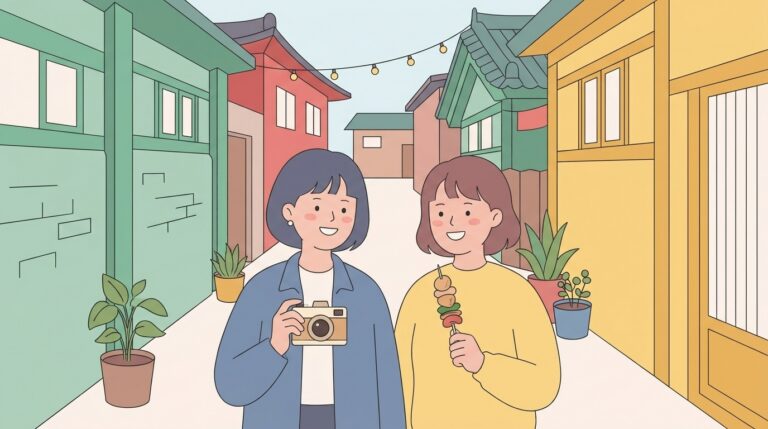
Resolving Travel Style Differences in Korea: Photos vs. Foodie Adventures
Phase 1: Empathy (Storytelling Opening)
안녕하세요! 매일한글 에디터입니다. (Hello! This is your Daily Hangul Editor.)
Picture this: You are standing in the vibrant, winding alleys of Seongsu-dong on a crisp Saturday afternoon. Your stomach is rumbling with the force of an earthquake—you have spent the last three weeks dreaming about a bubbling bowl of spicy gamjatang (pork backbone stew) at an iconic nearby diner. But just as you take two steps toward food bliss, your travel buddy freezes in front of a pastel-colored concept store: “Wait! The natural lighting here is unreal! Please take just 50 photos of me holding this tote bag!”
Your polite smile twitches. You love your friend, but your blood sugar is dropping faster than the Seoul subway during rush hour.
Traveling with close friends or partners is the ultimate friendship test, especially in South Korea where world-class photo aesthetic zones (insaengshot) and legendary food shrines (matjib) pull you in opposite directions at every intersection. Based on real classroom surveys from our B1 Daily Hangul community, the most frustrating challenge travelers face isn’t navigating Seoul’s subway system—it is learning how to negotiate travel styles comfortably in Korean without creating tense, awkward silence. Master today’s intermediate conversational strategies, and you will navigate compromises with total grace, ensuring both your friend’s camera roll and your appetite stay gloriously full!
Phase 2: Top 3 Core Expressions (Deep Dive)
1. 번갈아 가면서 하자 (Beon-ga-ra ga-myeon-seo ha-ja)
- Pronunciation: Beon-ga-ra ga-myeon-seo ha-ja (Sounds like: “Bun-gah-rah gah-myun-saw ha-jah”)
- Meaning: Literal: “Let’s do it while alternating.” | Real Nuance: “Let’s take turns doing what we each want.”
- K-Culture Moment: You will hear this constantly on Korean travel variety shows like Earth Arcade or Running Man whenever cast members must take turns completing missions or sharing food.
- Editor’s Insight: The connective ending
-면서expresses two simultaneous or linked continuous patterns. When paired with번갈아(in turns), it frames negotiation as a smooth, fair relay race rather than a painful sacrifice. - Situation Spectrum: Casual: ✅ | Semi-formal: ⚠️ (Use ‘번갈아 가면서 해요’) | Formal: 🚫
- 🤔 Think About It: In English, we often say “Let’s meet in the middle.” How does the Korean focus on taking turns (
번갈아) build active collaboration instead of cold arithmetic?
2. 이번엔 내가 맞춰 줄게 (I-beon-en nae-ga mat-chwo jul-ge)
- Pronunciation: I-beon-en nae-ga mat-chwo jul-ge (Sounds like: “Ee-bun-en nay-gah maht-chwo jool-geh”)
- Meaning: Literal: “This time, I will fit/adjust for you.” | Real Nuance: “I’ll roll with your plan this round!”
- K-Culture Moment: Seen in contemporary K-Dramas when two characters reach a sweet turning point after bickering over weekend plans.
- Editor’s Insight: The verb
맞추다means to calibrate, adapt, or match pieces together. Adding the auxiliary-아/어 주다(to do as a kind favor) indicates voluntary, warm generosity rather than grumpy surrender. - Situation Spectrum: Casual: ✅ | Semi-formal: ⚠️ (Use ‘이번엔 제가 맞춰 드릴게요’) | Formal: 🚫
- 🤔 Think About It: Notice the word
맞추다(to match/harmonize). Why do you think Korean friendship dynamics prefer the metaphor of fitting together like puzzle pieces?
3. 사이좋게 반반씩 하자 (Sa-i-jo-ke ban-ban-ssik ha-ja)
- Pronunciation: Sa-i-jo-ke ban-ban-ssik ha-ja (Sounds like: “Sah-ee-joh-kay bahn-bahn-sheek ha-jah”)
- Meaning: Literal: “Let’s do half-and-half peacefully.” | Real Nuance: “Let’s do fifty-fifty and keep things sweet!”
- K-Culture Moment: Think of ordering half-fried, half-seasoned chicken (ban-ban chicken). Korean culture loves the golden ratio of peaceful split decisions.
- Editor’s Insight: The adverb
사이좋게(amicably / on great terms) softens the numeric transaction of반반(half-half), turning what could feel like stubborn scorekeeping into warm bonding. - Situation Spectrum: Casual: ✅ | Semi-formal: ⚠️ (Use ‘사이좋게 반반씩 해요’) | Formal: 🚫
- 🤔 Think About It: Does your native tongue have a phrase that explicitly commands companionship while dividing time or tasks?
Phase 3: Textbook Korean vs. Real Korean
Situation 1: Suggesting photos first, then immediately heading to eat
- 📖 교과서 한국어 (Textbook): “우선 사진을 촬영하고 그 후에 식당에 갑시다.” (U-seon sa-jin-eul chwal-yeong-ha-go geu hu-e sik-dang-e gap-si-da. / “First let us photograph, and subsequently proceed to the dining hall.”)
- 🗣️ 진짜 한국어 (Real Native): “사진 먼저 후딱 찍고 바로 밥 먹으러 가자!” (Sa-jin meon-jeo hut-ttak jjik-go ba-ro bap meok-eu-reo ga-ja! / “Let’s snap your photos real quick and head straight to eat!”)
- 💡 왜 다를까? (Why the difference?): Native speakers use the punchy adverb
후딱(in a flash) and conversational verb찍다(to snap) rather than stiff Sino-Korean words like촬영하다.
Situation 2: Asking your friend if they are okay with going to your restaurant pick next
- 📖 교과서 한국어 (Textbook): “당신은 저의 음식점 선택에 동의하십니까?” (Dang-sin-eun jeo-ui eum-sik-jeom seon-taek-e dong-ui-ha-sip-ni-kka? / “Do you agree with my choice of dining establishment?”)
- 🗣️ 진짜 한국어 (Real Native): “이번엔 내 최애 맛집 가도 괜찮지?” (I-beon-en nae choe-ae mat-jib ga-do gwaen-chanh-ji? / “Is it cool if we hit my all-time favorite food spot this turn?”)
- 💡 왜 다를까? (Why the difference?): Using
당신(you) with friends feels hostile or overly formal in Korea. Replacing it with최애(ultimate bias / all-time favorite) builds instant shared excitement.
Phase 4: K-Culture Deep Dive & Non-Verbal Manners
4-1. 눈치 (Nunchi) & Body Gestures
- The Low-Angle Commitment Stance (매너 다리 / 열정 샷): If your companion loves photos, squatting low or bending your knees to make their legs look longer in the frame displays sincere cultural respect. Even if you are starving, putting genuine enthusiasm into their photos earns you immense goodwill.
- The Stomach-Patting “Nunchi Signal”: If you feel your hunger turning into irritability, do not roll your eyes or sigh. Lightly tap your belly with a playful pout and say, “나 슬슬 당 떨어져!” (Na seul-seul dang tteol-eo-jyeo! / “My blood sugar is dropping!”). It signals your physical limit gently.
- The Pinky Promise (약속!): When agreeing to split the afternoon between photo spots and restaurants, playfully link your pinky finger (
새끼손가락 걸기). It transforms negotiations into an endearing shared pact.
4-2. Cultural Code Analysis: 인생샷 (Insaengshot) vs. 금강산도 식후경
Korea has a legendary historic proverb: 금강산도 식후경 (Geum-gang-san-do sik-hu-gyeong), which translates to: “Even the breathtaking sights of Mount Geumgang can only be appreciated on a full stomach.” In contrast, modern Korean MZ travel culture prioritizes 인생샷 (In-saeng-syat), meaning “a once-in-a-lifetime photo.” The modern travel conflict is essentially ancient wisdom clashing with Instagram aesthetics. Acknowledging both desires as equally valid is the secret to drama-free Korean travel.
Phase 5: Real-Life Roleplay Scenario
- Setting: A sunlit alleyway in Yeonnam-dong packed with trendy dessert cafes.
- Characters:
- You (민우 / Minwoo): A passionate food lover whose stomach has been growling for 40 minutes.
- 지수 (Jisoo): Your travel buddy, an aspiring lifestyle creator clutching an iPhone on portrait mode.
지수 (Jisoo): 🎭 (Looking through the camera lens with sparkling eyes) 와, 민우야! 저기 담쟁이덩굴 벽 완전 대박이다! 저기서 딱 스무 장만 찍어주면 안 돼?
(Wa, Min-u-ya! Jeo-gi dam-jaeng-i-deong-gul byeok wan-jeon dae-bak-i-da! Jeo-gi-seo ttak seu-mu jang-man jjik-eo-ju-myeon an dwae? / “Wow, Minwoo! That ivy wall over there is incredible! Can you snap just twenty photos of me there?”)
민우 (You): 🎭 (Stomach grumbles audibly, smiles warmly but winces slightly) 사진은 진짜 예쁘겠다! 근데 지수야, 나 지금 뱃속에서 천둥 쳐.
(Sa-jin-eun jin-jja ye-ppeu-get-da! Geun-de Ji-su-ya, na ji-geum baet-sok-e-seo cheon-dung chyeo. / “The photo will look gorgeous! But Jisoo, thunder is literally roaring inside my stomach right now.”)
지수 (Jisoo): 🎭 (Giggles guiltily) 아, 진짜? 많이 배고파? 그래도 자연광이 지금 제일 좋은데…
(A, jin-jja? Man-i bae-go-pa? Geu-rae-do ja-yeon-gwang-i ji-geum je-il joh-eun-de… / “Ah, really? Are you that hungry? But the natural lighting is at its peak right now…”)
민우 (You): 🎭 (Offers an encouraging smile and raises two fingers) 그럼 우리 사이좋게 반반씩 하자! 딱 5분 동안 내가 인생샷 건져줄게.
(Geu-reom u-ri sa-i-jo-ke ban-ban-ssik ha-ja! Ttak o-bun dong-an nae-ga in-saeng-syat geon-jyeo-jul-ge. / “Then let’s split it fifty-fifty peacefully! I’ll capture your photo of a lifetime in exactly five minutes.”)
지수 (Jisoo): 🎭 (Surprised and excited) 진짜? 5분 만에 가능해?
(Jin-jja? O-bun man-e ga-neung-hae? / “Really? You can pull that off in five minutes?”)
민우 (You): 🎭 (Pretends to adjust professional camera lenses) 당연하지! 대신 사진 찍고 나면 이번엔 내가 찜해둔 칼국수 맛집으로 바로 뛰어가기다?
(Dang-yeon-ha-ji! Dae-sin sa-jin jjik-go na-myeon i-beon-en nae-ga jjim-hae-dun kal-guk-su mat-jib-eu-ro ba-ro ttwi-eo-ga-gi-da? / “Of course! But in exchange, once we’re done, we sprint straight to the knife-cut noodle spot I picked, deal?”)
지수 (Jisoo): 🎭 (Hooks her pinky happily) 콜! 서로 취향 번갈아 가면서 맞추니까 진짜 좋다. 얼른 찍고 먹으러 가자!
(Kol! Seoro chwi-hyang beon-ga-ra ga-myeon-seo mat-chu-ni-kka jin-jja joh-da. Eol-leun jjik-go meok-eu-reo ga-ja! / “Deal! Taking turns matching each other’s tastes feels so great. Let’s snap these fast and go eat!”)
민우 (You): 🎭 (Crouches down into the dedicated photographer stance) 좋아, 포즈 취해봐! 하나, 둘, 셋!
(Joh-a, po-jeu chwi-hae-bwa! Ha-na, dul, set! / “Awesome, strike a pose! One, two, three!”)
🔀 Interactive Decision Point
If Jisoo asks for another 20 minutes of photos after the agreed 5 minutes, what do you say?
- Option A: “아 진짜 짜증 나! 나 혼자 밥 먹으러 갈 테니까 혼자 찍어.” (I’m annoyed! I’m going to eat alone, take photos yourself.)
- ❌ Bad: Destroys group rapport and turns minor hunger into a vacation-ruining grudge.
- Option B: “아무 말도 안 하고 한숨 푹 쉬면서 억지로 100장 더 찍어준다.” (Say nothing, sigh deeply, and resentfully take 100 more photos.)
- ⚠️ Risk: Passive-aggressive toxicity. Korean nunchi culture will pick up your resentment immediately, ruining the vibe.
- Option C: “지수야, 약속한 5분 끝! 이제 내 배 채워줄 차례야, 당장 출발하자~” (Jisoo, our promised 5 minutes are up! Now it’s time to feed my belly, let’s head out now~)
- ✅ Best: Playful, firm, holds the agreed boundary with affection and humor.
Phase 6: 10-Second Emotional Shadowing Drill
Practice reading these out loud, pausing at the slashes (/) and channeling the emotional stage directions!
[😊 기쁘고 활기차게 / Bright & Upbeat]
“사진 먼저 / 후딱 예쁘게 찍고, / 우리 바로 맛집 가자! / 약속!”
(Sa-jin meon-jeo / hut-ttak ye-ppeu-ge jjik-go, / u-ri ba-ro mat-jib ga-ja! / Yak-sok! / Let’s snap photos quick and pretty first, / and head right to the food spot! / Promise!)-
[🥺 장난스럽게 배고픔을 호소하며 / Playfully Whining & Hungry]
“나 진짜 당 떨어져서 / 현기증 나거든? / 이번엔 나한테 / 맞춰 주라!”
(Na jin-jja dang tteol-eo-jyeo-seo / hyeon-gi-jeung na-geo-deun? / I-beon-en na-han-te / mat-chwo ju-ra! / My blood sugar dropped so hard / I’m getting dizzy, you know? / Please go along with me / this time!) -
[🤝 다정하고 단호하게 / Warm & Firmly Compromising]
“서로 취향 존중하면서 / 번갈아 가면서 즐기자. / 사이좋게 반반!”
(Seo-ro chwi-hyang jon-jung-ha-myeon-seo / beon-ga-ra ga-myeon-seo jeul-gi-ja. / Sa-i-jo-ke ban-ban! / Respecting each other’s tastes, / let’s enjoy by taking turns. / Peacefully fifty-fifty!)
Phase 7: K-Culture Mini Dictionary
- 인생샷 (In-saeng-syat) | Noun
- Literal: “Life shot.” Real meaning: The ultimate, picture-perfect photo of a lifetime worthy of being your profile banner forever. Used when complimenting someone’s photo: “이거 완전 인생샷이다!” (This is totally your life shot!).
- 맛집 투어 (Mat-jib Tu-eo) | Noun
- Literal: “Famous restaurant tour.” Real meaning: An itinerary meticulously plotted around acclaimed culinary institutions rather than monuments.
- 당 떨어지다 (Dang Tteol-eo-ji-da) | Idiom / Expression
- Literal: “Sugar is falling.” Real meaning: To become sluggish, lightheaded, or irritable due to an empty stomach (“hangry”). Universally excused in Korean social culture.
- 콜 (Kol) | Slang / Exclamation
- Origin: English poker term “Call.” Real meaning: “Deal!”, “I’m in!”, or “Sounds like a plan!” The ultimate casual acceptance response among friends.
Phase 8: Traveler’s Survival Kit
Top 3 Survival Expressions
- “저 배고파서 쓰러질 것 같아요!” (Jeo bae-go-pa-seo sseu-reo-jil geot gat-a-yo! / “I feel like I’m going to collapse from hunger!”)
- 💡 Pro Tip: Use this when you need an exaggerated, humorous excuse to stop an endless photoshoot instantly.
- “딱 한 장만 더 찍고 바로 이동해요.” (Ttak han jang-man deo jjik-go ba-ro i-dong-hae-yo. / “Let’s take just one more single photo and move immediately.”)
- 💡 Pro Tip: Sets a firm numerical limit before patience runs out.
- “각자 자유 시간 1시간 갖고 여기서 다시 만날까?” (Gak-ja ja-yu si-gan han-si-gan gat-go yeo-gi-seo da-si man-nal-kka? / “Shall we take one hour of solo free time and meet back here?”)
- 💡 Pro Tip: When preferences are completely irreconcilable, Korean friends often split up briefly to protect the friendship vibe.
Editor’s Travel Note: Apps & Navigation
Don’t let itinerary disputes ruin your trip. Plan food and photography spots cooperatively in advance using the [네이버 지도 앱 다운로드 (Download Naver Map App)] where you can create shared lists with color-coded markers (pink for photo spots, orange for diners). To bypass agonizing waiting lines at peak hours, download the [캐치테이블 실시간 맛집 예약 (CatchTable Real-time Restaurant Reservation App)] so your food is ready the minute your companion finishes snapping photos!
Phase 9: A Step Deeper (Reflective Thinking)
In Western traveling culture, radical individual autonomy is frequently prioritized—travelers readily split up for the entire day if tastes diverge. However, in Korean culture, travel is anchored in the collective spirit of 우리 (U-ri – We / Us). The shared memory of dining together and celebrating an experience together is considered far more precious than checking off a personal bucket list alone. When you learn to alternate (번갈아 가면서) rather than simply walking away, you are stepping directly into the heart of Korean relational warmth (정, Jeong).
💬 Your Turn: Have you ever experienced a travel conflict where your friend wanted aesthetic photos while you were dying of hunger? How did you resolve it in your native language?
Phase 10: FAQ & Common Mistakes
Q: Can I use “내 말대로 해” (Do as I say) when I am really hungry?
A: Absolutely avoid this! 내 말대로 해 sounds aggressive, dictatorial, and rude among friends. Instead, opt for the charming intermediate phrase: 이번엔 내 소원 들어주라! (Please grant my wish this time!).
Q: What is the difference between ‘번갈아’ and ‘교대로’?
A: 번갈아 is used organically in daily conversational speech between friends for informal sharing (e.g., sharing turns choosing restaurants). 교대로 is more formal and systematic, frequently used for work shifts or scheduled duty rotations.
Q: Is it considered impolite to suggest separate solo time during a trip in Korea?
A: Not anymore! Among younger generations (MZ generation), suggesting 따로 또 같이 (separately yet together) for an hour or two is widely respected as healthy emotional hygiene during vacations.
🚨 Common Mistakes Board
- ❌ Mistake 1: Calling your friend
당신(Dang-sin) to translate “You should choose next.”- Correct Action: Omit the pronoun entirely or say their name followed by
-아/야(e.g.,지수야, 다음엔 네가 골라!).
- Correct Action: Omit the pronoun entirely or say their name followed by
- ❌ Mistake 2: Saying
참으세요(Please endure it) to a hungry friend.- Correct Action: Never tell a hungry Korean companion to just “endure.” Acknowledge it immediately:
얼른 밥 먹으러 가자!(Let’s hurry and eat!).
- Correct Action: Never tell a hungry Korean companion to just “endure.” Acknowledge it immediately:
- ❌ Mistake 3: Using dry formal grammar like
동의합니다(I agree) during casual friend banter.- Correct Action: Keep it natural and casual by shouting
콜!(Deal!) or좋아!(Sounds great!).
- Correct Action: Keep it natural and casual by shouting
Phase 11: Action Missions
- 🥉 Bronze Mission (Solo Vocal Drill): Practice the shadowing drill from Phase 6 three times while looking in the mirror, exaggerating your facial expressions.
- 🥈 Silver Mission (Social Connection): Send a message to your upcoming travel buddy in Korean: “이번 한국 여행은 서로 취향 맞춰주면서 재미있게 놀자!” (Let’s have fun matching each other’s tastes on this Korea trip!).
- 🥇 Gold Mission (Real-Life Application): The next time you visit a Korean restaurant or cafe with a friend, use
반반씩 하자(Let’s do half-and-half) when deciding on dishes to share! - 🎮 K-Culture Mission: Watch an episode of a Korean travel vlog (like Pungja’s Ttogan-jip or Battle Trip) and listen for how often cast members use the word
맛집vs인생샷.
Phase 12: Interactive Quiz Challenge
1. Situation Judgment: Your friend has been taking photos in front of a mural for 15 minutes and you are ravenous. Which phrase best strikes a smooth compromise?
* a) “사진 그만 찍어, 진짜 질린다.”
* b) “사진 3분만 더 찍고, 바로 내가 찾은 맛집으로 이동하자! 콜?”
* c) “당신은 식당에 가야만 합니다.”
2. Fill in the Blank: Fill in the missing B1 connector to mean “taking turns matching”:
* “서로 취향을 번갈아 가_____ 맞춰 주기로 했어요.”
3. True or False: In Korea, telling your travel partner “나 슬슬 당 떨어져” (My sugar is dropping) is considered an offensive insult.
* (True / False)
👉 Click to reveal answers & explanations!
- Answer: b) Option B establishes an affectionate time limit, validates their hobby, and transitions straight to food using friendly conversational Korean.
- Answer: -면서 (
번갈아 가면서= while alternating turns). - Answer: False! It is an adorable and universally understood way to declare that hunger is arriving without sounding aggressive.







