

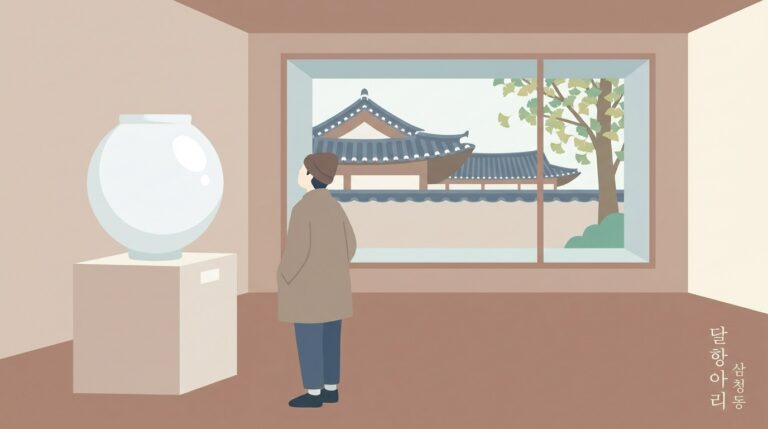
Beyond Pretty: How to Critique Korean Art and Architecture Like a Seoul Insider
Phase 1: 공감 (Story-Driven Opening)
안녕하세요! 매일한글 에디터입니다. (Hello! I’m your Daily Hangul editor.)
Picture this: You are standing inside the sunlit rotunda of the National Museum of Modern and Contemporary Art (MMCA) in Seoul, or perhaps wandering through an avant-garde gallery tucked away in the alleyways of Samcheong-dong. In front of you is a monolithic installation made of scorched cedar and crushed granite. You turn to your Korean friend, an art enthusiast, or an architect colleague whose aesthetic opinion you deeply respect. You feel a brilliant surge of thoughts—you want to discuss how the raw materials contrast with the minimalist gallery space, or how the piece deconstructs traditional notions of harmony.
Yet, the only words that seem to surface from your tongue are: “와, 진짜 예뻐요!” (Wa, jinjja yeppeoyo! / Wow, it’s really pretty!) or “엄청 멋있네요” (Eomcheong meosinneyo / It’s really cool).
Your companion smiles politely and nods, but the conversation immediately stalls. That familiar pang of frustration hits: you have a sophisticated C1-level mind in your native language, but in Korean, you sound like a middle school tourist on their first field trip. Art in Korea is no longer just a passive weekend hobby; from the ‘RM effect’ to the bustling Seoul Art Week and Frieze Seoul, cultural criticism has become a vibrant social currency among young professionals and creatives. Drawing from our feedback sessions with over 300 advanced learners and curators, this guide will equip you with authentic, razor-sharp critical vocabulary to articulate form, context, and aesthetic discourse like a true Seoulite cultural insider.
Phase 2: 핵심 표현 3선 심층 분석 (Core Critical Expressions)
1. 여백의 미가 돋보여요 (Yeobaek-ui mi-ga dotboyeoyo)
- Pronunciation: [Yeo-baek-ui mi-ga dot-bo-yeo-yo] (Think: “yaw-beck-wee mee-gah doht-boh-yaw-yoh”)
- Meaning: Literal: “The beauty of blank space stands out.” | Actual Nuance: “The intentional restraint and negative space create a powerful contemplative aesthetic.”
- K-Culture Moment: Seen frequently in art documentaries or when aesthetic lifestyle influencers and idols (such as RM from BTS) post monochrome paintings by Dansaekhwa masters like Park Seo-Bo or Lee Ufan.
- Editor’s Insight: 여백 (Yeobaek) is not simply “empty space” or “wasted room.” In Korean aesthetic philosophy, what is left unpainted or unfilled is dynamic; it breathes life into what is present. Saying this highlights that you recognize deliberate absence as an active artistic choice.
- Situation Spectrum: Casual ⚠️ | Semi-formal ✅ | Formal ✅
- 🤔 Think About It: While Western modernism often focuses on the “composition of forms” (what occupies space), traditional Korean aesthetics value the “resonance of void.” How does your culture view negative space?
2. 조형적 긴장감이 느껴져요 (Johyeongjeok ginjanggam-i neukkyeojyeoyo)
- Pronunciation: [Jo-hyeong-jeok gin-jang-gam-i neu-kkyeo-jyeo-yo] (Think: “joh-hyung-jawk geen-jahng-gahm-ee new-kkyaw-jyaw-yoh”)
- Meaning: Literal: “I feel sculptural/formal tension.” | Actual Nuance: “The visual balance, sharp angles, or structural juxtaposition create an engaging, palpable friction.”
- K-Culture Moment: Widely used by design critics in architectural reviews of contemporary Seoul landmarks, such as Dongdaemun Design Plaza (DDP) or Amorepacific Headquarters.
- Editor’s Insight: 조형 (Johyeong) refers to the shaping, plastic art, or formal construction of an object, while 긴장감 (Ginjanggam) conveys dramatic tension. This expression immediately upgrades you from a casual gallery visitor to an analytical critic who perceives the physical forces at play within a structure.
- Situation Spectrum: Casual ⚠️ | Semi-formal ✅ | Formal ✅
- 🤔 Think About It: In English, we often say a piece “has dynamic balance.” Does “tension” (긴장감) carry a positive or negative connotation in your native language?
3. 맥락을 전복시키는 시도예요 (Maengnageul jeonboksikineun sidoyeyo)
- Pronunciation: [Maeng-nak-eul jeon-bok-si-ki-neun si-do-ye-yo] (Think: “meng-nah-keul jawn-bok-shee-kee-noon shee-doh-yay-yoh”)
- Meaning: Literal: “It is an attempt to overturn the context.” | Actual Nuance: “This work subversive; it deliberately deconstructs and challenges institutional or historical narratives.”
- K-Culture Moment: Common in contemporary performance art reviews, experimental indie theater, or politically charged Biennale installations.
- Editor’s Insight: 전복시키다 (Jeonboksikida) literally means to capsize or overthrow. When applied to cultural discourse, it signals a high degree of critical literacy, indicating that you understand both the dominant historical context and the artist’s provocative subversion.
- Situation Spectrum: Casual 🚫 | Semi-formal ✅ | Formal ✅
- 🤔 Think About It: Why does Korean criticism favor structural and sociological terms like 맥락 (context) and 전복 (subversion) over simple emotive adjectives like 충격적이다 (shocking)?
Phase 3: 교과서 한국어 vs 진짜 한국어 (Textbook vs. Real Critical Korean)
Situation 1: Discussing surface finish and material properties
- 📖 교과서 한국어: “이 작품은 색채와 재료가 아주 아름답습니다.” (I jakpumeun saekchaewa jaeryoga aju areumdapseumnida. / “The colors and materials of this artwork are very beautiful.”)
- 🗣️ 진짜 한국어: “물성이 주는 아우라가 정말 압도적이네요.” (Mulseong-i juneun auraga jeongmal apdojeogineyo. / “The sheer physical presence and raw materiality of this piece are overwhelming.”)
- 💡 왜 다를까? Educated Korean speakers rarely reduce physical materials to 재료 (ingredients/supplies). Instead, they use 물성 (materiality/inherent physical properties), focusing on how the tangible qualities evoke an aura.
Situation 2: Discussing ambiguous or conceptual artworks
- 📖 교과서 한국어: “작가의 의도를 이해하기가 참 어렵네요.” (Jakgaui uidoreul ije-hagiga cham eoryeomneyo. / “It is very difficult to understand the artist’s intention.”)
- 🗣️ 진짜 한국어: “관객에게 해석의 여지를 활짝 열어둔 작업 같네요.” (Gwangaek-ege haeseogui yeojireul hwaljjak yeoreodun jageop gannéyo. / “It feels like a piece that intentionally leaves the interpretive field wide open for the viewer.”)
- 💡 왜 다를까? Admitting incomprehension can sound naive. Reframing ambiguity as 해석의 여지 (room for interpretation) demonstrates respect for conceptual open-endedness.
Phase 4: K-Culture 딥다이브 & 비언어적 매너 (Non-Verbal Art Etiquette)
4-1. 눈치 (Nunchi) & Gallery Demeanor
- The Gallery Stance: In Korean galleries, do not stand nose-to-canvas immediately. Step back at least two meters, clasp your hands lightly behind your back or at waist height, and tilt your head slightly. This non-verbal posture signals deep contemplation rather than casual inspection.
- The Whispered Consensus: Koreans observe strict 정숙 (jeongsuk – quietness) in exhibition halls. If you wish to comment, lean in and use a soft, low register. Never point directly at a canvas with an outstretched finger; instead, use an open palm gesturing gently toward the area of interest.
4-2. The Cultural Phenomenon: Art as Identity for Young Korea
In contemporary Seoul, visiting galleries is an expression of cultivated taste (취향). The explosion of art-fair culture (such as Frieze Seoul) and curated spaces like the Leeum Museum of Art has turned aesthetic critique into an essential part of social discourse among young professionals. Demonstrating that you can engage with 담론 (discourse) rather than just snapping an Instagram photo elevates you instantly from tourist to intellectual confidant.
Phase 5: 실전 롤플레이 시나리오 (Real-Life Roleplay)
- Location: A contemporary solo exhibition opening at a gallery in Bukchon, Seoul.
- Character: Min-su (큐레이터 민수), an intellectual and insightful indie gallery curator.
- 민수: “이번 전시는 전통 한옥의 구조적 특징을 현대적으로 재해석한 설치 작업 위주예요. 어떠세요?” (Ibeon jeonsineun jeontong hanogui gujojeok teukjingeul hyeondaejeogeuro jaehaeseokan seolchi jageop wiju-yeyo. Eotteoseyo? / “This exhibition focuses on installation work that reinterprets traditional Hanok structures from a modern perspective. What do you think?”)
- 나:
🎭 (턱을 가볍게 매만지며 작품을 천천히 둘러본다)“기둥과 보가 교차하는 지점에서 조형적 긴장감이 팽팽하게 느껴지네요.” (Gidunggwa boga gyocha-haneun jijeom-eseo johyeongjeok ginjanggam-i paengpaenghage neukkyeojineyo. / “I sense a tight formal tension at the intersection of the pillars and crossbeams.”) - 민수: “정확히 보셨네요! 특히 저 거친 질감의 한지와 콘크리트 패널 조합은 어떻게 다가오나요?” (Jeonghwaki bosyeonneyo! Teukhi jeo geochin jilgamui hanjiwa kongkeuriteu paeneol johabeun eotteoke dagaonayo? / “You saw right through it! How does that combination of rough-textured hanji paper and concrete panels strike you?”)
- 나:
🎭 (한 발짝 뒤로 물러서며 조용히 감탄사를 흘린다)“이질적인 재료들이 맞물리면서 물성이 주는 아우라가 극대화되는 것 같아요.” (Ijiljeogin jaeryodeuri manmullimyeonseo mulseong-i juneun auraga geukdaehwadoeneun geot gat-ayo. / “As heterogeneous materials interlock, the aura generated by their materiality seems completely amplified.”) - 민수: “맞아요. 과거와 현대의 대립을 나타내죠. 그런데 일각에서는 이 공간 배치가 너무 난해하다는 평도 있어요.” (Maj-ayo. Gwagowa hyeondaeui daeribeul natanaejyo. Geureonde ilgak-eseoneun i gonggan baechiga neomu nanhaehadaneun pyeongdo isseoyo. / “Exactly. It represents the collision of past and present. Yet, some critics argue this spatial layout is overly esoteric.”)
- 나:
🎭 (고개를 끄덕이며 차분한 미소를 짓는다)“하지만 오히려 관객에게 해석의 여지를 열어두어 사유의 깊이를 더해주는 훌륭한 시도 아닐까요?” (Hajiman ohiryeo gwangaek-ege haeseogui yeojireul yeoreodueo sayuui gipireul deohaejuneun hullyunghan sido anilkkayo? / “But shouldn’t we see it as a splendid attempt that leaves room for interpretation, thereby deepening the viewer’s contemplation?”) - 민수:
🎭 (눈을 반짝이며 깊이 공감한다)“와, 작가의 내면적 의도를 정말 섬세하게 꿰뚫어 보시네요!” (Wa, jakgaui naemyeonjeok uidoreul jeongmal seomsehage kkwettulheo bosineyo! / “Wow, you truly see through to the artist’s inner intent with such sensitivity!”) - 나: “한국 전통 건축의 차경(借景) 개념이 현대 미술과 만났을 때 생기는 담론이 참 흥미진진합니다.” (Hanguk jeontong geonchugui chagyeong gaenyeomi hyeondae misulgwa mannasseul ttae saenggineun damnoni cham heungmijinjinhamnida. / “The discourse created when the traditional Korean concept of ‘borrowed scenery’ intersects with contemporary art is truly fascinating.”)
🔀 인터랙티브 분기점 (Interactive Choice)
How would you react if Min-su asked you about the empty center of the exhibition hall?
* Choice A: “너무 텅 비어 있어서 좀 썰렁하고 아쉬운데요?” (Neomu teong bieo isseoseo jom sseolleonghago aswiundeyo? / “It’s completely empty, so it feels a bit desolate and disappointing, doesn’t it?”)
* ➡️ Feedback (Bad): Reduces intentional negative space to an accidental void. Sounds unprepared for critical discourse.
* Choice B: “이 비어 있는 공간이 작품 간의 맥락을 연결하며 여백의 미를 탁월하게 살려내네요.” (I bieo inneun gonggani jakpum ganui maengnageul yeongyeolhamyeo yeobaek-ui mireul tagwolhage sallyeonaeneyo. / “This void connects the contexts between works and brilliantly brings out the aesthetic of negative space.”)
* ➡️ Feedback (Best!): Professional, insightful, and perfectly matches the vocabulary of an art critic.
* Choice C: “미완성인 것 같은데, 작가가 시간에 쫓겼나 봐요.” (Miwansong-in geot gateunde, jakgaga sigane jjotgyeonna bwayo. / “It looks unfinished; the artist must have run out of time.”)
* ➡️ Feedback (Risk): Humorous among close friends, but overly cynical during an opening. You risk offending the curator.
Phase 6: 10초 감정 섀도잉 드릴 (10-Second Emotion Shadowing Drill)
- Line 1:
[🤔 사색적이고 나지막하게 - Contemplative and low-toned]- “기둥과 보가 교차하는 지점에서 / 조형적 긴장감이 / 팽팽하게 느껴져요.”
- (Gidunggwa boga gyocha-haneun jijeom-eseo / johyeongjeok ginjanggam-i / paengpaenghage neukkyeojyeoyo.)
- Line 2:
[✨ 감탄하며 통찰력 있게 - Insightfully admiring]- “이질적인 재료들이 맞물리며 / 물성이 주는 아우라가 / 정말 압도적이네요.”
- (Ijiljeogin jaeryodeuri manmullimyeo / mulseong-i juneun auraga / jeongmal apdojeogineyo.)
- Line 3:
[🏛️ 지적이고 설득력 있게 - Intellectual and persuasive]- “관객에게 해석의 여지를 열어두어 / 사유의 깊이를 더해주는 / 흥미로운 작업입니다.”
- (Gwangaek-ege haeseogui yeojireul yeoreodueo / sayuui gipireul deohaejuneun / heungmiroun jageop-imnida.)
Phase 7: K-Culture 미니 사전 (Critique Mini Dictionary)
- 물성 (Mulseong) | Materiality / Physical Essence
- The raw, inherent physical character of a material (stone, metal, paper, soil). Used in art discourse to describe the sensory weight or tangible reality of the medium.
- 차경 (Chagyeong) | Borrowed Scenery
- A traditional Korean architectural concept where an interior frame (window, door, courtyard) “borrows” the surrounding natural landscape rather than creating artificial barriers.
- 담론 (Damnon) | Discourse
- A structured, critical debate or thematic conversation surrounding art, philosophy, or society. e.g., “현대 미술의 새로운 담론을 형성하다” (Forming a new discourse in contemporary art).
- 결 (Gyeol) | Grain / Texture of Spirit & Form
- Originally the grain of wood or fabric; conceptually, it refers to the inner rhythm, texture, or poetic temperament of a person, artwork, or tradition.
Phase 8: 여행자를 위한 생존 키트 (Traveler’s Cultural Survival Kit)
Survival Expressions TOP 3
- “도슨트 해설은 몇 시에 시작하나요?” (Doseunteu haeseoreun myeot sie sijakanayo? / What time does the docent tour begin?)
- Pro Tip: Korean docent tours at major museums are usually free and packed with high-level conceptual insights.
- “이 전시 사진 촬영 가능한가요?” (I jeonsi sajin chwaryeong ganeunghangayo? / Is photography permitted in this exhibition?)
- Pro Tip: Contemporary galleries often permit silent photography (using live mode or silent camera apps), but flashes and tripods are strictly prohibited.
- “도록은 어디서 구매할 수 있나요?” (Dorogeun eodiseo gumaehal su innayo? / Where can I purchase the exhibition catalogue?)
- Pro Tip: Catalogues (도록 – dorok) often contain critical essays (서문/비평문) that serve as goldmines for advanced C1 reading.
Editor’s Travel Note
For navigation and seamless entry, download the 네이버 지도 앱 다운로드 to find hidden independent art spaces around Samcheong-dong, Seochon, and Hannam-dong. For major exhibitions at state museums, use the 국립현대미술관 모바일 가이드 앱 다운로드 to stream multilingual scholarly audio commentaries straight to your earphones.
Phase 9: “한 발 더 깊이” (Cultural Insights)
Korean aesthetics rarely attempt to overpower the viewer. Unlike monumental traditions that dominate landscape through grandeur, Korean architecture and traditional art operate on the premise of 순응 (Sun-eung: natural adaptation) and 비움 (Bium: emptying). When an architect designs a window to frame a mountain peak (차경), or when a Dansaekhwa painter repeats thousands of faint pencil strokes on raw hanji, the goal is not to assert ego, but to open up a meditative threshold. Learning Korean critical vocabulary requires internalizing this quiet confidence—where simplicity is not lack of skill, but the highest refinement of thought.
💬 Your Turn: Which aesthetic principle resonates more with you: dynamic formal tension or the stillness of empty space? Share your thoughts below using today’s vocabulary!
Phase 10: FAQ & 흔한 실수 (FAQ & Error Prevention)
Q: Can I use “여백의 미” when talking about modern minimalist interior design or coffee shops?
A: Absolutely! It is frequently used by Koreans to praise cafés that prioritize spaciousness and minimalist concrete over crowded seating.
Q: What is the difference between 재료 (materials) and 물성 (materiality)?
A: 재료 refers strictly to the objective components (e.g., “wood, paint, nails”), while 물성 delves into the aesthetic, tactile, and expressive nature of those materials interacting with space.
Q: Is the word ‘비평’ (critique) considered negative or aggressive in Korean?
A: Not at all in an intellectual context. While ‘비난’ (binan) means personal condemnation or fault-finding, 비평 (bi-pyeong) denotes scholarly, constructive analysis and aesthetic judgment.
🚨 흔한 실수 (Common Mistakes TOP 3)
- Calling negative space “빈자리” (Binjari): 빈자리 usually refers to an empty passenger seat or an unfilled job opening! In art, always use 여백 (Yeobaek).
- Using “이상해요” (It’s strange) for challenging conceptual art: While conversational, it sounds dismissive. Instead, say “작품이 상당히 실험적이네요” (The piece is quite experimental).
- Translating “Tension” as ‘스트레스’ (Stress): When describing visual energy between forms, never say ‘스트레스.’ Use 조형적 긴장감 (Johyeongjeok ginjanggam).
Phase 11: 액션 미션 & 참여 유도 (Action Missions)
- 🥉 Bronze Level: Whisper the 3 shadowing sentences from Phase 6 looking in the mirror, paying close attention to contemplative facial pacing.
- 🥈 Silver Level: Choose an image of your favorite artwork or building, post it to social media, and write a 1-sentence Korean critique using 물성 or 여백의 미.
- 🥇 Gold Level: Visit a local museum or take a virtual gallery tour of MMCA online, and share a 3-sentence Korean critique in our comments section below!
- 🎮 K-Culture Mission: Watch RM’s art museum vlogs or an interview with an architect on YouTube; write down every time they use the words 맥락, 물성, or 결!
Phase 12: 인터랙티브 퀴즈 챌린지 (Interactive Quiz)
- [상황 판단] When a gallery curator asks for your thoughts on an unadorned white wall framing a single unglazed ceramic jar, what is the most sophisticated response?
- (A) “벽이 너무 하얘서 페인트를 더 칠해야 할 것 같아요.”
- (B) “소박한 도자기와 빈 벽면이 어우러져 여백의 미가 돋보이네요.”
- (C) “작품 수가 너무 적어서 티켓 값이 아까워요.”
- [빈칸 채우기] 다음 빈칸에 가장 알맞은 비평 용어를 고르세요.
- “이 조각품은 묵직한 쇳덩어리와 투명한 유리가 맞물리며 독특한 (_____)적 긴장감을 만들어냅니다.”
- [True / False] In Korean culture, calling an exhibition layout “해석의 여지가 많다” is an insult implying the artist was lazy.
- (True / False)
👉 Click here to reveal the answers and explanations!
- 정답: (B)
- 해설: (B) accurately praises the intentional negative space (여백의 미) and harmonious simplicity, whereas (A) and (C) are casual, uncritical reactions.
- 정답: 조형 (Johyeong)
- 해설: Combined with ‘적 긴장감’, 조형적 긴장감 denotes the sculptural and formal visual friction between conflicting materials.
- 정답: False
- 해설: Praising a work for having “해석의 여지” (room for interpretation) is a high compliment in contemporary art discourse, honoring openness and audience agency.
- 해설: Praising a work for having “해석의 여지” (room for interpretation) is a high compliment in contemporary art discourse, honoring openness and audience agency.







