

Phase 1: Empathy & Story Immersion
안녕하세요! It is your Daily Hangul editor, your trusted Korean culture navigator. Imagine this scene straight out of the acclaimed workplace K-drama Misaeng (Incomplete Life): It is Monday morning, 9:00 AM. Your coffee is barely touched when an urgent notification rings across the office. A manufacturing defect was detected on 3,000 units of your client’s flagship product, and the entire shipment deadline is compromised. Your client is rightfully panicked, their tone on the phone freezing cold, demanding answers and threatening to cancel the partnership.
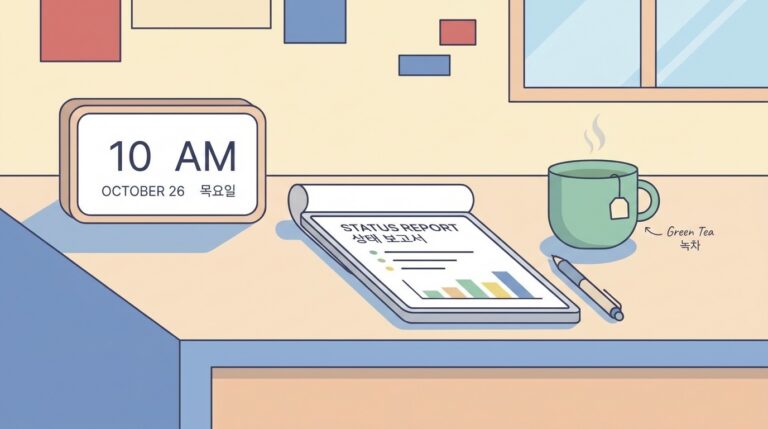
In Korean corporate culture, crises happen, but how you react determines whether you earn lifetime loyalty or lose the account forever. Instead of making excuses or going silent, you implement a lifeline strategy: scheduling a real-time production and shipment status briefing every single morning at exactly 10:00 AM. Sharing progress systematically transforms client anxiety into renewed trust. Today, based on real corporate training feedback, we will learn how to draft impeccable corrective action emails, master formal crisis management vocabulary, and communicate with the poise of a seasoned Korean trade specialist.
Phase 2: Key Expressions Deep Dive
1. 매일 오전 10시에 공정 진행률을 실시간으로 공유해 드리겠습니다.
- Pronunciation: [Mae-il o-jeon yeol-si-e gong-jeong jin-haeng-nyul-eul sil-si-gan-eu-ro gong-yu-hae deu-ri-get-seum-ni-da] (Sounds like: “May-il oh-jeon yull-she-eh gong-jung jean-hang-nyool-ool sheel-she-gahn-oo-ro gong-yoo-hay doo-ree-get-soom-nee-dah”)
- Meaning: Literal: “I will share the process progress rate in real-time every morning at 10 AM.” | Real Nuance: “We are taking absolute ownership of this recovery process and will give you daily, predictable peace of mind.”
- K-Culture Moment: Seen in corporate thrillers like Agency or Search: WWW when an account executive stabilizes a furious corporate client during an executive crisis committee.
- Editor’s Insight: Notice the humble auxiliary verb 드리겠습니다 (deurigessseumnida) instead of 하겠습니다 (hagesseumnida). In Korean business, you never simply ‘do’ something for a client; you ‘offer’ the action humbly upward.
- Situation Spectrum: Casual: 🚫 | Semi-formal: ⚠️ | Formal: ✅
- 🤔 Think About It: Why does specifying a precise time (오전 10시) carry more psychological reassurance in Korean business culture than simply saying ‘자주’ (frequently)?
2. 납기 지연으로 심려를 끼쳐 드려 진심으로 송구스럽습니다.
- Pronunciation: [Nap-gi ji-yeon-eu-ro sim-ryeo-reul kki-chyeo deu-ryeo jin-sim-eu-ro song-gu-seu-reop-seum-ni-da] (Sounds like: “Nahp-ghee jee-yone-oo-ro sheem-ryuh-rool kee-chhyuh doo-ryuh jean-sheem-oo-ro song-goo-soo-rop-soom-nee-dah”)
- Meaning: Literal: “I am truly apologetic for causing worry due to the delivery delay.” | Real Nuance: “We acknowledge the gravity of our mistake and express deep, respectful regret for the disruption caused to your schedule.”
- K-Culture Moment: The signature opening line of formal press conferences or high-stakes B2B corrective action letters in Korean business dramas.
- Editor’s Insight: For B2 level learners, replace everyday apologies like 죄송합니다 (joesonghamnida) with 송구스럽습니다 (songguseureopseumnida) in written dispute communications. It conveys the deepest level of professional remorse.
- Situation Spectrum: Casual: 🚫 | Semi-formal: ⚠️ | Formal: ✅
- 🤔 Think About It: How does acknowledging someone’s ‘worries’ (심려) shift the focus from the technical glitch to the emotional impact on the human counterpart?
3. 재발 방지 대책 및 시정조치 계획서를 송부해 드립니다.
- Pronunciation: [Jae-bal bang-ji dae-chaek mit si-jeong-jo-chi gye-hoek-seo-reul song-bu-hae deu-rim-ni-da] (Sounds like: “Jay-bahl bahng-jee day-check meet she-jung-jo-chee gyeh-hwek-suh-rool song-boo-hay doo-reem-nee-dah”)
- Meaning: Literal: “I am sending the recurrence prevention countermeasure and corrective action plan.” | Real Nuance: “Here is our structured, irreversible roadmap proving that this error will never occur again.”
- K-Culture Moment: The climactic document handed across the mahogany boardroom table in Misaeng that turns a contract termination into an approved restart.
- Editor’s Insight: In written B2B correspondence, avoid using the casual 보내드립니다 (bonaedeurimnida). Instead, use 송부해 드립니다 (songbuhae deurimnida), a refined Sino-Korean term tailored for contracts, reports, and official attachments.
- Situation Spectrum: Casual: 🚫 | Semi-formal: ⚠️ | Formal: ✅
- 🤔 Think About It: In your home culture, is a corrective action plan usually delivered simultaneously with an apology, or after an investigation period?
Phase 3: Textbook Korean vs. Real Korean
Situation 1: Explaining that the issue is currently being resolved
- 📖 교과서 한국어 (Textbook Korean): 문제를 지금 고치고 있습니다. (Munjereul jigeum gochigo itseumnida. – “I am fixing the problem right now.”)
- 🗣️ 진짜 한국어 (Real Korean): 원인 규명 후 재생산 공정에 즉시 착수하였습니다. (Won-in gyumyeong hu jaesaengsan gongjeong-e jeuksi chaksuhayeotseumnida. – “Having verified the root cause, we immediately initiated the reproduction process.”)
- 💡 왜 다를까? (Why is it different?): In high-stakes business environments, vague verbs like 고치다 (to fix) sound immature and reactive. Sophisticated business vocabulary like 착수하다 (to initiate/embark upon) reassures clients of methodical, enterprise-level competency.
Situation 2: Promising to update the client regularly
- 📖 교과서 한국어 (Textbook Korean): 진행 상황을 자주 알려드릴게요. (Jinhaeng sanghwang-eul jaju allyeodeurilgeyo. – “I will let you know the progress often.”)
- 🗣️ 진짜 한국어 (Real Korean): 매일 오전 정기 브리핑을 통해 공정 현황을 투명하게 공유해 드리겠습니다. (Mae-il ojeon jeonggi beuriping-eul tonghae gongjeong hyeonhwang-eul tumyeonghage gong-yuhae deurigessseumnida. – “We will transparently share the process status via regular daily morning briefings.”)
- 💡 왜 다를까? (Why is it different?): In Korean corporate culture, ambiguity creates extreme anxiety. Promising transparent, scheduled disclosure (정기 브리핑, 투명하게) demonstrates proactive accountability.
Phase 4: K-Culture Deep Dive & Non-Verbal Manners
4-1. 눈치 (Nunchi) & Gestures: Restoring Client Trust
When addressing quality defects or shipping setbacks in Korea, non-verbal cues carry as much weight as written documents:
* The 45-Degree Bow of Responsibility: If meeting the client in person, perform a deliberate 45-degree bow (정중한 인사, jeongjunghan insa) before taking your seat. Keep your hands neatly clasped in front of your navel (gongsu, 공수 자세).
* Proactive Transparency (선제적 대응): Never wait for an upset client to call you first. Korean business professionals practice nunchi by anticipating client dread. Sending your update email at 09:59 AM, right before the promised 10:00 AM mark, signals utmost dedication.
* Two-Handed Document Submission: When handing over an official corrective action plan (sijeongjochiseo), always present the paper with both hands, lightly tilting it toward the client so they can immediately read the heading.
4-2. Cultural Code: The Sacred Value of 신뢰 (Sinroe – Trust)
In Western contract negotiations, penalties are strictly defined by clauses and damages. However, in Korea, corporate collaboration relies heavily on 신뢰 (sinroe, mutual business trust). A single delay can shatter this bond because your counterpart must report upward to their own team leader (timjangnim) and executive director (sangmunim). When you provide daily updates at 10 AM, you are not just updating software numbers; you are arming your Korean counterpart with defensive data so they do not face reprimand from their superiors. By saving their face (che-myeon, 체면), you turn a crisis into an enduring alliance.
Phase 5: Real-World Roleplay Scenario
- Setting: Conference Room B at Hanil Electronics Headquarters in Seoul. Team Leader Choi (최 팀장), a meticulous and stern client manager, sits across from Alex, an operations lead resolving a sudden circuit board delay.
Turn 1
* 최 팀장: 알렉스 매니저님, 이번 납품 지연 건으로 우리 생산 라인까지 멈추게 생겼습니다. 어떻게 책임지실 겁니까?
* (Alex maenijeonim, ibeon nap-pum ji-yeon geon-euro uri saengsan rain-kkaji meomchuge saenggyeotseumnida. Eotteoke chaegimjisil geomnikka?)
* “Manager Alex, this delivery delay is about to halt our entire assembly line. How do you intend to take responsibility for this?”
* 🎭 [팔짱을 끼고 굳은 표정으로 서류를 내려놓으며] (Crossing arms and setting down the documents with a stern expression)
Turn 2
* 알렉스: 팀장님, 예기치 못한 불량으로 큰 차질을 빚게 하여 머리 숙여 사과드립니다.
* (Timjangnim, yegichi mothan bulryang-euro keun chajil-eul bitge haye meori sugyeo sagwadeurimnida.)
* “Team Leader Choi, I bow my head in apology for causing significant disruption due to this unexpected defect.”
* 🎭 [정중하게 상체를 30도 이상 숙이며 엄숙한 어조로] (Bowing the upper body over 30 degrees politely with a solemn tone)
Turn 3
* 최 팀장: 사과만으로 해결될 문제가 아닙니다. 당장 재공정 일정은 어떻게 됩니까?
* (Sagwaman-euro haegyeoldoel munjega animnida. Dangjang jaegongjeong iljeong-eun eotteoke doemnikka?)
* “An apology alone will not resolve this. What is the immediate timeline for the reproduction process?”
* 🎭 [눈살을 찌푸리며 시계를 확인한다] (Frowning slightly while glancing at his wristwatch)
Turn 4
* 알렉스: 네, 원인 분석을 마친 후 어젯밤 전량 재생산에 긴급 착수했습니다.
* (Ne, won-in bunseok-eul machin hu eojetbam jeonlyang jaesaengsan-e gingeup chaksuhaetseumnida.)
* “Yes, sir. After completing root-cause analysis, we initiated emergency reproduction for the entire volume last night.”
* 🎭 [차분하게 시정조치 보고서를 양손으로 전달하며] (Calmly handing over the corrective action report with both hands)
Turn 5
* 최 팀장: 재생산 물량이 또 불량 나거나 납기가 또 밀리면 우리는 계약 해지할 수밖에 없어요.
* (Jaesaengsan mulryang-i tto bulryang nageona napgiga tto milrimyeon urineun gyeyak haejihal subakke eopseoyo.)
* “If there are defects in the reproduction batch or if delivery gets pushed again, we will have no choice but to terminate the contract.”
* 🎭 [보고서 첫 장을 넘기며 날카롭게 응시한다] (Flipping the first page of the report and glaring sharply)
Turn 6
* 알렉스: 염려하시는 부분 충분히 이해합니다. 그래서 매일 오전 10시마다 공정 진행률과 출하 현황을 실시간으로 직접 공유해 드리겠습니다.
* (Yeomryeohasineun bubun chungbunhi ihaehamnida. Geuraeseo maeil ojeon yeolsimada gongjeong jinhaengnyul-gwa chulha hyeonhwang-eul silsigan-euro jikjeop gong-yuhae deurigessseumnida.)
* “I completely understand your concern. Therefore, I will personally share the real-time production progress and shipment status every morning at 10 AM.”
* 🎭 [확신에 찬 눈빛으로 눈을 맞추며] (Making steady eye contact with a confident expression)
Turn 7
* 최 팀장: 매일 오전 10시요? 실시간 수치가 포함된 보고서입니까?
* (Maeil ojeon yeolsiyo? Silsigan suchiga pohamdoen bogoseoimnikka?)
* “Every morning at 10 AM? Will the report include real-time metrics?”
* 🎭 [표정이 약간 누그러지며 안경을 고쳐 쓴다] (Expression softening slightly while adjusting glasses)
Turn 8
* 알렉스: 네, 검품 합격률과 일일 선적 수량을 투명하게 기재하여 담당자님들께 메일과 유선으로 즉시 보고드리겠습니다.
* (Ne, geom-pum hapgyeongnyul-gwa il-il seonjeok suryang-eul tumyeonghage gijaehaye damdangjanimdeulkke meil-gwa yuseon-euro jeuksi bogodeurigessseumnida.)
* “Yes. We will transparently record the inspection pass rate and daily shipment volume, reporting immediately via email and phone to your team.”
* 🎭 [깍듯하게 고개를 끄덕이며 양손을 모은다] (Nodding deferentially with hands clasped together)
🔀 Interactive Choice Point
At this moment, Team Leader Choi asks: “What happens if your factory runs into another power or material shortage overnight?”
- Option A: “그건 저희 공장 사정이라 미리 알 수는 없지만 최선을 다하겠습니다.” (Geugeon jeohui gongjang sajeong-ira miri al suneun eopjiman choeseon-eul dahagessseumnida. – That is our internal factory matter so we cannot know in advance, but we will do our best.)
- Option B: “비상 예비 라인을 24시간 가동 중이며, 만약 1%의 변동이라도 생기면 오전 10시 이전이라도 즉각 유선 보고드리겠습니다.” (Bisang yebi rain-eul 24sigan gadong jung-imyeo, manyak 1%ui byeondong-irado saenggimyeon ojeon 10si ijeon-irado jeukgak yuseon bogodeurigessseumnida. – We are running emergency backup lines 24 hours a day, and if even a 1% variance occurs, we will report immediately via phone even before 10 AM.)
- Option C: “걱정하지 마십시오. 무조건 약속한 기한까지 다 맞춰 보내겠습니다.” (Geokjeonghaji masipsio. Mujogeon yaksokhan gihankkaji da matchwo bonaegessseumnida. – Do not worry. We will unconditionally make sure everything is delivered on time.)
Feedback:
* Option A is Bad: Saying internal factory problems are unavailable to the client breaks professional transparency and makes you look irresponsible.
* Option B is Best: You present a redundant safeguard (24-hour backup line) and commit to instant escalations, providing total psychological reassurance.
* Option C is a Risk: Promising “unconditionally” (무조건) during a quality crisis sounds like empty bluster and increases client skepticism.
Phase 6: 10-Second Emotional Shadowing Drill
Practice these high-stakes professional lines by observing the pause markers (/) and channeling the required emotional nuance.
Sentence 1
[🙇♂️ 깊은 반성과 단호한 책임감으로](With deep remorse and decisive accountability)- 납기 지연으로 / 심려를 끼쳐 드려 / 진심으로 송구스럽습니다.
- (Nap-gi ji-yeon-eu-ro / sim-ryeo-reul kki-chyeo deu-ryeo / jin-sim-eu-ro song-gu-seu-reop-seum-ni-da.)
- “For the delivery delay / causing you great concern / I am sincerely apologetic.”
Sentence 2
[🤝 차분하고 신뢰감 넘치는 톤으로](In a calm, trust-inspiring tone)- 매일 오전 10시마다 / 재생산 물량의 공정 진행률을 / 실시간으로 공유해 드리겠습니다.
- (Mae-il o-jeon yeol-si-ma-da / jae-saeng-san mul-ryang-ui gong-jeong jin-haeng-nyul-eul / sil-si-gan-eu-ro gong-yu-hae deu-ri-get-seum-ni-da.)
- “Every morning at 10 AM / the reproduction batch process progress rate / we will share in real time.”
Sentence 3
[🛡️ 빈틈없는 준비와 전문성을 담아](Conveying flawless preparation and expertise)- 재발 방지를 위한 / 시정조치 계획서를 작성하였으니 / 검토 부탁드립니다.
- (Jae-bal bang-ji-reul wi-han / si-jeong-jo-chi gye-hoek-seo-reul jak-seong-ha-yeot-seu-ni / geom-to bu-tak-deu-rim-ni-da.)
- “For preventing recurrence / having formulated a corrective action plan / we request your kind review.”
Phase 7: K-Culture Mini Dictionary
- 시정조치 (Sijeongjochi) [noun]
- Meaning: Corrective Action / Remedial Measure.
- Usage: A critical B2B formal term required when answering quality claims (클레임, keulle-im). It refers to the formal institutional change preventing defect recurrences.
- 납기 (Napgi) [noun]
- Meaning: Delivery date / Payment deadline.
- Usage: Short for 납품 기한 (nappum gihan). In Korean commerce, preserving 납기 is considered sacred; missing it is called 납기 지연 (napgi ji-yeon).
- 공정률 (Gongjeongnyul) [noun]
- Meaning: Progress rate / Process completion percentage.
- Usage: Widely used in manufacturing, construction, and IT. Pairing it with 실시간 (silsigan, real-time) shows immediate operational control.
- 송구하다 (Songguhada) [adjective]
- Meaning: To feel deeply apologetic and overwhelmed with remorse.
- Usage: Far more formal and deferential than 죄송하다 (joesonghada). Essential for official apology correspondence and high-level client dispute resolutions.
Phase 8: Business Survival Kit
Top 3 Business Survival Phrases
- 사태 수습에 만전을 기하고 있습니다. (Satae suseub-e manjeon-eul gihago itseumnida.)
- Meaning: “We are making every possible effort to resolve this situation.”
- Pro Tip: Use this when the client asks if your upper management is actively involved.
- 진행 상황을 1시간 단위로 체크하여 전달하겠습니다. (Jinhaeng sanghwang-eul han-sigan dan-wi-ro che-keu-hayeo jeondalhagessseumnida.)
- Meaning: “I will monitor and report progress in hourly increments.”
- Pro Tip: Shows proactive agility during acute manufacturing stoppages.
- 동일한 문제가 재발하지 않도록 공정을 전면 재점검하였습니다. (Dong-ilhan munjega jaebal-haji antorok gongjeong-eul jeonmyeon jae-jeomgeom-hayeotseumnida.)
- Meaning: “We have completely overhauled the process to ensure the same issue does not recur.”
- Pro Tip: Concludes your corrective email on a decisive, forward-looking note.
Editor’s Business Travel & Navigation Note
When dealing with factory emergencies in industrial hubs like Hwaseong, Gumi, or Changwon, public navigation maps often fail to track industrial complex gates. Ensure your team utilizes a reliable local navigation tool like the Naver Map application download to coordinate direct courier pickups (퀵서비스, kwik-seobiseu) directly between factory dispatch docks without logistical delays.
Phase 9: A Step Deeper (한 발 더 깊이)
In modern Korean corporate culture, the phenomenon of palli-palli (hurry-hurry) is world-famous. However, when errors arise, the cultural virtue shifts instantly from speed to chaegim-gam (책임감, deep personal and organizational accountability). Unlike corporate cultures where executives immediately seek legal liability shields, Korean business partners expect emotional synchronization first: acknowledging the distress caused to your partner before debating technical fault. Providing updates every day at 10 AM demonstrates both jeongseong (정성, sincere devotion) and structured professionalism. It reassures your client that they are not weathering the storm alone.
💬 Your Turn: How does your home country’s workplace manage sudden supply chain delays? Do vendors give daily structured updates, or do they wait until the final delivery is resolved? Share your workplace experiences in the comments below!
Phase 10: FAQ & Avoiding Misunderstandings
Q: Can I just write 죄송합니다 in an official apology letter to a Korean corporate partner?
A: While 죄송합니다 (joesonghamnida) is polite, it can sound overly conversational or inadequate in official written correspondence involving financial losses or delays. Using 진심으로 송구스럽습니다 (jinsim-euro songguseureopseumnida) or 머리 숙여 사과드립니다 (meori sugyeo sagwadeurimnida) reflects genuine B2-level business gravitas.
Q: Why is 10:00 AM such a preferred update time in Korean offices?
A: Korean office workers usually start their workday at 9:00 AM, spending the first hour organizing tasks, attending morning scrum meetings, and clearing priority emails. By scheduling your progress update for exactly 10:00 AM, you provide fresh data right when managers prepare their mid-morning executive briefings.
Q: What is the difference between 사과문 (sagwamun) and 시정조치서 (sijeongjochiseo)?
A: A 사과문 is an official letter of apology focusing on acknowledging responsibility and expressing remorse. A 시정조치서 is an objective, technical Corrective Action Request (CAR) document detailing the defect root cause, containment actions, reproduction milestones, and recurrence prevention systems.
🚨 Common Mistakes Warning Board
- Mistake: Writing “I will try my best” as “노력해 볼게요” (Noryeokhae bolgeyo).
- Why it fails: Sounds non-committal and casual, bordering on disrespectful during a crisis.
- Correct Action: Use “만전을 기하겠습니다” (Manjeon-eul gihagessseumnida – “We will ensure complete thoroughness”).
- Mistake: Staying silent until the whole batch is fixed because “there is no finished result yet.”
- Why it fails: In Korea, silence during a delay is interpreted as abandonment or deceit.
- Correct Action: Send status updates at scheduled intervals even if the progress is only incremental (e.g., “현재 공정률 45% 진행 중입니다”).
- Mistake: Using casual pronouns like “저희 회사” without honorific humility.
- Why it fails: Sounds self-centered.
- Correct Action: Refer to your company humbly as “저희 측” (jeohui cheuk) or “당사” (dangsa), and the client as “귀사” (gwisa).
Phase 11: Action Mission & Engagement
- 🥉 Bronze Mission (Solo Practice): Read the Phase 6 shadowing sentences aloud 3 times, focusing on clean pronunciation of Sino-Korean business compounds: 시정조치 계획서 and 공정 진행률.
- 🥈 Silver Mission (Social / Community): Leave a comment writing a one-sentence formal update to a client announcing a shipping delay using 송구스럽습니다.
- 🥇 Gold Mission (Real-World Application): The next time you draft an email to a Korean vendor or client, replace casual words like 보내다 with 송부해 드리다 and set a designated daily briefing time.
- 🎮 K-Culture Mission: Watch Episode 5 of the workplace drama Misaeng. Watch how the sales team handles export delays at the port and notice the body language and language choices used when negotiating with domestic freight handlers!
Phase 12: Interactive Quiz Challenge
Question 1: Situation Judgment
Your factory encounters a 3-day production delay due to raw material inspection failures. Which email opening sentence best balances deep apology with professional composure?
* A) 납기 못 지켜서 미안하고 다음 주까지 해볼게요.
* B) 납기 지연으로 심려를 끼쳐 드려 진심으로 송구스러우며, 시정조치 계획을 보고드립니다.
* C) 자재 업체 탓에 지연되었으니 저희 잘못은 아닙니다.
👉 Click to reveal Answer & Explanation
Correct Answer: B
Explanation: Option B uses high-register business honorifics (심려를 끼쳐 드려 진심으로 송구스러우며) and immediately couples the apology with a constructive remedial plan (시정조치 계획). Option A is unacceptably casual, while Option C blames a sub-contractor, which shatters client trust.
Question 2: Fill-in-the-Blank
Complete the client update sentence: “매일 오전 10시마다 재생산 물량의 공정 진행률을 _________ 공유해 드리겠습니다.”
* A) 대충 (daechung)
* B) 실시간으로 (silsigan-euro)
* C) 어쩌다가 (eojjeodaga)
👉 Click to reveal Answer & Explanation
Correct Answer: B (실시간으로)
Explanation: ‘실시간으로’ means ‘in real-time’. Promising to share progress metrics in real-time gives anxious clients transparent visibility into production recovery.
Question 3: True or False Cultural Quiz
True or False: In Korean business ethics, if you do not have good news or completed solutions yet, it is better to avoid contacting the client until the issue is 100% resolved.
👉 Click to reveal Answer & Explanation
Correct Answer: False
Explanation: Radio silence (연락 두절) is considered the worst possible response in Korean corporate culture. Even if the defect is still being resolved, providing scheduled regular updates (like every morning at 10 AM) reassures the client that the problem is being handled with urgent dedication.







