

Mastering the Bluff Warmth of the Gyeongsang Dialect: The Nuances of ‘-예’, ‘-노’, and ‘-나’
Phase 1: Empathy (Immersive Story Opening)
안녕하세요! 매일한글 에디터입니다. (Hello! It’s your Daily Hangul editor.)
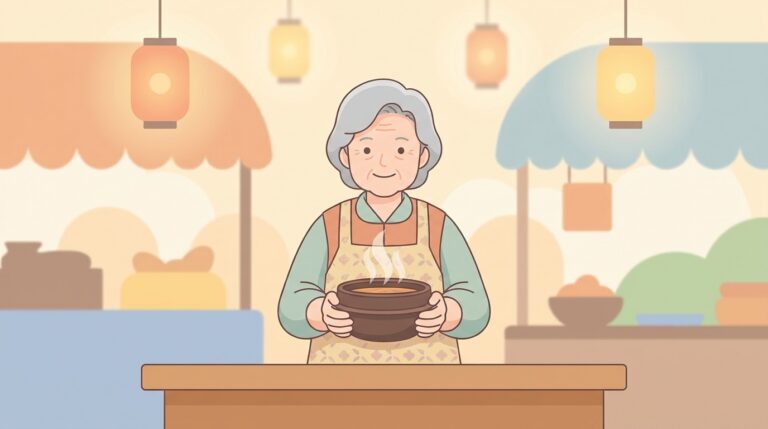
Imagine stepping off the KTX at Busan Station on a crisp evening and heading straight into an alleyway thick with savory steam from a 24-hour Dwaeji Gukbap (돼지국밥, pork rice soup) tavern. You take a seat, expecting the singsong, gentle Seoul refrain of “주문하시겠어요? (Jumunhasigesseoyo? – May I take your order?)”. Instead, the matriarch sets down a pitcher of iced barley tea with an abrupt clatter, looks straight past your shoulder, and barks: “뭐 묵을라꼬? (Mwo mugeullakko? – What are you having?)”. When your scalding bowl arrives, she nudges the bowl of fresh chives toward you and mutters without breaking stride: “뜨거우이 조심하이소. 밥은 묵고 댕기나? (Tteugeou-i josimha-iso. Babeun mukgo daenggina? – It’s hot, watch out. Have you been eating properly?)”.
If you have trained purely in standard Seoul Korean (표준어), your immediate instinct might be defensiveness: Did I offend her? Is she angry with me? But look closer at her actions: she has scooped an extra mountain of tender pork into your bowl without charging a single won.
Welcome to the linguistic heart of the Gyeongsang (Southeastern / 동남 방언) dialect zone. This linguistic ecosystem, spanning Busan, Daegu, Ulsan, and the surrounding provinces, is renowned across the peninsula for its bluff, laconic, seemingly stern veneer—a quality known as muttukttuk (무뚝뚝함)—which shields an ocean of deep, familial tenderness known as sokjeong (속정). Many advanced C2 learners struggle here because Gyeongsang speech breaks classical textbook rules: the vowels ‘ㅓ’ (eo) and ‘ㅡ’ (eu) frequently merge into an undifferentiated mid-central acoustic space, pitch accents dictate syntax, and snappy interrogative sentence endings like ‘-예’, ‘-능교’, ‘-노’, and ‘-나’ follow strict morphological rules that textbook Korean never covers. This guide draws upon real dialect coaching sessions and field recordings to transform your understanding of Korean sociolinguistic diversity, unlocking the true literary and emotional depth of Southeastern Korean speech.
Phase 2: Deep Dive into Core Expressions
1. 밥 뭇나? (Bap munna?) vs 밥 뭐 묵었노? (Bap mwo mugeonno?)
- Pronunciation: [Bap mun-na?] / [Bap mwo mug-eon-no?] (Tip: In “뭇나”, push the pitch up sharply on “뭇”, like asking a surprised “What?!”; in “묵었노”, drop the pitch abruptly on the ending “노”)
- Meaning: Literal: “Did you eat rice?” / “What rice did you eat?” | Actual Nuance: “I care about your fundamental well-being, though my pride prevents me from giving you a warm hug.”
- K-Culture Moment: In the iconic nostalgia drama Reply 1997 (응답하라 1997), Yoon Yoon-jae’s gruff father figures use these clipped questions instead of “I missed you” or “How was your day?”
- Editor’s Insight: This illustrates the fundamental grammatical rule of Gyeongsang interrogative suffixes: ‘-나’ (-na) is reserved strictly for polar (Yes/No) questions (판정의문문), whereas ‘-노’ (-no) must attach to content questions featuring interrogative pronouns like who, what, where, or why (설명의문문). Swapping them (e.g., saying 밥 뭇노?) immediately exposes an unnatural, artificial accent.
- Situation Spectrum: Casual: ✅ | Semi-formal: ⚠️ | Formal: 🚫
- 🤔 Think About It: Why does Gyeongsang culture channel affection into interrogatives about bodily sustenance rather than explicit verbal declarations of love?
2. 맞나-예 (Manna-ye)
- Pronunciation: [Mat-na-ye] (Tip: Glide the “na” into an elongated, gentle “ye” with a slightly rising-falling contour, akin to a thoughtful English “Is that so-o?”)
- Meaning: Literal: “Is it right? (Polite)” | Actual Nuance: “I am deeply listening to you, empathizing with the absurdity or emotional weight of your story.”
- K-Culture Moment: Listen to real-life variety shows featuring BTS members Jimin and Jungkook slipping into their native Busan accents; whenever an elder drops shocking news, this reaction instantly surfaces.
- Editor’s Insight: In standard Korean, “맞아요 (maj-ayo)” validates facts. But the hybrid Gyeongsang construction of ‘맞나’ + polite particle ‘-예’ serves as an active-listening backchannel (추임새). The regional particle ‘-예’ (-ye) substitutes the standard ‘-요’ (-yo), adding an earthy, respectful deference that softens blunt rhetorical statements without losing authenticity.
- Situation Spectrum: Casual: ⚠️ | Semi-formal: ✅ | Formal: ✅
- 🤔 Think About It: How does replacing the open vowel ‘-요’ with the fronted vowel ‘-예’ psychologically shorten interpersonal distance in dialectal speech?
3. 와 그라능교? (Wa geuraneunggyo?)
- Pronunciation: [Wa geu-ra-neung-gyo?] (Tip: Stress the initial “Wa!” with a high pitch, then roll the “neung-gyo” downward smoothly)
- Meaning: Literal: “Why are you acting like that? (Polite)” | Actual Nuance: “What is troubling your heart so deeply? Speak up, I’m here to shoulder it with you.”
- K-Culture Moment: Often uttered by veteran actors like Song Kang-ho or Kim Hae-sook playing weary, seasoned parents in classic Korean cinema who see through their child’s fake smile.
- Editor’s Insight: The ending ‘-능교’ (-neunggyo) is an honorific interrogative suffix endemic to Southeastern Korea, functioning identically to standard “-십니까? (-simnikka?)” or “-시나요? (-sinayo?)”. While standard honorifics sound administrative or corporate, ‘-능교’ conveys genuine communal solicitude wrapped in polite linguistic etiquette.
- Situation Spectrum: Casual: 🚫 | Semi-formal: ✅ | Formal: ✅
- 🤔 Think About It: Does formal linguistic deference in your native language sound clinical, or can it evoke raw, unvarnished warmth as ‘-능교’ does?
Phase 3: Textbook Korean vs Real Korean
Situation 1: Inquiring about a delayed order at a bustling local eatery
- 📖 교과서 한국어 (Textbook Korean):
“사장님, 제가 주문한 돼지국밥은 언제쯤 나오나요? 확인 부탁드립니다.”
(Sajangnim, jega jumunhan dwaejigukbabeun eonjejjeum naonayo? Hwagin butakdeurimnida.)
“Boss, approximately when will the pork soup I ordered come out? Please check for me.” - 🗣️ 진짜 한국어 (Real Gyeongsang Korean):
“이모님, 국밥 다 됐능교? 배고파 죽겠네예!”
(Imonim, gukbap da dwaenneunggyo? Baegopa jukgenne-ye!)
“Auntie, is the soup ready? I’m starving to death here!” - 💡 왜 다를까? (Why the divergence?):
Textbook Korean relies on bureaucratic passives and modal distance to preserve face. In traditional Gyeongsang food culture, dining establishments operate on surrogate familial intimacy; using overly stiff, indirect honorifics creates emotional distance, whereas a hearty, direct query anchored by ‘-능교’ and ‘-네예’ signals insider trust and playful camaraderie.
Situation 2: Expressing shock and solidarity when a friend shares bad news
- 📖 교과서 한국어 (Textbook Korean):
“정말 믿기지 않네요. 어떻게 그런 부당한 일이 일어날 수가 있죠?”
(Jeongmal mitgiji anne-yo. Eotteoke geureon budanghan iri ireonal suga itjyo?)
“That is truly unbelievable. How could such an unfair event occur?” - 🗣️ 진짜 한국어 (Real Gyeongsang Korean):
“맞나?! 와, 그짓말 아이가! 억수로 속상했겠네.”
(Manna?! Wa, geujitmal aiga! Eoksuro soksanghaetgenne.)
“Are you serious?! Wow, that must be a lie! You must have been insanely upset.” - 💡 왜 다를까? (Why the divergence?):
Standard Korean leverages complex evaluative adjectives. Real Southeastern speech relies on instantaneous emotional shockwaves: the vowel-neutralized ‘그짓말’ (geujitmal)—where the standard ‘거’ (/ʌ/) merges into ‘그’ (/ɯ/)—paired with the regional intensifier ‘억수로’ (eoksuro – tremendously) conveys spontaneous, uncurated emotional solidarity.
Phase 4: K-Culture Deep Dive & Non-Verbal Nuances
4-1. Nunchi (눈치) & Non-Verbal Mechanics
When navigating Gyeongsang dialect dynamics, understanding acoustic volume and physical stance is non-negotiable. Standard Seoul Korean treats high volume and staccato cadence as markers of irritation. In Gyeongsang provinces, however, Middle Korean pitch accents (성조) survive vividly: syllables carry distinct High (H), Low (L), and Rising (R) tonal contours. What sounds to an untrained ear like an explosive argument between two cab drivers at Jagalchi Market is, acoustically, just their pitch-accent system carrying information across sea winds!
* The Standoffish Glance (무심한 시선 처리): Do not expect prolonged, eager eye contact. A genuine Gyeongsang local will often address you while looking down at a cutting board or staring out into the street. Do not interpret this as disrespect; it represents the traditional avoidance of performative flattery.
* The Brusque Plate Drop (탁 내려놓기): Dishes may land on your table with decisive force. This tactile abruptness reflects functional efficiency, not aggression.
* The Lip-Purse Affirmation: When listening, an older Gyeongsang speaker will subtly protrude their lower lip, nod once sharply, and drop an assertive, low-frequency “어 (Eo)” or “맞다 (Matda)”. Match this energy with centered, humble confidence.
4-2. Cultural Code Analysis: The Literary & Cinematic Archetype
From Bong Joon-ho’s scripts to classic masterpieces like Friend (친구, 2001) and Ode to My Father (국제시장, 2014), the Gyeongsang dialect serves as South Korea’s dramatic shorthand for stoic resilience. Historically, the southeastern coastal rim and industrial heartlands (Yeongnam) weathered the frontlines of wartime trauma, rapid industrialization, and maritime hardship. Under harsh conditions, long-winded, decorative linguistic pleasantries were discarded in favor of survival-oriented, telegraphic brevity.
In contemporary K-Dramas, when a writer wants to convey a male lead who acts like cold granite on the outside while secretly paying off a loved one’s debt or walking five miles in the rain to deliver medicine, they almost universally root his childhood in Gyeongsang-do. The clipped endings ‘-노’ and ‘-나’ eliminate performative sentimentality, allowing the underlying deed of service (속정) to shine without theatrical fanfare.
Phase 5: Interactive Role-Play Scenario
Setting: A tiny, steam-veiled pork soup tavern nestled in an alley of Busan’s Seomyeon. Clock shows 8:30 PM. The floor is tiled; the scent of boiling marrow broth fills the room.
Characters:
* Halmeoni Sun-ja (손맛 장인 순자 할매): 74 years old. Piercing gaze, silver hair in a hairnet, worn floral apron, big heart hidden behind a sandpaper tongue.
* Learner (C2 Advanced Student): You, navigating native dialect subtleties with cultural grace.
[Scene Start]

👵 할매 순자: (뚝배기를 쾅 소리 나게 식탁에 내려놓으며) 자, 묵으소.
(Ja, mugeuso.)
🎭 [Thumps the earthenware bowl onto the metal table, barely making eye contact]
"Here, eat up."

👤 학습자: (국물을 한 숟갈 맛본 뒤 감탄하며) 와, 이모님 국물이 진짜 끝내주네예!
(Wa, imonim gukmuri jinjja kkeunnaejune-ye!)
🎭 [Takes a steaming spoonful, eyes widening with genuine delight, leaning forward]
"Wow, auntie, this broth is truly phenomenal!"

👵 할매 순자: (무심하게 마늘 그릇을 툭 밀어 넣으며) 쯧, 싱거우면 다대기나 풀지, 와 호들갑인교?
(Tteut, singgeoumyeon dadaegina pulji, wa hodeulgap-inggyo?)
🎭 [Clicks her tongue softly, shoving the seasoned red pepper paste forward with her thumb]
"Tsk, if it's bland, mix in some chili paste; why all the fuss?"

👤 학습자: (미소 지으며) 아니, 깊은 맛이 예술이라서 그렇습니더. 부산 오길 잘했네예.
(Ani, gipeun masi yesuriraseo geureoseumnideo. Busan ogil jalhaetne-ye.)
🎭 [Smiles knowingly, adjusting posture to radiate comfortable ease]
"No, it's just that the depth of flavor is art. I'm so glad I came down to Busan."

👵 할매 순자: (식탁 모서리를 행주로 훔치며 힐끔 쳐다본다) 타지 사람 같은데... 서울서 내려왔능교?
(Taji saram gateunde... Seourseo naeryeowatneunggyo?)
🎭 [Wipes the table corner briskly with a rag, glancing sideways with rising curiosity]
"Looks like you're from out of town... Did you come down all the way from Seoul?"

👤 학습자: (고개를 끄덕이며) 예, 맞심니더. 공부하다가 바람 쫌 쐬러 왔지예.
(Ye, matsimnideo. Gongbuhadaga baram jjom ssoereo watjiye.)
🎭 [Nods with measured warmth, adopting the regional vowel weight]
"Yes, that's right. I was studying and came down to catch some sea breeze."

👵 할매 순자: (돌아서서 주방으로 가려다 멈칫하며) 젊은 사람이 삐쩍 말라가지고... 밥은 제대로 묵고 댕기나?
(Jeolmeun sarami ppijjeok mallagajigo... Babeun jedaero mukgo daenggina?)
🎭 [Pauses mid-turn toward the kitchen, eyeing your slim frame with gruff maternal concern]
"Young folk looking like a skinny twig... Have you been eating your meals properly out there?"

[Branching Decision Point!]
🔀 인터랙티브 분기점 (Choose your response to Grandma Sun-ja’s question: “밥은 제대로 묵고 댕기나?”)
- Choice A: “어르신, 왜 저의 식사 여부를 그런 거친 말투로 물어보시는 것입니까?”
(Eoreusin, wa jeoui siksa yeobureul geureon geochin malturo mureobosineun geosimnikka?) - Choice B: “예, 할매! 혼자 살다 보니까 대충 때우는데, 오늘 이 국밥 묵고 힘 팍팍 나네예!”
(Ye, halmae! Honja salda bonikka daechung ttaeuneunde, oneul i gukbap mukgo him pakpak naneye!) - Choice C: “밥 뭐 묵었노?! 걱정 안 하셔도 됩니다.”
(Bap mwo mugeonno?! Geokjeong an hasyeodo doemnida.)
Detailed Branch Feedback
- If you chose A (Risk/Fail): Fatal pragmatic error. Applying literal Seoul hyper-honorifics to confront her tone as “harsh” misinterprets pure sokjeong as an insult. Grandma Sun-ja will immediately withdraw into icy silence, take your empty bowl away early, and treat you like a distant stranger. You failed the cultural nunchi test.
- If you chose B (Best! C2 Native Immersion): Perfection. Calling her affectionately “할매 (Halmae – Grandma)”, admitting vulnerable self-sufficiency (“혼자 살다 보니까”), and validating her food with the polite dialect ending ‘-네예’ satisfies every regional sociolinguistic norm. Expect her to emerge from the kitchen thirty seconds later with a free side of boiled pork belly slices (suyuk) dropped onto your table with a gruff: “남기지 말고 다 묵으라 (Eat it all, don’t leave scraps).”
- If you chose C (Bad): Catastrophic grammatical clash. Mixing up the wh-question ending ‘-노’ into a non-question statement directed upward at an elder sounds both grammatically incoherent and shockingly rude. Grandma will look at you bewildered, wondering where your Korean language school went wrong.
Phase 6: 10-Second Emotional Shadowing Drill
Read each sentence out loud. Observe the slashes / as acoustic rhythm pauses, and match the specified emotional tone.
Drill 1: The Brusque Caring Inquiry
[🤨 무심한 듯 툭 던지며 챙겨줄 때 / Deadpan, laconic concern]
밥은 / 뭇나? / 굶지 말고 / 든든하이 / 챙겨 묵으소-예.
(Babeun / munna? / Gumji malgo / deundeunha-i / chaenggyeo mugeuso-ye.)

Drill 2: Explosive Empathic Astonishment
[😲 두 눈을 크게 뜨고 격한 공감을 표할 때 / Sharp, wide-eyed shock & solidarity]
맞나?! / 와, / 그짓말 / 같은 소릴 / 와 하노?!
(Manna?! / Wa, / geujitmal / gateun soril / wa hano?!)

Drill 3: Respectful yet Deeply Intimate Farewell
[👵 잔잔한 미소와 따스한 속정을 담아 / Warm, understated filial warmth]
날 추우이 / 조심히 / 드가시소-예. / 또 오겠심니더.
(Nal chu-u-i / josimhi / deugasiso-ye. / Tto ogessimnideo.)
Phase 7: K-Culture Mini-Dictionary
- 속정 (Sokjeong) | Noun
Deep, unadvertised inner affection. Unlike aejeong (애정), which seeks verbal and physical expression, sokjeong is intentionally buried beneath an unflinching, stoic exterior. In regional business culture, a partner who demonstrates sokjeong might drive a ruthless bargain in meetings, only to quietly resolve your logistical bottlenecks behind the scenes without taking credit. -
무뚝뚝 (Muttukttuk) | Noun / Adjective Stem
Curitness, bluff laconicism. Not a personality flaw, but a prized cultural posture across Gyeongsang-do. It signals emotional solidity and distaste for superficial flattery. To describe a Busan native as muttukttuk-hada often carries fond respect, implying they are dependable when crises strike. -
성조 (Seongjo – Pitch Accent) | Linguistic Term
Lexical pitch contours. While standard Seoul Korean completely lost Middle Korean vowel length and tone distinctions, the Southeastern dialect preserved an active pitch-accent system. Syllables distinguish word meanings and grammatical moods based on whether they are pronounced at high, mid, or low pitch registers. -
살갑다 (Salgapda) | Adjective
Sweetly affectionate and tenderly engaging. In Gyeongsang dialect literary discourse, this word often functions as the antithesis of the local temperament. A local will proudly declare, “우리 집안 사람들은 살갑지는 못해도 의리는 있다 (Our family members aren’t sweetly affectionate, but we possess absolute loyalty).”
Phase 8: Traveler’s Survival Kit
TOP 3 Southeastern Survival Phrases
-
얼마예? (Eolmaye?)
Standard: 얼마예요? (Eolmayeyo? – How much is this?)
Pro Tip: Dropping the soft Seoul “-예요” for the brisk, grounded “-예?” instantly signals to market vendors at Jagalchi or Gukje Market that you understand local cadence, reducing your tourist markup profile. -
쫌 깎아주이소! (Jjom kkak-kaju-iso!)
Standard: 조금 깎아주세요! (Jogeum kkak-kaju-seyeo! – Please give me a small discount!)
Pro Tip: The word “쫌 (Jjom)” carries immense functional weight in Gyeongsang speech. Pronounce the tense consonant ‘ㅉ’ with a sharp, crisp drop. It communicates playful bargaining without whining. -
마, 됐다! (Ma, dwaetda!)
Standard: 됐습니다 / 이제 그만하세요. (Dwaessimnida / Ije geumanhaseyo. – That’s quite enough / Never mind.)
Pro Tip: “마 (Ma)” is short for “임마 (imma)” or “마련 (just/simply)”. Uttering “마, 됐다!” with a waving hand lets you gracefully dismiss pushy touts or playfully cut off a friend who is overthinking a dilemma.
🧳 Editor’s Travel Note: Conquering the Southeastern Metropolises
When traveling beyond the Seoul capital area into Busan, Daegu, or Changwon, standard transit habituations shift. While the Seoul metro system relies on automated multi-language chime routines, navigating regional transfer hubs requires real-time agility. We strongly recommend configuring the Naver Map application interface for real-time bus arrivals; local municipal bus drivers in Busan drive with celebrated coastal speed and will rarely wait at the curb if you hesitate. At checkout counters, older shopkeepers will rarely ask “영수증 필요하세요? (Do you need a receipt?)”; they will simply thrust the payment card back at you with a curt: “됐능교? (Are we done?)”. Meet their gaze, nod firmly, and reply: “예, 수고하이소! (Ye, sugoha-iso! – Yes, keep up the good work!)”.
Phase 9: “한 발 더 깊이” (Deep Cultural Reflection)
Language is never merely an acoustic code; it is the sedimented emotional history of geography. The Southeastern dialect region, cradled by the Nakdong River basin and walled in by the rugged Taebaek mountains, nurtured tight-knit communities that lived under constant exposure to unpredictable maritime storms and historical invasions. In such terrains, wordy embellishments are survival liabilities; speed, direct clarity, and unyielding loyalty are everything. When a standard Seoul speaker stretches vowels with soothing, upward-gliding politeness (“그랬어요오~?”), a Gyeongsang native may instinctively perceive artificiality, wondering what hidden agenda lies behind the decorative melody. Conversely, when the Gyeongsang speaker drops a bare, rock-like “맞나 (Is that so)”, they are offering the highest gift their culture knows: absolute, unvarnished honesty without emotional posturing.
💬 Your Turn: In your native culture or regional background, do people equate linguistic directness with rudeness, or is clipped bluntness celebrated as a sign of sincere, lifelong loyalty? Have you ever misinterpreted someone’s deep care because of their abrupt tone? Share your reflections in the comments below!
Phase 10: FAQ & Avoiding Misconceptions
Q: Why do elderly Gyeongsang speakers say ‘스울’ (Seu-ul) instead of ‘서울’ (Seoul) or ‘그짓말’ (Geujitmal) instead of ‘거짓말’ (Geojitmal)?
A: This is a classic phonological marker of the Southeastern dialect: the merger (중화) of the vowels /ㅓ/ (eo) and /ㅡ/ (eu). In Middle Korean, these were distinct vowels, but across many Gyeongsang sub-dialects, the tongue positioning for these two mid-vowels shifted toward a single neutral vowel sound. Consequently, older native speakers do not distinguish between “어른 (eoreun – adult)” and “으른 (eureun)”, naturally pronouncing standard words with ‘ㅡ’ substituting for ‘ㅓ’.
Q: How can I remember whether to use ‘-노’ or ‘-나’ without freezing mid-sentence?
A: Use the Information Check Rule. If the question can be answered with a simple “Yes” or “No”, you must end with ‘-나’ (“밥 뭇나?” -> Yes, I ate / No, I didn’t). If the sentence contains an information-seeking question word such as what (뭐), where (어디), who (누구), or why (와), you must end with ‘-노’ (“와 그라노?” -> Why are you acting like that?). Mixing this up is the #1 tell of an amateur dialect mimic.
Q: Is using the polite dialect ending ‘-예’ considered informal or disrespectful in formal Seoul business meetings?
A: Yes, keep it out of formal Seoul corporate boardrooms. While ‘-예’ is an honorific particle equivalent to ‘-요’ within Gyeongsang-do, standard Korean business protocol (비즈니스 한국어) mandates standard Seoul haeroche or hapsyoche (e.g., “-습니다”, “-습니까”). Using ‘-예’ in Seoul can make you sound unstandardized or overly casual, though using it locally in Busan restaurants or markets will win hearts instantly.
🚨 Common Mistakes (흔한 실수) Alert Board

1. The Indiscriminate '-노' Blunder
   ❌ Mistake: "오늘 날씨 진짜 좋노?" (Using '-노' on a yes/no rhetorical question)
   ✅ Correction: "오늘 날씨 진짜 좋나?" or "오늘 날씨 와 이리 좋노?!" (Adding '와 이리' justifies '-노').

2. Over-exaggerating Intonation into Aggression
   ❌ Mistake: Yelling clipped sentences with a scowl to "sound authentic."
   ✅ Correction: Keep facial muscles relaxed; let the pitch accent (musical high/low register) do the work rather than volume.

3. Forcing Dialect with Strangers in Formal Corporate Settings
   ❌ Mistake: Replying "맞심니더" to a Seoul client during an initial zoom interview.
   ✅ Correction: Stick to standard "네, 맞습니다" in formal cross-regional professional settings.
Phase 11: Action Missions & Cultural Immersion
- 🥉 Bronze Mission (Solo Vocal Drill): Practice the difference between polar and content questions in your room. Record your voice saying: “밥 뭇나? (Did you eat?)” followed by “뭐 묵었노? (What did you eat?)”. Listen to ensure your pitch spikes high on “뭇” and dives deep on “노”.
- 🥈 Silver Mission (Social Media Decoding): Find a clip of a native Gyeongsang K-Pop idol (e.g., BTS’s Jimin/Suga, Stray Kids’ I.N, or Apink’s Eunji) speaking in Satoori (방언). Identify at least one instance of ‘-예’, ‘-노’, or ‘-나’, transcribe the sentence, and post it to your study log with its standard Korean equivalent.
- 🥇 Gold Mission (Real-World Deployment): When visiting a restaurant run by Gyeongsang natives or during your next trip to Busan/Daegu, consciously replace standard “감사합니다, 안녕히 계세요” with a warm, humble: “잘 묵고 갑니데이! 수고하이소-예! (I ate well! Keep up the good work!)”.
- 🎮 K-Culture Mission: Watch Episode 1 of the drama Reply 1997 (응답하라 1997). Count how many times the lead characters use the expressive confirmation marker “맞나!” instead of standard “진짜?”.
Phase 12: Interactive Quiz Challenge
Test your C2 mastery of Southeastern Korean dialect mechanics. Read each prompt carefully before opening the spoilers!
Question 1: Situational Pragmatics
You enter a historic bakery in Daegu. The elderly owner notices you holding a local pastry and asks warmly:
“그거 어디서 찾았____?”
Which suffix grammatically and culturally completes this question?
* (A) -나
* (B) -노
* (C) -능교
* (D) -네예
🔍 Click to reveal the Answer & Linguistic Breakdown
Correct Answer: (B) -노 (or in an elder-to-younger semi-formal setting, -노 / -능교 depending on honorific distance, but strictly -노 over -나 due to the question word ‘어디서’)
C2 In-Depth Analysis:
The sentence contains the interrogative pronoun ‘어디서 (where)’. Under the morphosyntactic rules of Gyeongsang Korean, an information question (설명의문문) containing an interrogative pronoun cannot accept the polar interrogative suffix ‘-나’. Therefore, “어디서 찾았노?” is the grammatically correct regional form. Option (A) ‘-나’ is grammatically ungrammatical here. Option (D) ‘-네예’ is a declarative ending, not an interrogative.
Question 2: Vowel Neutralization Decoding
An auntie at a Busan open-air fish stall shouts to her assistant:
“야야, 스면 사는 으른들 오셨다! 그짓말 하지 말고 단디 챙기도!”
What is the accurate standard Korean (표준어) translation of this sentence?
🔍 Click to reveal the Answer & Linguistic Breakdown
Standard Korean Translation:
“얘야, 서면 사는 어른들 오셨다! 거짓말 하지 말고 확실히 챙겨 드려라!”
(Yaeya, Seomyeon saneun eoreundeul osyeotda! Geojitmal haji malgo hwaksilhi chaenggyeo deuryeora!)
C2 In-Depth Analysis:
This sentence demonstrates three hallmark Southeastern dialect features:
1. ‘ㅓ’ -> ‘ㅡ’ Neutralization: “서면” becomes “스면”, “어른” becomes “으른”, and “거짓말” becomes “그짓말”.
2. Lexical Adverb ‘단디’ (Dandi): A famous Gyeongsang dialect term meaning “firmly, solidly, carefully” (단단히 / 빈틈없이).
3. Imperative Contraction ‘챙기도’: Derived from standard “챙겨 줘라” (take care of / pack properly).
Question 3: True or False Cultural Nuance
True or False: When a Gyeongsang speaker replies to an elder’s narrative with “맞나-예”, they are challenging the truthfulness of the elder’s statement by demanding factual verification.
🔍 Click to reveal the Answer & Linguistic Breakdown
Correct Answer: False!
C2 In-Depth Analysis:
While standard Korean “맞나요? (Is that correct?)” can occasionally sound like a factual inquiry or verification check, the dialectal composite “맞나-예” functions primarily as an empathetic discourse marker (추임새). It signals deep engagement, active emotional alignment, and respectful backchanneling, validating the speaker’s emotional state without literal skepticism.







