

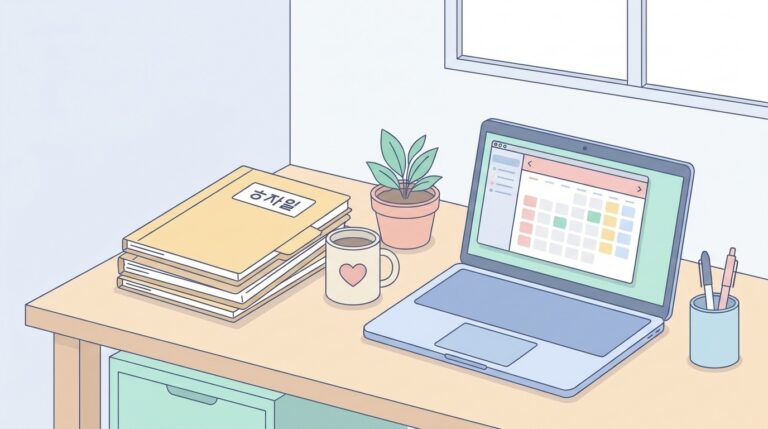
Speak Like a Pro in a Korean Office: Essential Titles and Respectful Requests
Phase 1: Empathy (Story-Driven Opening)
안녕하세요! 매일한글 에디터입니다.
Picture this: You just landed your dream internship or got transferred to a branch office in Seoul. You are walking across a polished glass-and-marble office floor straight out of a K-drama like Misaeng or King the Land. You have just printed out an important project report. Your supervisor, Lee Seoyeon, is sitting at her desk sipping an iced Americano. You want to walk up to her and say, “Hey Seoyeon, could you look at this file?”
Freeze right there! In Western office culture, addressing your boss by their first name can make you sound friendly and approachable. But in Korea, doing that might cause a sudden, awkward silence where the whole room freezes and stares at you! Navigating Korean workplace titles (hoching) can feel like defusing a bomb for beginners. Should you call her Seoyeon-ssi? Manager Lee? Or just tap her shoulder nervously?
Don’t panic. Thousands of expats and international employees make this exact blunder every single day. Master just a few simple golden rules of Korean office hierarchy and you will transform from an anxious outsider into a culturally savvy professional whom everyone loves to mentor. Today, we will decode the magic phrase: “이서연 과장님, 서류 확인 부탁드립니다 (I Seoyeon Gwajangnim, seoryu hwagin butakdeurimnida – Manager Lee Seoyeon, please check the document)” so you can deliver your work with total confidence!
Phase 2: Deep Dive into 3 Core Expressions
1. 이서연 과장님 (I Seoyeon Gwajangnim)
- Pronunciation: [I Seo-yeon Gwa-jang-nim] (Sounds like: Ee Suh-yuhn Gwah-jahng-neem)
- Meaning: Literal: “Manager Lee Seoyeon” | Nuance: “Respected Section Chief Lee Seoyeon”
- K-Culture Moment: You hear this in every workplace drama! Subordinates rarely call a manager “Hey” or just their last name. They combine Full Name + Job Title + the honorific suffix 님 (nim).
- Editor’s Insight: The suffix 님 (nim) is your ultimate corporate shield. Adding 님 elevates the title with deep respect. While you can address peers of equal rank as [First Name]-ssi, you should never drop nim when speaking to anyone higher than you!
- Situation Spectrum: Casual 🚫 | Semi-formal ⚠️ | Formal ✅
- 🤔 Think About It: In English, calling your boss “Boss” sounds either humorous or like a mafia movie. Why does Korean culture prefer titles over personal names in public spaces?
2. 서류 확인 부탁드립니다 (Seoryu hwagin butakdeurimnida)
- Pronunciation: [Seo-ryu hwa-gin bu-tak-deu-rim-ni-da] (Sounds like: Suh-ryoo hwah-geen boo-tahk-deu-reem-nee-dah)
- Meaning: Literal: “Document confirmation, I request as a favor.” | Nuance: “Please be so kind as to check over these papers.”
- K-Culture Moment: Handing a presentation folder to a senior team leader in a boardroom scene before taking a respectful half-step backward.
- Editor’s Insight: Instead of demanding action with 주세요 (juseyo – please give/do), Koreans use 부탁드립니다 (butakdeurimnida – I request this favor). It frames your request as asking for their gracious help rather than giving an instruction.
- Situation Spectrum: Casual 🚫 | Semi-formal ⚠️ | Formal ✅
- 🤔 Think About It: Notice how polite Korean softens commands into requests for favors. How does your native language handle polite requests to superiors?
3. 수고하셨습니다 (Sugohasyeotseumnida)
- Pronunciation: [Su-go-ha-syeot-seum-ni-da] (Sounds like: Soo-go-ha-shyut-seum-nee-dah)
- Meaning: Literal: “You underwent hardship.” | Nuance: “Thank you for your hard work! / Well done today!”
- K-Culture Moment: The synchronized chorus sung across the office when the clock hits 6:00 PM and team members pack up their laptops.
- Editor’s Insight: Be careful! Sugohasyeotseumnida (past tense) is fine when someone has finished helping you or at the end of the day. But never say Sugohaseyo (present tense imperative) to your senior when leaving, as it implies telling an elder “keep struggling!”
- Situation Spectrum: Casual ⚠️ | Semi-formal ✅ | Formal ✅
- 🤔 Think About It: Why does Korean society celebrate “enduring struggle” (sugo) as an act of solidarity and care?
Phase 3: Textbook Korean vs. Real Korean
Situation 1: Calling someone’s attention in an office
- 📖 Textbook Korean: 당신, 이것을 보세요. (Dangsin, igeoseul boseyo. / You, look at this.)
- 🗣️ Real Korean: 과장님, 잠깐 서류 확인 부탁드립니다. (Gwajangnim, jamkkan seoryu hwagin butakdeurimnida. / Manager, could you please take a quick look at this document?)
- 💡 Why is it different? The word 당신 (dangsin) literally translates to “you” in dictionaries, but in real life, using it with a boss sounds confrontational or aggressive, almost like picking a fight!
Situation 2: Asking if your supervisor is busy
- 📖 Textbook Korean: 지금 시간이 있습니까? (Jigeum sigani itseumnikka? / Do you have time now?)
- 🗣️ Real Korean: 과장님, 지금 잠깐 괜찮으세요? (Gwajangnim, jigeum jamkkan gwaenchaneuseyo? / Manager, do you have a quick moment right now?)
- 💡 Why is it different? Real Korean workplace speech relies heavily on gentle cushion words like 잠깐 (jamkkan – briefly) and 괜찮으세요? (gwaenchaneuseyo? – is it alright?) to avoid imposing on someone’s schedule.
Phase 4: K-Culture Deep Dive & Non-Verbal Manners
4-1. Nunchi & The Two-Hand Rule
In Korea, body language speaks before your mouth even opens! When you deliver papers to Manager Lee:
1. The Two-Handed Handover (두 손): Hold the folder with both hands, thumbs slightly pointing forward, and offer it with the text oriented toward her so she can read it instantly.
2. The Polite Stance: Keep your elbows close to your torso. If one hand is holding the desk or hanging in your pocket, your professional Nunchi score will drop to zero.
3. Eye Angle: Make brief, respectful eye contact with a gentle bow of your head (around 15 degrees). Don’t stare unblinkingly into your manager’s eyes; soften your gaze toward their neck or collar.
4-2. The Korean Corporate Ladder (직급 체계)
Korean companies run on clearly defined hierarchical ladders. Understanding where people stand will save you from social landmines:
* 사원 (Sawon): Entry-level staff / Rookie
* 대리 (Daeri): Assistant Manager
* 과장 (Gwajang): Section Manager (Like Manager Lee!)
* 차장 (Chajang): Deputy General Manager
* 부장 (Bujang): General Manager / Department Head
When addressing anyone above you, formula: [Last Name] + [Job Title] + 님 (Nim). For example: 이 과장님 (I Gwajangnim) or simply 과장님 (Gwajangnim).
Phase 5: Real-Life Roleplay Scenario
Setting: A modern, sunlit startup office in Pangyo Tech Valley.
Characters:
* Alex: A bright foreign intern eager to make a great impression.
* Manager Lee Seoyeon (이서연 과장님): A capable, supportive, but busy project lead.
- Turn 1 (Alex):
과장님, 지금 잠깐 괜찮으세요?
(Gwajangnim, jigeum jamkkan gwaenchaneuseyo?)
“Manager, do you have a quick moment right now?”
🎭 Stands near her desk at a polite distance, holding documents with both hands. -
Turn 2 (Manager Lee):
네, 알렉스 씨. 무슨 일이에요?
(Ne, Allekseu ssi. Museun irieyo?)
“Yes, Alex. What’s going on?”
🎭 Turns her monitor slightly and looks up warmly. -
Turn 3 (Alex):
이서연 과장님, 기획서 서류 확인 부탁드립니다.
(I Seoyeon Gwajangnim, gihoekseo seoryu hwagin butakdeurimnida.)
“Manager Lee Seoyeon, could you please review the project proposal document?”
🎭 Hands over the paper using both hands with a gentle 15-degree nod. -
Turn 4 (Manager Lee):
아, 벌써 다 작성했어요? 어디 봐요.
(A, beolsseo da jakseonghaesseoyo? Eodi bwayo.)
“Oh, you finished it already? Let me take a look.”
🎭 Receives the paper with both hands and skims through the first page. -
Turn 5 (Alex):
수정할 부분이 있으면 언제든 말씀해 주세요.
(Sujeonghal bubuni isseumyeon eonjedeun malsseumhae juseyo.)
“Please let me know anytime if there is anything that needs revision.”
🎭 Takes a small step back, keeping hands resting neatly in front. -
Turn 6 (Manager Lee):
정리 아주 깔끔하게 잘했네요! 승인해 둘게요.
(Jeongni aju kkalkkeumhage jalhaenneyo! Seung-inhae dulgeyo.)
“You organized this so cleanly! I will approve it.”
🎭 Nods approvingly and signs the top corner. -
Turn 7 (Alex):
감사합니다, 과장님!
(Gamsahamnida, gwajangnim!)
“Thank you so much, Manager!”
🎭 Smiles brightly with a respectful bow. -
Turn 8 (Manager Lee):
수고 많았어요, 알렉스 씨! 커피 한잔하고 와요.
(Sugo manasseoyo, Allekseu ssi! Keopi hanjanhago wayo.)
“Great work, Alex! Go grab a cup of coffee.”
🎭 Hands the signed document back with a friendly wink.
🔀 Interactive Decision Point
Suppose Manager Lee was typing an urgent email when you arrived. How should you address her?
- Choice A: Tap her shoulder and say: “서연아, 이거 빨리 봐줘! (Seoyeon-a, igeo ppalli bwajwo!)”
❌ Bad: Extreme danger! Speaking in informal banmal and dropping her title will immediately land you in an emergency HR meeting. - Choice B: Stand silently directly behind her chair without saying a word until she notices you.
⚠️ Risk: Creepy and startling! She might jump out of her seat spilled iced coffee everywhere. - Choice C: Stand slightly to the side, wait for a typing pause, and say softly: “과장님, 급하지 않으실 때 서류 확인 부탁드립니다.” (Gwajangnim, geuphaji aneushil ttae seoryu hwagin butakdeurimnida.)
🌟 Best: Flawless! This shows peak professional etiquette (nunchi) by acknowledging her workflow.
Phase 6: 10-Second Emotion Shadowing Drill
Practice matching the cadence, natural pauses (/), and emotional tones of these native work lines:
[💼 Crisp, respectful, and attentive]
과장님, / 서류 확인 / 부탁드립니다!
(Gwajangnim, / seoryu hwagin / butakdeurimnida!)-
[😊 Humble and considerate]
지금 / 잠깐 시간 / 괜찮으세요?
(Jigeum / jamkkan sigan / gwaenchaneuseyo?) -
[🤝 Sincere and grateful]
오늘도 / 정말 / 수고하셨습니다!
(Oneuldo / jeongmal / sugohasyeotseumnida!)
Phase 7: K-Culture Mini Dictionary
- 과장님 (Gwajangnim): Section Chief / Manager. The quintessential middle-management rank in Korea responsible for leading operational teams.
- 서류 (Seoryu): Official paperwork or business documents. Combined with 확인 (hwagin – checking/verification).
- 부탁드립니다 (Butakdeurimnida): “I humbly ask this favor of you.” The most trusted phrase for polite business requests.
- 넵 (Nep): The energetic, crisp Korean workplace version of “Yes!” It sounds significantly more alert and professional than a drawn-out 네 (ne).
Phase 8: Survival Kit for Travelers & Expats
Top 3 Survival Expressions for Daily Encounters
- 저기요, 잠시만요! (Jeogiyo, jamsimanyo!)
Pro Tip: Use this to politely get anyone’s attention in a store, restaurant, or when squeezing through a crowded subway car. - 이거 확인해 주세요. (Igeo hwaginhae juseyo.)
Pro Tip: The casual/general version of checking documents or bills at the hotel front desk or telecom counter. - 감사합니다, 수고하세요! (Gamsahamnida, sugohaseyo!)
Pro Tip: Say this cheerily when walking out of convenience stores or cafes as a polite goodbye to the barista or cashier.
Editor’s Travel Note
When navigating modern Korean offices or meeting partners in Seoul, download the Naver Map navigation tool on Google Play rather than relying on Google Maps, which lacks detailed walking paths in Korea. Also, keep your corporate credit card or T-Money transport card handy—always hand payment cards over with both hands to show everyday courtesy!
Phase 9: “One Step Deeper” (Reflective Question)
In Western individualist cultures, calling people by their given names symbolizes equality and closeness. In Korea’s relational society, however, acknowledging a person’s social status, role, and effort through their title (hoching) is the highest form of respect. When you call someone Gwajangnim, you aren’t just labeling their job; you are honoring the years of dedication and hard work it took them to achieve that position within the community.
💬 Your Turn: Does your native language rely on professional titles, or do you prefer first names? How would you feel if someone at work dropped all titles on your very first day? Share your thoughts below!
Phase 10: FAQ & Avoiding Misunderstandings
Q: Can I address my Korean boss as “Mr. Lee” or “Ms. Seoyeon” in an email?
A: In purely foreign multinational firms, English names are common. But in Korean domestic companies, using “Mr. Lee” sounds foreign and aloof. Always use their job title: 이 과장님 (Manager Lee) or 이서연 과장님.
Q: What is the difference between ~씨 (~ssi) and ~님 (~nim)?
A: ~씨 (~ssi) is used between colleagues of equal rank or downward to younger peers (e.g., 알렉스 씨). Using ~씨 upward toward a manager or elder sounds dismissive. Always use ~님 (~nim) for superiors!
Q: Can I say “수고하세요 (Sugohaseyo)” to my senior manager as I leave the office?
A: No! It carries the nuance of telling an elder to keep toiling. Instead, say: “먼저 퇴근하겠습니다! (Meonjeo toegeunhagetseumnida – I will leave first!)” or “오늘 수고 많으셨습니다! (Oneul sugo maneusyeotseumnida – Thank you for your hard work today!)”.
🚨 Common Mistakes Alert
- Mistake: Calling your boss 너 (neo) or 당신 (dangsin) because your translation app said it means “you”.
Correct Action: Omit the pronoun completely or use their title + nim (과장님). - Mistake: Handing over a report with one hand while holding your phone with the other.
Correct Action: Always present items with both hands, or support your right forearm with your left hand. - Mistake: Dropping the honorific when talking about your manager to another team.
Correct Action: In modern Korean offices, keep the 님 attached to honor your boss unless strictly using traditional internal-external speech.
Phase 11: Action Missions & Engagement
- 🥉 Bronze Mission (Solo Practice): Stand before a mirror with a notebook. Practice extending it with both hands while reciting: “과장님, 서류 확인 부탁드립니다!” 3 times smoothly.
- 🥈 Silver Mission (Social Audio): Record your voice saying the phrase on your Instagram Story or voice memo, tag
@DailyHangul, and let us review your intonation! - 🥇 Gold Mission (Real Life Application): The next time you watch a Korean office drama (like Misaeng), spot 3 different titles ending in ~nim and write down their timestamps in our comments.
🎮 K-Culture Mission: Watch Episode 1 of Misaeng: Incomplete Life and listen carefully to how rookie intern Jang Geu-rae addresses his team manager Oh Sang-sik. You will hear 오 과장님 (Manager Oh) dozens of times!
Phase 12: Interactive Quiz Challenge
1. Situational Judgment:
You need your team leader, Park Minho (Deputy General Manager / 차장), to approve your vacation request form. What should you say?
* A) 민호야, 이거 서류 확인해 줘. (Minho-ya, igeo seoryu hwaginhae jwo.)
* B) 박 차장님, 서류 확인 부탁드립니다. (Bak Chajangnim, seoryu hwagin butakdeurimnida.)
* C) 박민호 씨, 서류를 빨리 보세요. (Bak Minho ssi, seoryureul ppalli boseyo.)
2. Fill in the Blank:
“과장님, 지금 잠깐 시간 ____________?” (Manager, do you have a moment right now?)
* A) 있냐 (itnya)
* B) 없어요 (eopseoyo)
* C) 괜찮으세요 (gwaenchaneuseyo)
3. True or False:
It is completely polite to hand your manager a document with only your left hand as long as you bow your head. (True / False)
👉 Click here to reveal answers and explanations!
-
Answer: B
Explanation: You must address your manager using [Last Name] + [Job Title] + [Nim] (박 차장님) followed by the respectful request formula 부탁드립니다. -
Answer: C
Explanation: 괜찮으세요? (Gwaenchaneuseyo? – Is it alright?) is the natural, courteous cushion phrase used when inquiring about someone’s availability. -
Answer: False
Explanation: In Korean etiquette, one-handed delivery (especially the left hand) is viewed as casual or rude in formal settings. Always present documents with both hands (두 손)!







