

Mastering the POS Register: What to Do When the Cash Doesn’t Balance at Your Korean Part-Time Job
Phase 1: Empathy (Story Opening)
안녕하세요! 매일한글 에디터입니다. (Hello! This is your Daily Hangul editor.)
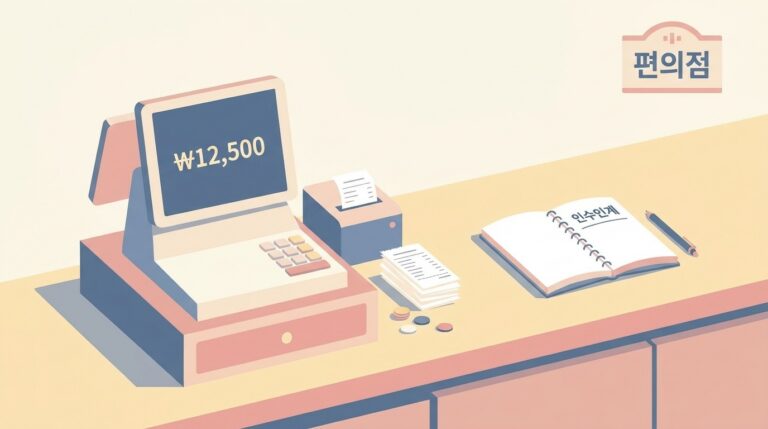
Imagine this classic K-drama scenario: It is 10:55 PM at a trendy 24-hour cafe in Yeonnam-dong or a bustling convenience store in Hongdae. Your feet are aching, the last customer just left with their iced Americano, and your shift ends at 11:00 PM. All you want to do is clock out, grab a midnight snack, and catch the last subway home. You hit “정산 (Register Closing)” on the POS screen, count the drawer coins and crisp blue thousand-won bills, and stare in utter disbelief. The screen flashes: -4,500 KRW.
Your stomach drops. Did you hand someone an extra five-thousand won bill by accident? Did someone pay with cash while you were rushing a delivery order? In Korean part-time jobs (알바 – alba), register discrepancies happen to literally everyone, whether you are a local college student or a brave international resident working your first gig in Seoul. The good news? Nobody expects you to be a flawless calculator machine on day one. What managers do care about is your honesty, your calm problem-solving attitude, and how clearly you document the situation in the shift handover note (인수인계 노트 – insu-in-gye noteu).
Based on real coaching sessions with dozens of expats working across Korea, mastering this specific moment will turn what could be an awkward reprimand into an opportunity to show your boss how reliable and communicative you are. Let’s make sure you never freeze in front of a blinking POS machine again!
Phase 2: Core 3 Expressions In-Depth
1. 만약 현금이 비거나 남으면 (Maneyak hyeongeumi bigeona nameumyeon)
- Pronunciation: mah-nyahk hyun-geum-ee bee-guh-nah nah-meum-yeon (Think of “bee” like the insect buzzing, and “nam” like yum with an N).
- Meaning: Literally “If cash is empty (short) or remains (over),” practically used as “If the cash count is short or in excess.”
- K-Culture Moment: You will hear this exact sentence when a friendly senior alba student trains a rookie during training shifts in youth workplace dramas like Backstreet Rookie (편의점 샛별이) or Start-Up.
- Editor’s Insight: The verb 비다 (bida, to be empty/vacant) is everyday store jargon for missing money or inventory. If your register is short 2,000 won, Korean staff naturally say “2,000원이 비어요” (I-cheon-won-i bieoyo). On the flip side, 남다 (namda) means surplus cash is left over.
- Situation Spectrum:
- Casual (반말): ⚠️ (Only with co-workers your age: 현금 비거나 남으면 알려줘)
- Semi-formal (존댓말 – 아/어요): ✅ (Standard polite for shift handovers and colleagues)
- Formal (격식체 – ㅂ/습니다): ✅ (Ideal for formal notes to the store owner/점장님)
- 🤔 Think About It: In many Western stores, even a tiny register surplus is swept under the rug as a “positive error.” Why do you think Korean register audits treat having extra money (남는 돈) with the exact same scrutiny as missing money (비는 돈)?
2. 결제 내역과 거스름돈 영수증을 대조해 봐요 (Gyeolje naeyeok-gwa geoseureumdon yeongsujeung-eul daejohe bwayo)
- Pronunciation: gyeol-je nae-yeok-gwa guh-seu-reum-don young-soo-jeung-eul dae-joh-hae bwah-yo (Focus on “dae-jo”: like “diet-jo”, meaning cross-checking/comparing).
- Meaning: Literally “Let’s cross-check the payment details and the change receipts.”
- K-Culture Moment: Seen in detective dramas or retail vlogs when colleagues lay out paper receipts in neat chronological stacks next to the glowing POS screen to spot where a manual transaction went wrong.
- Editor’s Insight: 대조하다 (daejohada) is a wonderfully professional B1 verb meaning to compare two sets of records side-by-side to verify accuracy. Instead of vaguely saying “영수증 다시 봐요” (Let’s look at the receipts again), saying “대조해 봐요” shows you know structured accounting protocol.
- Situation Spectrum:
- Casual: ⚠️ (To close peer: 영수증이랑 결제 내역 대조해 봐)
- Semi-formal: ✅ (Perfect for peer-to-peer instructions or proposing a solution)
- Formal: ✅ (대조해 보시기 바랍니다 / 대조하여 확인했습니다 in written reports)
- 🤔 Think About It: Modern Korea is nearly cashless, with credit cards and mobile pay taking up over 85% of transactions. How does this make rare cash mistakes even more visible during end-of-day balances?
3. 인수인계 노트에 꼼꼼히 적어 둘게요 (Insu-in-gye noteu-e kkomkkomhi jeogeo dulgeyo)
- Pronunciation: een-soo-een-gyeh noh-teu-eh kkoam-kkoam-hee juh-guh dool-geh-yo (Double consonant “kk” sounds tight, like the sharp “k” in ‘sky’).
- Meaning: “I will write it down meticulously in the handover notebook for the next shift.”
- K-Culture Moment: The iconic green-covered binder or KakaoTalk group chat log where store staff log damaged goods, VIP customer notes, and register differences before clocking out.
- Editor’s Insight: 꼼꼼히 (kkomkkomhi) is the ultimate resume and workplace power adverb in Korea! It conveys that you didn’t just scribble a note; you checked the details with high diligence. The pattern -아/어 둘게요 adds the warm nuance of “I will take care of this in advance for your benefit.”
- Situation Spectrum:
- Casual: 🚫 (Sounds overly formal for buddies unless jokingly professional)
- Semi-formal: ✅ (The golden standard for communicating with the next shift worker)
- Formal: ✅ (인수인계장에 상세히 기재해 두겠습니다)
- 🤔 Think About It: How does documenting mistakes openly in a communal handover note reflect the Korean value of “not passing inconvenience to the next person” (배려 / 피해 주지 않기)?
Phase 3: Textbook Korean vs Real Korean
Scenario 1: Reporting a Cash Shortage
- 📖 Textbook Korean: 정산 금액에 오차가 발생하여 금액이 부족합니다. (Jeongsan geumaeg-e ochaga balsaenghayeo geumaeg-i bujokhambnida. / An error occurred in the settlement amount, causing a cash deficiency.)
- 🗣️ 진짜 한국어 (Real Korean): 정산해 보니까 현금이 3천 원 정도 비어요. (Jeongsanhae bonikka hyeon-geum-i sam-cheon won jeongdo bieoyo. / I ran the register closing, and cash is short by about 3,000 won.)
- 💡 왜 다를까? (Why is it different?): Native Korean staff rarely use stiff words like 오차 (mathematical error) or 부족 (insufficiency) during spoken closing shifts. The active verb 비다 (to be missing/short) is instantly understood and sounds like practical, on-the-ground communication.
Scenario 2: Leaving a Note for the Owner/Senior
- 📖 Textbook Korean: 차기 근무자에게 전달 사항을 기록하겠습니다. (Chagi geunmujayege jeondal sahangeul girok-hagesseumnida. / I will record the delivery matters for the next worker.)
- 🗣️ 진짜 한국어 (Real Korean): 다음 타임 분 보시게 인수인계장에 메모 남겨 둘게요! (Daeum taim bun bosige insu-in-gye-jang-e memo namgyeo dulgeyo! / I’ll leave a memo in the handover log so the next shift person can see it!)
- 💡 왜 다를까? (Why is it different?): Korean part-timers naturally refer to the next worker as “다음 타임 분” (the person on the next shift) rather than the legalistic 차기 근무자. Using -게 (so that they can see) displays polite empathy.
Phase 4: K-Culture Deep Dive & Non-Verbal Manners
4-1. 눈치 (Nunchi) & Body Language: Handling the Register Under the Camera
When your register does not balance, your physical posture speaks louder than your words:
1. The CCTV Angle: Never count cash hiding behind the counter or under the desk. In Korea, every register has a security camera directly overhead for everyone’s protection. Count bills on top of the counter, flattening them with both hands (두 손) in plain sight of the camera.
2. Double Verification: Count twice: first by bills in groups of ten, then coins in stacks. If you realize an amount is off, do not immediately text your boss “Help!” with question marks. First, pull the paper batch tape (마감 영수증) and verify that all cash transactions on screen match the receipts in the tray.
3. Handing Over Receipts: When clipping the receipts to the handover binder, point the note right side up facing the reader, and use both hands if handing it in person to a shift manager.
4-2. The “Part-Timer Ecosystem” (알바 문화) in Korea
In South Korea, doing an alba is a rite of passage for university students, working holidaymakers, and young adults. Because Korean society places intense emphasis on speed and precision (빨리빨리 + 꼼꼼함), register handover logs are treated with serious respect. If a register is short 1,000 KRW (less than $1 USD), the store owner rarely gets angry about the money itself; what causes friction is when a worker leaves without mentioning it, forcing the morning staff to wonder if they lost it. Transparency builds unbeatable trust in Korean workplaces.
Phase 5: Real Roleplay Scenario
- Setting: 10:50 PM at a cozy franchised bakery-cafe in Mapo-gu. The closing chime is playing softly. You are closing with the seasoned senior part-timer, 민지 (Minji).
민지: 오늘 마감 시재 점검 다 끝났어요? (Oneul magam sijae jeomgeom da kkeun-nasseoyo?)
(Did you finish today’s closing cash count?)
You: 🎭 (Scratching your head with a worried expression, looking down at the till)
어… 방금 맞춰 봤는데, 현금이 5천 원 정도 비어요. (Eo… banggeum matchwo bwanneunde, hyeon-geum-i o-cheon won jeongdo bieoyo.)
(Uh… I just balanced it, but the cash seems short by about 5,000 won.)
민지: 5천 원이요? 혹시 거스름돈 잘못 나간 거 아닐까요? (O-cheon won-iyo? Hoksi geoseureumdon jalmot nagan geo anilkkayo?)
(5,000 won? Could it be that change was given out incorrectly?)
You: 🎭 (Calmly spreading the cash receipts beside the POS screen)
그럴 수도 있어요. 만약 현금이 비거나 남으면 결제 내역과 거스름돈 영수증을 다시 한번 대조해 보라고 하셨죠? (Geureol sudo isseoyo. Maneyak hyeongeumi bigeona nameumyeon gyeolje naeyeok-gwa geoseureumdon yeongsujeung-eul dasi hanbeon daejohe borago hasyeotjyo?)
(That could be. You told me that if cash is short or over, we should cross-check today’s cash transactions and change receipts once more, right?)
민지: 맞아요! 포스기에서 오늘 현금 영수증 재출력해서 같이 확인해 봐요. (Majayo! Poseugi-eseo oneul hyeon-geum yeongsujeung jaechullyeok-haeseo gachi hwaginhae bwayo.)
(Exactly! Let’s reprint today’s cash receipts from the POS and check together.)
You: 🎭 (Tapping the POS screen together and pointing at a manual transaction entry)
아! 3시쯤에 현금 영수증을 두 번 승인 취소한 내역이 있네요. (A! Se-si-jjeum-e hyeon-geum yeongsujeung-eul du beon seung-in chwisohan naeyeog-i itneyo.)
(Ah! Around 3 PM, there is an entry where a cash receipt cancellation was processed twice.)
민지: 찾았다! 실제 돈을 잃어버린 게 아니라 전산 입력 실수였네요. 다행이에요! (Chajatda! Silje don-eul ireobeorin ge anira jeonsan ipryeok silsu-yeotneyo. Dahaeng-ieyo!)
(Found it! So actual money wasn’t lost; it was just a computer entry error. What a relief!)
You: 🎭 (Taking out the store handover binder and picking up a pen)
정말 다행이에요. 점장님이랑 내일 오픈 근무자분 보시게 인수인계 노트에 꼼꼼히 적어 둘게요. (Jeongmal dahaeng-ieyo. Jeomjang-nim-irang naeil opeun geunmujapun bosige insu-in-gye noteu-e kkomkkomhi jeogeo dulgeyo.)
(Such a relief. I will write it down meticulously in the handover notebook so the store manager and tomorrow’s opening shift worker can see it.)
🔀 Interactive Decision Point!
You notice the cash drawer has 1,000 won extra right before leaving. What should you do?
- Option A: Slip the 1,000 won coin into the store tip jar or your pocket since “extra money doesn’t hurt anyone.”
- Feedback: 🚫 Bad Choice! Korea’s strict business ethics and ubiquitous CCTV will treat this as workplace embezzlement, regardless of how small the amount is.
- Option B: Leave the money in the register without saying a word, assuming the morning shift will balance it out.
- Feedback: ⚠️ Risky! The morning staff will face an unexplainable mismatch during their open-balance check and may suspect bookkeeping negligence on your shift.
- Option C: Write “+1,000 KRW surplus during closing check, receipts cross-checked” in the handover note and inform the manager via text.
- Feedback: ✅ Best Choice! This showcases absolute integrity and professional maturity, cementing you as a top-tier trusted employee.
Phase 6: 10-Second Emotion Shadowing Drill
Practice speaking with authentic emotion and natural pauses (/)!
[😰 당황스럽지만 차분하게 / Flustered but trying to stay composed]
포스기 정산 금액이랑 / 실제 현금이 / 3천 원 정도 안 맞아요. / 다시 세어 볼게요.
(Poseugi jeongsan geumaeg-irang / silje hyeon-geum-i / sam-cheon won jeongdo an majayo. / Dasi seeo bolgeyo.)
“The POS closing amount and / the actual cash / don’t match by about 3,000 won. / I will count it once more.”-
[💡 침착하고 해결 중심적으로 / Calm and solution-oriented]
만약 현금이 비거나 남으면 / 영수증 내역을 / 하나씩 대조해 보면 돼요!
(Maneyak hyeongeumi bigeona nameumyeon / yeongsujeung naeyeog-eul / hanassik daejohe bomyeon dwaeyo!)
“If the cash is short or over, / we can just cross-check / the receipt history one by one!” -
[🤝 든든하고 신뢰감 있게 / Dependable and trustworthy]
걱정하지 마세요, / 제가 인수인계 노트에 / 사유를 꼼꼼히 적어 둘게요.
(Geokjeonghaji maseyo, / jega insu-in-gye noteu-e / sayureul kkomkkomhi jeogeo dulgeyo.)
“Don’t worry, / I will write down the reason / meticulously in the handover notebook.”
Phase 7: K-Culture Mini Dictionary
-
시재 점검 (Sijae Jeomgeom)
- Meaning: Cash Drawer Audit / Balance Inspection
- Usage: Essential store vocabulary. Morning shift does 오픈 시재 (opening cash count), and night shift completes 마감 시재 (closing register count).
- 빵꾸 (Ppang-kku) / 마이너스 (Maineoseu)
- Meaning: A hole / shortfall (slang)
- Usage: While 빵꾸 originated from the Japanese word for puncture (panku), young Korean workers commonly use it to mean a register deficit: “오늘 시재 5천 원 빵꾸 났어” (We’re short 5,000 won today). Use this casually with friends, but stick to 비다 (to be short) with managers!
- 인수인계 (Insu-in-gye)
- Meaning: Handover / Takeover of duties
- Usage: A foundational business term throughout Korean society. Composed of 인수 (taking over) and 인계 (handing off). In cafes and shops, the handover note is called 인수인계장.
- 영수증 재출력 (Yeongsujeung Jaechullyeok)
- Meaning: Receipt Reprinting
- Usage: The emergency button on every Korean POS system (포스기). If a paper receipt jammed or a cash dispute arises, you tap this function to cross-check sales.
Phase 8: Traveler & Alba Survival Kit
Top 3 Survival Expressions
- 현금영수증 필요하세요? (Hyeon-geum-yeong-su-jeung piryohaseyo?)
- Pro Tip: When customers pay cash in Korea, by law you must offer a tax-deductible Cash Receipt. Ask this with a warm smile!
- 마감 정산 확인 부탁드립니다. (Magam jeongsan hwag-in butakdeurimnida.)
- Pro Tip: Use this formal phrase when texting your store owner at the end of the shift with the attached photo of the POS tally slip.
- 잔돈(거스름돈) 500원 여기 있습니다. (Jandon/geoseureumdon o-baek-won yeogi isseumnida.)
- Pro Tip: Hand coins over with both hands cupped slightly to prevent dropping them on the counter.
Editor’s Travel & Alba Note
If you plan to live, study, or work in South Korea, download the most reliable tools: you can search local part-time opportunities directly on Alba Heaven (알바천국) mobile portal and navigate your commute using Naver Map app for public transit. Remember: Korean bus and subway systems are strictly card-based now, meaning customers carrying paper cash are often tourists or elderly residents, so handle cash register interactions with extra patience!
Phase 9: “한 발 더 깊이” (Going Deeper: Cultural Insight)
In Western corporate cultures, individual shifts are often heavily siloed—what happens during your 4-hour window is strictly your liability, and once you clock out, your responsibility ends. In Korea, however, a store is viewed as an interconnected communal ecosystem (공동체). The 인수인계 노트 (handover log) is not just a ledger of facts; it is an act of consideration (배려) toward the person taking your spot. When you take the extra three minutes to explain why the register is 1,000 won off, you save your teammate 30 minutes of anxiety tomorrow morning. Workplace harmony in Korea is built on these tiny, thoughtful bridges.
💬 Your Turn: Have you ever experienced a cash mismatch while traveling or working abroad? How do businesses handle register shortages in your home country? Tell us your story in the comments below!
Phase 10: FAQ & Common Mistakes
Q: What should I do if the cash drawer is short by a large amount (e.g., over 30,000 KRW) and I cannot find the receipt?
A: Do not panic, and do not try to cover it out of your own wallet immediately! Call or message your store manager (점장님) right away. Calmly state: “정산 중 3만 원 차이가 나서 영수증을 대조해 보았는데 원인을 찾지 못했습니다. CCTV 확인이 필요할 것 같습니다.” (There is a 30,000 won difference during closing and I cross-checked receipts but couldn’t find the cause. We may need to check the CCTV.) Honesty protects you.
Q: Can I use the word “빵꾸” (ppang-kku) when messaging my store manager?
A: It is best to avoid it in messages to supervisors. While common among casual peer part-timers, writing “시재 5천 원 빵꾸 났습니다” can sound unprofessional. Instead, write “시재 정산 결과 5,000원의 차액(부족분)이 발생했습니다.”
Q: Why do Korean customers ask for “현금영수증” (Cash Receipts) if they already took the credit card-style receipt?
A: In Korea, a 현금영수증 (Cash Receipt) is directly tied to the National Tax Service for year-end personal income tax deductions. Customers will input their mobile phone number into the pin pad so the government registers their cash spending.
🚨 흔한 실수 (Common Mistakes) Warning Board
- Mistake: Throwing away duplicate or cancelled paper receipts during a busy rush.
- Correct Action: Always spear them onto the receipt spindle (영수증 꽂이) or save them under the drawer till the end of the shift for cross-checking.
- Mistake: Handing out cash change with one hand while typing with the other.
- Correct Action: Place both hands forward when giving change to customers. In Korea, one-handed cash handoffs can be seen as dismissive.
- Mistake: Hiding an unbalanced register balance in the handover note hoping nobody notices.
- Correct Action: Always record:
[마감 시재: -2,000원 (영수증 대조 완료/특이사항 메모)]. Transparency earns respect.
- Correct Action: Always record:
Phase 11: Action Missions & Community Engagement
- 🥉 Bronze Mission (Solo Practice): Read the Unit sentence out loud 5 times in front of a mirror: “만약 현금이 비거나 남으면 오늘 현금 결제 내역과 거스름돈 영수증을 다시 한번 대조해 봐요.”
- 🥈 Silver Mission (Social Share): Write your own sample handover note in Korean for an imaginary cafe in the comments below. Include today’s date, closing balance status, and a polite closing remark!
- 🥇 Gold Mission (Real-Life Application): Next time you visit a convenience store or cafe in Korea and pay with cash, listen closely for the cashier asking “현금영수증 해드릴까요?” and answer politely in Korean: “아니요, 괜찮습니다!” (No, it’s okay!) or “네, 휴대폰 번호 입력할게요!” (Yes, I’ll enter my phone number!).
- 🎮 K-Culture Mission: Watch an episode of a workplace or part-time themed K-drama (like Clean with Passion for Now or Backstreet Rookie) and spot when workers check the counter binder or POS machine!
Phase 12: Interactive Quiz Challenge
Test what you have learned today! Click on the toggle boxes below to check your answers.
1. Situational Judgment
You are doing the register closing and discover that you have 2,000 won more than the POS system calculated. Which action is the most culturally and professionally appropriate?
* (A) Quietly take the 2,000 won since the register is not at a loss.
* (B) Log the surplus in the handover note, cross-check the cash transaction history, and notify the manager.
* (C) Delete a random transaction from the POS so the numbers equal out.
👉 Click here to reveal the Answer & Explanation
Correct Answer: (B)
Explanation: In Korean business protocol, unexplained surplus cash (남는 돈) must be logged and cross-checked against receipts just like a shortage. Modifying electronic records or pocketing cash violates basic workplace rules.
2. Fill-in-the-Blank
Fill in the missing Korean word:
“만약 현금이 비거나 ________ 오늘 현금 결제 내역과 영수증을 대조해 봐요.”
(Hint: The opposite of 비다 / meaning ‘to remain or be left over’)
👉 Click here to reveal the Answer & Explanation
Correct Answer: 남으면 (nameumyeon)
Explanation: The sentence uses the verb 남다 (to remain/surplus) combined with the conditional grammar -으면 (if/when).
3. True / False Cultural Check
True or False: When counting money at a Korean retail store counter, it is considered polite to count the cash out of sight under the counter so customers do not feel uncomfortable.
👉 Click here to reveal the Answer & Explanation
Correct Answer: False!
Explanation: Cash must always be counted clearly on top of the counter directly under the CCTV camera. This protects both the customer and the part-time worker from misunderstandings or accusations of mishandling funds.







