

Phase 1: Empathy (Story-Driven Opening)
안녕하세요! I am your Daily Hangul editor, your personal Korean cultural navigator! Have you ever had that heartbreaking moment in a cozy Hongdae cafe or under the neon lights of a Seoul convenience store when your Korean friend drops their head onto the table, sighs deeply, and whispers that everything is going wrong? Maybe they bombed an important job interview, failed a college exam, or just feel completely burned out by the fast-paced Ppalli-Ppalli lifestyle.
You want to hug them with words. You want to say, “Hey, I’ve got your back no matter what. Don’t lose hope!” But your mind freezes. The only word that pops into your head is a textbook-style Himnaeseyo (힘내세요), which sometimes sounds like a generic cheer at a sports match rather than deep, soul-healing comfort.
Don’t worry! Real warmth in Korean isn’t about using complex grammar. It’s about showing that you belong to the same team. In this guide, built on real feedback from hundreds of elementary learners, you will master the exact emotional phrases that make your Korean friends tear up with gratitude. Let’s learn how to say: “I am always on your side!”
Phase 2: Top 3 Core Expressions for Warm Comfort
1. 난 언제나 네 편이야 (Nan eonjena ne pyeon-iya)
- Pronunciation: [Nan eon-je-na ne pyeon-i-ya] (Sounds like “Nan un-jeh-nah neh pyun-ee-yah”)
- Meaning: Literal: “I am always your side” | Real Nuance: “No matter what happens, I’m in your corner.”
- K-Culture Moment: You hear this in every emotional K-Drama climax (like Twenty-Five Twenty-One or Itaewon Class) when the lead character faces public criticism and their closest friend quietly stands beside them.
- Editor’s Insight: The magic word here is 편 (pyeon), which means “side” or “team.” In Korean culture, shifting from an outsider to being on someone’s pyeon is the ultimate sign of unconditional loyalty.
- Situation Spectrum: Casual: ✅ | Semi-formal: ⚠️ (Use: 저는 언제나 OO 씨 편이에요 / Jeoneun eonjena OO ssi pyeon-ieyo) | Formal: 🚫
- 🤔 Think About It: In English, we often say “I support you.” But Korean creates a physical team boundary: “I stand in your territory.” How does standing on someone’s side feel warmer than simply supporting them?
2. 기운 차려, 힘내! (Giun charyeo, himnae!)
- Pronunciation: [Gi-un cha-ryeo, him-nae!] (Sounds like “Gee-oon cha-ryuh, heem-neh!”)
- Meaning: Literal: “Collect your vital energy, draw your strength!” | Real Nuance: “Pull yourself together gently; you’ve got this!”
- K-Culture Moment: When an idol group member is visibly exhausted backstage during a grueling tour, members hand them a warm vitamin drink and softly tap their back saying this exact phrase.
- Editor’s Insight: Giun (기운) refers to your physical and spiritual energy. Saying giun charyeo isn’t a harsh order; it’s a caring reminder to breathe and gather your scattered spirit.
- Situation Spectrum: Casual: ✅ | Semi-formal: ⚠️ (Use: 기운 내세요 / Giun naeseyo) | Formal: 🚫
- 🤔 Think About It: Notice how Korean links emotional sadness directly with physical energy depletion. Have you felt your giun drop when feeling low?
3. 맛있는 거 먹으러 가자 (Masinneun geo meogeureo gaja)
- Pronunciation: [Ma-sin-neun geo meo-geu-reo ga-ja] (Sounds like “Mah-sheen-neun guh muh-geu-ruh gah-jah”)
- Meaning: Literal: “Let’s go eat something delicious.” | Real Nuance: “I see you’re suffering, so let me take care of your body and mind right now.”
- K-Culture Moment: In almost every slice-of-life drama, friends don’t talk through feelings immediately. Instead, they drag their friend to a spicy Tteokbokki stall or a warm Samgyeopsal grill.
- Editor’s Insight: For Koreans, food (bap) equals love and safety. Offering a meal is the most practical and beloved form of emotional first aid.
- Situation Spectrum: Casual: ✅ | Semi-formal: ⚠️ (Use: 맛있는 거 먹으러 가요 / Masinneun geo meogeureo gayo) | Formal: 🚫
- 🤔 Think About It: Why does sharing food feel more comforting than long philosophical advice when you are deeply overwhelmed?
Phase 3: Textbook Korean vs. Real Korean
Situation 1: Cheering someone up when they feel hopeless
- 📖 Textbook Korean: 기운을 내십시오. 당신은 잘할 수 있습니다. (Giuneul naesipsio. Dangsineun jalhal su itseumnida. / Please exert energy. You are capable of doing well.)
- 🗣️ Real Korean: 힘내! 넌 무조건 잘할 거야. (Himnae! Neon mujogeon jalhal geoya. / Hang in there! You will definitely do great, no doubt.)
- 💡 Why is it different? The textbook phrase sounds like an automated announcement on the subway. Real friends use absolute affirming adverbs like mujogeon (unconditionally / no matter what) to boost confidence.
Situation 2: Reassuring someone that they are not alone
- 📖 Textbook Korean: 저는 당신을 지지합니다. (Jeoneun dangsineul jijihamnida. / I support you.)
- 🗣️ Real Korean: 내가 네 편인 거 알지? (Naega ne pyeon-in geo alji? / You know I’m on your side, right?)
- 💡 Why is it different? Jijihada sounds like a political endorsement on the evening news! Turning your support into a gentle question (…alji?) invites emotional intimacy.
Phase 4: K-Culture Deep Dive & Non-Verbal Manners
4-1. Nunchi (눈치) & Comfort Gestures
When comforting a Korean friend, aggressive hugging or staring directly into their eyes while they cry can actually make them feel embarrassed (bukkureopda). Koreans value emotional dignity.
* The Shoulder Pat (토닥토닥 / Todak-todak): Sit side-by-side rather than face-to-face. Gently pat their upper shoulder or back with a cupped palm.
* The Eye Contact Rule: Look ahead at the street or your coffee cup while listening. This removes the pressure for them to keep their composure.
* Quiet Attentiveness: Offer a tissue without making a big scene. Small, considerate actions demonstrate elite-level Nunchi.
4-2. Cultural Code: The Healing Power of Comfort Food (소울푸드)
In Korea, emotional recovery often has a flavor profile. Spicy comfort foods like Yeopgi Tteokbokki or Dakbal (spicy chicken feet) are believed to sweat out emotional stress (seuteureseu pulda). Alternatively, warm bone broths like Seolleongtang symbolize restoration. When you say “I am on your side,” sealing it with a hot meal is the ultimate cultural gesture of Jeong (정 – deep affection).
Phase 5: Real-Life Roleplay Scenario
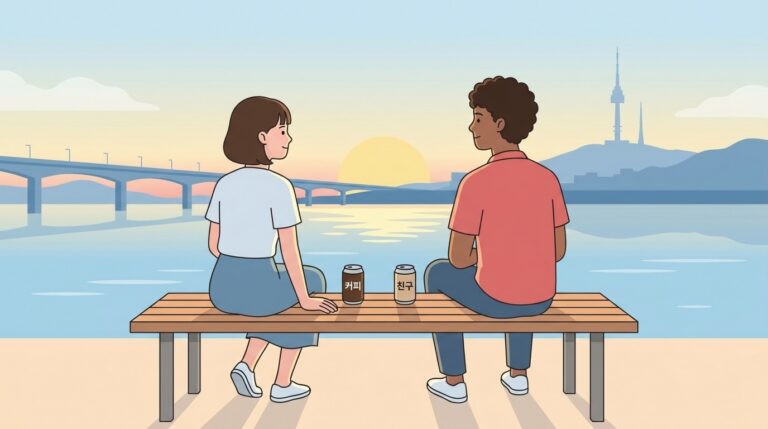
Setting: A chilly autumn evening on a bench by the Han River (Yeouido). Minho is sitting slumped over after his startup funding pitch was rejected.
- Turn 1 (Minho): 나 오늘 발표 완전 망쳤어… 다 끝난 것 같아. (Na oneul balpyo wanjeon mangchyeosseo… da kkeunnan geot gata.)
🎭 Looking down at his sneakers with drooping shoulders.
“I completely ruined the presentation today… It feels like everything is over.” - Turn 2 (You): 민호야, 너무 자책하지 마. (Minhoya, neomu jachaekhaji ma.)
🎭 Sitting down next to him and passing a warm can of coffee.
“Minho, don’t blame yourself so much.” - Turn 3 (Minho): 내가 준비를 더 열심히 했어야 했는데. (Naega junbireul deo yeolsimhi haesseoya haenneunde.)
🎭 Sighing deeply and holding the warm can with both hands.
“I should have prepared much harder.” - Turn 4 (You): 아니야. 너 진짜 최선을 다했잖아. (Aniya. Neo jinjja choeseoneul dahaetjana.)
🎭 Gently patting his back once.
“No way. You truly did your absolute best, you know that.” - Turn 5 (Minho): 사람들이 나를 무능하다고 생각할까 봐 무서워. (Saramdeuri nareul muneunghadago saenggakhalkka bwa museowo.)
🎭 Voice trembling slightly.
“I’m scared people will think I’m incompetent.” - Turn 6 (You): 남들이 뭐라 하든, 난 언제나 네 편이야. (Namdeuri mwora hadeun, nan eonjena ne pyeon-iya.)
🎭 Speaking in a calm, firm, and warm tone.
“Whatever other people say, I am always on your side.” - Turn 7 (Minho): …고마워. 네 말 들으니까 마음이 좀 놓인다. (…Gomawo. Ne mal deureunikka maeumi jom noinda.)
🎭 Wiping the corner of his eye and faintly smiling.
“…Thank you. Hearing you say that puts my mind at ease.” - Turn 8 (You): 기운 차려! 한강 라면 먹으러 가자. 내가 쏜다! (Giun charyeo! Hangang ramyeon meogeureo gaja. Naega ssonda!)
🎭 Standing up and offering a hand to pull him up.
“Cheer up! Let’s go grab Han River instant ramen. It’s on me!”
🔀 Interactive Choice Point: How will you react next?
- Option A: “괜찮아, 다 잘될 거야. 맛있는 거 먹자!” (Gwaenchana, da jaldoel geoya. Masinneun geo meokja!)
👉 Feedback (BEST): Empathetic, supportive, and transitions smoothly into healing comfort food. Perfect score! - Option B: “다음에는 더 일찍 준비하면 돼. 울지 마.” (Daeumeneun deo iljjik junbihamyeon dwae. Ulji ma.)
👉 Feedback (BAD): Too logical and dismissive! Giving unsolicited critique when someone is wounded hurts their feelings. - Option C: “나도 옛날에 실패한 적 있어. 내 얘기 들어볼래?” (Nado yennare silpaehan jeok isseo. Nae yaegi deureobollae?)
👉 Feedback (RISK): Sharing experiences can build empathy, but turning the spotlight onto yourself too quickly might make them feel unheard.
Phase 6: 10-Second Emotion Shadowing Drill
Read these out loud! Follow the rhythm breaks (/) and embody the bracketed emotions:
[🥺 Tender & Reassuring]
걱정하지 마, / 난 언제나 / 네 편이야. (Geokjeonghaji ma, / nan eonjena / ne pyeon-iya.)
(Don’t worry… / I am always… / on your side.)-
[💪 Energetic & Encouraging]
털어버리고 / 기운 차려! / 넌 할 수 있어! (Teoreobeorigo / giun charyeo! / Neon hal su isseo!)
(Shake it off / regain your energy! / You can do it!) -
[😊 Playful & Caring]
오늘 힘들었지? / 맛있는 거 먹고 / 힘내자! (Oneul himdeureotji? / Masinneun geo meokgo / himnaeja!)
(Tough day, right? / Let’s eat good food / and recharge!)
Phase 7: K-Culture Mini Dictionary
- 편 (Pyeon) | Noun: Side / Team / Corner
- Usage: Used with possessive words: Nae pyeon (my side), Ne pyeon (your side). In any Korean office or friend circle, knowing who is your pyeon is vital emotional security.
- 기운 (Giun) | Noun: Vital energy / Spirits / Strength
- Usage: When someone looks pale or depressed, Koreans say Giuni eopseo boyeo (You look drained of energy). Pairing it with charyeo means restoring that vital force.
- 위로 (Wiro) | Noun: Consolation / Comfort
- Usage: Wiroga doeda means “to feel comforted.” Sending a song or a heartfelt text message is often referred to as delivering wiro.
- 토닥토닥 (Todak-todak) | Onomatopoeia: Gently patting on the back
- Usage: Widely used in text messages as an emote: “힘내! 토닥토닥!” (Hang in there! Pat pat!). It visualizes affectionate physical reassurance.
Phase 8: Survival Kit for Travelers
Top 3 On-the-Go Comfort Expressions
- 괜찮아, 다 지나갈 거야. (Gwaenchana, da jinagal geoya.)
- Meaning: It’s okay, this too shall pass.
- Pro Tip: Use this when travel plans get ruined (e.g., missed the KTX train or got caught in a downpour).
- 오늘 진짜 고생 많았어. (Oneul jinjja gosaeng manasseo.)
- Meaning: You truly worked hard through great hardship today.
- Pro Tip: The ultimate phrase to end a tiring day of walking 20,000 steps with your travel buddy.
- 내가 도와줄 테니까 걱정 마. (Naega dowajul tenikka geokjeong ma.)
- Meaning: I will help you out, so don’t worry.
- Pro Tip: Perfect when your friend loses their T-Money card or can’t figure out self-checkout kiosks.
🧳 Editor’s Travel Note: When Plans Fall Apart in Seoul
If your friend has a meltdown during your trip, do not force them onto the crowded subway line 2 during rush hour. Instead, navigate to the nearest peaceful green space using the Naver Map App navigation guide. Find an instant Han River convenience store, use the self-cooking ramen machines, and order fried chicken through the Baedal Minjok food delivery guide. Hot soup by the water fixes 99% of travel blues!
Phase 9: “One Step Deeper” (Cultural Insight)
In Western languages, comfort often centers on the individual’s inner resilience: “You are strong enough to beat this.” In Korea, comfort centers on the collective collective safety net: “우리 (Uri – We)”. When you tell someone Nan ne pyeon-iya (I’m on your side), you are fundamentally declaring that their struggle is no longer an isolated battle. You are absorbing half of the weight.
Korea’s historical resilience against hardships (Han / 한) transformed into a culture where nobody is left to suffer entirely on their own if they have true companions. Being a friend in Korea means showing up with comfort food and standing shoulder-to-shoulder.
💬 Your Turn: What is the most comforting phrase someone has ever told you in your native language? Drop a comment below and let’s find its warmest Korean counterpart together!
Phase 10: FAQ & Avoiding Misunderstandings
Q: Can I use “파이팅 (Fighting!)” when someone is deeply grieving or crying?
A: Be careful! While Paiting is fantastic for tests, sports matches, and job interviews, it can sound overly aggressive or dismissive when someone is experiencing profound grief, loss, or depression. In heavy moments, replace Fighting with gentle phrases like 힘내 (Himnae) or 난 네 편이야 (Nan ne pyeon-iya).
Q: How do I say “I am on your side” to someone older or in a higher status?
A: Never use ne pyeon with elders, as ne (네) is informal “you.” Say: “제가 항상 응원하고 있습니다” (Jega hangsang eung-wonhago itseumnida / I am always rooting for you) or “언제나 팀장님 편입니다” (Eonjena timjangnim pyeon-imnida / I am always on your side, Team Leader).
Q: Does “밥 먹었어? (Did you eat?)” really mean they want to eat right now?
A: Not necessarily! Nine times out of ten, asking if you’ve eaten is simply a Korean greeting of care and emotional check-in. If they see you down, it doubles as an offer to nourish you.
🚨 Common Mistakes Alert
- Translating “Cheer up” as 기뻐해 (Gippeohae): Gippeohada means to feel joy. Telling a crying friend Gippeohae sounds like ordering them: “Be joyful right now!” Always use 힘내 (Himnae) or 기운 차려 (Giun charyeo).
- Using “당신 (Dangsin)” for “You”: Saying Dangsin pyeon-ieyo sounds either like a soap opera line between a married couple or an aggressive confrontation. Address your friend by their name + i/ya (e.g., Minho-ya, nan ne pyeon-iya).
- Over-promising with “다 괜찮아질 거야” without listening: Koreans value acknowledging the pain (gosaeng) before jumping to easy solutions.
Phase 11: Action Missions
- 🥉 Bronze Mission (Solo Shadowing): Stand before a mirror, place your hand on your own chest, and say with a warm smile: “기운 차려, 난 언제나 네 편이야!” three times.
- 🥈 Silver Mission (Digital Message): Send a KakaoTalk or Instagram DM to a friend who had a busy week with the text: “오늘 고생 많았어! 토닥토닥 푹 쉬어 (You worked so hard today! Pat pat, rest well)”.
- 🥇 Gold Mission (Real Life): Buy a warm drink or snack for a classmate, coworker, or friend who looks tired, hand it over, and say: “맛있는 거 먹고 힘내!”
- 🎮 K-Culture Mission: Watch one episode of a slice-of-life K-Drama (like Hospital Playlist or My Mister) and see if you can spot the character offering comfort food or tapping a friend’s back.
Phase 12: Interactive Quiz Challenge
Question 1: Situational Judgment
Your Korean friend just failed their driving test for the third time and is sitting on the curb looking devastated. Which phrase is the BEST and warmest response?
* A) 기뻐하세요! (Gippeohaseyo!)
* B) 민호야, 기운 차려. 내가 언제나 네 편인 거 알지? 맛있는 거 먹으러 가자. (Minhoya, giun charyeo. Naega eonjena ne pyeon-in geo alji? Masinneun geo meogeureo gaja.)
* C) 다음에는 더 일찍 일어나세요. (Daeumeneun deo iljjik ireonaseyo.)
🔍 Click to reveal Answer & Explanation
Correct Answer: B
Explanation: Option B combines empathy, reassurance of loyalty (ne pyeon), and the culturally beloved offer of comfort food! Option A improperly orders them to be happy, and Option C gives cold, unwanted advice.
Question 2: Fill in the Blanks
Fill in the missing words to say: “I am always on your side.”
* 난 ( ) 네 ( )이야.
🔍 Click to reveal Answer & Explanation
Correct Answer: 언제나 (eonjena) / 편 (pyeon)
Explanation: Eonjena means “always” and pyeon means “side/team.” Full sentence: 난 언제나 네 편이야 (Nan eonjena ne pyeon-iya).
Question 3: True or False Cultural Quiz
True or False: In Korea, when comforting a crying friend, making intense direct eye contact and giving a prolonged tight hug is always the most polite reaction.
🔍 Click to reveal Answer & Explanation
Correct Answer: False!
Explanation: Koreans value preserving emotional dignity. Gentle side-by-side seating, soft back patting (todak-todak), and giving them space to wipe their tears without staring shows proper Nunchi.







