

Phase 1: Empathy (Real Talk from Your Seoul Bestie)
안녕하세요! 매일한글 에디터입니다. (Hello! It’s your Daily Hangul editor.)
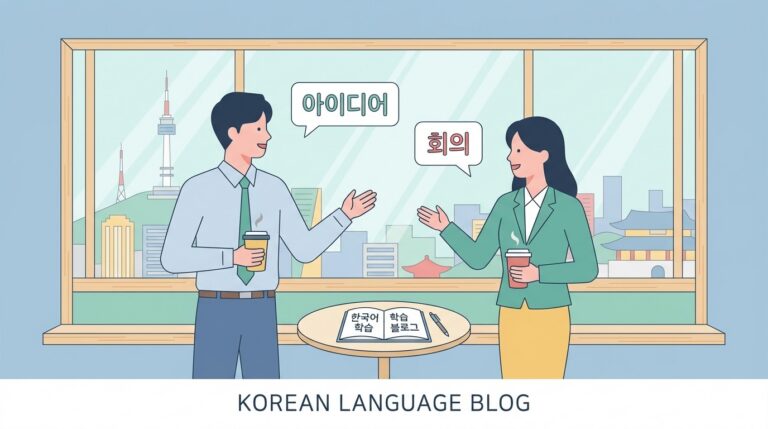
Picture this: You have been enjoying the pajama-friendly perks of working from home. But today is your required hybrid office day in Gangnam or Yeouido. If you watch K-dramas like Misaeng or Start-Up, you already know the vibe. Colleagues gather around the office pantry, iced Americanos in hand, sketching thoughts on clear glass boards and cracking jokes.
When working remotely behind Slack or Zoom, sending a quick “Do you have a minute?” can feel heavy, transactional, and exhausting. But the moment you step onto the office floor, you catch someone’s eye, exchange a smile, and suddenly solve a two-day roadblock in five minutes. That warm camaraderie is real, but intermediate learners often tell me: “Editor, how do I express that I actually enjoy bouncing ideas around face-to-face without sounding stiff or like a textbook robot?”
Based on real feedback from foreign professionals navigating Korean office life, this guide gives you the exact phrases, nuances, and workplace etiquette to turn in-person days into genuine relationship builders.
Phase 2: 3 Key Expressions for Hybrid Office Days
1. 얼굴 보고 이야기해요 (Eolgul bogo iyagihaeyo)
- Pronunciation: [Eol-gul bo-go i-ya-gi-hae-yo] (Sounds like all-ghoul bow-go ee-yah-ghee-hay-yo)
- Meaning: Literal: “Let’s look at faces and talk.” | Real Nuance: “Let’s discuss this face-to-face / in person.”
- K-Culture Moment: In modern workplace dramas like Search: WWW, whenever Slack threads drag on with endless text, someone always steps over to the desk and says, “우리 그냥 얼굴 보고 이야기해요!”
- Editor’s Insight: This is never an aggressive confrontation. In Korean culture, seeing someone’s eyes, micro-expressions, and breathing room signifies mutual trust and respect.
- Situation Spectrum:
- Casual: 얼굴 보고 얘기하자 (Eolgul bogo yaegihaja) ✅
- Semi-formal: 얼굴 보고 이야기해요 (Eolgul bogo iyagihaeyo) ✅
- Formal: 대면으로 논의하시지요 (Daemyeon-euro non-uihasijiyo) ⚠️ (Often reserved for external client proposals)
- 🤔 Think About It: Why do you think Korean communication places such deep value on physical presence when solving complex challenges, compared to async-first digital cultures?
2. 머리를 맞대고 고민해 봐요 (Meorireul matdaego gominhae bwayo)
- Pronunciation: [Meo-ri-reul mat-dae-go go-min-hae bwa-yo] (Sounds like muh-ree-reul maht-day-go go-mean-hay bwa-yo)
- Meaning: Literal: “Let’s touch heads and worry/think.” | Real Nuance: “Let’s put our heads together and brainstorm a solution.”
- K-Culture Moment: In Start-Up, whenever Sandbox founders hit an unexpected coding bug, the team huddles over sticky notes chanting, “우리 머리 맞대면 방법이 나올 거예요!”
- Editor’s Insight: The verb “맞대다” (to put together/touch closely) evokes visual warmth. It symbolizes collective ownership of a problem—you are never left stranded alone.
- Situation Spectrum:
- Casual: 머리 맞대보자 (Meori matdaeboja) ✅
- Semi-formal: 머리를 맞대고 고민해 봐요 (Meorireul matdaego gominhae bwayo) ✅
- Formal: 함께 지혜를 모아보겠습니다 (Hamkke jihyereul moabogesseumnida) ⚠️
- 🤔 Think About It: Notice the somatic metaphor of physical proximity (“heads touching”). How does your native language describe joint problem-solving?
3. 소속감이 들어요 (Sosokgami deureoyo)
- Pronunciation: [So-sok-ga-mi deu-reo-yo] (Sounds like soh-soke-gah-mee dew-ruh-yo)
- Meaning: Literal: “A feeling of belonging enters.” | Real Nuance: “I feel a sense of team belonging / I feel connected.”
- K-Culture Moment: In Hospital Playlist, when the squad sits together after a 14-hour shift sharing hot tteokbokki, they talk about how comforting it is to belong to this group.
- Editor’s Insight: Koreans use the verb “들다” (to enter/settle) for emotions that happen naturally to you. You do not force belonging; the communal atmosphere invites it in.
- Situation Spectrum:
- Casual: 소속감 들어 (Sosokgam deureo) ✅
- Semi-formal: 소속감이 들어요 (Sosokgami deureoyo) ✅
- Formal: 소속감을 강하게 느낍니다 (Sosokgameul ganghage neukkimnida) ✅
- 🤔 Think About It: In Korea, belonging (소속감) is directly tied to the concept of “우리” (we/our). How does physical presence foster belonging in your culture?
Phase 3: Textbook Korean vs. Real Korean
Situation 1: Suggesting a spontaneous quick sync at the desk
- 📖 Textbook Korean: 우리는 회의실에서 공식 회의를 진행해야 합니다. (Urineun hoe-uisireseo gongsik hoe-uireul jinhaenghaeya hamnida. – We must conduct an official meeting in the conference room.)
- 🗣️ Real Korean: 잠깐 5분만 싱크 맞춰볼까요? (Jamkkan o-bun-man singkeu matchwobolkkayo? – Shall we sync up for just 5 minutes?)
- 💡 Why the difference? Saying “공식 회의” (official meeting) makes people dread calendar overload. Real Korean tech and hybrid teams love the loanword “싱크 맞추다” (sync) or “가벼운 티타임” (light tea time) to lower pressure.
Situation 2: Expressing relief about discussing in person
- 📖 Textbook Korean: 사무실 출근은 의사소통 효율성을 향상시킵니다. (Samusil chulgeuneun uisasotong hyoyulseong-eul hyangsangsikimnida. – Commuting to the office improves communication efficiency.)
- 🗣️ Real Korean: 역시 직접 보니까 속이 다 시원하네요! (Yeoksi jikjeop bonikka sogi da siweonhaneyo! – Seeing you in person really clears everything up so fast!)
- 💡 Why the difference? Koreans love visceral body idioms. “속이 시원하다” (my stomach/chest feels refreshed and unburdened) captures the exact psychological relief of resolving confusing online messages face-to-face.
Phase 4: K-Culture Deep Dive & Non-verbal Manners
4-1. 눈치 (Nunchi) & Desk-Side Gestures
When initiating a quick chat in an open-plan Korean office, non-verbal manners make or break your interaction:
* The “Two-Handed Tumbler” Approach: When walking up to a teammate’s desk, carry your coffee tumbler or a notebook using both hands. Standing empty-handed with crossed arms can appear demanding.
* Lowered Posture: Never look down on someone who is seated. Squat down slightly or pull up an extra wheelie chair so your eye level matches theirs. Tilt your head forward 10 degrees to show attentive listening.
* Reading the Keyboard Sound (타자 소리 눈치): If a colleague is hammering their mechanical keyboard at lightning speed with their brow furrowed, their Slack status may say active, but their mind is in crisis. Wait until they pause for a water break.
4-2. The Secret Power of the “탕비실” (Office Pantry)
Forget stiff boardroom pitches. In Korean corporate culture, true bonding happens in the 탕비실 (Tangbisil) or during the sacred ritual of 식후 아아 (Sik-hu Ah-Ah: Post-lunch Iced Americano). Going to pick up takeout coffee in a group of 3 or 4 people allows hierarchy barriers to soften. Junior and senior colleagues freely exchange off-the-cuff product ideas, personal weekend plans, and funny memes. If you want to build team belonging, never skip the coffee walk!
Phase 5: Real-World Roleplay Scenario
Setting: A vibrant co-working floor in Seongsu-dong. Sunlight streams through large industrial windows. You (Alex, Marketing Strategist) are holding a warm latte. Subin (Senior UX Designer) is sketching app wireframes at her standing desk.
- Turn 1 (Subin): 알렉스 씨, 오늘 오프라인 출근 날이죠? 슬랙으로 공유한 와이어프레임 보셨어요? (Alex-ssi, oneul opeurain chulgeun narijyo? Seullaeg-euro gong-yuhan wayeopeureim bosyeosseoyo? – Alex, it’s your office day today, right? Did you see the wireframe I shared on Slack?)
- Turn 2 (Alex): 🎭 [Smiling warmly, pulling up a rolling chair] 네, 수빈 님! 텍스트로 보니까 감이 잘 안 왔는데, 직접 이야기 나누고 싶었어요. (Ne, Subin-nim! Tekseuteuro bonikka gami jal an wanneunde, jikjeop iyagi nanugo sipeosseoyo. – Yes, Subin-nim! Reading it via text didn’t give me the full picture, so I really wanted to chat in person.)
- Turn 3 (Subin): 맞아요. 역시 얼굴 보고 이야기해야 피드백이 빠르죠. 잠깐 탕비실 가서 커피 리필하고 회의 부스로 갈까요? (Majayo. Yeoksi eolgul bogo iyagihaeya pideubaegi ppareujyo. Jamkkan tangbisil gaseo keopi ripilhago hoe-ui buseuro galkkayo? – Exactly. Nothing beats face-to-face talk for fast feedback. Shall we refill our coffee in the pantry and head to a meeting booth?)
- Turn 4 (Alex): 🎭 [Nodding and walking together] 좋아요! 재택할 때는 혼자 끙끙 앓았는데, 출근하니까 머리를 맞댈 수 있어서 든든해요. (Joh-ayo! Jaetaekhal ttaeneun honja kkeungkkeung aranneunde, chulgeunhanikka meorireul matdael su iss-eoseo deundeunhaeyo. – Sounds great! When working remotely I was agonizing all by myself, but being in the office and putting our heads together feels so reassuring.)
- Turn 5 (Subin): 저도요! 모니터 너머로만 소통할 때는 좀 고립된 느낌이었는데, 이렇게 모이니까 진짜 한 팀 같은 소속감이 들어요. (Jeodoyo! Moniteo neomeoroman sotonghal ttaeneun jom goripdoen neukkim-ieonneunde, ireoke moinikka jinjja han tim gateun sosokgami deureoyo. – Same here! Communicating only through monitors felt isolating, but gathering like this gives a true sense of team belonging.)
- Turn 6 (Alex): 🎭 [Opening notebook with a pencil ready] 그럼 이번 신규 기능 카피라이팅부터 가볍게 털어볼까요? (Geureom ibeon sin-gyu gineung kapiraiting-buteo gabyeopge teoreobolkkayo? – Then shall we lightly hash out the copywriting for this new feature first?)
- Turn 7 (Subin): 완전 좋아요! 정답 찾으려 하지 말고, 알렉스 씨 아이디어 편하게 막 던져주세요. (Wanjeon joh-ayo! Jeongdap chajeuryeo haji malgo, Alex-ssi a-i-di-eo pyeonhage mak deonjyeojuseyo. – Love it! Don’t worry about finding the perfect answer right away, just toss out ideas freely.)
- Turn 8 (Alex): 🎭 [Taking a sip of coffee] 네! 서로 핑퐁 치면서 오늘 오전 안에 뼈대 완성해 봐요. (Ne! Seoro pingpong chimyeonseo oneul ojeon ane ppyeodae wanseonghae bwayo. – Yes! Let’s ping-pong ideas back and forth and finish the backbone this morning.)
🔀 Interactive Decision Point
You want to invite another teammate, Minho, who is wearing headphones at his desk, to join your quick 10-minute brainstorming session. What do you do?
- Option A: Walk up, tap his shoulder firmly, and say: “민호 씨, 바쁘신 건 알지만 1시간 동안 공식 회의 좀 하시죠.” (Minho-ssi, I know you are busy, but let’s have an official meeting for an hour.)
- Feedback [Bad]: Tapping headphones abruptly causes a startle reaction, and framing it as an “official 1-hour meeting” creates instant stress.
- Option B: Make gentle eye contact, wait for him to glance up, and say softly: “민호 님, 혹시 커피 한잔하시면서 10분만 가볍게 핑퐁 해볼 수 있을까요?” (Minho-nim, could we grab a coffee and lightly ping-pong ideas for 10 minutes?)
- Feedback [Best]: Exemplary nunchi! The combination of coffee, a time cap (10 minutes), and casual language (“핑퐁”) makes saying yes effortless.
- Option C: Send an urgent Slack DM saying: “슬랙 답장이 늦으셔서 직접 왔어요. 지금 당장 와이어프레임 봐주세요.” (You answered late on Slack so I came over. Check this wireframe right now.)
- Feedback [Risk]: Passive-aggressive. It weaponizes the physical office space to enforce digital surveillance.
Phase 6: 10-Second Emotion Shadowing Drill
Train your muscle memory with these emotional cadence markers (/ = brief breath pause):
[😊 Welcoming & Bright]
오랜만에 / 얼굴 보니까 / 진짜 좋네요!
(O-raen-ma-ne / eol-gul bo-ni-kka / jin-jja joh-ne-yo!)
“It’s so wonderful / to see your face / in person after so long!”-
[🤝 Confident & Reassuring]
우리 머리 맞대면 / 오늘 안에 / 금방 해결할 수 있어요.
(U-ri meo-ri mat-dae-myeon / o-neul an-e / geum-bang hae-gyeol-hal su iss-eo-yo.)
“If we put our heads together, / within today / we can solve this in no time.” -
[✨ Warm & Sincere]
사무실 나오니까 / 확실히 / 팀 소속감이 들어요.
(Sa-mu-sil na-o-ni-kka / hwak-sil-hi / tim so-sok-gam-i deu-reo-yo.)
“Coming into the office / definitely / gives me that feeling of team belonging.”
Phase 7: K-Culture Mini Dictionary
- 탕비실 (Tangbisil) [Office Pantry]: The holy grail of casual encounters. Equipped with instant coffee mix, carbonated water machines, and seasonal snacks, this room serves as the informal networking hub.
- 티키타카 / 핑퐁 (Tikitaka / Ping-pong) [Rapid Back-and-Forth Collaboration]: Borrowed from football and table tennis, this describes when ideas bounce back and forth smoothly between colleagues without awkward silences.
- 하이브리드 근무 (Ha-i-beu-ri-deu geun-mu) [Hybrid Work]: Combining remote work (재택근무) and office commutes (사무실 출근), which has become standard across Seoul IT hubs.
- 번개 티타임 (Beon-gae ti-ta-im) [Flash Tea Break]: “번개” means lightning. An impromptu 15-minute coffee run initiated on the spot to decompress.
Phase 8: Survival Kit for Travelers & Expats
TOP 3 Survival Phrases
- 잠깐 커피 한잔 하실래요? (Jamkkan keopi hanjan hasillaeyo?)
- Meaning: “Would you like to grab a quick coffee?”
- Pro Tip: The single best phrase to unlock an informal brainstorming session without booking a conference room.
- 얼굴 뵙고 인사드리고 싶었어요. (Eolgul boepgo insadeurigo sipeosseoyo.)
- Meaning: “I really wanted to greet you in person face-to-face.”
- Pro Tip: Perfect polite greeting when you meet a cross-functional teammate or senior leader on your office commute day.
- 자리 비우실 때 슬랙 남겨둘게요! (Jari biusil ttae seullaek namgyeodulgeyo!)
- Meaning: “If you step away from your desk, I will leave you a Slack message!”
- Pro Tip: Shows respect for their physical space so they don’t feel monitored at their desk.
Editor’s Travel & Commute Note
Navigating Seoul during peak commute hours (출근길) requires preparation! If you are commuting to shared offices in Teheran-ro or Pangyo, download the 네이버 지도 (Naver Map) 앱 to check accurate subway transfer times and bus arrival alerts. Keep a rechargeable physical T-money card or mobile transport card ready at turnstiles to avoid rush-hour bottlenecks.
Phase 9: One Step Deeper (Cultural Reflection)
In the West, workplace autonomy is frequently defined by individual boundary setting and solitude. But in Korea, organizational strength historically blooms from “정” (Jeong – deep emotional attachment) and “우리” (Uri – the collective identity). When everyone is isolated in their home offices, this communal fuel gradually empties. Going to the office is not just about physical surveillance; for many Koreans, sharing the same physical air, eating together, and nodding in real-time reaffirms that “we are enduring and building this journey together.”
💬 Your Turn: Do you feel more creative working solo from home, or do you thrive on the dynamic energy of working side-by-side with your team? Share your hybrid routine in the comments below!
Phase 10: FAQ & Avoiding Misunderstandings
Q: Can I use “얼굴 보고 이야기해요” with my team manager or director?
A: Yes, but soften it to formal honorifics: “팀장님, 혹시 시간 되실 때 대면으로 잠깐 상의드릴 수 있을까요?” (Team Leader, if you have a moment, could I consult with you in person?). Using “얼굴 보고 이야기해요” directly to executive directors can sound slightly too casual.
Q: What is the exact difference between 재택근무 and 원격근무?
A: 재택근무 (Jaetaek-geunmu) literally translates to “home-residence work” (working strictly from home). 원격근무 (Wongyeok-geunmu) means remote work from anywhere, including cafes, co-working spaces, or during workations in Jeju Island.
Q: How do Koreans say “brainstorming” in daily casual office talk?
A: While “브레인스토밍” is understood, it sounds like an academic workshop. Real teammates say “아이디어 회의” (idea meeting), “아이디어 좀 털어봐요” (let’s shake out some ideas), or “핑퐁 해봐요” (let’s ping-pong).
🚨 Common Mistakes Alert
- Mistake: Saying “우리 만나요!” (Uri mannayo!) to a colleague at their desk.
- Correct Action: “만나요” sounds like scheduling a romantic date or social meetup. Say “잠깐 이야기 나눌 수 있을까요?” (Jamkkan iyagi nanul su iss-eulkkayo? – Could we share a brief talk?).
- Mistake: Vanishing from the office for coffee without signaling nearby teammates.
- Correct Action: Give a friendly head nod and say “커피 한잔 뽑아올게요!” (I’ll go grab a cup of coffee and be right back!).
- Mistake: Switching to 반말 (casual speech) just because you had fun at lunch.
- Correct Action: Keep your polite 존댓말 (-요 / -습니다) intact until a senior colleague explicitly suggests “말 편하게 하세요” (feel free to speak comfortably).
Phase 11: Action Missions
- 🥉 Bronze Mission (Solo Practice): Stand in front of your mirror, smile, and practice saying “오랜만에 얼굴 보니까 진짜 좋네요!” 3 times with warm intonation.
- 🥈 Silver Mission (Social Connection): Post your favorite desk setup or hybrid work beverage on Instagram or your study community with the caption: “오늘도 머리를 맞대고 화이팅! #매일한글 #하이브리드근무”
- 🥇 Gold Mission (Real Life): Next time you collaborate with a Korean colleague or language partner, message them: “다음에는 사무실에서 얼굴 보고 이야기해요! (Let’s chat face-to-face in the office next time!)”
- 🎮 K-Culture Mission: Watch one episode of Misaeng (Incomplete Life) or Gaus Electronics. Spot how many times teammates resolve an issue around the instant coffee station rather than via formal email!
Phase 12: Interactive Quiz Challenge
Test your real-world Korean workplace intuition!
1. Situation Judgment: You see your colleague Subin staring blankly at a spreadsheet looking stuck. How do you naturally suggest tackling it together?
* A) “혼자 하지 말고 저랑 공식 미팅 잡으세요.”
* B) “수빈 님, 커피 한잔하면서 같이 머리 맞대볼까요?”
* C) “재택근무 안 하고 왜 출근하셨어요?”
2. Fill in the Blank:
“오랜만에 팀원들을 직접 만나니까 진짜 한 팀 같은 ( )이/가 들어요.”
* A) 소속감 (Sense of belonging)
* B) 피로감 (Sense of fatigue)
* C) 긴장감 (Sense of tension)
3. True or False:
In Korean hybrid work culture, suggesting “얼굴 보고 이야기해요” means you are angry and want to reprimand the other person.
* True / False
👉 Click here to reveal answers and explanations!
Answers:
1. B) “수빈 님, 커피 한잔하면서 같이 머리 맞대볼까요?” – Suggesting a coffee and using “머리를 맞대다” provides warm, peer-to-peer solidarity.
2. A) 소속감 – “소속감이 들어요” is the natural collocated phrase for feeling integrated into a team.
3. False – Far from being confrontational, “얼굴 보고 이야기해요” is an empathetic, high-context shortcut to reduce miscommunication and build connection!







