

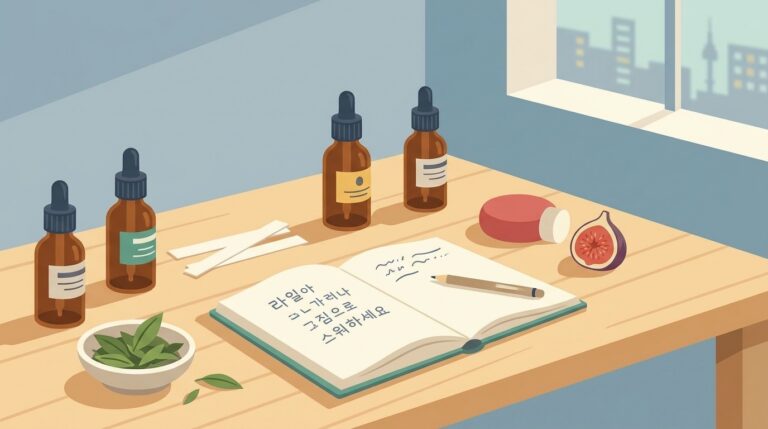
The Art of Heart Notes: Mastering Fragrance Vocabulary at a Seoul Niche Perfume Atelier
Phase 1: 공감 (Immersive Story Opening)
안녕하세요! 매일한글 에디터입니다. (Hello! This is your Daily Hangul editor.)
Picture this: You step off the vibrant, brick-paved streets of Seongsu-dong—Seoul’s bustling epicenter of bespoke pop-ups and indie aesthetics—and duck into a serene, sunlit perfume atelier. The interior smells heavenly: hints of damp cedarwood, dried botanical petals, and soothing green tea. A chic perfumer dressed in linen smiles warmly, gestures to dozens of brown apothecary dropper bottles, and asks you with genuine curiosity:
“어떤 느낌의 미들 노트를 생각하고 오셨어요?” (What kind of feeling are you envisioning for your middle notes?)
Suddenly, your mind races. You know basic Korean words for “good” (좋아요) and “flower” (꽃), but how do you capture that exquisite, ephemeral moment when the sharp alcohol burst clears away and the true heart of your fragrance emerges? In Korean perfumery, middle notes—lasting from one to three hours—are the emotional anchor of the entire scent. Whether you’re drawn to velvet damask rose, dreamy jasmine, sensual ylang-ylang, ripe fig (무화과), or roasted black tea (홍차), knowing the exact sensory verbs unlocks a magical creative dialogue.
Today, we’ve distilled years of classroom feedback from intermediate learners into this practical Seoul workshop guide. By the end of this lesson, you won’t just memorize terms—you will speak about fragrance with the nuance, emotional warmth, and sophistication of a true Seoul insider!
Phase 2: 핵심 표현 3선 심층 분석 (Deep Dive: Top 3 Core Expressions)
1. 알코올 향이 날아가다 (Alko-ol hyangi naragada)
- Pronunciation: [Al-ko-ol hyang-i na-ra-ga-da] (Sounds like: ahl-co-hole hyang-ee nah-rah-gah-dah)
- Meaning: Literal: “The alcohol scent flies away.” | Nuance: The initial sharp, stinging alcohol blast evaporates, clearing the stage for the true heart notes.
- K-Culture Moment: On beauty YouTube vlogs or idol “Get Ready With Me” clips, creators always wave a fragrance strip gently and say, “알코올 날아갈 때까지 10초만 기다려요” (Wait just 10 seconds until the alcohol flies off).
- Editor’s Insight: Koreans frequently use the verb 날아가다 (to fly away) for sensory phenomena that dissipate into the air—like steam, smoke, or volatile vapors. It sounds much more natural and dynamic than using technical terms like 증발하다 (to evaporate).
- Situation Spectrum:
- Casual: ✅ (알코올 날아가면 진짜 좋아!)
- Semi-formal: ✅ (알코올이 날아간 뒤에 다시 맡아보세요.)
- Formal: ✅ (알코올 향이 날아간 후 미들 노트가 전개됩니다.)
- 🤔 Think About It: In English, we say “the alcohol wears off or dries down,” but Korean views it as literally taking flight (날아가다). What does this reveal about how physical movement is mirrored in Korean sensory descriptions?
2. 중심을 잡다 (Jungsim-eul japda)
- Pronunciation: [Jung-sim-eul jap-da] (Sounds like: joong-sheem-ool jahp-dah)
- Meaning: Literal: “To catch/hold the center.” | Nuance: To anchor the composition, serve as the backbone, or provide emotional stability to a blend.
- K-Culture Moment: In design competitions and gourmet cooking shows like Culinary Class Wars, judges frequently evaluate whether the core ingredient “중심을 잘 잡고 있는지” (is anchoring the dish’s identity firmly).
- Editor’s Insight: In perfumery, top notes vanish quickly, and base notes linger subtly. The middle note is the hero that 중심을 잡다—anchoring vibrant florals or bittersweet black tea so the fragrance feels cohesive rather than chaotic.
- Situation Spectrum:
- Casual: ✅
- Semi-formal: ✅
- Formal: ✅
- 🤔 Think About It: In Korean society, balance and staying grounded are celebrated virtues. Notice how 중심을 잡다 applies seamlessly to physical balance, fragrance architecture, and mental composure.
3. 은은하게 퍼지다 (Euneun-hage peojida)
- Pronunciation: [Eun-eun-ha-ge peo-ji-da] (Sounds like: oon-oon-hah-geh puh-jee-dah)
- Meaning: Literal: “To spread delicately / diffuse softly.” | Nuance: A scent that radiates gently without suffocating the room—the hallmark of refined Korean fragrance aesthetics.
- K-Culture Moment: Characters in K-dramas admiring someone’s sweater or scarf often whisper, “좋은 향이 은은하게 퍼지네…” (A lovely scent is drifting so softly).
- Editor’s Insight: Never describe your ideal perfume as simply 강하다 (strong/heavy). In modern Korea, heavy sillage can be seen as intrusive. 은은하다 (subtle, soft, refined) is the golden standard of complimenting someone’s scent.
- Situation Spectrum:
- Casual: ✅
- Semi-formal: ✅
- Formal: ✅
- 🤔 Think About It: Why does Korean emphasize subtlety (은은함) over loudness in shared public spaces like cafes and the subway?
Phase 3: 교과서 한국어 vs 진짜 한국어 (Textbook vs. Real-Life Korean)
Situation 1: Describing a floral heart note
- 📖 교과서 한국어 (Textbook): 이 꽃 냄새는 정말 강하고 좋습니다. (I kkot naemsaeneun jeongmal ganghago joseumnida.) — “This flower smell is very strong and good.”
- 🗣️ 진짜 한국어 (Real-Life): 장미 향이 너무 튀지 않고 은은하게 감돌아요. (Jangmi hyangi neomu twiji anko euneunhage gamdorayo.) — “The rose note isn’t overly loud; it just lingers softly.”
- 💡 왜 다를까? (Why is it different?): Koreans distinguish between 냄새 (general odor/smell) and 향 (refined fragrance/aroma). Furthermore, intermediate speakers use 튀지 않다 (not sticking out awkwardly) and 감돌다 (to linger gently in the air) to express sophisticated restraint.
Situation 2: Requesting black tea and fig middle notes
- 📖 교과서 한국어 (Textbook): 저는 차와 과일 향기를 섞고 싶습니다. (Jeoneun chawa gwail hyanggireul seokgo sipsumnida.) — “I want to mix tea and fruit scents.”
- 🗣️ 진짜 한국어 (Real-Life): 달달한 무화과에 쌉싸름한 홍차 향을 얹어서 중심을 잡고 싶어요. (Daldalhan muhwagwa-e ssapssareumhan hongcha hyangeul eonjeoseo jungsimeul japgo sipeoyo.) — “I’d love to layer bittersweet black tea over sweet fig to anchor the middle notes.”
- 💡 왜 다를까? (Why is it different?): Instead of dry technical verbs like 섞다 (to mix), artisan workshops frequently use sensory pairings like 달달하다 (sweet & pleasant), 쌉싸름하다 (pleasantly bittersweet), and 얹다 (to layer atop).
Phase 4: K-Culture 딥다이브 & 비언어적 매너 (K-Culture Deep Dive & Non-Verbal Manners)
4-1. 눈치 (Nunchi) & Atelier Body Language
- The Scent Strip Protocol: When the instructor dips a testing strip (시향지, sihyangji) into essential oils, do not shove it directly under your nose immediately. Hold the dry end, gently waft it 5–10 cm from your nose, and wait 15 seconds for the top alcohol note to disperse. Close your eyes slightly and inhale slowly—this signals to the perfumer that you appreciate the complexity of their ingredients.
- The Coffee Bean Reset: If your nose gets overwhelmed by heavy florals, you will see a small jar of roasted coffee beans (원두). Never lean over and huff violently. Pick up the jar with both hands, sniff gently twice, smile, and replace it gently on the wooden tray. This mindful gesture shows impeccable manners (매너).
4-2. Cultural Code: The Cult of “살냄새” (Skin Scents)
In South Korea, high-density communal living and daily commutes on crowded subways (like Seoul Metro Line 2) have created a unique olfactory culture. Aggressive, room-filling oriental perfumes can be considered 민폐 (minpye, an inconvenience to others). Instead, the Korean market is obsessed with 살냄새 (sal-naemsae)—fragrances that blend with your personal skin chemistry to smell like clean, warm, freshly washed skin. Middle notes featuring comforting black tea, soft fig pulp, and delicate white jasmine are celebrated because they feel intimate, cozy, and considerate.
Phase 5: 실전 롤플레이 시나리오 (Real-Life Roleplay Scenario)
- Location: 아틀리에 숨 (Atelier Soom), an indie perfumery workshop tucked in a quiet alley of Seongsu-dong.
- Characters: Minji (조향사 민지 – Warm, detail-oriented master perfumer) & Alex (알렉스 – Intermediate learner crafting a signature scent).
- 민지: “알렉스 님, 탑 노트가 날아간 뒤 1~3시간 동안 향수의 주제를 보여줄 미들 노트를 골라볼까요?”
(Alex-nim, shall we choose the middle note that reveals your perfume’s core theme for 1 to 3 hours once the top notes fade?)
🎭 손끝으로 장미, 자스민, 홍차 오일 병을 가리키며 -
알렉스: “네! 너무 화려한 꽃향기보다는, 마음이 차분해지는 향이면 좋겠어요.”
(Yes! Rather than an overly loud floral, I’d prefer a scent that calms the mind.)
🎭 두 손을 무릎에 모으고 차분하게 눈을 맞추며 -
민지: “그렇다면 은은한 자스민에 쌉싸름한 홍차 향을 더해 중심을 잡아보는 건 어떨까요?”
(In that case, how about adding bittersweet black tea to delicate jasmine to anchor the heart?)
🎭 시향지에 오일을 한 방울 떨어뜨려 건네며 -
알렉스: “홍차 향이요? 차분하면서도 깊이가 있어서 정말 매력적일 것 같아요!”
(Black tea? It sounds so charming because it is calm yet full of depth!)
🎭 기대에 찬 표정으로 시향지를 받아들며 -
민지: “시향지를 가볍게 흔들어 알코올 향이 날아간 뒤에 천천히 맡아보세요.”
(Gently wave the scent strip and smell it slowly after the alcohol scent flies away.)
🎭 손목을 살랑살랑 흔드는 시범을 보이며 -
알렉스: “와, 알코올이 날아가니까 달달한 무화과와 홍차 향이 은은하게 퍼지네요.”
(Wow, as the alcohol flies off, the sweet fig and black tea aromas diffuse so softly.)
🎭 눈을 감고 미소를 지으며 깊게 숨을 들이쉬며 -
민지: “어머, 표현이 정말 섬세하세요! 미들 노트의 중심이 아주 탄탄하게 잡혔어요.”
(Oh my, your description is so delicate! The center of your middle note is anchored solidly.)
🎭 박수를 작게 치며 흐뭇하게 바라보며 -
알렉스: “선생님 덕분이에요. 이 조합으로 비율을 맞춰보고 싶어요!”
(It’s all thanks to you, teacher. I’d love to balance the ratios with this combination!)
🎭 공책에 오일 방울 수를 메모하며
🔀 Interactive Decision Point (분기점)
After testing the black tea and jasmine strip, how will Alex respond to Minji’s question?
- Option A: “쌉싸름한 홍차가 자스민의 단맛을 눌러줘서 중심이 딱 잡혀요!” (The bittersweet black tea tames the jasmine’s sweetness, perfectly anchoring the center!)
- Outcome: Best! The perfumer will be amazed by your sensory nuance and offer you rare single-estate tea notes reserved for connoisseurs.
- Option B: “꽃 냄새가 너무 독해서 머리 아파요. 다른 거 줘요.” (The flower smell is too toxic, gives me a headache. Give me another.)
- Outcome: Bad. Using 냄새 (odor) and 독하다 (toxic/overwhelming) with the blunt imperative 줘요 feels discourteous to an artisan’s craft.
- Option C: “그냥 알아서 제일 잘 팔리는 걸로 다 섞어주세요.” (Just mix whatever sells the best on your own.)
- Outcome: Risk. Defeats the artistic purpose of a bespoke atelier; the instructor will feel confused about your personal aesthetic tastes.
Phase 6: 10초 감정 섀도잉 드릴 (10-Second Emotion Shadowing Drill)
Practice these natural rhythm patterns with the suggested pause markers (/) and emotional tone tags:
[🌿 차분하고 섬세하게 - Calm & Deliberate]
“알코올이 날아가면 / 무화과 향이 / 은은하게 퍼져요.”
(Alko-ori naragamyeon / muhwagwa hyangi / euneunhage peojyeoyo.)-
[✨ 감탄하며 또렷하게 - Wonderstruck & Articulate]
“쌉싸름한 홍차 향이 / 미들 노트의 중심을 / 딱 잡아주네요!”
(Ssapssareumhan hongcha hyangi / mideul noteu-ui jungsimeul / ttak jabajuneyo!) -
[🌸 부드럽고 설레는 톤 - Gentle & Excited]
“장미 향이 너무 튀지 않아서 / 살냄새처럼 / 정말 자연스러워요.”
(Jangmi hyangi neomu twiji anaseo / salnaemsaecheoreom / jeongmal jayeonseureowoyo.)
Phase 7: K-Culture 미니 사전 (Mini Fragrance Dictionary)
- 시향지 (Sihyangji) | Scent Testing Strip / Blotter Paper
- Real-Life Usage: The thin white paper strip used in ateliers. In Korea, you always hold the printed brand end and smell the untreated pointed tip. Never place the wet end directly on table surfaces.
- 살냄새 (Salnaemsae) | Natural Skin Scent / Cozy Human Warmth
- Real-Life Usage: The quintessential compliment for clean musk, subtle tea, or soft woody drydowns that seem to radiate naturally from your skin rather than from a bottle.
- 잔향 (Janhyang) | Drydown / Lingering Scent Trail
- Real-Life Usage: Refers to the scent that clings to a person’s cashmere scarf or wrists hours later. Perfumers frequently ask: “잔향은 포근한 느낌을 선호하시나요?” (Do you prefer a cozy feel for your lingering drydown?).
- 착향 (Chakhyang) | Skin-Testing Perfume on Body
- Real-Life Usage: While 시향 is smelling on paper, 착향 means spraying directly on your wrist to see how body heat and skin pH transform the middle and base notes.
Phase 8: 여행자를 위한 생존 키트 (Traveler’s Survival Kit)
Top 3 Survival Expressions for Seoul Ateliers
- “미들 노트로 차분한 홍차 향을 넣고 싶어요.”
(Mideul noteuro chabunhan hongcha hyangeul neoko sipeoyo.)
Pro Tip: Perfect for telling the instructor you want black tea notes to balance floral sweetness. - “알코올이 날아간 뒤에 다시 한번 맡아볼게요.”
(Alko-ori naragan dwi-e dasi hanbeon mat-a-bolgeyo.)
Pro Tip: Use this polite phrase if you accidentally smelled the strip too early while the alcohol was still potent. - “향이 너무 튀지 않고 은은해서 마음에 들어요.”
(Hyangi neomu twiji anko euneunhaeseo ma-eume deureoyo.)
Pro Tip: The ultimate phrase to approve a formulation during blending checks.
Editor’s Travel Note
- Booking Workshops: Atelier reservations in Seongsu-dong, Bukchon, or Yeonnam-dong fill up weeks in advance. Search for studios directly via 네이버 지도 앱에서 향수 공방 검색하기 (Search for perfume ateliers on the Naver Map app) and look for “원데이 클래스” (one-day classes).
- Olfactory Fatigue Hack: If smelling coffee beans doesn’t work, Seoul perfumers advise pressing your nose against your own clean cotton shirt sleeve and exhaling deeply. Your brain recognizes your own scent as baseline zero, instantly resetting your olfactory receptors!
Phase 9: “한 발 더 깊이” (Deeper Reflection Essay)
In a bustling metropolis of nearly ten million people sharing compact cafes and subway cars, personal space in Korea is as much acoustic and olfactory as it is physical. Choosing a perfume heart note centered on soothing roasted black tea, grounded cedar, or delicate fig rather than high-octane spice reflects an intrinsic Korean social value: 배려 (baeryeo—considerate mindfulness for those sharing your space). When you balance your middle notes so they linger softly (은은하게) without demanding the room’s attention, you are participating in a quiet, beautiful form of Korean social harmony.
💬 Your Turn: If you were to blend your signature Korean middle note right now, would you lean toward sweet fig (무화과), blooming jasmine (자스민), or calming black tea (홍차)? Tell us in the comments in Korean using today’s expression: “제 미들 노트는 ~향이 중심을 잡아요!”
Phase 10: FAQ & 오해 방지 (FAQ & Common Mistakes)
Q: Is it considered rude to say ‘냄새’ instead of ‘향’ in a perfume workshop?
A: It is not an insult, but it sounds somewhat unrefined. In Korean, 냄새 often denotes everyday smells (like food cooking or socks), while 향 (hyang) or 향기 (hyanggi) specifically honors pleasant fragrances, incense, or fine perfumery. Stick with 향 in workshops!
Q: How long do middle notes actually last compared to top notes?
A: Top notes typically volatilize within 10 to 20 minutes as the alcohol evaporates. Middle heart notes unfold over the next 1 to 3 hours, representing 70% of your fragrance’s identity before sliding into base notes like amber or musk.
Q: Can I combine both fruit and floral middle notes together?
A: Absolutely! That is the core of modern Korean niche perfumery. Pairing green fig (무화과) with clean white florals (자스민, 은방울꽃) creates a dewy garden scent beloved across Seoul.
🚨 Common Mistakes Alert
- Mistake: Violently rubbing your wrists together after spraying.
- Correct Action: Rubbing creates friction and heat that crushes top and middle volatile notes. Lightly dab your wrists or let the air dry them naturally.
- Mistake: Sniffing the dropper bottle directly from the rim.
- Correct Action: Concentrated oil in the bottle opening will numb your nose with pure alcohol. Always use a clean 시향지 (blotting paper).
- Mistake: Describing your preferred scent as “강한 향기” (strong scent).
- Correct Action: Say “지속력이 길고 중심이 뚜렷한 향” (a scent with long longevity and a distinct core theme).
Phase 11: 액션 미션 & 참여 유도 (Action Missions)
- 🥉 Bronze Mission (Solo Shadowing): Stand before a mirror with an imaginary scent strip. Practice saying: “알코올 향이 날아가니까 은은한 홍차 향이 중심을 잡아주네요!” with a smooth, appreciative smile.
- 🥈 Silver Mission (Social Share): Take a photo of your favorite personal perfume or fragrant hand cream. Post it on your Instagram Story with the sticker text: “내 취향 미들 노트: 은은한 자스민 향 🌸” and tag @DailyHangul.
- 🥇 Gold Mission (Real-Life Atelier Challenge): On your next trip to an indie fragrance shop or boutique in Korea (like Granhand, Nonfiction, or Tamburins), ask the staff: “알코올 날아간 뒤 잔향이 어떻게 남나요?” (How does the lingering scent settle once the alcohol clears?).
- 🎮 K-Culture Discovery Mission: Watch an episode of a Korean lifestyle show or idol perfume haul vlog. Count how many times they praise a fragrance for being 은은하다 (gentle/subtle) rather than 강하다 (strong)!
Phase 12: 인터랙티브 퀴즈 챌린지 (Interactive Quiz Challenge)
Test your intermediate fragrance expertise below!
1. Situation Judgment: You want to explain that your perfume shouldn’t be overly sweet, but should have a solid foundation of tea. Which phrase is the most natural at a Seoul atelier?
– (A) 홍차 향으로 중심을 잡아서 너무 달지 않게 해주세요.
– (B) 홍차 냄새를 팍팍 넣어서 단맛을 다 죽여주세요.
– (C) 단 것은 다 싫으니까 홍차만 100% 섞어주세요.
2. Fill in the Blank: 알코올이 ________ 뒤에 자스민의 은은한 향이 퍼져요.
– (A) 떨어지는 (tteoreojineun)
– (B) 날아간 (naragan)
– (C) 헤어지는 (heeojineun)
3. True or False: In Korean fragrance etiquette, describing a perfume as “살냄새 같다” is considered an insult indicating that the person smells sweaty.
– (A) True
– (B) False
👉 Click here to reveal the answers and explanations!
- Answer: (A) — “홍차 향으로 중심을 잡아서…” is sophisticated, polite, and clearly explains balance without using crude verbs.
- Answer: (B) 날아간 — We say 알코올이 날아가다 (alcohol takes flight/evaporates).
- Answer: (B) False — 살냄새 is one of the highest compliments in contemporary Korean perfume culture, praising a fragrance for melting naturally and pleasantly into your personal skin scent!







