

안녕하세요! 매일한글 에디터입니다.
Imagine this: You are sitting at a bustling Korean BBQ restaurant in the heart of Seoul. The smell of sizzling pork belly fills the air, and you just took a bite of spicy kimchi jjigae. Suddenly, your tongue is on fire! You desperately need a glass of cold water. You wave your hand and say, “Moo-roo please!” But the server tilts their head with a puzzled look. You try again: “Moor? Mool-uh?” You are tongue-tied, sweating, and wondering why such a basic three-letter word feels like solving a riddle.
Here is the secret: you just stumbled into the world of 받침 (Batchim)—Korean final consonants! Specifically, the infamous ㄹ (Rieul) batchim in the word 물 (Mul – Water). In English, we either curl our tongue back for an ‘R’ sound or swallow our tongue for a dark ‘L’. But in Korean, ㄹ at the bottom of a block has its own magical, light touch. Master this single sound, and not only will you quench your thirst anywhere in Korea, but locals will immediately compliment your shockingly natural pronunciation. Let’s unlock the mystery of 물 (Mul) together!
1. 물 좀 주세요 (Mul jom juseyo)
- Pronunciation: [Mool jom joo-seh-yo] (Make the ‘Mul’ sound like the word ‘bull’, but tap the tip of your tongue gently right behind your top front teeth!)
- Meaning: Literal: “Water a little please” | Real nuance: “Could I please have some water?”
- K-Culture Moment: Every classic K-Drama scene where the main character eats fiery tteokbokki on a first date and frantically points at their mouth asking for water!
- Editor’s Insight: The tiny word 좀 (jom) literally means “a little,” but it acts as a magical politeness cushion. Without 좀, “물 주세요” can sound a bit demanding. Adding 좀 makes you sound warm and considerate.
- Situation Spectrum: Casual ⚠️ | Semi-formal ✅ | Formal ✅
- 🤔 Think About It: In English, we simply add “please” to the end. Why do you think Korean uses softening words like “a little” to avoid sounding demanding?
2. 물은 셀프예요? (Mureun selpeu-yeyo?)
- Pronunciation: [Moo-reun sell-peu-yeh-yo?] (Notice how the ‘ㄹ’ sound slides smoothly into the next vowel ‘은’!)
- Meaning: Literal: “Is water self?” | Real nuance: “Is water self-service here?”
- K-Culture Moment: Entering a busy local snack bar (분식집, bunsikjib) and noticing a big metal water dispenser in the corner with stacked stainless-steel cups.
- Editor’s Insight: The English word “self” was adopted into Korean as 셀프 (selpeu). You will see signs everywhere in casual restaurants saying 물은 셀프 (Water is self-service).
- Situation Spectrum: Casual ✅ | Semi-formal ✅ | Formal ⚠️
- 🤔 Think About It: How does adopting international loanwords like “self” reflect the fast-paced, practical dining culture of modern Korea?
3. 시원한 물 있어요? (Siwonhan mul isseoyo?)
- Pronunciation: [Shee-won-han mool ee-sseo-yo?]
- Meaning: Literal: “Is there refreshing/cold water?” | Real nuance: “Do you have cold water?”
- K-Culture Moment: Walking into a cozy convenience store after climbing Namsan Tower on a humid July afternoon.
- Editor’s Insight: 시원하다 (Siwonhada) means both “cool/refreshing” in temperature and a psychological feeling of relief. Koreans rarely drink room-temperature water; icy cold water is the default soul-saver.
- Situation Spectrum: Casual ✅ | Semi-formal ✅ | Formal ✅
- 🤔 Think About It: In your home culture, is it common to expect ice-cold water everywhere for free, or do restaurants charge for chilled bottled water?
📖 교과서 한국어 (Textbook Korean) vs 🗣️ 진짜 한국어 (Real Korean)
Situation 1: Asking the server for drinking water
- 📖 교과서 한국어: 저에게 물을 주십시오. (Jeo-ege muleul jusipsio.) — Please grant me water.
- 🗣️ 진짜 한국어: 저기요, 물 좀 주세요! (Jeogiyo, mul jom juseyo!) — Excuse me, could we get some water please!
- 💡 왜 다를까?: “주십시오” is textbook-archaic and sounds like you are requesting supplies in a historical war drama! In daily life, “저기요” (excuse me) paired with “물 좀 주세요” is the gold standard.
Situation 2: Asking if you should grab your own water
- 📖 교과서 한국어: 물을 직접 가져가야 합니까? (Muleul jikjeop gajyeogaya hamnikka?) — Must I personally transport the water?
- 🗣️ 진짜 한국어: 물 셀프예요? (Mul selpeu-yeyo?) — Is water self-service?
- 💡 왜 다를까?: Real Koreans love efficient everyday shorthand. Combining the noun “물” directly with “셀프예요?” gets straight to the point in two seconds.
4-1. 눈치 (Nunchi) & Gestures
When requesting water in a Korean eatery, do not snap your fingers or wave aggressively. Instead, scan the room with your eyes (눈치, Nunchi). If you see a water purifier station, simply walk up and help yourself. If the restaurant has table service, gently raise one hand to chest height, make eye contact with the server, and say “저기요~ (Jeogiyo~)” with a polite nod. When they bring the water bottle, receive it with both hands as a universal sign of respect.
4-2. Cultural Code: The Legendary Metal Water Bottle
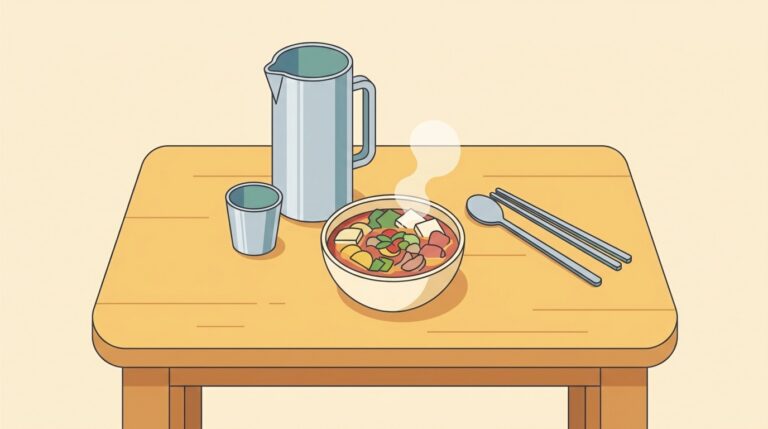
In Korea, water is a human right at restaurants. The moment you sit down, you will almost always be greeted with a condensation-dripping stainless-steel pitcher and small metal cups—completely free! There is no charge for tap or filtered water. It is an extension of 정 (Jeong), the collective warmth and hospitality that forms the backbone of Korean social fabric.
실전 롤플레이: Spicy Tteokbokki Emergency
Characters:
* Min-jun (민준): The energetic, friendly owner of a neighborhood snack shop.
* You: A hungry traveler tackling spicy tteokbokki for the first time.
- You:
🎭 [Sweating and gasping for air]저기요! (Jeogiyo!) — Excuse me! - Min-jun:
🎭 [Wiping the counter, looking over kindly]네! 뭐 드릴까요? (Ne! Mwo deurilkkayo?) — Yes! What can I get for you? - You:
🎭 [Pointing at your mouth with an apologetic smile]너무 매워요! 물 좀 주세요. (Neomu maewoyo! Mul jom juseyo.) — It’s so spicy! Could I get some water please. - Min-jun:
🎭 [Chuckles warmly and gestures toward the corner]아, 우리 가게는 물 셀프예요! 저기 정수기 있어요. (A, uri gageneun mul selpeu-yeyo! Jeogi jeongsugi isseoyo.) — Ah, water is self-service in our shop! The purifier is right over there. - You:
🎭 [Nodding gratefully]아, 셀프예요? 감사합니다! (A, selpeu-yeyo? Gamsahamnida!) — Ah, it’s self-service? Thank you! - Min-jun:
🎭 [Points to the small fridge]컵은 살균기 안에 있어요. 시원하게 드세요! (Keobeun salgyungi ane isseoyo. Siwonhage deuseyo!) — The cups are inside the sterilizer. Enjoy it cold! - You:
🎭 [Grabbing a cold metal cup]네, 시원한 물 마실게요! (Ne, siwonhan mul masilgeyo!) — Yes, I will drink some cold water! - Min-jun:
🎭 [Smiling broadly]매운 거 잘 드시네요! 화이팅! (Maeun geo jal deusineyo! Hwaiting!) — You handle spicy food well! Fighting!
🔀 Your Next Move: How do you respond after grabbing the water?
- Option A: “사장님, 물 진짜 시원해요! 감사해요!” (Sajangnim, mul jinjja siwonhaeyo! Gamsahaeyo!)
Feedback: [BEST] Instant friendship unlocked! Praising the icy water and thanking the owner creates an instant local bond. - Option B: “물 더 줘요.” (Mul deo jwoyo.)
Feedback: [BAD] Drop the informal speech! Using blunt, non-polite language to an elder owner is a major social faux pas. - Option C: Stay completely silent, drink three cups, and stare at the wall.
Feedback: [RISK] While not offensive, you miss out on an authentic Korean conversational moment. A quick smile and “감사합니다” goes a long way!
10초 감정 섀도잉 드릴 (10-Second Emotional Shadowing)
Practice saying these lines with realistic rhythm and emotion! The slash / marks where you should take a micro-pause.
[🥵 Gasping for air, tongue burning]
저기요! / 물 / 좀 / 주세요!
(Jeogiyo! / Mul / jom / juseyo!)-
[🤔 Curious and looking around]
여기… / 물은 / 셀프예요?
(Yeogi… / mureun / selpeu-yeyo?) -
[🤤 In desperate need of icy cold relief]
시원한 / 물 / 있어요?
(Siwonhan / mul / isseoyo?)
K-Culture 미니 사전 (Mini Dictionary)
- 물 (Mul) | Water | The essential liquid of life. Remember: end with the tongue flat against the upper gums, never curling backward like an American “R”!
- 셀프 (Selpeu) | Self-Service | Konglish term seen on signs throughout restaurants, rest stops, and cafes across South Korea.
- 받침 (Batchim) | Final Consonant | The sound that sits at the bottom of a Korean syllable block, grounding the word’s acoustic finish.
- 리을 (Rieul – ㄹ) | The ‘L/R’ Consonant | The chameleon consonant. At the start of a syllable, it sounds like a light flap ‘R’; at the bottom (받침), it sounds like a soft, clear ‘L’.
Traveler’s Survival Kit
Top 3 Survival Phrases
- 물 주세요 (Mul juseyo) | Water, please. | Use this when you sit down at any sit-down restaurant.
- 찬물 있어요? (Chanmul isseoyo?) | Do you have cold water? | Perfect during scorching Korean summer days.
- 물 어디 있어요? (Mul eodi isseoyo?) | Where is the water? | Ideal when looking around for the self-service purifier.
Editor’s Travel Note
- Tap water in Korea is technically purified and safe, but almost nobody drinks straight from the faucet. Locals use countertop filtration machines (정수기) or drink bottled water.
- If you are wandering around Seoul and get parched, every single subway station has free filtered water fountains near the restrooms.
- To easily find nearby convenience stores or water refill spots, consider downloading local map tools like 네이버 지도 앱 다운로드.
한 발 더 깊이 (One Step Deeper: Food & Jeong)
In many western cities, ordering water at a restaurant requires deciding between “still or sparkling” and paying three to five dollars for a glass bottle. In Korea, asking money for plain drinking water is culturally unthinkable. Water is seen as hospitality itself—a basic human courtesy extended to anyone who walks across the threshold. The tiny metal cup of cold water given freely reflects the quiet beauty of 정 (Jeong): an unspoken care for the stranger who enters your home.
💬 Your Turn: In your home country, is water at dining establishments typically free or charged? How does this influence the way you order food?
FAQ & 오해 방지
Q: Why does ㄹ sound like ‘L’ in 물, but like ‘R’ in 라면 (Ramen)?
A: Great observation! When ㄹ sits at the bottom of a block (as a 받침), your tongue stays pressed against the roof of your mouth, making a clean “L” sound (like in call or bell). But when ㄹ appears at the top or between two vowels, your tongue taps quickly and releases, creating a light flap “R” sound!
Q: Is tap water safe to drink in Korea?
A: Yes, municipal tap water in Korea is clean and rigorously tested. However, culturally, Koreans almost exclusively drink water filtered through a 정수기 (water purifier) or boiled barley tea (보리차).
Q: What happens if I mispronounce 물 (Mul) as 불 (Bul)?
A: Be careful! 불 (Bul) means fire! If you are eating spicy food and accidentally shout “불 좀 주세요!”, the server might jokingly bring you a lighter or wonder why you are asking for more flames when your mouth is already burning!
🚨 흔한 실수 (Common Mistakes) TOP 3
- Curling the tongue back into an English ‘R’: Saying “Moor” makes it completely unintelligible to Koreans. Keep your tongue touching right behind your front teeth like the word “wool”.
- Adding an extra syllable vowel: Saying “Mu-ru” (무루). Korean syllables are compact! Stop the sound crisp on the ㄹ without adding “-u”.
- Forgetting to check if it’s self-service: Calling the busy server over for water when there is a giant 물은 셀프 sign right above your head.
Action Missions
- 🥉 Bronze Mission (Solo): Stand in front of a mirror. Say “물 (Mul)” 10 times. Freeze your tongue on the last sound and verify the tip of your tongue is touching behind your top teeth.
- 🥈 Silver Mission (Social): Leave an audio voice note or comment practicing “물 좀 주세요!” to your language exchange partner or on your study feed.
- 🥇 Gold Mission (Real Life): Walk into a Korean restaurant or mart and successfully request water using “물 좀 주세요!” without switching to English.
🎮 K-Culture Mission: Watch an episode of a Korean variety show (like Jinny’s Kitchen or Running Man) and spot how many times the cast members drink water from stainless-steel cups or point to a 물은 셀프 sign!
Interactive Quiz Challenge
Question 1: Situational Choice
You are seated at a busy neighborhood noodle bar. You see other diners getting up to fill cups from a silver dispenser. What should you do?
* A) Yell “저기요! 물 가져오세요!” (Excuse me! Bring water!)
* B) Walk to the dispenser, take a metal cup, and pour your own water.
* C) Sit quietly and wait 30 minutes for the water to appear.
Question 2: Fill in the Blank
“Excuse me, could I get some water please?”
저기요, ____ 좀 주세요! (Mul)
Question 3: True or False
True or False: In Korean, when ㄹ is used as a 받침 (batchim) at the end of a syllable, your tongue should curl back like the American “R” in “car”.
👉 Click here for Answers & Explanations!
- Answer: B. If other customers are getting their own water, it is almost certainly a 물은 셀프 (self-service) shop!
- Answer: 물 (Mul). Full sentence: 저기요, 물 좀 주세요! (Jeogiyo, mul jom juseyo!)
- Answer: False. Never curl your tongue back! The ㄹ 받침 is a light “L” sound with the tongue touching flat against the roof of the mouth behind the front teeth.







