

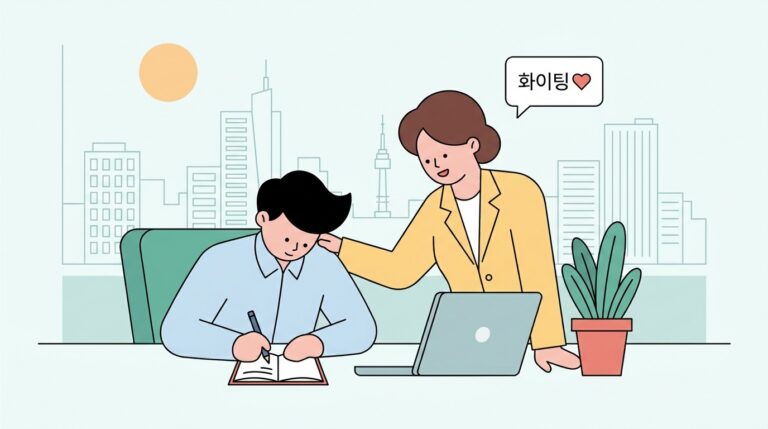
Mastering Office Onboarding: How to Take Notes and Ask Questions to Your Korean Mentor
Phase 1: Empathy (Story-Driven Opening)
안녕하세요! 매일한글 에디터입니다. (Hello! I’m your Daily Hangul editor.)
Picture this: It is 9:15 AM on your third day at a bustling Seoul tech company in Pangyo. Your sasu (사수, assigned senior mentor), known for being lightning-fast and razor-sharp, turns around and says, “Alex-ssi, let’s walk through our project deployment cycle.” Your heart races. You sit beside their dual monitors, nod vigorously, and try to absorb Korean corporate jargon flying at 100 miles per hour. But five minutes later, you realize you have no paper, no pen, and your mind is an absolute blank slate. When they ask, “Got all that?” your nervous smile gives you away instantly.
If you’ve watched the iconic K-drama Misaeng (Incomplete Life), you know this exact panic. Rookie Jang Geu-rae survived not because he knew everything, but because his trusty pocket notepad never left his hands. In Korean corporate culture, walking up to a senior’s desk empty-handed when they are teaching you is considered a classic rookie misstep. Taking diligent notes is not just about remembering facts; it is the ultimate non-verbal signal of respect, humility, and willingness to learn (yeoljeong, 열정).
Based on feedback from hundreds of international professionals navigating Korean offices, mastering the art of note-taking etiquette transforms you from an anxious newcomer into a reliable colleague. Let’s make sure you never face your sasu unprepared again!
Phase 2: Core Expressions Deep Dive
1. 제가 메모하면서 들어도 될까요? (Jega memohamyeonseo deureodo doelkkayo?)
- Pronunciation: [Je-ga me-mo-ham-yeon-seo deu-reo-do doel-kka-yo?] (Sounds like Je-gah meh-mo-hahm-yun-suh doo-ruh-doh dwel-kkah-yoh)
- Meaning: Literal: “May I listen while taking notes?” / Natural nuance: “Do you mind if I jot this down as you explain?”
- K-Culture Moment: Seen frequently in office dramas like King the Land or Start-Up when ambitious interns pull out their notepads before an executive starts talking.
- Editor’s Insight: Asking permission before writing down sensitive business info shows proactive consideration (baeryeo, 배려). It gives your mentor a heads-up that you might pause momentarily to write.
- Situation Spectrum:
- Casual (반말): 🚫 나 메모하면서 들어도 돼? (Too informal for training)
- Semi-formal (해요체): ✅ 제가 메모하면서 들어도 될까요?
- Formal (하십시오체): ✅ 제가 메모하며 경청해도 되겠습니까?
- 🤔 Think About It: In many Western offices, people assume you’ll type directly into Slack or your laptop without asking. Why does Korean business etiquette value verbal permission before taking notes during a 1-on-1 explanation?
2. 이 부분 한 번만 다시 설명해 주실 수 있나요? (I bubun han beonman dasi seolmyeonghae jusil su 있nayo?)
- Pronunciation: [I bu-bun han beon-man da-si seol-myeong-hae ju-sil su in-na-yo?] (Rhymes roughly with Ee boo-boon hahn buhn-mahn dah-she sul-myung-hae joo-sheel soo een-nah-yoh)
- Meaning: Literal: “Can you explain this part one more time?” / Natural nuance: “Could you clarify this specific step once more?”
- K-Culture Moment: In Misaeng, when the rookie admits confusion honestly rather than pretending to understand and causing a costly export error later.
- Editor’s Insight: Notice the softening particle 한 번만 (just once). It softens the burden on your mentor and signals that you paid attention to the rest of the briefing.
- Situation Spectrum:
- Casual: 🚫 다시 말해줘. (Rude to seniors)
- Semi-formal: ✅ 이 부분 한 번만 다시 설명해 주실 수 있나요?
- Formal: ✅ 죄송하지만 이 부분을 다시 한번 설명해 주시겠습니까?
- 🤔 Think About It: Why is asking a mentor to repeat something early considered far more professional in Korea than staying quiet to “save face”?
3. 말씀해 주신 내용 정리해 보았습니다. (Malsseumhae jusin naeyong jeongnihae boasseumnida.)
- Pronunciation: [Mal-sseum-hae ju-sin nae-yong jeong-ni-hae bo-at-seum-ni-da] (Mahl-ssuhm-hae joo-sheen neh-yong jung-nee-hae boh-aht-seum-nee-dah)
- Meaning: Literal: “I tried organizing the contents you spoke.” / Natural nuance: “Here is a summary of what you explained for your confirmation.”
- K-Culture Moment: The triumphant moment when a mentee sends a well-structured follow-up message on Kakao Work or Dooray to confirm the task parameters.
- Editor’s Insight: 말씀 is the honorific noun for words/speech (mal). Using malsseumhae jusin honors your mentor’s time and expertise.
- Situation Spectrum:
- Casual: 🚫 말한 거 정리했어. (Strictly forbidden with mentors)
- Semi-formal: ⚠️ 말씀하신 거 정리했어요. (Acceptable in relaxed startups)
- Formal: ✅ 말씀해 주신 내용 정리해 보았습니다.
- 🤔 Think About It: How does sending a structured recap protect both you and your senior from cross-cultural miscommunication?
Phase 3: Textbook Korean vs. Real-World Korean
Situation 1: Acknowledging an instruction while writing
- 📖 Textbook Korean: 알겠습니다. (Algesseumnida. – I understood.)
- 🗣️ Real-World Korean: 네, 바로 메모했습니다! 확인 감사합니다. (Ne, baro memohaesseumnida! Hwag-in gamsahamnida. – Got it, I’ve noted that down immediately! Thank you for clarifying.)
- 💡 Why is it different? Simply saying algesseumnida can sound passive or generic. Saying baro memohaesseumnida confirms an active action that proves you captured the information.
Situation 2: When the senior is explaining too fast
- 📖 Textbook Korean: 천천히 말해 주세요. (Cheoncheonhi malhae juseyo. – Please speak slowly.)
- 🗣️ Real-World Korean: 선배님, 죄송하지만 제가 필기 속도가 조금 느려서 천천히 부탁드려도 될까요? (Seonbaenim, joesonghajiman jega pilgi sokdoga jogeum neuryeoseo cheoncheonhi butakdeuryeodo doelkkayo? – Senior, I apologize, but my note-taking is a bit slow—could I trouble you to slow down just slightly?)
- 💡 Why is it different? Directly saying “speak slowly” points the issue at the speaker. Attributing the delay to your own writing speed is classic Korean relational politeness (jeongjung-han pyohyeon).
Phase 4: K-Culture Deep Dive & Non-Verbal Etiquette
4-1. Nunchi & Body Language: The Art of the Physical Notebook
In Korean corporate life, the medium matters. If you whip out a tablet and start tapping, older seniors might wonder: Are they texting friends on Kakaotalk, or are they taking notes?
* The 45-Degree Angle Rule: Always tilt your tablet or notepad slightly so your mentor can see pen strokes or screen activity. This transparency builds instant trust.
* Two-Handed Posture: When receiving a printed document, hand out or take it with both hands (duson-euro). Keep your pen held respectfully, nodding at intervals (kkudeok-kkudeok).
* Eye Contact Rhythm: Look at your senior’s eyes when they deliver the main objective, look down to write key terms, and look back up immediately to confirm comprehension.
4-2. Cultural Code: The Sasu-Busasu Bond
The relationship between a sasu (사수, senior mentor) and a busasu (부사수, apprentice rookie) runs deep in Korean workplace lore. Your sasu is judged by upper management on how quickly and effectively you integrate. When you take detailed notes, you aren’t just helping yourself; you are protecting your senior’s reputation by avoiding repetitive blunders. As highlighted in office dramas, a rookie who carries a neat pocket notebook is universally recognized as someone ready for growth.
Phase 5: Real-Life Roleplay Scenario
Setting: Finance Department meeting corner at a Seoul headquarters. Mentor Ji-hoon (지훈 대리) is walking new recruit Alex (알렉스) through the monthly expense filing portal.
- Ji-hoon (사수): 알렉스 씨, 지금 이번 달 법인카드 정산 방법 알려드릴게요. (Alex-ssi, jigeum ibeon dal beob-inkadeu jeongsan bangbeop allyeodeurilgeyo. / Alex, I’ll show you how to settle this month’s corporate card expenses now.)
- Alex (신입사원): 🎭 [Quickly pulling out a notebook and pen, sitting up straight] 네, 선배님! 제가 메모하면서 들어도 될까요? (Ne, seonbaenim! Jega memohamyeonseo deureodo doelkkayo? / Yes, mentor! May I take notes as you explain?)
- Ji-hoon: 🎭 [Nodding with a satisfied smile] 네, 좋아요. 우선 영수증을 날짜별로 스캔해서 전표에 첨부해야 해요. (Ne, joayo. Useon yeongsujeung-eul naljjabyeollo seukaenhaeseo jeonpyoe cheombuhaeya haeyo. / Great. First, you must scan receipts by date and attach them to the voucher.)
- Alex: 🎭 [Diligently writing down the keywords] 영수증 날짜순 스캔… 네, 적었습니다! 그다음은 어떻게 하나요? (Yeongsujeung naljjasun seukaen… Ne, jeogeosseumnida! Geuda-eumeun eotteoke hanayo? / Receipts scanned by date… Yes, written down! What comes next?)
- Ji-hoon: 그다음 승인 라인에 팀장님과 본부장님을 지정하고 상신 버튼을 누르면 끝나요. (Geuda-eum seung-in ra-ine timjangnim-gwa bonbujangnim-eul jijeonghago sangsin beoteun-eul neureumyeon kkeutnayo. / Next, designate the Team Leader and Division Head in the approval line, then click the submit button.)
- Alex: 🎭 [Pausing pen with a respectful look] 선배님, 죄송하지만 승인 라인 직책을 한 번만 다시 말씀해 주실 수 있나요? (Seonbaenim, joesonghajiman seung-in ra-in jikchaegeul han beonman dasi malsseumhae jusil su 있nayo? / Senior, excuse me, but could you repeat the approval line titles just once more?)
- Ji-hoon: 팀장님 먼저, 그다음 본부장님 결재예요. 헷갈리기 쉽죠? (Timjangnim meonjeo, geuda-eum bonbujangnim gyeoljaeyeyo. Hetgal-ligi swipjyo? / Team Leader first, then Division Head approval. Easy to confuse, right?)
- Alex: 🎭 [Showing the written steps with a slight nod] 네! 말씀해 주신 내용 정리해 보았습니다. 확인 부탁드립니다! (Ne! Malsseumhae jusin naeyong jeongnihae boasseumnida. Hwag-in butakdeurimnida! / Yes! I’ve summarized the steps you shared. Please kindly check!)
🔀 Interactive Decision Point
Ji-hoon finishes explaining the software tool. What should you do next?
* Option A: Put your notebook away immediately, say “네, 다 알겠어요!” (Ne, da algesseoyo!) and return to your desk without checking.
* Option B: Say “선배님, 제가 적은 내용을 1분만 소리 내어 확인해도 될까요?” (Senior, may I read back what I wrote for one minute to confirm?) and cross-check the key points.
* Option C: Leave your notebook open on Ji-hoon’s desk and ask him to proofread every sentence while you grab a coffee.
- Feedback:
- Option A (Risk): High risk of making a mistake later. Saying you know everything without confirming can come across as overconfident.
- Option B (Best!): Professional gold standard! Known as the “readback method,” it proves diligence and eliminates misunderstandings immediately.
- Option C (Bad): Disrespectful of your mentor’s time; treating your mentor like an assistant will severely hurt rapport.
Phase 6: 10-Second Emotion Shadowing Drill
Practice these lines out loud matching the cadence marks (/) and emotional tone tags:
[😊 Earnest and ready]
제가 / 메모하면서 / 들어도 될까요? / 준비되셨을 때 / 말씀해 주세요!
(Je-ga / me-mo-ham-yeon-seo / deu-reo-do doel-kka-yo? / Jun-bi-doe-syeo-sseul ttae / mal-sseum-hae ju-se-yo!)-
[📝 Focused and appreciative]
네, 선배님! / 이 부분 / 핵심 키워드 / 바로 적었습니다.
(Ne, seon-bae-nim! / I bu-bun / haek-sim ki-wo-deu / ba-ro jeo-geo-sseum-ni-da.) -
[🥺 Humble and clarifying]
죄송하지만, / 결재 순서만 / 한 번만 / 다시 확인해 주실 수 있나요?
(Joe-song-ha-ji-man, / gyeol-jae sun-seo-man / han beon-man / da-si hwa-g-in-hae ju-sil su in-na-yo?)
Phase 7: K-Culture Mini Dictionary
- 사수 (Sasu) | Direct Mentor / Senior Work Guide
- The specific senior employee assigned to train and protect a rookie during onboarding. The rookie is called a 부사수 (Busasu).
- 필기 (Pilgi) / 메모 (Memo) | Note-taking & Jotting Down
- In Korean offices, pilgi refers to detailed procedural writing, while memo refers to quick bullet-point capture during rapid explanations.
- 온보딩 (Onboding) | New Hire Onboarding
- Widely used in Korean corporations today alongside traditional terms like sin-ip sawon gyoyuk (new employee training).
- 전표 (Jeonpyo) | Accounting Slip / Voucher
- The infamous document every Korean office worker deals with when managing expenses and procurement.
Phase 8: Expat & Traveler Survival Kit
Top 3 Survival Phrases for Office Supplies & Assistance
- 작은 수첩과 펜 어디에 있나요? (Jageun sucheop-gwa pen eodie 있nayo?)
- Where can I find a small notebook and pen?
- Pro Tip: Ask your administrative team (chongmu-tim, 총무팀) on Day 1 to receive official company stationary.
- 사진 한 장 찍어 놓아도 될까요? (Sajin han jang jjigeo noado doelkkayo?)
- May I take a quick photo of this screen/board?
- Pro Tip: If a workflow diagram on a whiteboard is too intricate to sketch quickly, always ask before snapping a photo.
- 제가 이해한 게 맞는지 확인 부탁드립니다. (Jega ihaehan ge manneunji hwag-in butakdeurimnida.)
- Please confirm if my understanding is correct.
- Pro Tip: Use this opening line in email recaps or chat messages to show accountability.
Editor’s Office Supply Note
If your company doesn’t issue stationery immediately, check the stationery section at a nearby store using Naver Map search for Kyobo Hottracks. Premium grid-lined notebooks like Maruman or classic Korean Mun-gu brands keep your notes neat. If you prefer digital tablets, consider checking Korean office etiquette forums to gauge whether tablets with quiet stylus nibs are welcomed in your specific department.
Phase 9: One Step Deeper (Cultural Perspective)
In Western corporate cultures, independence is often celebrated early: you are handed a manual and expected to “figure things out” or ask questions asynchronously. In Korea, however, learning tasks is fundamentally relational and communal (jeong, 정, and collective responsibility). When your sasu sits down to explain an operational flow, they are investing their own limited task time into your success. Writing things down shows that you value their time and will not force them to repeat the same basic mechanics twice. It is a tangible demonstration of seong-sil-ham (성실함, diligence and integrity).
💬 Your Turn: In your home country’s workplace, is taking handwritten notes seen as diligent, or do colleagues prefer typing on laptops/phones? Share your experience in the comments below!
Phase 10: FAQ & Common Mistakes
Q: Can I use an iPad or Galaxy Tab instead of a paper notepad when my mentor trains me?
A: Yes, but with two important caveats! First, ask: “태블릿으로 메모해도 괜찮을까요?” (May I take notes on my tablet?). Second, use an Apple Pencil or S-Pen rather than an audible mechanical keyboard, and make sure your tablet screen remains angled so your senior knows you are strictly taking notes.
Q: What if my mentor speaks Korean so quickly that I cannot write everything down?
A: Never suffer in silence! Immediately use the magic phrase: “선배님, 키워드만 먼저 적고 있는데, 잠깐만 천천히 말씀해 주실 수 있을까요?” (Senior, I’m noting down key terms—could you speak just a little slower for a moment?). Korean seniors appreciate rookies who speak up proactively over those who pretend to understand.
Q: Should I rewrite my rough onboarding notes into a clean document later?
A: Absolutely. In Korean companies, creating your own “Rookie Manual” (sin-ip sawon maenyueol) by organizing messy notes into a clean Notion page or binder is considered one of the highest-rated onboarding habits.
🚨 Common Mistakes Warning Board
- Mistake: Nodding silently without writing anything down.
- Correct Action: Always keep a notebook open and pen unclicked, writing key system terms and deadlines.
- Mistake: Asking your mentor the exact same procedural question three days later.
- Correct Action: Review your notes before approaching your mentor. Open with: “I reviewed my notes from Tuesday, but had a quick question regarding step three.”
- Mistake: Typing on a smartphone during a verbal briefing.
- Correct Action: Avoid smartphones entirely during 1-on-1 mentor briefings; it often looks like personal messaging.
Phase 11: Action Missions
- 🥉 Bronze Mission (Solo Practice): Stand before a mirror with a notepad and pen. Practice saying: “제가 메모하면서 들어도 될까요?” smoothly three times in under 10 seconds.
- 🥈 Silver Mission (Community Engagement): Share a photo of your Korean study notebook or desk setup on Instagram or Threads with the phrase: #오늘도열심히메모 (Taking diligent notes today too!).
- 🥇 Gold Mission (Real-World Execution): Next time a Korean colleague, teacher, or boss explains a process, consciously open your notepad, ask for permission to write, and summarize the key takeaway back to them.
- 🎮 K-Culture Mission: Watch Episode 1 or 2 of the K-drama Misaeng. Notice how the new interns clutch their small black notebooks during company orientations!
Phase 12: Interactive Quiz Challenge
1. Situation Judgment: Your mentor starts explaining how to format the weekly team report. What is the most polite and natural way to ask to take notes?
a) 여기서 뭐 적어야 돼? (What should I write here?)
b) 제가 메모하면서 들어도 될까요? (May I take notes while listening?)
c) 그냥 이메일로 보내주세요. (Just send it by email.)
2. Fill-in-the-Blank: Complete the polite confirmation phrase:
“말씀해 주신 내용 ________ 보았습니다. 확인 부탁드립니다!”
(Hint: “I organized / summarized”)
a) 놀아 (nora)
b) 정리해 (jeongnihae)
c) 버려 (beoryeo)
3. True or False: In Korean office culture, pulling out a smartphone to take quick notes without prior explanation is widely encouraged by senior managers.
* True / False
👉 Click to Reveal Answers & Explanations!
- Answer: b) 제가 메모하면서 들어도 될까요?
- Explanation: Option (b) uses appropriate polite language (haeyoche) and demonstrates proactive attentiveness without being demanding.
- Answer: b) 정리해 (jeongnihae)
- Explanation: Jeongnihae boasseumnida means “I have organized/summarized [the content] to review.”
- Answer: False
- Explanation: Typing on a smartphone often looks like casual text chatting to seniors. A paper notebook or a tablet with a stylus is far better received!
- Explanation: Typing on a smartphone often looks like casual text chatting to seniors. A paper notebook or a tablet with a stylus is far better received!







