

Navigating the Crossfire: Master C2 Korean for Geopolitical Compliance and Sanctions
Phase 1: Empathy (Immersive Storytelling Opening)
안녕하세요! 매일한글 에디터입니다. (Annyeonghaseyo! Maeil Hangul editeoimnida.) Welcome back to another high-level dive into the pulse of Korean business and language!
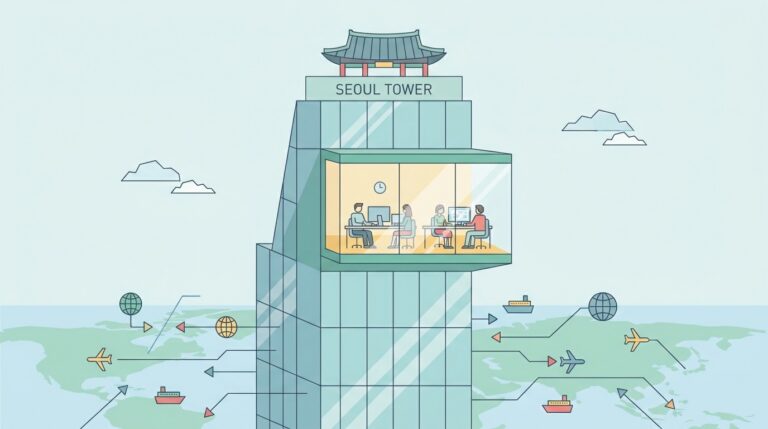
Picture this: You are sitting on the 32nd floor of a glass skyscraper in Teheran-ro, Gangnam. It looks straight out of an episode of Agency (대행사) or Misaeng (미생). Across the table sits the Chief Legal Officer and the Head of Global Strategy. The atmosphere is tense. A new round of extraterritorial secondary boycotts from Washington has just collided head-on with Beijing’s Anti-Foreign Sanctions Law. Your company’s semiconductor supply chain is caught right in the geopolitical crossfire. A board member turns to you and asks for your direct assessment on the firm’s export control exposure.
At this executive level, textbook Korean like “조심해야 합니다 (We must be careful)” simply will not cut it. The real struggle our C2 advanced learners face is navigating the high-stakes lexicon of economic statecraft, strategic hedging, and weaponized interdependence in fluent Korean. Today’s guide stems directly from our bespoke training for multinational executives and legal counsels operating in Seoul. By mastering these nuanced, high-register formulations, you will effortlessly command boardrooms and articulate complex risk strategies with total cultural authority.
Phase 2: Core Expressions Deep Dive
1. 지정학적 리스크를 선제적으로 헤지하다 (Jijeonghakjeok riseukeureul seonjejeogeuro hejihada)
- Pronunciation: [Jijeonghakjeok riseukeureul seonjejeogeuro hejihada] (Think of ‘seon-je’ sounding crisp like ‘sun-gel’ without the l, moving swiftly into the finance loanword ‘hedge’ with a clean Korean verbal ending)
- Meaning: Literal: To preemptively hedge geopolitical risk | Actual Nuance: To strategically neutralize geopolitical exposure across bifurcated regulatory regimes before punitive actions strike.
- K-Culture Moment: Echoing the cutthroat corporate boardroom battles in Reborn Rich (재벌집 막내아들), where strategy heads scramble to immunize sprawling conglomerates from foreign regulatory crosswinds.
- Editor’s Insight: Combining the Sino-Korean term 선제적 (preemptive/proactive) with the technical financial loanword 헤지하다 creates an indispensable, high-status executive expression.
- Situation Spectrum: Casual 🚫 | Semi-formal ⚠️ | Formal ✅
- 🤔 Think About It: Notice how Korean corporate parlance effortlessly fuses Sino-Korean conceptual roots with Western financial terminology. What does this reveal about Korea’s agile position in global markets?
2. 상충하는 제재 법령 사이에서 줄타기하다 (Sangchunghaneun jejae beomnyeong saieseo jultagihada)
- Pronunciation: [Sangchunghaneun jejae beomnyeong saieseo jultagihada] (Emphasize ‘jultagi’ with a bouncy tap on the tip of your tongue, evoking the traditional high-wire acrobat)
- Meaning: Literal: To walk a tightrope between conflicting sanctions laws | Actual Nuance: To perform a high-stakes, delicate balancing act when complying with one nation’s sanctions legally violates another’s blocking statute.
- K-Culture Moment: Reminiscent of political thrillers like Vagabond or the movie Steel Rain, where diplomats and corporate fixers walk a razor-thin line between competing superpowers.
- Editor’s Insight: 줄타기 (tightrope walking) originates from traditional Korean acrobatic performance (Jultagi), a UNESCO intangible cultural heritage. In executive Korean, it captures intense operational precariousness.
- Situation Spectrum: Casual ⚠️ | Semi-formal ✅ | Formal ✅
- 🤔 Think About It: English often uses “caught between a rock and a hard place.” Why does the dynamic acrobatics of 줄타기 imply active agency and calculated balance rather than passive helplessness?
3. 공급망 다변화와 컴플라이언스 내재화가 시급하다 (Gonggeupmang dabyeonhwawa keompeullieonseu naejaehwaga sigeuphada)
- Pronunciation: [Gonggeupmang dabyeonhwawa keompeullieonseu naejaehwaga sigeuphada] (Pace yourself steadily over ‘nae-jae-hwa’, drawing out the deliberate administrative resonance)
- Meaning: Literal: Supply chain diversification and internalizing compliance are urgent | Actual Nuance: We must decouple single-point dependencies and embed rigorous geopolitical oversight into our daily corporate DNA immediately.
- K-Culture Moment: The signature tone of authoritative economic news anchors on KBS or SBS Special Reports covering critical mineral dependencies and battery alliances.
- Editor’s Insight: 내재화 (internalization) implies absorbing external standards until they become an instinctive, institutional reflex.
- Situation Spectrum: Casual 🚫 | Semi-formal ⚠️ | Formal ✅
- 🤔 Think About It: How does the register shift when moving from simple ‘준수’ (compliance/following rules) to ‘내재화’ (deep structural internalization)?
Phase 3: Textbook Korean vs. Real Korean
Scenario 1: Discussing corporate vulnerability to secondary sanctions
- 📖 교과서 한국어 (Textbook Korean): 외교적 갈등으로 인해 기업 활동에 위험이 발생할 수 있습니다. (Oegyojoek galdeungeuro inhye gieop hwaldonge wiheomi balsaenghal su isseumnida. / Corporate risk may occur due to diplomatic friction.)
- 🗣️ 진짜 한국어 (Real Executive Korean): 고래 싸움에 새우 등 터지는 꼴이라, 지정학적 리스크 관리가 안 되면 한 방에 훅 갑니다. (Gorae ssaume saeu deung teojineun kkol-ira, jijeonghakjeok riseukeu gwanriga an doemyeon han bange huk gamnida. / We are like a shrimp crushed in a whale fight; if we fail to manage this geopolitical risk, our business could collapse overnight.)
- 💡 왜 다를까? (Why is it different?): While textbook Korean sticks to sterilised administrative prose, senior Korean executives frequently invoke visceral proverbs like ‘고래 싸움에 새우 등 터진다’ alongside punchy colloquial idioms like ‘한 방에 훅 간다’ to cut through bureaucratic complacency.
Scenario 2: Warning against legal exposure under export controls
- 📖 교과서 한국어 (Textbook Korean): 각국의 제재 규정을 철저히 지키도록 체계를 정비해야 합니다. (Gakgugui jejae gyujeongeul cheoljeohi jikidorok chegyereul jeongbihaeya hamnida. / We must overhaul our systems to abide strictly by each country’s sanctions.)
- 🗣️ 진짜 한국어 (Real Executive Korean): 세컨더리 보이콧 리스트에 오르는 순간 끝장입니다. 꼬투리 잡히지 않도록 이중 용도 품목 실사를 샅샅이 훑어야 해요. (Sekeondeori boikot riseuteue oreuneun sungan kkeutjang-imnida. Kkoturi japhiji antorok ijung yongdo pummok silsareul satsathi hulteoya haeyo. / The moment we land on a secondary boycott list, it’s game over. We must comb through dual-use item due diligence so nobody finds a pretext to hit us.)
- 💡 왜 다를까? (Why is it different?): Seasoned corporate general counsels deploy punchy, vivid expressions like ‘꼬투리 잡히다’ (giving pretext for fault-finding) and ‘샅샅이 훑다’ (thoroughly comb through) during closed-door crisis sessions.
Phase 4: K-Culture Deep Dive & Non-Verbal Manners
4-1. Nunchi & Executive Non-Verbal Protocol
When briefing Korean executives or C-suite stakeholders on geopolitical compliance dilemmas:
* The Lowered-Register Delivery: When delivering alarming risk reports (such as a pending export ban), lower your vocal pitch slightly and maintain deliberate, unhurried cadence. Rapid, shrill explanations read as panicked and inexperienced.
* The Two-Handed Briefing Fold: When pointing out items on an executive memo or slide deck, never point with an index finger. Gather your fingers gracefully or use an open palm with your left hand lightly touching your right wrist or forearm. This signals utmost deference and institutional gravity.
* Calculated Pauses (정적의 미학): In Korean corporate culture, silent processing shows depth. After stating a grave compliance paradox, pause for three seconds to allow the room to digest the geopolitical weight.
4-2. Cultural Code Analysis: The “Sandwich Crisis” Paradigm (샌드위치 위기론)
Korea’s industrial miracle was built upon navigating precarious vulnerabilities—historically encapsulated by the business theory known as the Sandwich Predicament (샌드위치 신세), caught technologically between advanced Western or Japanese IP and cost-competitive manufacturing hubs. Today, this mindset has evolved into hyper-vigilant compliance engineering. When Korean business dramas depict legal teams, compliance officers are not mere auditors; they are strategic warriors shielding the company’s lifeline from weaponized global interdependencies.
Phase 5: Real-World Roleplay Scenario
Setting: A soundproof executive boardroom at a multinational tech conglomerate headquarters in Gwanghwamun, Seoul.
Characters:
* 이 부사장 (Executive VP Lee): Veteran strategist, cautious, intensely focused on market share retention.
* 알렉스 (Alex – You): Chief Geopolitical Compliance Officer, sharp, analytical, fluent in global trade cross-currents.
이 부사장: 알렉스 이사, 미국 상무부의 대중 수출통제 조치가 갈수록 강화되고 있는데, 우리 신제품 파운드리 라인은 안전한 겁니까?
(Alex Isa, Miguk Sangmubuu daejung suchultongje jochiga galsurok ganghwadoego inneunde, uri sinjepum paundeuri raineun anjeonhan geomnikka?)
🎭 [안경을 만지작거리며 굳은 표정으로 서류를 내려놓는다 / Adjusting his glasses with a grim expression, setting down his briefing folder]
“Director Alex, the US Commerce Department’s export controls against China are intensifying by the day. Is our new product foundry line safe?”
알렉스: 솔직히 말씀드리면, 현 체제로는 살얼음판을 걷는 형국입니다.
(Soljikhi malsseumdeurimyeon, hyeon chejeroneun sareoreumpaneul geonneun hyeongguk-imnida.)
🎭 [침착하고 단호한 눈빛으로 태블릿 화면을 띄우며 / Displaying the risk assessment matrix on a tablet with calm, resolute eye contact]
“To speak candidly, with our current setup, we are effectively walking on thin ice.”
이 부사장: 상충하는 규정 때문에 이러지도 저러지도 못하는 상황이란 말입니까?
(Sangchunghaneun gyujeong ttaemune ireojido jeoreojido mothaneun sanghwang-iran marimnikka?)
🎭 [답답하다는 듯 헛기침을 하며 / Clearing his throat in frustration]
“Are you saying we are paralyzed between conflicting regulations?”
알렉스: 그렇습니다. 미국의 세컨더리 보이콧 규정과 현지의 반외국제재법 사이에서 자칫 샌드위치 신세가 될 수 있습니다.
(Geureoseumnida. Migugui sekeondeori boikot gyujeonggwa hyeonjiui ban-oegukjejaebeop saieseo jachit saendeuwichi sinsega doel su isseumnida.)
🎭 [두 손을 가지런히 모으고 목소리를 낮추며 / Clasping hands formally and lowering voice with measured conviction]
“Precisely. Between US secondary sanctions and local anti-foreign sanction blocking statutes, we risk becoming collateral damage in a sandwich trap.”
이 부사장: 그렇다고 거대 시장을 포기할 수도 없잖습니까. 묘수가 없겠어요?
(Geureotdago geodae sijangeul pogihal sudo eopjanseumnikka. Myosuga eopgetseoyo?)
🎭 [미간을 찌푸리며 조언을 구하듯 상체를 앞으로 기울인다 / Leaning forward with furrowed brows, soliciting strategic insight]
“Still, we cannot simply forfeit a massive consumer market. Do we have no viable counter-play?”
알렉스: 단기적 땜질 처방으로는 한계가 있습니다. 공급망을 원천적으로 이원화하고, 본사 직속의 지정학 컴플라이언스 컨트롤타워를 가동해야 합니다.
(Dangijeok ttaemjil cheobang-euroneun hangyega isseumnida. Gonggeupmangeul woncheonjeogeuro iwonhwahago, bonsa jiksogui jijeonghak keompeullieonseu keonteorol-tawo-reul gadonghaeya hamnida.)
🎭 [핵심 로드맵을 짚어가며 흔들림 없는 태도로 / Pointing with an open hand to the transition roadmap with unwavering confidence]
“Short-term stopgap fixes have clear limits. We must structurally bifurcate our supply chains and activate a dedicated geopolitical compliance control tower directly under global headquarters.”
이 부사장: 법무팀과 리스크관리팀을 총동원하면 내부 반발 없이 속도를 낼 수 있을까요?
(Beommutim-gwa riseukugwanritimeul chongdong-wonhamyeon naebu banbal eopsi sokdoreul nael su isseulkkayo?)
🎭 [조심스럽게 고개를 끄덕이며 / Nodding thoughtfully]
“If we mobilize both Legal and Risk Management, can we expedite this transition without organizational pushback?”
알렉스: 최고경영진의 결단만 뒷받침된다면, 선제적 규범 준수 체계를 조기에 안착시킬 수 있습니다.
(Choegogyeong-yeongjinui gyeoldanman dwitbatchimdoendamyeon, seonjejeok gyubeom junsu chegyereul jogie anchaksikil su isseumnida.)
🎭 [확신에 찬 미소를 지으며 고개를 숙여 결재를 요청한다 / Offering a confident, reassuring nod while formally presenting the sign-off charter]
“Provided we have the executive leadership’s firm backing, we can firmly establish our proactive regulatory compliance framework ahead of schedule.”
🔀 Interactive Decision Point
How should Alex respond if Executive VP Lee asks: “What if we simply route these dual-use items through a third-party intermediary in Southeast Asia to save costs?”
- Choice A: “어차피 적발 확률이 낮으니 제3국 우회 수출로 단기 실적을 방어합시다.” (Eochapi jeokbal hwangryuri najeuni jesamguk uuhoe suchullo danggi siljeogeul bang-eohapsida. / Since detection risk is low anyway, let’s route through a third country to defend quarterly earnings.)
👉 Feedback [Bad]: Fatal risk! Secondary sanctions target deceptive transshipment. You compromise the enterprise and destroy professional credibility. - Choice B: “우회 수출은 우회로가 아니라 직격탄입니다. 엔드유저(최종사용자) 스크리닝을 고도화하고 공급망을 완전히 탈동조화해야만 법적 제재를 면탈할 수 있습니다.” (Uuhoe suchureun uuhoeroga anira jikgyeoktan-imnida. Endeu-yujeo seukeurining-eul godohwahago gonggeupmangeul wanjeonhi taldongjohwahaeyaman beopjeok jejaereul myeontalhal su isseumnida. / Transshipment is not a detour; it’s a direct torpedo. We can only avoid legal penalties by upgrading end-user screening and completely decoupling supply chains.)
👉 Feedback [Best]: Authoritative, uncompromising, and strategically sound. Signals premier C2 fluency and boardroom leadership. - Choice C: “글쎄요, 현지 대리인의 재량에 맡기고 본사는 공식적으로 모르는 것으로 정리하면 어떨까요?” (Geulsseyo, hyeonji daeriinui jaeryang-e matgigo bonsaneun gongsikjeogeuro moreuneun geoseuro jeongrihamyeon eotteolkkayo?)*
👉 Feedback [Risk]: Willful blindness doctrines trigger severe criminal penalties under international export regimes. Unacceptable risk profile.
Phase 6: 10-Second Emotional Shadowing Drill
Read these aloud matching the exact pauses (/) and emotional signposts! This trains boardroom poise under cross-examination.
[💼 단호하고 결단력 있게 / Resolute & Decisive]
규제 당국의 칼날이 매서워진 만큼 / 어설픈 땜질 처방으로는 / 기업의 영속성을 담보할 수 없습니다.
(Gyuje danggugui kalnari maeseowojin mankeum / eoseolpeun ttaemjil cheobang-euroneun / gieobui yeongsokseong-eul dambohal su eopseumnida.)
“As regulatory scrutiny sharpens to a razor’s edge / superficial stopgap fixes / cannot guarantee the perpetual survival of our firm.”-
[⚠️ 신중하고 경계하며 / Cautious & Vigilant]
사소한 규범 위반 하나가 / 세컨더리 보이콧의 빌미가 되어 / 해외 자산 동결로 번질 위험이 큽니다.
(Sasohan gyubeom wiban hanaga / sekeondeori boikot-ui bilmiga doeeo / hae-oe jasan donggyeollo beonjil wiheomi keumnida.)
“A single minor compliance lapse / could become the pretext for secondary boycotts / creating a severe risk of overseas asset freezes.” -
[🤝 설득력 있고 당당하게 / Persuasive & Authoritative]
지정학 리스크는 회피의 대상이 아니라 / 철저한 컴플라이언스 체계 구축을 통해 / 초격차 경쟁력으로 치환해야 할 과제입니다.
(Jijeonghak riseukeuneun hoepiui daesang-i anira / cheoljeohan keompeullieonseu chegye guchugeul tonghae / chogyeokcha gyeongjaengnyeogeuro chihwanhaeya hal gwajeimnida.)
“Geopolitical risk is not something to run away from; / by building an uncompromising compliance architecture, / it is a challenge we must convert into super-gap market dominance.”
Phase 7: K-Culture Mini Dictionary
-
세컨더리 보이콧 (Sekeondeori Boikot)
Meaning: Secondary Boycott / Extraterritorial Sanction
Insight: In Korean trade journals, this represents the ultimate existential regulatory penalty—barring third-country foreign financial institutions and companies from the global clearing financial network. -
무기화된 상호의존성 (Mugihwadoen Sanghouijonseong)
Meaning: Weaponized Interdependence
Insight: A high-frequency academic and policy term in Seoul think tanks (like ASAN or KIEP), describing how central nodes in global production networks are leveraged for geopolitical coercion. -
지정학 컴플라이언스 (Jijeonghak Keompeullieonseu)
Meaning: Geopolitical Regulatory Compliance
Insight: Moving beyond basic anti-money laundering (AML), this newly minted executive term refers to tracking real-time statutory friction between jurisdictions like the US, EU, and China. -
초격차 (Chogyeokcha)
Meaning: Extreme Gap / Super-Gap Dominance
Insight: Coined by former Samsung executives, this iconic term denotes widening the technology and operational gap so vastly that competitors—and geopolitical leverage—cannot easily disrupt you.
Phase 8: Corporate Navigator Survival Kit
Survival Expressions for Executive Meetings
-
컴플라이언스 이슈가 없는지 사전 법률 검토를 마쳤습니까?
(Keompeullieonseu issyuga eomneunji sajeon beopryul geomtoreul machyeosseumnikka?)
“Have you completed the preliminary legal review to ensure there are no compliance vulnerabilities?”
Pro Tip: Use this to preemptively halt unvetted supply chain contracts before operational execution. -
양국 규제 당국의 가이드라인을 동시에 충족할 우회책이 있나요?
(Yang-guk gyuje danggugui gaideuraineul dongsie chungjokhal uuhoechaegi innayo?)
“Is there a viable alternative structure that simultaneously satisfies regulatory guidelines from both jurisdictions?”
Pro Tip: Framing solutions as ‘대안’ (alternative) or ‘솔루션’ prevents the perception of illegal evasion. -
공급망 실사 보고서 최신본을 대외비로 공유해 주십시오.
(Gonggeupmang silsa bogoseo choesinboneul dae-oebiro gong-yuhae jusipsio.)
“Please share the latest update of the supply chain due diligence report under strict confidentiality (대외비).”
Editor’s Corporate Navigator Note
When heading to executive briefings in Seoul’s financial corridors (Yeouido 여의도 or Teheran-ro 테헤란로), optimize your logistics using the 네이버 지도 앱 다운로드 to calculate reliable subway arrival times down to the minute. Never be late: in corporate Korea, arriving 10 minutes early is standard respect. When exchanging business cards (명함 교환), present your card with both hands with your company title facing the recipient, and take at least 15 seconds to review their credentials before setting it respectfully on the meeting table.
Phase 9: “One Step Deeper” (Reflective Cultural Essay)
For millennia, the Korean Peninsula has navigated intense geopolitical vortexes, historically surrounded by continental and maritime superpowers. This historical crucible forged an instinctual corporate survival strategy known colloquially as 기민한 적응력 (nimble adaptability). In contemporary commerce, when Korean boardrooms tackle export control dilemmas, compliance is not merely viewed as a legal checkbox; it is experienced as national and corporate safeguarding. Language reflects this gravity—corporate directives rarely say “규정을 따르자 (Let’s follow the rule)”; they invoke “체계를 내재화하여 리스크를 선제적으로 방어하자 (Let us internalize the architecture to preemptively defend against systemic risk).”
💬 Your Turn: How does your home country’s corporate culture conceptualize geopolitical friction? Is compliance treated as an administrative cost center or a strategic boardroom shield? Share your thoughts below in Korean!
Phase 10: FAQ & Avoiding Misunderstandings
Q: Can I use the loanword ‘리스크’ (Risk) and ‘컴플라이언스’ (Compliance) in formal Korean reports?
A: Absolutely! In fact, at the C2 executive level, terms like 지정학적 리스크 (geopolitical risk), 컴플라이언스 체계 (compliance framework), and 듀 딜리전스 (due diligence) are standard nomenclature across major Korean conglomerates (재벌) and regulatory white papers.
Q: What is the subtle nuance between ‘규범 준수’ and ‘컴플라이언스’?
A: 규범 준수 (gyubeom junsu) is the formal Sino-Korean phrase emphasizing broad moral and statutory obedience to rules and norms. 컴플라이언스 (keompeullieonseu) specifically denotes the specialized, institutionalized enterprise control architecture (audits, screening, certifications) designed to withstand legal scrutiny.
Q: How do I diplomatically express that a business partner’s proposed deal creates secondary sanction risks?
A: Avoid blunt accusations like “당신 제안은 불법입니다 (Your proposal is illegal).” Instead, frame it through regulatory friction: “제안해 주신 구조는 현행 수출통제 규제 당국의 유권해석상 세컨더리 보이콧에 저촉될 소지가 다분하므로, 추가 법률 검토가 불가피합니다 (The proposed structure carries considerable exposure to secondary boycott sanctions under current regulatory agency interpretations, rendering further legal review unavoidable).”
🚨 Common Mistakes Alert
- Mistake: Using “세컨더리 제재” instead of the established phrase “세컨더리 보이콧” (Secondary Boycott).
Correction: In Korean media and regulatory documentation, 세컨더리 보이콧 is the undisputed industry standard. - Mistake: Confusing “우회 (detour/bifurcation)” with illegal “탈법 (law evasion)”.
Correction: Use “공급망 이원화 (supply chain dual-tracking/bifurcation)” or “합법적 대체 조달 (lawful alternative sourcing)” to convey legitimate compliance strategies. - Mistake: Overusing informal endings like “-인 것 같아요” in executive summaries.
Correction: Anchor executive briefings with decisive formal endings: “-로 판단됩니다 (It is assessed as…)” or “-가 불가피합니다 (It is deemed unavoidable).”
Phase 11: Action Mission & Engagement
- 🥉 Bronze Level: Practice reading the Phase 6 Emotional Shadowing Drill aloud 3 times, focusing on clear separation of syllables in ‘지정학 컴플라이언스’ and ‘세컨더리 보이콧’.
- 🥈 Silver Level: Write a 3-sentence executive update in Korean proposing a supply chain audit to your company’s general counsel, using at least two core phrases from Phase 2.
- 🥇 Gold Level: Post your Silver Mission summary on LinkedIn or in the comments below, tagging your post
#DailyHangulGeopoliticsto receive peer and editor critique! - 🎮 K-Culture Mission: Watch an episode of a Korean business drama (such as Misaeng or Agency). Note down at least two moments where team managers debate compliance or risk management protocols using formal honorifics.
Phase 12: Interactive Quiz Challenge
Test your executive command! Read each question and click the spoiler dropdown to check your answers and detailed explanations.
1. 상황 판단 (Situational Judgment)
Your cross-border supplier suggests labeling dual-use microchips as consumer audio hardware to bypass stringent export authorization. Which response best represents executive-level C2 Korean?
* A) “좋은 아이디어네요. 세관에 걸리지만 않게 포장해 주세요.”
* B) “품목 허위 신고는 명백한 수출통제 위반으로, 즉각적인 수출 자격 박탈 및 세컨더리 보이콧 대상이 되므로 절대 불가합니다.”
* C) “법률 위반이지만 이번 분기만 비밀리에 진행합시다.”
2. 빈칸 채우기 (Fill in the Blank)
미국과 중국의 규제 법령이 정면으로 충돌하는 가운데, 다국적 기업들은 어느 한쪽의 제재를 위반하지 않기 위해 정교한 지정학 ( ) 체계를 수립하고 있다.
(Hint: The loanword for corporate regulatory oversight)
3. True / False Cultural Insight
True or False: In executive briefings with Korean corporate leadership, using colloquial expressions like “한 방에 훅 갑니다” is acceptable when delivering an urgent verbal wake-up call, but formal written memos should consistently maintain terms like “돌이킬 수 없는 경영상 위해를 초래할 수 있습니다.”
👉 Click here for Answers and Explanations!
-
Answer: B
Explanation: Option B exhibits exemplary high-register business Korean (“품목 허위 신고는 명백한 수출통제 위반으로… 절대 불가합니다”), balancing professional resoluteness with clear legal justification. -
Answer: 컴플라이언스 (Compliance)
Explanation: The full phrase is ‘지정학 컴플라이언스’ (geopolitical compliance), representing advanced institutional response mechanisms. -
Answer: True
Explanation: Seasoned senior leaders frequently use vivid, colloquial idioms verbally behind closed doors to heighten urgency, but written internal reports strictly demand elevated, objective vocabulary (경영상 위해 초래, 리스크 심화).






