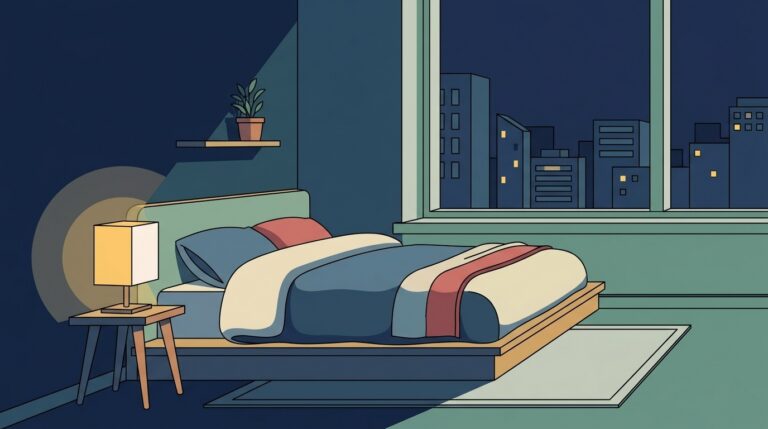
Ending the Day in Korea: Turning Off the Lights and Tucking into Bed
Phase 1: Empathy (Opening Story)
안녕하세요! 매일한글 에디터입니다. (Hello! I am your Daily Hangul editor.)
Picture this: You have just finished a whirlwind day exploring the energetic alleys of Seoul or powering through your daily grind. You climbed up the stairs to your room, washed up, and your body feels delightfully heavy with exhaustion. You drop onto your mattress, reach over to click off the bedside light, and let out a deep, satisfying sigh. In classic K-dramas, this is that warm, cozy scene where the lead character finally wraps themselves in a fluffy quilt, stares at the ceiling in the quiet dark, and smiles as they text their close friend before drifting off.
Yet, many beginner learners freeze right here. When sharing your evening routine with a Korean friend, host family, or language partner, do you translate literally and say awkward phrases like “I make the lamp die”? Don’t worry! Bedtime phrases in Korean are among the warmest, easiest, and most emotionally rewarding expressions you can learn. Drawing from years of tutoring real students who felt nervous using evening Korean, this guide will help you talk about switching off the lights and climbing into bed with absolute confidence.
Phase 2: Top 3 Core Expressions Deep Dive
1. 불을 꺼요 (Bureul kkeoyo)
- Pronunciation: [Bureul kkeoyo] (Sounds like boo-reul kuh-yoh—think of saying “boo”, the “reul” sound, and then “cur” without the r).
- Meaning: Literal: “I extinguish the fire/light” vs. Actual: “I turn off the light.”
- K-Culture Moment: You’ll hear this in virtually every family K-drama when parents call out from the living room to their kids’ bedrooms: “이제 불 끄고 자!” (Turn off the lights and sleep now!).
- Editor’s Insight: Long before electric bulbs arrived in Korea, people used candles and oil lamps with open flames (불, fire). Even with modern smart switches, Koreans still say “extinguish the fire” (불을 끄다) rather than using mechanical loanwords.
- Situation Spectrum: Casual: 불 꺼 (✅) | Semi-formal: 불을 꺼요 (✅) | Formal: 불을 끕니다 (✅)
- 🤔 Think About It: In English, you “turn” or “switch” a device. In Korean, you “extinguish” the illumination. How does your native language conceptualize turning off lights?
2. 침대에 누워요 (Chimdaee nuwoyo)
- Pronunciation: [Chim-dae-e nu-wo-yo] (Sounds like cheem-day-eh noo-wuh-yoh).
- Meaning: Literal: “I lie down on/in the bed” vs. Actual: “I am lying in bed / I’m crashing into bed.”
- K-Culture Moment: When K-pop idols hold late-night live streams on bubble or Weverse, they constantly tell fans: “저 지금 침대에 누웠어요” (I’m lying in bed right now).
- Editor’s Insight: Korean clearly distinguishes between “눕다” (the physical act of lying flat) and “자다” (the physiological state of sleeping). You can lie down for hours scrolling on your phone without sleeping—and that state is strictly “침대에 누워요”!
- Situation Spectrum: Casual: 침대에 누워 (✅) | Semi-formal: 침대에 누워요 (✅) | Formal: 침대에 눕습니다 (✅)
- 🤔 Think About It: Why do you think Korean culture separates the act of lying down from actual sleep? It gives dedicated verbal space for that sweet, relaxed wind-down time!
3. 잘 자요 (Jal jayo)
- Pronunciation: [Jal jayo] (Sounds like Jahl jah-yoh—rhythmic like “dull bar-low”).
- Meaning: Literal: “Sleep well” vs. Actual: “Good night / Sweet dreams.”
- K-Culture Moment: The iconic singer Sung Si-kyung made this phrase a national phenomenon by whispering “잘 자요” at the end of his midnight radio show every single night.
- Editor’s Insight: This phrase carries tender, caring affection. However, remember it is meant for friends, peers, or people younger than you. Never say it to your boss or elderly host grandparents!
- Situation Spectrum: Casual: 잘 자 (✅) | Semi-formal: 잘 자요 (✅) | Formal to elders: 안녕히 주무세요 (✅, use this instead!)
- 🤔 Think About It: Korean features a completely separate, elevated vocabulary set for elders sleeping. What does this reveal about societal respect and age hierarchy?
Phase 3: Textbook Korean vs. Real Korean
Situation 1: Letting your roommate know you are turning in
- 📖 교과서 한국어 (Textbook): “저는 지금 잠을 잡니다.” (Jeoneun jigeum jameul jamnida. – “I sleep a sleep now.”)
- 🗣️ 진짜 한국어 (Real-life): “저 이제 자려고요.” (Jeo ije jaryeogoyo. – “I’m going to sleep now.”)
- 💡 왜 다를까? (Why is it different?): Textbook sentences often repeat the tautology jameul jada with rigid formal endings. Real Koreans use the soft intention ending -려고요 (-ryeogoyo), making your bedtime statement conversational and warm.
Situation 2: Asking someone to flip the wall switch
- 📖 교과서 한국어 (Textbook): “전등 스위치를 조작해 주십시오.” (Jeondeung seuwichireul jojakhae jusipsio. – “Please operate the electric light switch.”)
- 🗣️ 진짜 한국어 (Real-life): “불 좀 꺼 줘요.” (Bul jom kkeo jwoyo. – “Could you turn off the light, please?”)
- 💡 왜 다를까? (Why is it different?): Everyday Korean replaces overly technical words like jeondeung (electric lamp) with the simple word bul, and adds the magic softening word jom (a little/please).
Phase 4: K-Culture Deep Dive & Non-verbal Manners
4-1. 눈치 (Nunchi) & Bedtime Etiquette
In Korea, sharing a space—whether a university dorm, guesthouse, or host family home—requires considerate nunchi (social awareness). You should never suddenly plunge a shared room into pitch darkness without warning. Before reaching for the switch, always give a gentle verbal cue like “불 꺼도 괜찮아요?” (Bul kkeodo gwaenchannayo? – Is it okay to turn off the light?) and wait for a nod or affirmative hum. If you want to continue reading or using your phone, keep a small personal clip-on light or mood lamp on rather than leaving the main ceiling light blazing.
4-2. Culture Code: Floor Beds to Aesthetic Mood Lamps
Traditional Korean houses relied on ondol (온돌), an underfloor radiant heating system where people slept directly on quilted mattresses (yoh) spread across warm floors. While modern Korean apartments commonly feature Western-style raised beds (chimdae), the winter routine still honors this floor warmth with heated electric pads (jeongijangpan). Additionally, Korean youth culture places huge importance on mudeudeung (무드등, mood lamps). Harsh fluorescent overhead lights are strictly daytime work lighting; switching them off in favor of a soft amber mood lamp is an essential ritual marking the transition to nighttime peace.
Phase 5: Real-World Roleplay Scenario
Setting: You are sharing an Airbnb studio in Hongdae with Minji (민지), a friendly local college student. After a long day of touring, you are both ready to crash.
- 민지: 오늘 하루도 진짜 길었죠? (Oneul harudo jinjja gireotjyo? – Today was really long, wasn’t it?) [🎭 Stretching her arms with a tired, gentle smile]
- You: 네, 너무 피곤해요. (Ne, neomu pigonhaeyo. – Yes, I’m so tired.) [🎭 Flopping onto your bed mattress]
- 민지: 저도요. 이제 침대에 누워요. (Jeodoyo. Ije chimdaee nuwoyo. – Me too. Now I’m lying down in bed.) [🎭 Pulling up her duvet]
- You: 침대가 정말 편해요. (Chimdaega jeongmal pyeonhaeyo. – The bed is really comfortable.) [🎭 Letting out a relieved sigh]
- 민지: 슬슬 잘까요? 불 꺼도 괜찮아요? (Seulseul jalkkayo? Bul kkeodo gwaenchannayo? – Shall we sleep soon? Is it okay if I turn off the light?) [🎭 Reaching her hand toward the wall switch]
- You: 네, 불 꺼 줘요! (Ne, bul kkeo jwoyo! – Yes, please turn off the light!) [🎭 Nodding sleepily]
- 민지: 스위치 끕니다! 잘 자요! (Seuwichi kkeumnida! Jal jayo! – Switching off! Sleep well!) [🎭 Clicking off the overhead light and switching on a soft mood lamp]
- You: 잘 자요, 내일 봐요. (Jal jayo, naeil bwayo. – Good night, see you tomorrow.) [🎭 Closing your eyes contentedly]
🔀 Interactive Branching Choice
When Minji asks: “불 꺼도 괜찮아요?” (Bul kkeodo gwaenchannayo?), how do you respond?
- Option A: “네, 불 꺼 줘요! 잘 자요!” (Ne, bul kkeo jwoyo! Jal jayo!)
- Feedback (Best): Perfect! Natural, polite, warm, and signals you are ready to rest.
- Option B: “싫어요! 아직 유튜브 봐요!” (Sireoyo! Ajik yutyubeu bwayo!)
- Feedback (Bad): Too blunt and childlike. If you still want to watch videos, say politely: “아직 폰 조금만 더 볼게요. 무드등 켤까요?” (I’ll check my phone a bit more. Shall we turn on the mood lamp?).
- Option C: “안녕히 주무십시오!” (Annyeonghi jumusipsio!)
- Feedback (Risk): Grammatically respectful, but far too stiff for a peer in pajamas inside your room. It feels like you are reporting to a military commander!
Phase 6: 10-Second Emotion Shadowing Drill
Practice these lines out loud with feeling! Pay close attention to the pause slash (/).
- [😮💨 Exhausted yet deeply relieved]
아, / 드디어 / 침대에 누워요.
(A, / deudieo / chimdaee nuwoyo.)
Ah, finally, I’m lying down in bed. -
[🛋️ Cozy and serene]
이제 / 불 끄고 / 푹 쉬어요.
(Ije / bul kkeogo / puk swieoyo.)
Now let’s turn off the light and rest deeply. -
[🌙 Soft and heartwarming]
오늘도 수고했어요, / 잘 자요.
(Oneuldo sugohaesseoyo, / jal jayo.)
You worked hard today too, good night.
Phase 7: K-Culture Mini Dictionary
- 무드등 (Mudeudeung) | Mood lamp / Ambient light
- Meaning: Soft, warm accent lights favored in Korean solo-living studios (one-room) to create cozy, aesthetic nighttime vibes.
- 이불킥 (Ibulkik) | Blanket kick
- Meaning: The hilarious phenomenon of lying in bed and suddenly remembering an awkward or embarrassing thing you said earlier, kicking your blanket in frustration.
- 꿀잠 (Kkuljam) | Honey sleep (Deep, restorative sleep)
- Meaning: A combination of “honey” (꿀) and “sleep” (잠). Used frequently when wishing someone a deeply rejuvenating night: “꿀잠 자요!”
- 전기장판 (Jeongijangpan) | Electric heating mat
- Meaning: An electric mat placed over the mattress. Turning this on 15 minutes before bedtime is the quintessential Korean winter comfort ritual.
Phase 8: Travel Survival Kit
Top 3 Survival Phrases
- 불 어디서 꺼요? (Bul eodiseo kkeoyo?)
- Meaning: Where do I turn off the light?
- Pro Tip: Guesthouses and boutique hotels in Korea often hide light controls on bedside touchscreens or integrated wall panels.
- 이불 하나 더 주세요. (Ibul hana deo juseyo.)
- Meaning: Please give me one more blanket.
- Pro Tip: Helpful if your room feels chilly during spring or autumn transitions.
- 방이 좀 추워요. (Bangi jom chuwoyo.)
- Meaning: The room is a bit cold.
- Pro Tip: Staff can show you how to raise the floor heating thermostat (boil-eo, 보일러).
Editor’s Travel Note
When heading back to your accommodation after a night out in Seoul, navigate confidently by using the Naver Map app download for foreign travelers. In traditional Korean hanok stays or modern officetels, note that the master light switch is usually right by the front door entrance. You can turn off everything with one click before collapsing into bed!
Phase 9: “One Step Deeper” (Cultural Reflection)
In Korean society, going to bed is rarely just an individual physiological event; it is an acknowledgment of collective effort. When Koreans say good night, they almost always precede it with “오늘도 수고했어요” (You endured and worked hard today). In a fast-moving society where people push themselves tirelessly, tucking someone into bed with language is an act of validation. It acknowledges that you survived today’s responsibilities, and that you fully deserve this quiet rest.
💬 Your Turn: What is the first thing you say or do right before turning off your lights at night? Share your bedtime routine in the comments below in Korean or English!
Phase 10: FAQ & Common Mistakes
Q: Can I say “잘 자요” to my Korean professor or boss if we are on a trip?
A: Absolutely not! “잘 자요” (Jal jayo) is informal-polite, reserved for friends, younger people, or intimate peers. For professors, elders, or supervisors, always use the honorific phrase: “안녕히 주무세요” (Annyeonghi jumuseyo – Sleep peacefully) or “편안한 밤 되세요” (Pyeon-an-han bam doeseyo – Have a comfortable night).
Q: What is the difference between “눕다” (nupda) and “자다” (jada)?
A: “눕다” is purely physical: your back is flat against the mattress or floor. You can lie down to read, check Instagram, or daydream. “자다” means unconscious, actual sleep. If you are resting in bed while chatting, say “침대에 누워 있어요” (I am lying in bed), not “자고 있어요” (I am sleeping).
Q: Why do Koreans say “불을 끄다” instead of “전등을 끄다”?
A: While “전등” (jeondeung) specifically means electric light, native speakers prefer shorter, everyday words. “불” historically referred to candlelight or hearth fire, and it naturally evolved to represent indoor illumination in daily conversation.
🚨 흔한 실수 (Common Mistakes)
- Mistake: Saying “빛을 꺼요” (Bicheul kkeoyo).
- Correction: “불을 꺼요” (Bul-eul kkeoyo). “빛” is light as a natural phenomenon (sunlight, beam of radiance). Household lights and lamps are always called “불”.
- Mistake: Saying “침대에 자요” (Chimdae-e jayo).
- Correction: “침대에서 자요” (Chimdae-eseo jayo). Dynamic actions taking place in a location require the action particle “에서” (eseo), not just the destination particle “에” (e).
- Mistake: Saying “안녕히 가세요” to a roommate going to sleep in the next bed.
- Correction: “안녕히 가세요” means “Go in peace” (when someone is physically departing your location). For someone going to sleep in the same house, say “잘 자요” (Jal jayo).
Phase 11: Action Missions
- 🥉 Bronze Mission (Solo Practice): Tonight, right before your head hits the pillow, whisper out loud: “침대에 누워요. 불을 꺼요.” (I lie down in bed. I turn off the light.)
- 🥈 Silver Mission (Social Sharing): Take a cozy picture of your nightstand, mood lamp, or bed quilt, and post it with the caption: “오늘 하루도 끝! 불 끄고 꿀잠 자요 🌙” (Today is finished too! Turning off the light and getting sweet sleep).
- 🥇 Gold Mission (Real Interaction): Send a bedtime message to a Korean friend, teacher, or language exchange partner: “오늘 수고 많으셨어요! 편안한 밤 되세요!” (You worked so hard today! Have a comfortable night!).
- 🎮 K-Culture Mission: Watch an episode of a slice-of-life K-drama (like Hospital Playlist or Our Blues) and catch the exact phrase the characters use when turning off their lights.
Phase 12: Interactive Quiz Challenge
1. Situational Judgment
You are staying at a guesthouse with a Korean friend who is rubbing her eyes and yawning. You want to ask if it’s okay to turn off the main room light. What is the most natural thing to say?
* A) 불을 죽여도 돼요?
* B) 불 꺼도 괜찮아요?
* C) 잠을 누워요?
2. Fill in the Blank
Complete this cozy evening sentence:
“너무 피곤해서 이제 침대에 ________.” (Because I am so tired, I lie down on the bed now.)
* Hint: Form of 눕다 (to lie down).
3. True / False Cultural Check
True or False: Saying “잘 자요” (Jal jayo) to your host grandmother is considered proper, standard respect in Korean culture.
👉 Click here to reveal the answers and explanations!
- Answer: B) 불 꺼도 괜찮아요?
- Explanation: “불을 끄다” means to turn off the light, and adding “-도 괜찮아요?” asks for polite consent. Option A is an awkward literal translation, and Option C mixes up words nonsensically.
- Answer: 누워요 (nuwoyo)
- Explanation: The verb is 눕다 (irregular ‘ㅂ’ verb), which conjugates into 누워요 in the present polite tense.
- Answer: False
- Explanation: To elders, you must use the honorific verb form: “안녕히 주무세요” (Annyeonghi jumuseyo). Using “잘 자요” with elders sounds overly informal!
- Explanation: To elders, you must use the honorific verb form: “안녕히 주무세요” (Annyeonghi jumuseyo). Using “잘 자요” with elders sounds overly informal!