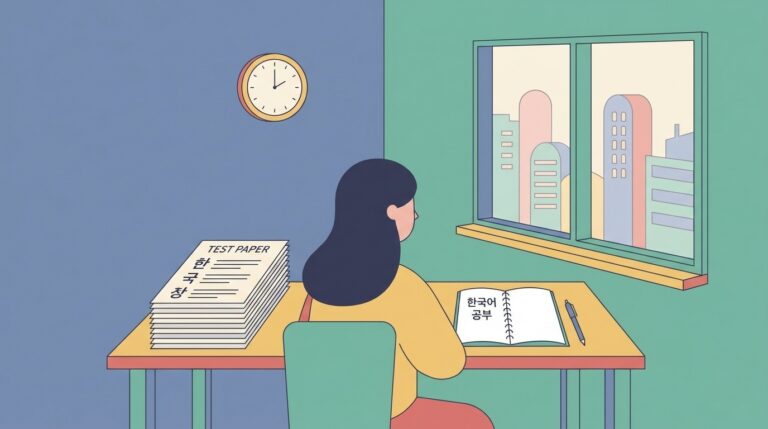
Why Korea Banned Killer Questions: The Ultimate B2 Guide to Suneung and Hagwon Culture
Phase 1: Empathy (Storytelling Opening)
안녕하세요! 매일한글 에디터입니다. (Hello! I’m your Daily Hangul editor.)
If you have watched K-dramas like SKY Castle or Crash Course in Romance (일타 스캔들), you might have felt chills watching parents scramble to get their children into elite hagwons (cram schools). Believe it or not, reality in Korea can be even more astonishing. Recently, headlines buzzed about ‘seven-year-old civil exams’ (7세 고시) for toddlers entering elite English kindergartens and ‘elementary medical school tracks’ (초등 의대반) for 10-year-olds! But the biggest shockwave arrived when the Korean Ministry of Education intervened directly in the College Scholastic Ability Test (수능 – Suneung), banning so-called ‘killer questions’ (킬러 문항)—ultra-complex problems that many argued could only be solved with expensive private tutoring tricks.
For intermediate (B2) Korean learners, discussing social issues like public education reform (공교육 정상화) and private education frenzy (사교육 열풍) can feel intimidating. Have you ever tried to join a serious discussion with Korean colleagues or language partners, only to freeze because your textbook never taught you terms like ‘변별력’ (discriminatory power of a test) or ‘물수능’ (an easy test)? Don’t worry. This guide draws on real feedback from fellow learners who wanted to talk about authentic Korean society without sounding like a robotic news broadcast. By the end of this guide, you will be able to share your insights naturally and with genuine cultural sensitivity!
Phase 2: Core Expressions Deep Dive
1. 킬러 문항을 배제하다 (Killeo munhang-eul baeje-hada)
- Pronunciation: [Kil-leo mun-hang-eul bae-je-ha-da] (Think of the English word killer + moon-hang + bay-jay-ha-da)
- Meaning: Literally “to exclude killer questions”; nuanced as removing abnormally difficult, multi-concept test items designed solely to trip up students.
- K-Culture Moment: In modern news broadcasts and parent community forums (like Mom-cafe), whenever Suneung mock tests (모의고사) wrap up, this phrase dominates the front page.
- Editor’s Insight: ‘배제하다’ is a formal B2-level verb meaning ‘to exclude/rule out’. Paired with the loanword ‘킬러 문항’, it captures modern governmental policy language mixed with colloquial test jargon.
- Situation Spectrum: Casual ⚠️ | Semi-formal ✅ | Formal ✅
- 🤔 Think About It: Does your home country’s university entrance exam use trick questions to rank students, or does it focus on standard competencies?
2. 사교육비 부담을 줄이다 (Sagyo-yukbi budam-eul jurida)
- Pronunciation: [Sa-gyo-yuk-bi bu-dam-eul ju-ri-da] (Sounds like sah-gyo-yook-bee + boo-dahm-eul + joo-ree-dah)
- Meaning: Literally “to reduce the private education expense burden”; used when addressing the financial strain that hagwon bills place on families.
- K-Culture Moment: Heated dinner-table debates between Korean parents discussing how much of the monthly household budget goes to after-school math and English academies in Daechi-dong.
- Editor’s Insight: ‘부담’ (burden/pressure) is an indispensable Korean word. You can also use it emotionally (e.g., 부담스러워요 – “I feel overwhelmed/pressured”).
- Situation Spectrum: Casual ✅ | Semi-formal ✅ | Formal ✅
- 🤔 Think About It: In Korea, spending over 20-30% of household income on after-school tutoring is common. How does this compare to social attitudes toward tutoring where you grew up?
3. 공교육을 정상화하다 (Gonggyo-yug-eul jeongsanghwahada)
- Pronunciation: [Gong-gyo-yug-eul jeong-sang-hwa-ha-da] (Pronounced like gong-gyo-yook-eul + jeong-sahng-hwa-ha-da)
- Meaning: Literally “to normalize public education”; it carries the nuance of restoring faith, authority, and fairness to standard school classrooms over private cram schools.
- K-Culture Moment: Spoken frequently by school teachers and policy analysts in documentaries debating why students sleep during morning high school classes after staying at hagwons until 10 PM.
- Editor’s Insight: The affix ‘-화하다’ transforms a noun into an action meaning ‘to turn into / to make ~’. ‘정상화’ means making something normal or functioning properly again.
- Situation Spectrum: Casual 🚫 | Semi-formal ✅ | Formal ✅
- 🤔 Think About It: What does ‘normalizing’ education mean to you: equal outcome, equal opportunity, or less competitive pressure?
Phase 3: Textbook Korean vs. Real Korean
Situation 1: Talking about how difficult the exam was
- 📖 교과서 한국어 (Textbook Korean): 이번 시험은 난이도 조절이 잘 되었습니다. (Ibeon siheom-eun nan-ido jojeor-i jal doe-eotseumnida. / The difficulty level of this exam was adjusted well.)
- 🗣️ 진짜 한국어 (Real Korean): 킬러 문항이 빠졌는데도 완전 불수능이었어요! (Killeo munhang-i ppajyeon-neundedo wanjeon bul-suneung-i-eosseoyo! / Even though killer questions were removed, it was still a totally brutal ‘fire’ Suneung!)
- 💡 왜 다를까? (Why is it different?): Koreans describe test difficulty using colorful food-and-element metaphors: a notoriously difficult exam is a ‘불수능’ (fire Suneung), while an easy one is a ‘물수능’ (water Suneung).
Situation 2: Talking about high academy costs
- 📖 교과서 한국어 (Textbook Korean): 학원비가 너무 많이 듭니다. (Hagwon-biga neomu mani deumnida. / The academy tuition costs a lot of money.)
- 🗣️ 진짜 한국어 (Real Korean): 애들 학원비 때문에 허리가 휠 지경이에요. (Aedeul hagwon-bi ttaemune heoriga hwil jigyeong-ieyo. / My back is practically breaking from paying for the kids’ hagwon fees.)
- 💡 왜 다를까? (Why is it different?): Native speakers use the visceral idiom ‘허리가 휘다’ (one’s back bends/breaks) to express intense financial pressure from caring for and educating children.
Phase 4: K-Culture Deep Dive & Non-verbal Manners
4-1. 눈치 (Nunchi) & Body Language: How to Discuss Education in Korea
When Koreans discuss children’s grades, hagwons, or university admissions, tension can rise quickly. Because education is tied directly to social status, never boast directly about someone getting into an elite academy (대치동 유명 학원).
* The Empathetic Sigh: When a Korean parent sighs and says, “요즘 애들 공부하기 너무 힘들어요” (Kids have it so tough studying these days), gently tilt your head down, nod slowly, and keep your voice soft.
* Lowering Your Voice: Discussing test scores or monthly hagwon expenditures is done in lowered tones, often with a hand slightly cupping the mouth. Speaking loudly about grades in public spaces violates social etiquette.
4-2. Cultural Code: The ‘Daechi-dong’ Phenomenon & K-Drama Parallels
In Crash Course in Romance, mothers line up outside academy gates at 6:00 AM just to reserve front-row seats for star celebrity lecturers (일타강사). Daechi-dong in southern Seoul is the beating heart of this multi-billion dollar private education empire. When the government excluded ‘killer questions’, critics worried that the exam would lose its ‘변별력’ (discriminatory power to separate top 0.1% students), while supporters cheered that high schoolers might finally get some sleep. On test day, Korea literally halts: airplanes delay takeoff during the English listening section, and stock markets open an hour late to clear traffic for test-takers!
Phase 5: Real-Life Roleplay Scenario
Setting: A quiet cafe near Daechi Station, Seoul. Textbooks and laptops line neighboring tables. You are sharing an iced Americano with Min-ji, whose younger brother is retaking the Suneung (재수생).
- 민지 (Min-ji): [한숨을 푹 쉬며] 어휴, 올해 수능 방침 바뀌고 나서 동생이 엄청 혼란스러워해요. (Eohyu, olhae suneung bangchim bakkwigo naseo dongsaeng-i eomcheong hollanseureowo-haeyo.)
🎭 행동 지문: Stirring her straw anxiously and looking at a mock test booklet.
(Sighs deeply) Ugh, ever since the Suneung test policy changed this year, my younger brother has been so confused. -
나 (You): 킬러 문항을 배제한다는 방침 때문이죠? 공교육 과정에서만 출제한다고 들었어요. (Killeo munhang-eul baeje-handaneun bangchim ttaemun-ijyo? Gonggyo-yuk gwajeong-eseoman chulje-handago deureosseoyo.)
🎭 행동 지문: Nodding with an empathetic, thoughtful gaze.
(That’s because of the policy excluding killer questions, right? I heard they will only test within the public school curriculum.) -
민지 (Min-ji): 맞아요. 그런데 사교육 기술 없이는 변별력을 어떻게 가를지 다들 불안해해요. (Majayo. Geureonde sagyo-yuk gisul eopsineun byeonbyeol-ryeog-eul eotteoke gareulji dadeul buran-haehaeyo.)
🎭 행동 지문: Tapping her fingers on the table.
(Exactly. But everyone is anxious about how they will differentiate top scorers without those private academy techniques.) -
나 (You): 사교육비 부담을 줄이려는 의도는 좋지만, 학생들 입장에서는 혼란스러울 수 있겠네요. (Sagyo-yukbi budam-eul juriryeoneun uidoneun jochiman, haksaengdeul ipjang-eseoneun hollanseureoul su itgenneyo.)
🎭 행동 지문: Leaning forward slightly to show active listening.
(The intention to ease the burden of academy costs is good, but from the students’ perspective, it must feel really disorienting.) -
민지 (Min-ji): 진짜 그래요. 게다가 초등학생 때부터 의대 준비하는 반까지 생기니 공교육이 설 자리가 없잖아요. (Jinjja geuraeyo. Gedaga chodeunghaksaeng ttaebuteo uiddae junbihaneun ban-kkaji saenggini gonggyo-yug-i seol jariga eopjanayo.)
🎭 행동 지문: Shaking her head in disbelief.
(So true. Besides, with prep classes for medical school starting as early as elementary school, public education loses its standing.) -
나 (You): 맞아요, 7세 고시라는 말까지 나오는 걸 보면 공교육 정상화가 정말 시급한 과제 같아요. (Majayo, chil-se gosi-raneun malkkaji naoneun geol bomyeon gonggyo-yuk jeongsanghwaga jeongmal sigeupan gwaje gat-ayo.)
🎭 행동 지문: Speaking in a calm, supportive tone.
(Indeed, when you even hear terms like ‘seven-year-old exams’, normalizing public education seems like a truly urgent task.) -
민지 (Min-ji): 이해해 줘서 고마워요. 그래도 킬러 문항이 빠지면 실수 하나로 등급이 갈릴까 봐 그게 제일 걱정이에요. (Ihaehae jwoseo gomawoyo. Geuraedo killeo munhang-i ppajimyeon silsu hanaro deunggeub-i gallilkka bwa geuge jeil geokjeong-ieyo.)
🎭 행동 지문: Relaxing her shoulders with a grateful smile.
(Thanks for understanding. Still, we worry that without killer questions, a single minor mistake might drop his entire percentile grade.) -
나 (You): 동생분이 지금까지 열심히 준비했으니 분명 좋은 결과가 있을 거예요! 힘내라고 전해 주세요. (Dongsaeng-buni jigeumkkaji yeolsimhi junbi-haesseuni bunmyeong joeun gyeolgwaga isseul geoyeyo! Himnaerago jeonhae juseyo.)
🎭 행동 지문: Giving a warm two-handed fist pump of encouragement.
(Your brother has prepared so diligently, so I’m sure he’ll get great results! Please pass along my encouragement.)
🔀 인터랙티브 분기점 (Interactive Decision Point)
Imagine Min-ji asks: “외국에서는 수능 같은 시험에서 학원 안 다녀도 좋은 대학 갈 수 있어요?” (In other countries, can you get into top universities without attending cram schools?)
- Option A: “학원 안 다녀도 다 갈 수 있죠. 한국 사교육은 솔직히 너무 과하고 비정상적이에요.” (Anyone can get in without academies. Honestly, Korean private education is way too excessive and abnormal.)
- ❌ Bad Feedback: Too blunt and dismissive of the deep-seated societal pressures Korean students endure. It sounds judgmental rather than empathetic.
- Option B: “나라마다 다르지만, 학교 수업과 과외 활동을 종합적으로 평가하는 곳도 많아요. 한국도 공교육 중심으로 조금씩 균형을 찾아가면 좋겠어요.” (It varies by country, but many places evaluate school classes and extracurriculars holistically. I hope Korea also gradually finds balance centered around public schools.)
- 🌟 Best Feedback: Thoughtful, respectful, and demonstrates high-level intercultural empathy using B2 vocabulary.
- Option C: “시험 제도는 정치인들 마음대로 바뀌니까 그냥 신경 쓰지 않는 게 제일 속 편해요.” (Testing systems change at politicians’ whims anyway, so not caring is best for peace of mind.)
- ⚠️ Risk Feedback: Overly cynical and dismisses the genuine stress of Min-ji’s brother studying 14 hours a day.
Phase 6: 10-Second Emotion Shadowing Drill
Practice reading these out loud with appropriate pauses (/) and facial expressions:
[😮 걱정스럽고 진지하게 - Concerned & Serious]
킬러 문항을 배제하면 / 사교육비 부담은 줄어들겠지만, / 변별력 논란은 / 계속될 것 같아요.
(Killeo munhang-eul baejehamyeon / sagyo-yukbi budam-eun jureodeulgetjiman, / byeonbyeol-ryeok nonran-eun / gyesokdoel geot gat-ayo.)-
[🤔 신중하고 균형 잡힌 태도로 - Thoughtful & Balanced]
공교육 과정을 벗어난 문제는 / 배제하는 것이 / 학생들을 위한 올바른 방향이라고 봐요.
(Gonggyo-yuk gwajeong-eul beoseonan munje-neun / baejehaneun geos-i / haksaengdeur-eul wihan olbareun banghyang-irago bwayo.) -
[🥺 공감하며 따뜻하게 - Warmly & Empathetically]
어린 나이부터 시험에 시달리는 아이들을 보면 / 공교육 정상화가 / 정말 시급해 보여요.
(Eorin naibuteo siheom-e sidallineun aideur-eul bomyeon / gonggyo-yuk jeongsanghwaga / jeongmal sigeuphae boyeoyo.)
Phase 7: K-Culture Mini Dictionary
- 킬러 문항 (Killeo munhang) | Killer Questions
- Extremely convoluted questions on the Suneung, often weaving college-level philosophy or intricate calculus into high school exams to filter out top-tier applicants.
- 대치동 학원가 (Daechi-dong hagwonga) | Daechi-dong Academy District
- The epicenter of South Korean private tutoring in Gangnam, Seoul, lined with thousands of hagwons and bustling late at night.
- 불수능 / 물수능 (Bul-suneung / Mul-suneung) | Fire Suneung / Water Suneung
- Vivid slang comparing an excruciatingly hard exam to blazing fire (불) and an unexpectedly breezy exam to mild water (물).
- N수생 (En-susaeng) | Multiple-attempt Test Takers
- A term combining ‘N’ (any algebraic number) with ‘수험생’ (test taker), referring to students taking the Suneung for the 2nd (재수), 3rd (삼수), or Nth time to enter elite universities.
Phase 8: Survival Kit for Travelers & Expats
Top 3 Survival Expressions for Daily Life
- “혹시 주변에 늦게까지 하는 독서실이나 스터디 카페 있나요?” (Hoksi jubyeon-e neutge-kkaji haneun dokseosil-ina seoteodi kape itnayo?)
- Pro Tip: Perfect for when you need a silent place to work or study late at night near educational districts.
- “이 동네는 학원 버스가 진짜 많이 다니네요.” (I dongneneun hagwon beoseuga jinjja mani danineyob.)
- Pro Tip: A great natural conversation starter if you walk past bustling hagwon pickup zones around 10:00 PM.
- “시험 기간이라 그런지 카페에 학생들이 꽉 찼어요.” (Siheom giggan-ira geureonji kape-e haksaengdeur-i kkwak chasseoyo.)
- Pro Tip: Use this when explaining why a local franchise cafe has no empty tables during exam weeks in June, September, or November.
Editor’s Travel Note
Curious to witness Korea’s real study fervor firsthand? Take the subway to Hanti Station (한티역) or Daechi Station (대치역) on Line 3 around 9:50 PM on a weekday. You will see hundreds of yellow buses and parents’ cars waiting in double lanes for the mandatory 10:00 PM hagwon curfew, where thousands of high schoolers pour out into the night clutching heavy backpacks. To navigate the streets and locate quieter neighborhood cafes away from the study rush, make sure to refer to the official 네이버 지도 앱 다운로드 page.
Phase 9: “One Step Deeper” (Reflective Question)
In South Korea, high academic performance historically served as the single most reliable ladder for socioeconomic mobility (개천에서 용 난다 – “A dragon rises from a small stream”). However, as competition escalated, this noble aspiration morphed into an arms race fueled by parents’ financial capital, sparking deep anxiety over fairness. When the state steps in to strike down ‘killer questions’, it is attempting not just to fix a test paper, but to heal a cultural wound born of relentless meritocratic pressure.
💬 Your Turn: In your home country, is standardized testing viewed as an equalizer or as a barrier? Have you ever felt the pressure of a make-or-break exam? Share your story in Korean or English in the comments below!
Phase 10: FAQ & Common Mistakes
Q: Does removing ‘killer questions’ mean the Korean Suneung is now easy?
A: Not at all! Examiners compensate by creating ‘준킬러 문항’ (semi-killer questions)—medium-hard questions that are slightly more challenging across the board. The total test remains very demanding, requiring consistent speed and accuracy.
Q: Why do Korean authorities regulate hagwon closing times?
A: By municipal ordinance in Seoul, hagwons must shut their doors by 10:00 PM to protect students’ health, sleep, and well-being. Even so, many students transition directly to 24-hour study cafes (스터디 카페) afterwards.
Q: What is the difference between 사교육 (private education) and 공교육 (public education)?
A: ‘공교육’ (Public education) refers to standardized education provided through government-accredited primary, middle, and high schools. ‘사교육’ (Private education) covers for-profit tutoring, after-school academies (학원), private lessons (과외), and commercial online test-prep services.
🚨 Common Mistakes TOP 3
- Calling Hagwon “Academy” or “School” randomly in Korean: Saying 우리 학교 끝났어 when you mean cram school confuses native speakers. Always use 학원 (Hagwon) for private institutes and 학교 (Hakgyo) for regular accredited schools.
- Using “킬러 문제” instead of the official policy term: While people understand 킬러 문제, in formal debates and essays, the accurate compound is 킬러 문항 (Killer munhang).
- Confusing ‘변별력’ (discriminatory ability) with ‘차별’ (unjust discrimination): 변별력 (Byeonbyeol-ryeok) is a positive testing metric meaning the exam can fairly tell apart different ability levels, whereas 차별 (Chabyeol) is negative social discrimination.
Phase 11: Action Missions
- 🥉 Bronze Mission (Solo): Read the Phase 6 Shadowing sentences 3 times aloud while timing yourself to 10 seconds per sentence.
- 🥈 Silver Mission (Social): Post an Instagram story or tweet sharing one Korean word you learned today (e.g., #불수능 or #킬러문항) and tag your study buddies.
- 🥇 Gold Mission (Real Life): Ask your Korean language exchange partner: “수능에서 킬러 문항을 배제하는 정책에 대해 어떻게 생각해요?” and listen carefully to their response.
- 🎮 K-Culture Mission: Watch Episode 1 of Crash Course in Romance (일타 스캔들) on Netflix and spot how many times the word 학원 (hagwon) or 수능 (Suneung) appears on street signs and dialogue.
Phase 12: Interactive Quiz Challenge
Test your understanding of Korean education terms! Think of the answer before expanding each toggle.
1. Situation Decision:
Your Korean friend says her younger cousin got a perfect score on an exam known as a ‘불수능’. What is the most appropriate response?
* (A) 물수능이라서 다행이네요!
* (B) 킬러 문항도 많았을 텐데 정말 대단하네요!
* (C) 공교육이 정상화되었나 봐요.
👉 Click to reveal Answer & Explanation!
- Correct Answer: (B)
- Explanation: A ‘불수능’ is an exceptionally tough exam loaded with tricky questions. Praising them for overcoming killer questions shows you understand the cultural slang! Option (A) contradicts the situation, and (C) is unrelated.
2. Fill-in-the-Blank:
정부는 가계의 ( ) 부담을 줄이기 위해 수능 출제 방침을 변경했습니다.
(The government altered the Suneung question guidelines to reduce household private education expenses.)
👉 Click to reveal Answer & Explanation!
- Correct Answer: 사교육비 (Private education expenses)
- Explanation: Combined with ‘부담을 줄이다’, ‘사교육비’ perfectly completes the official policy phrase.
3. True or False Cultural Quiz:
During the Korean Suneung English listening comprehension test, airplane flight schedules at Korean airports are adjusted to prevent engine noise.
👉 Click to reveal Answer & Explanation!
- Correct Answer: TRUE (O)
- Explanation: Aircraft takeoffs and landings are strictly suspended nationwide for approximately 35 minutes during the afternoon English listening section to ensure zero noise interference for students.