

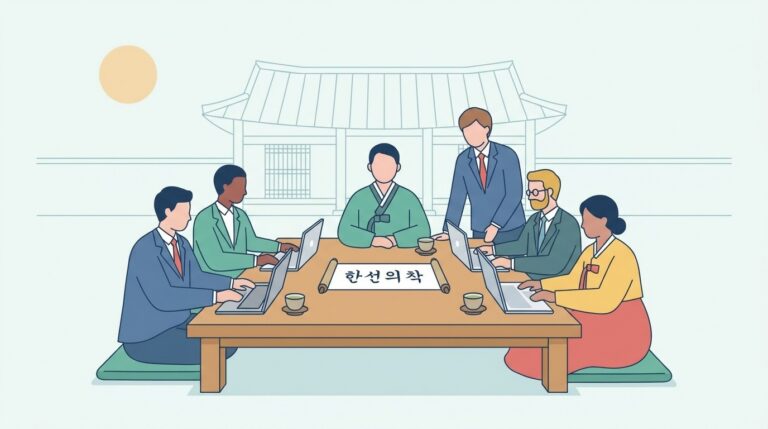
Leading Across Borders: Turning Cultural Friction into Creative Synergy in Korea
Phase 1: Empathy (Story-Driven Opening)
안녕하세요! 매일한글 에디터입니다. (Hello! I’m your Daily Hangul editor.)
Picture this scene from a sleek conference room in Pangyo, Korea’s Silicon Valley. A multinational project kickoff is underway. On one side sits a dynamic regional director from London, eager to standardize every sprint backlog and resolve debates within fifteen-minute intervals. On the other side sits a seasoned Korean senior operations director who grows noticeably quiet, offering contemplative pauses and subtle head tilts instead of direct counterarguments.
To an untrained eye, this silence feels like passive resistance or managerial inertia. But if you have spent years navigating Korean corporate boardrooms, you know what is actually happening: the Korean team is carefully reading the room (nunchi), assessing team cohesion, and wondering whether their unique local market insights are about to be steamrolled in the name of global uniformity.
In cross-border business, the instinctive urge is often to control differences—to iron out anomalies and force alignment. But as seasoned executives in Seoul know, real global leadership isn’t about homogenization. It is about embracing cultural friction as the very engine of innovation. Today, we’re diving into advanced C1 Korean expressions that demonstrate authentic executive tact, allowing you to orchestrate diverse perspectives into undeniable business synergy.
Phase 2: Core Expressions Deep Dive
1. 다름을 틀림으로 보지 않다 (Dareum-eul teullim-euro boji anta)
- Pronunciation: [Da-reum-eul teul-lim-eu-ro bo-ji an-ta] (Sounds like “dah-reum-eul tul-leem-eu-ro bo-jee ahn-tah”)
- Meaning: Literal: “Not viewing difference as being wrong” | Nuanced: Recognizing cultural and operational divergence as legitimate variation rather than an error to fix.
- K-Culture Moment: Evocative of boardroom confrontations in office dramas like Misaeng (Incomplete Life) or Search: WWW, where an enlightened C-suite leader defends an unconventional strategy brought forth by a non-traditional team.
- Editor’s Insight: In Korean, the words for “different” (다른) and “wrong” (틀린) are frequently mixed up colloquially. Using this distinction deliberately in executive contexts immediately signals philosophical maturity and high emotional intelligence.
- Situation Spectrum: Casual ⚠️ | Semi-formal ✅ | Formal ✅
- 🤔 Think About It: In your native culture, do people habitually frame unorthodox work methods as “inefficient” (wrong) or “alternative” (different)? How does vocabulary shape tolerance for organizational experimentation?
2. 결을 맞추다 (Gyeor-eul matchuda)
- Pronunciation: [Gyeo-reul mat-chu-da] (Think of running your hand along the smooth “grain” of fine Korean mulberry paper, ‘hanji’)
- Meaning: Literal: “To align the grain or texture” | Nuanced: Harmonizing underlying intentions, core values, and communication rhythms without flattening individual distinctiveness.
- K-Culture Moment: Used by visionary creative directors in K-Pop entertainment companies (such as behind-the-scenes documentaries of multinational idol groups) when harmonizing diverse vocal colors and cultural backgrounds into a cohesive concept.
- Editor’s Insight: Unlike 단순한 동의 (mere consensus), ‘결’ refers to intrinsic texture. Aligning ‘결’ means you aren’t changing who people are; you are aligning the orientation of their collective momentum.
- Situation Spectrum: Casual ✅ | Semi-formal ✅ | Formal ✅
- 🤔 Think About It: How do you establish common ground across borders without forcing international colleagues to abandon their native instincts?
3. 시너지로 승화시키다 (Ssineoji-ro seunghwasikida)
- Pronunciation: [Si-neo-ji-ro seung-hwa-si-ki-da] (Sounds like “she-ner-jee-ro seung-hwah-she-key-dah”)
- Meaning: Literal: “To sublimate into synergy” | Nuanced: Channeling raw tension or disparate viewpoints into a higher-order creative breakthrough.
- K-Culture Moment: Often delivered by inspirational leaders in tech startup narratives when transforming inter-departmental conflict into an industry-disrupting product launch.
- Editor’s Insight: ‘승화’ (sublimation) is a high-register term borrowed from chemistry and philosophy. It implies elevating base elements (conflict, confusion) into something pristine and valuable.
- Situation Spectrum: Casual 🚫 | Semi-formal ⚠️ | Formal ✅
- 🤔 Think About It: When was the last time team tension led directly to your best deliverable? What linguistic framing helped pivot that energy?
Phase 3: Textbook Korean vs. Real Executive Korean
Situation 1: Addressing Team Friction
- 📖 교과서 한국어 (Textbook): 우리는 서로의 차이점을 존중해야 합니다. (Urineun seoroui chaijeomeul jonjunghaeya hamnida.) – “We must respect each other’s differences.”
- 🗣️ 진짜 한국어 (Real C1 Executive): 서로 다른 백그라운드에서 오는 마찰을 오히려 건강한 자극으로 삼아보죠. (Seoro dareun baekgeuraundeueseo oneun machareul ohi려 geonganghan jageugeuro sam-abojo.) – “Let’s treat the friction stemming from our different backgrounds as healthy creative stimulus.”
- 💡 왜 다를까? (Why the nuance?): The textbook phrase feels didactic and moralizing. C1 executive Korean acknowledges the reality of “friction” (마찰) while strategically reframing it as productive organizational stimulus.
Situation 2: Leading a Strategy Alignment Session
- 📖 교과서 한국어 (Textbook): 갈등을 통제하고 하나의 의견으로 모으겠습니다. (Galdeungeul tongje-hago hanaui uigyeoneuro moeugesseumnida.) – “I will control the conflict and gather opinions into one.”
- 🗣️ 진짜 한국어 (Real C1 Executive): 이견을 무리하게 통제하기보다, 각자의 강점이 맞물리도록 판을 짜보겠습니다. (Igyeoneul muri-hage tongje-hagiboda, gakjaui gangjeomi manmullidorok paneul jjabogesseumnida.) – “Rather than forcibly policing diverging opinions, I will design a framework where each member’s unique strengths interlock.”
- 💡 왜 다를까? (Why the nuance?): Saying you will “control conflict” (갈등 통제) sounds autocratic. High-level executives speak of “setting the board” (판을 짜다) so distinct components mesh seamlessly (맞물리다).
Phase 4: K-Culture Deep Dive & Non-Verbal Leadership
4-1. Executive Nunchi & The Power of Non-Verbal Space
In Western boardrooms, immediate debate signals engagement. In a Korean executive setting, rapid-fire rebuttal can be perceived as an aggressive refusal to digest another’s perspective. When bridging cross-border teams:
* The Reflective Nod (고개 끄덕임): Before offering an alternative view, pause for 2–3 seconds while slightly tilting your chin downward. This non-verbally telegraphs: “I have fully received and weighed your point.”
* Softening the Direct Gaze: Direct, unblinking eye contact during critique can trigger defensiveness. Soften your gaze toward the mid-chest or project deck when reframing friction.
4-2. The Multinational K-Pop Blueprint for Synergy
Consider how agencies manage global pop powerhouses today. Groups feature members from Seoul, Tokyo, Los Angeles, and Bangkok. Early management tried rigid assimilation. Today’s global strategy focuses on cultural synthesis—weaving distinct vocal nuances, languages, and performance cultures into an innovative signature sound. True cross-cultural leadership in Korea today mirrors this exact dynamic: you do not dilute identity; you orchestrate its collision.
Phase 5: Real-World Roleplay Scenario
Setting: Late evening at a corporate strategy suite in Teheran-ro, Gangnam. Global Director Sarah and Senior Korean Team Lead Min-woo are debriefing after a heated cross-border stakeholder workshop.
- Turn 1 (민우 팀장): 사라 이사님, 오늘 본사 측에서 제안한 표준화 프로세스는 국내 실정과 너무 괴리가 커서 팀원들의 반발이 심합니다. (Sara isanim, oneul bonsa cheuk-eseo jeanhan pyojunhwa peuroseoseneun gungnae siljeong-gwa neomu goeriga keoseo timwondeurui banbari simhamnida.)
- 🎭 [서류를 내려놓으며 근심 어린 표정으로 찻잔을 만지작거린다]
- “Director Sarah, the standardized process proposed by headquarters today diverges so sharply from domestic reality that our local team is pushing back strongly.”
- Turn 2 (사라 이사): 민우 팀장님, 솔직하게 공유해 주셔서 감사해요. 본사의 가이드라인이 현장 감각을 충분히 담아내지 못했군요. (Min-u timjangnim, soljik-hage gong-yuhye jusyeoseo gamsahaeyo. Bonsaui gaideuraini hyeonjang gamgageul chungbunhi dam-anaeji mothaetgunyo.)
- 🎭 [차분하게 눈을 맞추며 고개를 끄덕인다]
- “Team Lead Min-woo, thank you for sharing that candidly. It sounds like headquarters’ guidelines failed to reflect your front-line reality.”
- Turn 3 (민우 팀장): 솔직히 다름을 억누르고 본사 방식대로 밀어붙이실까 봐 걱정했습니다. (Soljik-hi dareum-eul eongnuruego bonsa bangsikdaero mireobutisilkkwa bwa geokjeonghaetseumnida.)
- 🎭 [안도하는 숨을 내쉬며 경직되었던 어깨를 푼다]
- “Honestly, I was worried you would suppress our differences and push headquarters’ approach through regardless.”
- Turn 4 (사라 이사): 천만에요. 다름을 통제하기 시작하면 로컬 시장만의 생명력을 잃게 되니까요. (Cheonman-eyo. Dareum-eul tongje-hagi sijakhamyeon rokeol sijangmanui saengmyeongnyeog-eul ilke doenikkayo.)
- 🎭 [온화하면서도 단호한 눈빛으로 미소를 띤다]
- “Not at all. If we start policing differences, we lose the organic vitality of the local market.”
- Turn 5 (민우 팀장): 그렇다면 본사와 지사 간의 간극을 어떻게 좁히는 게 좋을까요? (Geureotamyeon bonsawa jisa ganui gangeug-eul eotteoke jophineun ge joeulkkayo?)
- 🎭 [노트를 펼치며 적극적인 협업 태세로 전환한다]
- “In that case, how do you suggest we bridge the chasm between HQ and the local branch?”
- Turn 6 (사라 이사): 다름을 틀림으로 보지 말고, 양쪽의 강점이 맞물리도록 결을 맞춰보죠. (Dareum-eul teullim-euro boji malgo, yangjjogui gangjeomi manmullidorok gyeor-eul matchwobojo.)
- 🎭 [두 손을 부드럽게 모아 상호 결합하는 제스처를 취한다]
- “Rather than seeing difference as error, let’s align our underlying grain so both sides’ strengths interlock.”
- Turn 7 (민우 팀장): 좋습니다. 한국 팀의 기민한 실행력을 본사의 리소스와 결합하면 오히려 독보적인 모델이 나오겠네요. (Joeusseumnida. Hanguk timui giminhang silhaengnyeog-eul bonsaui risoseuwa gyeolhaphamyeon ohi려 dokbojeogin moderi naogetneyo.)
- 🎭 [확신에 찬 눈빛으로 미소를 지으며 메모한다]
- “Agreed. Coupling the Korean team’s agile execution with HQ resources might actually birth an unrivaled business model.”
- Turn 8 (사라 이사): 바로 그거예요! 이 충돌을 우리만의 시너지로 승화시켜 봅시다. (Baro geu-geo-yeyo! I chungdoreul urimanui ssineojiro seunghwasikyeo bopsida.)
- 🎭 [자신감 넘치는 목소리로 악수를 청한다]
- “Exactly! Let’s sublimate this friction into our own unique synergy.”
🔀 Interactive Decision Point
How should Sarah close the strategy alignment meeting to ensure deep buy-in from the local team?
- Choice A: “본사 임원진에게는 제가 알아서 보고할 테니, 팀장님은 군말 없이 따라오세요.” (I will report to HQ executives on my own, so just follow without complaints.)
- Feedback (Bad): Highly authoritarian. Dismisses psychological safety and alienates local leadership.
- Choice B: “한국 팀의 독자적인 대안을 본사 승인 없이 바로 실행에 옮기시죠.” (Let’s execute the Korean team’s alternative immediately without HQ approval.)
- Feedback (Risk): Creates cross-border governance failure and leaves the local team vulnerable if targets are missed.
- Choice C: “한국 팀의 현장 데이터에 기반한 보완안을 제가 본사와 조율할 테니, 함께 결을 다듬어 보시죠.” (I will harmonize headquarters’ intent with an enhanced proposal based on your local data; let’s refine the grain together.)
- Feedback (Best): Pure C1 leadership. Acts as an executive buffer while validating front-line expertise.
Phase 6: 10-Second Emotion Shadowing Drill
Practice these high-impact executive cadences. Emphasize pauses marked with /.
[🤝 확신에 차서 포용력 있게]
다름을 / 틀림으로 규정하지 않을 때, / 비로소 진정한 혁신이 / 시작됩니다.
(Dareum-eul / teullim-euro gyujeonghaji aneul ttae, / biroso jinjeonghan hyeoksini / sijakdoemnida.)
“When we do not define difference as error, / genuine innovation / finally begins.”-
[🎯 차분하면서도 전략적으로]
본사의 시스템과 / 현장의 직관이 / 유기적으로 맞물리도록 / 판을 짜겠습니다.
(Bonsaui siseutemgwa / hyeonjangui jikgwani / yugijeogeuro manmullidorok / paneul jjagessumnida.)
“I will design the framework / so headquarters’ systems and field intuition / mesh organically.” -
[🔥 사기를 북돋우며 힘차게]
지금의 건설적인 충돌을 / 우리 팀만의 / 폭발적인 시너지로 승화시켜 보죠!
(Jigeumui geonseoljeogin chungdoreul / uri timmanui / pokbaljeogin ssineojiro seunghwasikyeo bojo!)
“Let’s transform this constructive friction / into our team’s / explosive synergy!”
Phase 7: K-Culture Mini Dictionary
- 화이부동 (和而不同, Hwaibudong): Harmony without Blind Conformity. A classical concept prized in modern Korean leadership meaning maintaining harmony and collaboration while preserving independent critical thought.
- 역지사지 (易地思之, Yeokjisaji): Stepping into the Other’s Shoes. In cross-border negotiations, invoking this demonstrates high empathy and willingness to understand partner constraints.
- 판을 짜다 (Paneul jjada): Designing the Strategic Board/Framework. Literally “weaving the board,” this phrase is used by visionary directors to describe designing an ecosystem where teammates can thrive without micromanagement.
- 티키타카 (Tiki-taka): Seamless Rhythmic Chemistry. Borrowed from football, Korean professionals use this to describe effortless, rapid-fire intellectual synergy and communication flow.
Phase 8: Expat Executive Survival Kit
Top 3 Executive Survival Phrases
- 1. 각자의 맥락을 먼저 짚어보시죠. (Gakjaui maeknageul meonjeo jipeobosijo.)
- Romanization: Gak-ja-ui maek-nak-eul meon-jeo ji-peo-bo-si-jo.
- Pro Tip: Use this during deadlock to calm tempers by exploring the historical “context” behind conflicting demands.
- 2. 생산적인 긴장감으로 받아들이겠습니다. (Saengsanjeogin ginjanggameuro badadeurigesseumnida.)
- Romanization: Saeng-san-jeok-in gin-jang-gam-eu-ro ba-da-deu-ri-get-seum-ni-da.
- Pro Tip: Great response when external audits or tough performance metrics create tension in the room.
- 3. 균형점을 함께 찾아가시죠. (Gyunhyeongjeomeul hamkke chajagasijo.)
- Romanization: Gyun-hyeong-jeom-eul ham-kke cha-ja-ga-si-jo.
- Pro Tip: A polite yet authoritative invitation to transition from finger-pointing to joint problem-solving.
Editor’s Professional Note
To thrive in Korea’s executive ecosystem, download the Remember Business Card App. In Korea, exchanging paper cards (myeongham) is an essential physical ritual. Use both hands when receiving a card, read it carefully for three seconds, and keep it on the table before scanning it into Remember after the meeting.
Phase 9: A Step Deeper (Reflection)
In classical East Asian philosophy, the concept of 화이부동 (和而不同)—harmony without conformity—is celebrated as the highest virtue of leadership. In modern cross-border enterprises operating in Seoul, this principle is more urgent than ever. Leaders who mistake obedience for loyalty often end up with sterile teams incapable of autonomous problem-solving. Embracing cultural divergence requires the courage to sit with discomfort, realizing that true team unity is not a unison chorus, but a rich, complex polyphony.
💬 Your Turn: Have you ever experienced a moment where an apparent cultural misunderstanding ended up revealing a breakthrough business opportunity? Share your story in the comments below!
Phase 10: FAQ & Common Misconceptions
Q: Does adopting a collaborative tone in Korean risk making a foreign leader look weak or indecisive?
A: Not when paired with advanced executive phrasing. Phrases like “결을 맞추다” or “판을 짜다” signal mastery over strategic architecture. In modern Korean enterprises (especially tech and entertainment), quiet strategic poise is respected far more than blustering authoritarian commands.
Q: When a Korean team member remains silent during open brainstorming, does it mean they have no ideas?
A: Rarely. Silence often reflects social calibration (nunchi): they may be considering hierarchical deference, refining ideas to avoid wasting collective time, or reading executive consensus. Address this by soliciting input individually in low-stakes settings using “역지사지” framing.
Q: Can I use “다름을 틀림으로 보지 않다” with my direct boss or CEO?
A: Yes, but frame it as an organizational philosophy rather than advice directed at them. Say: “저희 팀은 다름을 틀림으로 보지 않고, 다양한 시각을 시너지로 승화시키는 데 주력하고 있습니다.” (Our team focuses on not seeing differences as mistakes, but on sublimating diverse perspectives into synergy.)
🚨 Common Mistakes Alert
- Mistaking ‘틀리다’ (wrong) for ‘다르다’ (different): Never say “우리는 틀려요” (We are wrong) when you mean “우리는 달라요” (We are different). In leadership, this mistake undermines credibility.
- Equating agreement with compliance: Saying “알겠습니다” (I understand) means your counterpart has registered your point, not that they endorse it unconditionally. Verify alignment by checking the 결 (grain).
- Overriding silence too quickly: Jumping into awkward pauses within three seconds strips Korean counterparts of the contemplative window needed to articulate nuanced feedback.
Phase 11: Action Missions
- 🥉 Bronze Level: Stand in front of a mirror and practice delivering the 3 Shadowing Drills from Phase 6, paying close attention to the reflective downward nod.
- 🥈 Silver Level: Share this post on your professional network or Slack channel, highlighting the phrase “다름을 틀림으로 보지 않다” and adding your own reflection on cross-cultural leadership.
- 🥇 Gold Level: In your next international team sync or client meeting, actively deploy the phrase “각자의 맥락을 먼저 짚어보시죠” when friction arises.
- 🎮 K-Culture Mission: Watch an episode of the corporate drama Misaeng or a behind-the-scenes HYBE/SM audition series. Note how directors use silence, eye-level shifts, and tone modulation when offering critical creative feedback.
Phase 12: Interactive Quiz Challenge
Test your executive cultural intelligence! Click the toggle to reveal answers.
- Situational Judgment: Your overseas headquarters wants to replace a local Korean business workflow overnight. You want to propose integrating both approaches without offending HQ. Which phrase is best?
- (A) 본사 방식은 한국에서 절대 안 통합니다. (HQ’s way will never work in Korea.)
- (B) 양쪽의 강점이 맞물리도록 결을 맞춰보겠습니다. (Let’s align the grain so strengths from both sides interlock.)
- (C) 갈등을 피하기 위해 현장 의견을 묵살하겠습니다. (I will suppress local opinion to avoid conflict.)
- Fill in the Blank: “다름을 ______으로 보지 않고, 창의적인 시너지로 승화시킵시다.” (Let’s not view difference as _______, but sublimate it into creative synergy.)
-
True or False: In Korean executive culture, silence from local counterparts during a proposal debrief should always be interpreted as disinterest or lack of strategic direction.
🔍 Click to view answers and explanations!
- Answer: (B). Option B uses the elegant metaphor of 결을 맞추다 to convey collaborative synthesis without issuing an antagonistic ultimatum.
- Answer: 틀림 (teullim). 다름 (difference) vs. 틀림 (wrongness) is the fundamental linguistic axis of inclusive Korean leadership.
- Answer: False. Silence frequently signifies deep contextual reflection, risk evaluation, and relational consideration (nunchi). An adept global leader interprets this pause as an opportunity to invite nuanced perspectives.







