

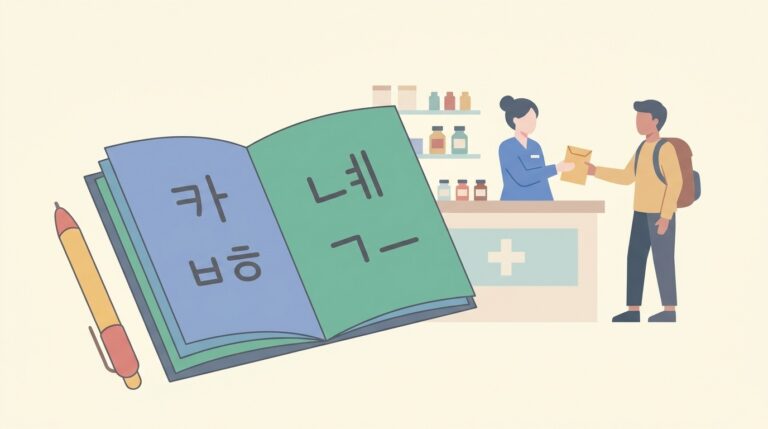
Never Panic at a Korean Pharmacy: How to Submit Prescriptions and Understand Dosages Like a Local
Phase 1: Empathy & Connection
안녕하세요! 매일한글 에디터입니다. (Hello! This is your Daily Hangul editor.)
Picture this: You are exploring the chilly autumn alleys of Ikseon-dong after binge-watching your favorite K-dramas, but your throat feels scratchy. By evening, you have a full-blown head cold. Bravely, you visit an ibihinhugwa (이비인후과 – ENT clinic), receive a paper prescription, and step into a nearby pharmacy glowing with a big red 약 (Yak) sign.
You slide the paper across the counter. The pharmacist hands you a neat paper pouch divided into small plastic packets of pills, smiles warmly, and says:
“항생제가 들어 있어서 증상이 좋아져도 끝까지 다 드셔야 해요.”
Your mind goes completely blank. You recognize hangsaengje (antibiotics) and kkeut (end), but what does the rest mean? Can you stop taking them once you feel better tomorrow? Do you take them before meals or after?
Medical Korean can feel intimidating—especially when you are already feeling under the weather! But don’t worry. This guide is built directly on real feedback from dozens of expat learners who felt that exact stomach-drop moment at local Korean pharmacies. By the end of this lesson, you will hand over prescriptions with effortless poise, understand crucial dosage warnings, and walk out with absolute peace of mind.
Phase 2: Core Expressions Deep Dive
Here are the top three life-saving phrases you need at any Korean pharmacy counter.
1. 처방전 여기 있어요. (Cheobangjeon yeogi isseoyo.)
- Pronunciation: Chuh-bang-jeon yuh-gee ee-ssuh-yo (Think: “Chub” as in chubby, “bang” like a drum, “jeon” like Korean pancake)
- Meaning: Literal: “Prescription is here.” | Real Nuance: “Here is my prescription, please.”
- K-Culture Moment: In the slice-of-life medical drama Hospital Playlist, you often see patients rushing into the first-floor pharmacy right outside the hospital doors handing this over.
- Editor’s Insight: In Korea, clinics and pharmacies are strictly separated by law (uiyak bun-eop). You will almost always get a paper prescription at a clinic to take to a neighboring pharmacy.
- Situation Spectrum: Casual: ⚠️ (처방전 여기 있어) | Semi-formal: ✅ (처방전 여기 있어요) | Formal: ✅ (처방전 여기 있습니다)
- 🤔 Think About It: In your home country, does the clinic send the script electronically, or do you physically hold your prescription paperwork like in Korea?
2. 끝까지 다 드셔야 해요. (Kkeutkkaji da deusyeoya haeyo.)
- Pronunciation: Kkeut-kka-jee dah deu-syuh-yah hae-yo (Start “kkeut” with a snappy, tense ‘k’ sound, like clicking a pen)
- Meaning: Literal: “You must eat it all to the very end.” | Real Nuance: “You must complete the full course of medication, even if you feel better.”
- K-Culture Moment: In Korean family dramas, an affectionate mother or caring partner will watch over someone taking medicine and nag lovingly: “약 남기지 말고 끝까지 다 먹어!” (Don’t leave pills behind, take them to the very end!)
- Editor’s Insight: 드시다 (deusida) is the polite honorific form of 먹다 (meokda – to eat/consume). Pharmacists will always use 드세요 (deuseyo) or 드셔야 해요 (deusyeoya haeyo) when speaking to adult patients.
- Situation Spectrum: Casual: 🚫 | Semi-formal: ✅ | Formal: ✅
- 🤔 Think About It: Why does Korean use the food verb “to eat” (먹다/드시다) for swallowing medicine, instead of a dedicated verb like “take” in English?
3. 졸릴 수 있어요. (Jollil su isseoyo.)
- Pronunciation: Jol-lil soo ee-ssuh-yo (“Jol” sounds like rolling a marble; “su isseoyo” sounds like a soft breeze)
- Meaning: Literal: “Sleepiness can exist.” | Real Nuance: “This might make you drowsy.”
- K-Culture Moment: Classic office comedy scenes in dramas where an overworked salaryman takes cold medicine during lunch break and accidentally dozes off during a team presentation.
- Editor’s Insight: The grammatical pattern -(으)ㄹ 수 있어요 denotes possibility (“can” / “may”). Listen for this phrase whenever you pick up cold, allergy, or motion sickness medicine.
- Situation Spectrum: Casual: ⚠️ (졸릴 수 있어) | Semi-formal: ✅ (졸릴 수 있어요) | Formal: ✅ (졸릴 수 있습니다)
- 🤔 Think About It: How do professionals in your culture warn customers about side effects without making them anxious?
Phase 3: Textbook Korean vs. Real Korean
Let’s bridge the gap between classroom grammar and the lively counter chatter at a Korean pharmacy.
Situation 1: Asking How to Take the Medicine
- 📖 Textbook Korean: 이 약의 복용법은 무엇입니까? (I yagui bogyongbeobeun mueosimnikka? – What is the method of taking this medicine?)
- 🗣️ Real Korean: 이거 어떻게 먹어야 해요? (Igeo eotteoke meogeoya haeyo? – How should I take this?)
- 💡 Why is it different? While “복용법” (dosage instruction) is a correct Hanja noun, everyday Koreans prefer simple, active verbs when speaking at the pharmacy counter.
Situation 2: The Pharmacist Explaining Not to Stop Early
- 📖 Textbook Korean: 증상이 호전되어도 투약을 중단하지 마십시오. (Jeungsangi hojeondoeeodo tuyageul jungdanhaji masipsio. – Do not discontinue administration even if symptoms improve.)
- 🗣️ Real Korean: 증상이 좋아져도 끝까지 다 드셔야 해요. (Jeungsangi joajyeodo kkeutkkaji da deusyeoya haeyo. – Even if you feel better, please finish the whole course.)
- 💡 Why is it different? Real pharmacists want you to be healthy and safe, so they speak in warm, approachable everyday honorifics (해요체) rather than cold medical jargon.
Phase 4: K-Culture Deep Dive & Non-Verbal Manners
4-1. 눈치 (Nunchi) & Counter Etiquette
- The Two-Hand Delivery (두 손): Always hand over your paper prescription with both hands or with your right hand supported lightly by your left forearm. This small sign of ye-ui (courtesy) instantly creates a warm rapport.
- The Attentive Nod: While the pharmacist reviews your dosing packet, stand close to the clear plastic screen and give short, rhythmic nods (“네~ 네~”). In Korea, silent blank stares can be misinterpreted as confusion or displeasure.
- Holding the Bag: Korean pharmacies place individual doses into sealed, transparent plastic strips called 한 포 (han po). They will slide these inside a paper pouch (yak-bongtu). Take the bag with both hands and give a slight bow.
4-2. Cultural Code: The Magic “Yak-bongtu” (약봉투)
Unlike many Western pharmacies where you get individual plastic bottles with child-proof caps, Korea uses high-tech packaging machines right behind the counter. For prescription oral meds, each scheduled dose (morning, noon, evening) is pre-packaged into a single tear-away packet containing all necessary pills together.
Look closely at your paper bag: it functions as your official receipt, medication information sheet, and dosage calendar all printed on a single sheet of paper! You will even see photos of your specific pills alongside explanations of side effects.
Phase 5: Real Role-play Scenario
Setting: Seoul Station Gwangjang Pharmacy (광장약국). Pharmacist Min-ji (smiling behind clear glasses) greets you at the counter.
- You: 안녕하세요, 처방전 여기 있어요. (Annyeonghaseyo, cheobangjeon yeogi isseoyo.)
🎭 Handing over the folded white hospital slip with both hands.
(Hello, here is my prescription.) - Pharmacist Min-ji: 네, 잠시만 앉아서 기다려 주세요. (Ne, jamsiman anjaseo gidaryeo juseyo.)
🎭 Takes prescription and enters data into the computer.
(Yes, please have a seat and wait for a moment.) - Pharmacist Min-ji: 김민수 님, 약 나왔습니다! (Kim Min-su nim, yak nawasseumnida!)
🎭 Calls your name while placing the paper envelope on the counter.
(Mr./Ms. Kim Min-su, your medicine is ready!) - You: 네! 어떻게 먹어야 해요? (Ne! Eotteoke meogeoya haeyo?)
🎭 Leaning in politely with attentive posture.
(Yes! How should I take these?) - Pharmacist Min-ji: 하루 세 번, 밥 먹고 삼십 분 뒤에 드세요. (Haru se beon, bap meokgo samsip bun dwie deuseyo.)
🎭 Pointing her pen at the morning, lunch, and dinner icons on the bag.
(Take them three times a day, 30 minutes after meals.) - Pharmacist Min-ji: 항생제가 들어 있어서 증상이 좋아져도 끝까지 다 드셔야 해요. (Hangsaengjega deureo isseoseo jeungsangi joajyeodo kkeutkkaji da deusyeoya haeyo.)
🎭 Making soft direct eye contact to emphasize importance.
(Since it contains antibiotics, you must finish the whole course even if symptoms improve.) - You: 혹시 졸릴 수 있어요? (Hoksi jollil su isseoyo?)
🎭 Asking with a cautious, curious expression.
(Could it perhaps make me drowsy?) - Pharmacist Min-ji: 네, 감기약 성분 때문에 조금 졸릴 수 있어요. 운전 조심하세요. (Ne, gamgiyak seongbun ttaemune jogeum jollil su isseoyo. Unjeon josimhaseyo.)
🎭 Smiling gently and sliding the bag into your hands.
(Yes, you might feel a bit drowsy due to the cold medicine ingredients. Be careful if driving.)
🔀 Interactive Decision Point
The pharmacist finishes speaking. How do you respond?
- Option A: “네, 알겠습니다. 끝까지 다 먹을게요! 감사합니다.” (Ne, algesseumnida. Kkeutkkaji da meogeulgeyo! Gamsahamnida.)
- Outcome: BEST CHOICE! 🌟 You acknowledged the antibiotic instruction, confirmed compliance naturally, and expressed warm gratitude.
- Option B: “네, 안녕히 계세요.” (Ne, annyeonghi gyeseyo.) and run out quickly.
- Outcome: RISK! ⚠️ Perfectly polite, but you didn’t acknowledge whether you understood the antibiotic warning, which might make the pharmacist worry.
- Option C: “나 내일 안 아프면 안 먹어요.” (Na naeil an apeumyeon an meogeoyo.)
- Outcome: BAD! 🚫 Using informal Panmal (na) sounds abrupt and disrespectful, and you directly contradicted the safety instruction to finish the course!
Phase 6: 10-Second Emotion Shadowing Drill
Practice matching natural pitch rises and emotional cadences! Slash marks (/) indicate breath pauses.
[🩺 진지하고 당부하듯 - Caring & earnest]
항생제가 들어 있어서 / 증상이 좋아져도 / 끝까지 다 드셔야 해요.
(Hangsaengjega deureo isseoseo / jeungsangi joajyeodo / kkeutkkaji da deusyeoya haeyo.)-
[🙋 조심스럽고 공손하게 - Polite & curious inquiry]
혹시 / 낮에 먹으면 / 졸릴 수 있어요?
(Hoksi / naje meogeumyeon / jollil su isseoyo?) -
[😊 안심시키며 씩씩하게 - Cheerful reassurance & thanks]
네! / 하루 세 번 / 꼭 챙겨 먹을게요!
(Ne! / haru se beon / kkok chaenggyeo meogeulgeyo!)
Phase 7: K-Culture Mini Dictionary
- 처방전 (Cheobangjeon) | Prescription
The official paper issued by a doctor. In Korea, you must submit it within the validity date printed at the bottom (usually 3 to 7 days). - 항생제 (Hangsaengje) | Antibiotics
One of the most frequently mentioned medical words at pharmacies. Always followed by instructions to finish the whole packet. - 식후 30분 (Sik-hu sam-sip-bun) | 30 minutes after meals
The golden rule of Korean medicine intake! It protects the stomach lining and helps establish a stable medication habit. - 약봉투 (Yak-bongtu) | Prescription paper envelope
A multi-functional marvel of Korean healthcare, functioning as receipt, medication schedule, and pill guide all in one.
Phase 8: Traveler’s Survival Kit
Top 3 Instant Counter Phrases
- 하루에 몇 번 먹어요? (Harue myeot beon meogeoyo?)
How many times a day do I take this?
Pro Tip: Use this if you forgot what the pharmacist said about meal timing. - 식전에 먹어요, 식후에 먹어요? (Sikjeone meogeoyo, sikhue meogeoyo?)
Do I take it before meals or after meals?
Pro Tip: Sikjeon = before food; Sikhu = after food. - 졸리지 않은 약으로 주세요. (Jolliji aneun yageuro juseyo.)
Please give me non-drowsy medication.
Pro Tip: Essential if you are buying over-the-counter allergy or cold medicine before a busy sightseeing day.
Editor’s Travel Note 💡
- Finding Open Pharmacies: If you fall sick late at night or on Sunday, look up a designated 휴일지킴이약국 (Holiday Guardian Pharmacy). You can easily check open nearby locations by opening the Naver Map Application Search.
- Payment Manners: Both domestic and international credit cards (Visa, Mastercard) and Samsung/Apple Pay are universally accepted at nearly every pharmacy, even for tiny 3,000 KRW purchases.
Phase 9: 한 발 더 깊이 (One Step Deeper)
In many Western countries, a pharmacy transaction can feel purely transactional—you pick up your standardized bottle, sign an electronic pad, and walk out. In Korea, however, bokyak jido (복약지도 – medication guidance) is considered a sacred communal duty of care. When a pharmacist reminds you, “증상이 좋아져도 끝까지 다 드셔야 해요,” they aren’t just reciting a warning label; they are expressing jeong (정 – deep cultural empathy and human connection). They treat you like family, ensuring you recover completely without relapse.
💬 Your Turn: Have you ever had a medical interaction in another country that surprised you with its warmth? Share your story in the comments below!
Phase 10: FAQ & Avoiding Misunderstandings
Q: What should I do if my prescription is about to expire?
A: Check the bottom right corner of your prescription sheet for the 사용기간 (period of validity). Most Korean prescriptions are valid for 3 to 7 days from the consultation date. If it expires, pharmacies legally cannot dispense it, and you must revisit the clinic for a reissue.
Q: Can I buy antibiotics over the counter without a prescription in Korea?
A: No. In South Korea, antibiotics, steroid treatments, and strong pain relievers are strictly classified as prescription drugs (cheobang yak). You must visit a local clinic first.
Q: What does “식후 30분” really mean? Do I literally need to set a timer?
A: In modern clinical practice, pharmacists explain that “식후 30분” simply means taking your pills shortly after your regular meal so you don’t forget and avoid stomach irritation. If you only eat a small banana or toast, that is still sufficient!
🚨 Common Mistakes Warning Board
- ❌ Mistake 1: Discarding leftover pills once symptoms disappear.
Correct Action: For antibiotics, always take every single packet until empty to prevent antibiotic resistance. - ❌ Mistake 2: Handing over the prescription paper with one hand while looking at your phone.
Correct Action: Give your full attention, offer the paper with two hands, and listen to the dosage guidance. - ❌ Mistake 3: Looking for liquid medicine bottles for adults.
Correct Action: Expect pre-sorted pill sachets sealed inside small transparent pockets. Tear open the packet and swallow with lukewarm water.
Phase 11: Action Missions
- 🥉 Bronze Level (Solo Practice): Read the shadowing drill sentences out loud 5 times in front of the mirror, focusing on connecting kkeut-kka-ji smoothly.
- 🥈 Silver Level (Social Sharing): Screenshot your favorite pharmacy expression from this post and share it to your Instagram story or study log, tagging
#DailyHangul! - 🥇 Gold Level (Real Life Challenge): Next time you visit Korea or a Korean pharmacy, ask clearly: “식후에 먹어야 해요?” without glancing at your phone notes!
- 🎮 K-Culture Mission: Watch an episode of a medical K-drama (like Hospital Playlist or Doctor Romantic) and spot the moment a doctor or nurse says “약 꼭 챙겨 드세요” (Make sure to take your medicine)!
Phase 12: Interactive Quiz Challenge
Test your real-world pharmacy skills!
1. Situational Judgment: You caught a mild fever and took 2 days of prescription medicine. Your fever is completely gone on day 3, but you have 2 days of antibiotic packets left. What should you do?
(A) Stop taking the pills immediately and save them for next winter.
(B) Take them until all packets are completely finished.
(C) Throw them in the general trash bin right away.
2. Fill-in-the-Blank: Complete the phrase meaning “It might make you drowsy”:
“혹시 ______ 수 있어요?”
(A) 배고플 (baegopeul)
(B) 졸릴 (jollil)
(C) 바쁠 (bappeul)
3. True or False: In South Korea, you can purchase oral antibiotics directly from a pharmacist without seeing a doctor first.
👉 Click to reveal answers & explanations!
-
Answer: (B)
Explanation: As the pharmacist emphasized (끝까지 다 드셔야 해요), antibiotics must be finished completely to eliminate bacteria and prevent resistance. -
Answer: (B) 졸릴
Explanation: 졸리다 means to feel sleepy/drowsy. Combined with -(으)ㄹ 수 있어요, it creates 졸릴 수 있어요 (It might make you drowsy). -
Answer: False
Explanation: Korea strictly separates clinic diagnosis and pharmacy dispensing (의약분업). Antibiotics always require an official doctor’s prescription (처방전).







