

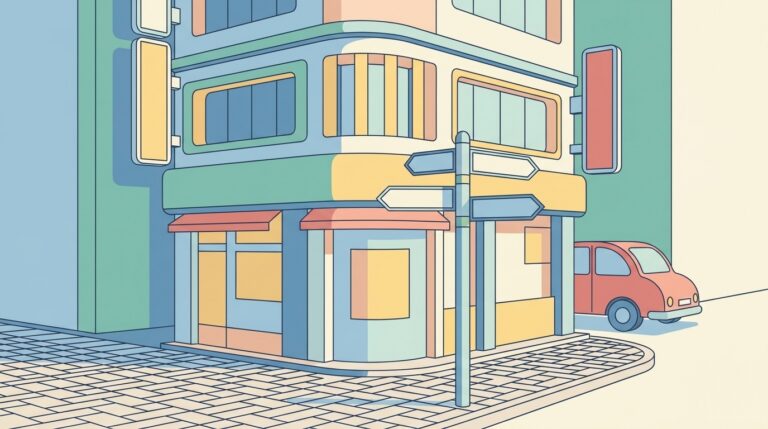
Master Korean Directions: Finding What’s Behind, In Front, and Next to You
Phase 1: Empathy (Welcome to Daily Hangul!)
안녕하세요! 매일한글 에디터입니다. Have you ever stepped out of a cozy alley cafe in Yeonnam-dong or Ikseon-dong, totally ready to call a taxi or find your rental car, only to realize you are completely turned around? You ask a friendly passerby where the parking lot is, and they kindly point and say, “건물 뒤에 있어요!” You freeze. You know “건물” (geonmul) is building, but is “뒤” (dwi) behind, in front, or next to? In classic K-drama style, your internal monologue goes into full panic mode while you nod awkwardly. Don’t worry! Every beginner learning Korean struggles with spatial markers. That is why today, we are conquering the core direction words—front, back, and side—with zero stress and 100% practical local street smarts.
Phase 2: Core Expressions Deep Dive
1. 건물 뒤에 주차장이 있어요 (Geonmul dwie juchajang-i isseoyo)
- Pronunciation: [Geon-mul dwi-e ju-cha-jang-i i-sseo-yo] (Rhymes with English “dwee” like tweet!)
- Meaning: Literal: “At the building’s back, parking lot exists.” / Real Nuance: “The parking lot is right behind the building.”
- K-Culture Moment: Think of a scene in a K-drama where a detective stakes out a suspect, whispering into the radio: “차는 건물 뒤에 있어요!” (The car is behind the building!)
- Editor’s Insight: In Korean, you place the landmark first, then the spatial noun, followed by the location particle ‘에’ (e). Formula: [Noun] + [위치 (뒤/앞/옆)] + [에 있어요].
- Situation Spectrum: Casual ✅ | Semi-formal ✅ | Formal ✅
- 🤔 Think About It: In English, we say “Behind the building” (preposition first). In Korean, the landmark anchors the thought first (“Building behind”). Notice how Korean speech builds from the big picture to the detail!
2. 편의점 옆에 있어요 (Pyeon-uijeom yeop-e isseoyo)
- Pronunciation: [Pyeon-ui-jeom yeo-pe i-sseo-yo] (The ‘p’ sound shifts into ‘e’, sounding like “yeo-pe”)
- Meaning: Literal: “Next to the convenience store it exists.” / Real Nuance: “It is right next to the convenience store.”
- K-Culture Moment: Your friend is trying to find you outside Hongdae Station: “Where are you?” You glance over and reply, “GS25 편의점 옆에 있어!”
- Editor’s Insight: “옆” (yeop) refers to the flank or side. When combined with the particle “-에”, liaison occurs, turning the sound into “yeope”.
- Situation Spectrum: Casual ✅ | Semi-formal ✅ | Formal ✅
- 🤔 Think About It: Why are convenience stores the universal navigation landmark in Korea? Because you can find one every 50 meters!
3. 은행 앞에 있어요 (Eunhaeng ap-e isseoyo)
- Pronunciation: [Eun-haeng a-pe i-sseo-yo] (“Ap” flows into “e” to sound like “ah-peh”)
- Meaning: Literal: “In front of bank it exists.” / Real Nuance: “It’s right out front of the bank.”
- K-Culture Moment: Meeting your date under the big bank sign in Gangnam: “우리 은행 앞에서 만나요!” (Let’s meet in front of the bank!)
- Editor’s Insight: “앞” (ap) denotes the front or visible face of any object or person.
- Situation Spectrum: Casual ✅ | Semi-formal ✅ | Formal ✅
- 🤔 Think About It: Do you tend to meet people by road names or by landmark entrances in your hometown? Korean culture relies heavily on building entrances.
Phase 3: Textbook Korean vs Real Korean
Situation 1: Asking where the restroom is
* 📖 교과서 한국어: 화장실이 어디에 위치하고 있습니까? (Hwajangsil-i eodi-e wichi-hago itseumnikka?)
* 🗣️ 진짜 한국어: 저기요, 화장실 어디에 있어요? (Jeogiyo, hwajangsil eodi-e isseoyo?)
* 💡 왜 다를까?: Nobody uses “위치하고 있습니까” (Is it situated) in everyday life. A soft “저기요” (Excuse me) paired with polite “-에 있어요?” sounds natural and polite.
Situation 2: Pointing someone to the parking lot
* 📖 교과서 한국어: 주차장은 본 건물 후면에 주차하시기 바랍니다. (Juchajang-eun bon geonmul humyeon-e juchahasigi baramnida.)
* 🗣️ 진짜 한국어: 주차장은 건물 바로 뒤에 있어요! (Juchajang-eun geonmul baro dwie isseoyo!)
* 💡 왜 다를까?: Real locals love adding the word “바로” (baro – right/directly) to give immediate, comforting clarity.
Phase 4: K-Culture Deep Dive & Non-verbal Manners
4-1. Nunchi & Gestures: How to Point Politely in Korea
In Western cultures, pointing directly with an outstretched index finger is common. In Korea, pointing directly at a person or right in front of someone’s face with a single finger can feel blunt or confrontational. When indicating a direction (like pointing behind a building), use an open palm with your fingers gently together, sweeping smoothly toward the direction. Tilt your head slightly while listening—this non-verbal cue shows you are actively exercising “눈치” (nunchi – contextual awareness).
4-2. Culture Code: The Maze of Korean Alleyways (골목 문화)
From hip cafes in Seongsu to vintage vinyl bars in Euljiro, Korea’s trendiest spots are rarely on main boulevards; they are hidden inside labyrinthine alleys (“골목”, golmok). Because street numbering can be tricky for newcomers, Koreans navigate by micro-landmarks: “건물 뒤” (behind the building), “약국 옆” (next to the pharmacy). Mastering these spatial words unlocks the coolest hidden spots in town.
Phase 5: Real-life Roleplay Scenario
Setting: You are parked in front of a busy aesthetic cafe in Yeonnam-dong. Minji, the stylish barista, walks out to water the plants.
- You: 저기요, 실례합니다. (Jeogiyo, sillyehamnida.) 🎭 Bowing slightly with hands clasped together.
- Minji: 네, 안녕하세요! 무엇을 도와드릴까요? (Ne, annyeonghaseyo! Mueos-eul dowa-deurilkkayo?)
- You: 혹시 주차장이 어디에 있어요? (Hoksi juchajang-i eodi-e isseoyo?)
- Minji: 아, 주차장이요? 카페 건물 바로 뒤에 있어요. (A, juchajang-iyo? Kape geonmul baro dwie isseoyo.) 🎭 Gesturing toward the back corner with an open palm.
- You: 건물 뒤요? 저 골목으로 들어가요? (Geonmul dwiyo? Jeo golmok-euro deureogayo?) 🎭 Pointing gently with open hand toward the side alley.
- Minji: 네, 맞아요! 편의점 옆 골목으로 돌면 바로 보여요. (Ne, majayo! Pyeon-uijeom yeop golmok-euro dolmyeon baro boyeoyo.)
- You: 아, 편의점 옆 골목이요! 감사합니다. (A, pyeon-uijeom yeop golmok-iyo! Gamsahamnida.) 🎭 Smiling with relief.
- Minji: 네, 조심히 들어가세요! (Ne, josimhi deureogaseyo!)
🔀 Interactive Choice Point: How will you confirm the location?
- Option A: “건물 뒤에 있어요? 알겠습니다!” (Behind the building? Got it!) -> [Best Outcome] Natural, concise, confirms the key direction accurately.
- Option B: “건물 안에서 차를 타요?” (Do I ride the car inside the building?) -> [Bad Outcome] Causes confusion because “안” means inside, not behind.
- Option C: “야, 저기 뒤?” (Hey, back there?) -> [Risk Outcome] Super rude! “야” is informal banmal used only with close friends of the same age.
Phase 6: 10-Second Emotion Shadowing Drill
[🤔 호기심 가득하고 정중하게]
저기요, / 주차장이 / 어디에 있어요? (Jeogiyo, / juchajang-i / eodi-e isseoyo?)-
[😮 번쩍 깨달으며 시원하게]
아! / 건물 뒤에 / 있어요? (A! / geonmul dwie / isseoyo?) -
[😊 안도하며 상냥하게]
편의점 옆에 / 있군요! / 감사합니다! (Pyeon-uijeom yeope / itgunyo! / Gamsahamnida!)
Phase 7: K-Culture Mini Dictionary
- 뒤 (Dwi) | Back / Behind | Used for spatial backside as well as temporal “after” (e.g., 그 뒤에 – after that).
- 앞 (Ap) | Front | Crucial for meeting spots outside exits (e.g., 출구 앞 – in front of the exit).
- 옆 (Yeop) | Side / Beside | Frequently paired with landmarks like stores or subway pillars (e.g., 옆집 – next-door neighbor).
- 주차장 (Juchajang) | Parking lot | Derived from Hanja: 駐 (park) + 車 (car) + 場 (place). Look for the blue ‘P’ sign.
Phase 8: Survival Kit for Travelers
- Top 1: 어디에 있어요? (Eodi-e isseoyo?) – Where is it?
- Pro Tip: Just say [Place] + 어디에 있어요? (e.g., 화장실 어디에 있어요? = Where is the restroom?).
- Top 2: 저 건물 뒤요? (Jeo geonmul dwiyo?) – Behind that building?
- Pro Tip: Repeating the direction with an upward lilt confirms you heard right.
- Top 3: 바로 옆이에요? (Baro yeop-i-e-yo?) – Is it right next door?
- Pro Tip: Saves you from walking three blocks past your destination.
Editor’s Travel Note
Google Maps is notoriously limited for pedestrian navigation in South Korea due to national security map data laws. Before your flight, download the 네이버 지도 앱 다운로드 (Naver Map) or KakaoMap. When searching for spots, tap the street view to spot whether the entrance or parking is “건물 앞” (front) or “건물 뒤” (back).
Phase 9: “One Step Deeper” (Cultural Reflection)
In Western urban layouts, addresses rely heavily on grid numbers and street names. In Korea, even with the modern road-name system (도로명 주소), everyday navigation remains profoundly landmark-centric and relational. People orient themselves relative to community focal points—the subway exit, the bakery, the space “behind” or “next to” another structure. This reveals the relational nature of Korean society, where entities exist in harmony with what surrounds them.
💬 Your Turn: Have you ever gotten lost in an alley or struggled to find an entrance in your travels? Share your funniest directional mishap in the comments!
Phase 10: FAQ & Common Mistakes
Q: Can I use ‘뒤’ (dwi) to mean ‘later’ in time?
A: Yes! Korean frequently uses spatial terms for time. “10분 뒤에” (sip-bun dwie) means “10 minutes later/after 10 minutes.”
Q: What is the difference between ‘옆’ (yeop) and ‘근처’ (geuncheo)?
A: “옆” specifically means immediately adjacent or beside, while “근처” means in the general neighborhood or vicinity.
Q: Do I always have to attach ‘에’ after ‘뒤’, ‘앞’, and ‘옆’?
A: When stating that something exists or is happening at that location, yes, attach ‘에’ (e.g., 뒤에, 앞에, 옆에).
🚨 Common Mistakes Board
- ❌ Mistake 1: Saying “뒤 건물” to mean “behind the building.”
- Correct Action: Say “건물 뒤”! Korean noun modifiers come first: [Anchor Noun] + [Direction].
- ❌ Mistake 2: Forgetting the particle ‘에’ when using ‘있어요’ (e.g., 건물 뒤 있어요).
- Correct Action: While understood in slang, always practice “건물 뒤에 있어요” for natural fluency.
- ❌ Mistake 3: Pronouncing “옆에” as “yeop-e” with a pause.
- Correct Action: Blend the sounds together smoothly: [yeo-pe]!
Phase 11: Action Missions
- 🥉 Bronze Mission (Solo): Look around your room right now. Say three items aloud using today’s words: 책상 앞 (in front of desk), 모니터 뒤 (behind monitor), 침대 옆 (next to bed).
- 🥈 Silver Mission (Social): Post an Instagram Story of your morning coffee and tag it with: “커피 옆에 노트북이 있어요!” (Next to the coffee is my laptop!).
- 🥇 Gold Mission (Live): During your next Korean restaurant visit or K-study session, ask the staff or tutor: “저기요, [물건] 어디에 있어요?” and listen for ‘앞’, ‘뒤’, or ‘옆’!
- 🎮 K-Culture Mission: Watch any modern K-drama episode and pause the moment a character receives directions on a phone call. Can you catch them saying “앞이야” or “뒤로 와”?
Phase 12: Interactive Quiz Challenge
Test your new directional superpower below! Click each dropdown to check your answers.
Quiz 1: Scenario Judgment (Click to view)
You are meeting a friend at a cafe. Your friend texts: “나 지금 서점 옆에 있어!” Where should you look for your friend?
– A) Inside the bookstore
– B) Right beside the bookstore
– C) Behind the bookstore
Correct Answer: B
Explanation: “옆” (yeop) means side/beside. If they were behind it, they would say “서점 뒤”.
Quiz 2: Fill in the Blank (Click to view)
Complete the sentence to say: “The car is behind the building.”
“차가 건물 _____ 있어요.”
Correct Answer: 뒤에 (dwie)
Explanation: “뒤” (behind) + “에” (location particle) gives us “뒤에”.
Quiz 3: True or False Culture Check (Click to view)
True or False: When directing an elder or taxi driver in Korea, it is polite to point directly with your single index finger.
Correct Answer: False
Explanation: Use an open hand with fingers together to gesture courteously. Single-finger pointing can be perceived as aggressive.






