

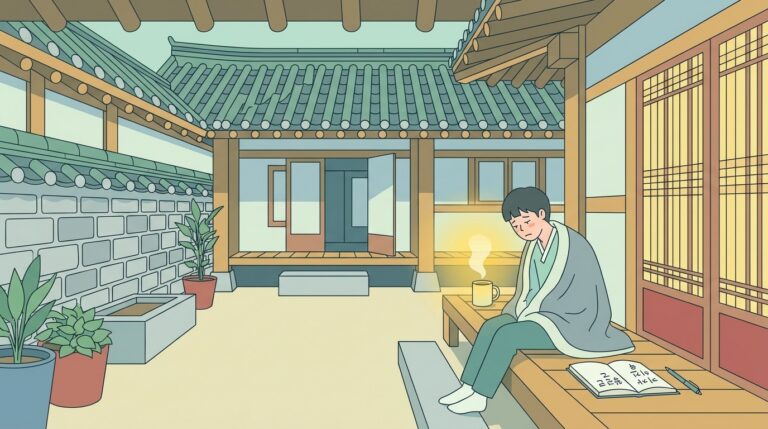
Phase 1: 공감 (A Warm, Empathic Opening)
안녕하세요! 매일한글 에디터입니다. (Annyeonghaseyo! It’s your Daily Hangul editor here.)
Picture this scene from a Seoul office district: It is 10:45 PM on a Tuesday in Yeouido. The sleek glass towers are still glowing like fluorescent lanterns. Inside, someone is staring at a sixth consecutive spreadsheet, their third iced americano long turned lukewarm. In Korean society, this quiet, relentless drive has a philosophical name popularized by philosopher Byung-Chul Han: the Burnout Society (피로사회, pirosahoe). We push ourselves past exhaustion under the banner of diligence, treating our emotional batteries like an endless resource until suddenly—we hit empty.
Have you ever watched K-dramas like Daily Dose of Sunshine (정신병동에도 아침이 와요) or Doctor Slump (닥터슬럼프) and felt that sudden pang of recognition? The protagonists are brilliant, hardworking, and deeply loved, yet they find themselves frozen in place by sudden depressive episodes or paralyzing burnout. For decades, admitting that your heart hurts carried a heavy social stigma in South Korea. But a quiet, transformative revolution is underway. Today’s Korea is learning to view emotional distress through a compassionate lens: “심리적 고통은 마음의 감기일 뿐이다” (Psychological pain is simply a cold of the heart).
When you catch a nasty winter cold in Seoul, you don’t agonize over whether you “deserve” to see an ENT doctor. You walk right into the nearest clinic, get a prescription, and rest. Why should our emotional resilience be treated any differently? Through real feedback from our advanced learners navigating workplace burnout and life transitions in Korea, this guide equips you with the exact C1-level lexicon and socio-cultural sensitivity to talk about mental health, de-stigmatize therapy, and support yourself or a friend with authentic Korean empathy.
Phase 2: 핵심 표현 3선 심층 분석 (Top 3 Core Expressions)
1. 마음의 감기예요, 부끄러운 게 아니에요 (Maeum-ui gamgi-yeyo, bukkeureoun ge anieyo)
- Pronunciation: [Mae-um-ui gam-gi-ye-yo, boo-kku-reo-oon ge ah-ni-ye-yo] (Think of the first vowel “mae” like the “me” in “mellow”, followed by “gamgi” which rhymes with “calm tea”)
- Meaning: “It’s just a cold of the heart/mind; it is nothing to be ashamed of.”
- K-Culture Moment: Seen frequently in medical and healing dramas whenever a psychiatrist gently reassures an overwhelmed corporate worker who feels guilty for seeking help.
- Editor’s Insight: The metaphor of “감기” (common cold) is South Korea’s most powerful public health rhetoric for removing mental health stigma. It shifts the blame from a moral failing or character defect to a seasonal, temporary biological illness anyone can catch when immunity dips.
- Situation Spectrum: Casual ⚠️ | Semi-formal ✅ | Formal ✅
- 🤔 Think About It: In your home culture, is therapy compared to treating physical ailments like a broken bone or a flu, or is it discussed in strictly psychological terms? How does framing mental distress as a “cold” lower barriers for seeking care?
2. 혼자 끙끙 앓지 말고 전문가 상담 한번 받아봐 (Honja kkeungkkeung alji malgo jeonmun-ga sangdam hanbeon badabwa)
- Pronunciation: [Hon-ja kkeung-kkeung ahl-ji mal-go jeon-moon-ga sang-dam han-beon bah-da-bwa] (The double consonant “끙끙” mimics the strained, groaning sound of someone carrying a heavy load alone)
- Meaning: “Don’t suffer in agonizing silence all by yourself; go see a specialist for a session.”
- K-Culture Moment: A heartfelt scene over warm tea where a senior mentor gently notices an employee’s hollow gaze and encourages them to visit an outpatient clinic instead of suppressing tears.
- Editor’s Insight: The mimetic adverb “끙끙” (groaning under weight) evokes visceral empathy. Pairing it with the suggestion “한번 받아봐” (try it once, casually) softens the burden of committing to lifelong psychiatric treatment.
- Situation Spectrum: Casual ✅ | Semi-formal ✅ | Formal 🚫
- 🤔 Think About It: Notice the difference between commanding someone to get help versus inviting them to “try it just once” (한번). How does Korean politeness use speculative and exploratory verb endings to soften sensitive medical advice?
3. 버티는 게 능사는 아니더라고요 (Beotineun ge neungsaneun anideoragoyo)
- Pronunciation: [Buh-ti-neun ge neung-sah-neun ah-ni-duh-rah-go-yo] (Flow smoothly: “neung-sa” sounds like “lung-sa” with a soft dental ‘n’)
- Meaning: “I realized that simply gritting one’s teeth and toughing it out isn’t always the right solution.”
- K-Culture Moment: A character who finally resigns from a toxic company or enters clinical recovery reflecting upon their journey during a deep late-night monologue.
- Editor’s Insight: The noun “능사” (能事) refers to the optimal, ultimate, or singular solution. Adding the reflective experiential ending “-더라고요” signals personal retrospection, allowing you to share life wisdom without sounding preachy.
- Situation Spectrum: Casual ⚠️ | Semi-formal ✅ | Formal ✅
- 🤔 Think About It: Traditional Korean collectivism has long glorified “존버” (slang for extreme endurance) and “끈기” (perseverance). Why is questioning the virtue of “endurance” a critical sign of maturity in modern Korean discourse?
Phase 3: 교과서 한국어 vs 진짜 한국어 (Textbook vs. Real Native Korean)
Situation 1: Describing absolute mental and physical depletion
- 📖 교과서 한국어 (Textbook):
극심한 피로와 스트레스로 인해 일상생활에 무기력증을 겪고 있습니다.
(Geuksimhan pirowa seuteureseuro inhae ilsangsaenghware mugiryeokjjeung-eul gyeokgo itseumnida.)
“Due to severe fatigue and stress, I am experiencing lethargy in my daily life.” - 🗣️ 진짜 한국어 (Real Korean):
번아웃이 제대로 와서 멘탈도 체력도 완전히 방전됐어요.
(Beon-a-usi jedaero waseo menttaldo cheryeokdo wanjeonhi bangjeondwaesseoyo.)
“Burnout hit me full force; my mental state and physical stamina are completely drained.” - 💡 왜 다를까? (Why the Difference?):
Native speakers rarely describe burnout using clinical diagnostic terms like “무기력증” (lethargy) in normal conversations. Instead, they use evocative tech metaphors such as “방전되다” (a battery draining to zero percent) and conversational loanwords like “멘탈” to convey acute exhaustion with raw authenticity.
Situation 2: Suggesting someone visit a psychiatric clinic without sounding alarming
- 📖 교과서 한국어 (Textbook):
정신과 전문의를 찾아가 진단과 치료를 받는 것을 권유합니다.
(Jeongsin-gwa jeonmun-uireul chajaga jindangwa chiryoreul banneun geoseul gwonyuhamnida.)
“I recommend that you visit a psychiatrist to receive a medical diagnosis and treatment.” - 🗣️ 진짜 한국어 (Real Korean):
너무 버거우면 혼자 참지 말고, 정신건강의학과 가서 가볍게 상담이라도 받아봐요.
(Neomu beogeoumyeon honja chamji malgo, jeongsingeon-gang-uihakgwa gaseo gabyeopge sangdam-irado badabwayo.)
“If it feels too overwhelming, don’t hold it all in alone; just drop by a mental health clinic for a light consultation.” - 💡 왜 다를까? (Why the Difference?):
The archaic shorthand “정신과” (psychiatry) still carries defensive historical baggage for some Koreans. Modern professionals and empathetic friends prefer the official, dignified title “정신건강의학과” (Department of Mental Health Medicine) or “마음 클리닉” (Mind Clinic), paired with “가볍게” (lightly) to demystify the clinic visit.
Phase 4: K-Culture 딥다이브 & 비언어적 매너 (Cultural Nuance & Non-Verbal Manners)
4-1. 눈치 (Nunchi) & Somatic Etiquette
Mental health remains a deeply vulnerable topic in Korean culture. Discussing clinical counseling requires finely calibrated 눈치 (Nunchi – social radar and intuitive tact):
* Lower Your Vocal Pitch and Decibels: Never blurt out advice across an open office floor or a bustling eatery. Shift your tone down by half an octave to create a cocoon of psychological safety.
* Softened Eye Contact: Unlike Western norms that mandate piercing, unwavering eye contact as a sign of undivided attention, staring directly into an emotionally distressed Korean peer’s eyes can trigger intense anxiety and shame. Practice soft, diagonal eye contact—look towards their hands or the rim of their tea cup periodically.
* Warm Two-Handed Tea Offerings: In Korean non-verbal etiquette, placing a warm beverage gently in front of someone with both hands communicates unconditional physical grounding before a single sentence of comfort is spoken.
4-2. Cultural Code Analysis: The Evolution from Stigma to ‘Mind Health’
In South Korea’s high-octane economic miracle, communal survival historically demanded total suppression of personal vulnerability. Showing grief or psychological collapse was formerly mislabeled as “정신력 부족” (a lack of mental fortitude).
However, the contemporary cultural sphere—anchored by insightful shows like Our Blues (우리들의 블루스) and memoirs like I Want to Die but I Want to Eat Tteokbokki (죽고 싶지만 떡볶이는 먹고 싶어)—has dismantled that archaic narrative. Young Koreans now view going to therapy not as an admission of defeat, but as 정서적 유지보수 (emotional maintenance), as routine and commendable as hiring a personal trainer at the gym.
Phase 5: 실전 롤플레이 시나리오 (Practical Roleplay Scenario)
Setting: A quiet corner table at a minimalist tea house in Seongsu-dong on a rainy Friday afternoon.
Characters:
* Min-jun (민준): A close Korean colleague who has noticed you skipping lunches and looking visibly gaunt over the last three weeks.
* You (Alex): A foreign professional working at a Seoul tech startup, wrestling with severe insomnia and chronic workload burnout.
민준: 알렉스 씨, 요즘 얼굴이 많이 상했어요. 잠은 좀 자요?
(Alex ssi, yojeum eolguri mani sanghaesseoyo. Jameun jom jayo?)
“Alex, your face looks so worn down lately. Are you getting any sleep at all?”
🎭 행동 지문: 따뜻한 보리차 잔을 두 손으로 감싸며 조심스럽게 건넨다.
Alex: 솔직히 말씀드리면, 번아웃이 제대로 와서 침대에 누워도 머리가 안 멈춰요.
(Soljiki malsseumdeurimyeon, beon-a-usi jedaero waseo chimdaee nuwodo meoriga an meomchwoyo.)
“To be honest, burnout hit me full force; even when I lie in bed, my brain won’t shut off.”
민준: 하아… 프로젝트 압박이 심했죠. 그래도 계속 버티는 건 위험해요.
(Haa… peurojekteu apbagi simhaetjyo. Geuraedo gyesok beotineun geon wiheomhaeyo.)
“Sigh… the pressure on this project has been brutal. But continuing to just endure it is dangerous.”
Alex: 그러게요. 근데 제가 나약해서 감정 조절을 못 하는 건가 싶어서 자책하게 돼요.
(Geureogeyo. Geunde jega nayakhaeseo gamjeong jojeoreul mot haneun geon-ga sipeoseo jachaekhage dwaeyo.)
“I know. But I keep blaming myself, wondering if I’m just weak and can’t manage my emotions.”
민준: 전혀 아니에요! 마음의 감기 같은 거라, 누구나 면역력 떨어지면 아플 수 있어요.
(Jeonhyeo anieyo! Maeum-ui gamgi gateun geora, nuguna myeon-yeongnyeok tteoreojimyeon apeul su isseoyo.)
“Not at all! It’s just like a cold of the mind; anyone can get sick when their immunity drops.”
🎭 행동 지문: 알렉스의 어깨를 가볍게 토닥이며 진지하게 눈을 맞춘다.
Alex: 민준 씨도 그렇게 생각하세요? 사실 병원에 가볼까 고민은 많이 했거든요.
(Min-jun ssi-do geureoke saenggakhaseyo? Sasil byeong-wone gabolkka gomin-eun mani haetgeodeunyo.)
“Do you really think so, Min-jun? To tell the truth, I’ve been debating whether to visit a clinic.”
민준: 당연하죠. 혼자 끙끙 앓지 말고, 회사 근처에 괜찮은 정신건강의학과 가서 상담이라도 받아봐요.
(Dang-yeonhajyo. Honja kkeungkkeung alji malgo, hoesa geuncheoe gwaenchaneun jeongsingeon-gang-uihakgwa gaseo sangdam-irado badabwayo.)
“Of course. Don’t suffer in silence alone; go visit a reputable clinic near the office just for a consultation.”
Alex: 네, 말씀 듣고 나니까 마음이 한결 가벼워지네요. 월요일에 바로 예약해 볼게요.
(Ne, malsseum deutgo nanikka maeumi han-gyeol gabyeowojineyo. Woryoire baro yeyakhaebolgeyo.)
“Thank you, hearing you say that makes my heart feel considerably lighter. I’ll make an appointment this Monday.”
🔀 인터랙티브 분기점 (Interactive Decision Point)
How would you respond if Min-jun asked: “정신건강의학과 진료 기록 남는 게 걱정돼서 망설여지시나요?” (Are you hesitant because you’re worried about medical records remaining on file?)
- Option A: “기록 같은 건 신경 안 써요. 그냥 제 의지가 부족한 것 같아서 쪽팔려요.”
Feedback: [Bad] Minimizing clinical symptoms as “lacking will” (의지 부족) and using harsh informal slang like “쪽팔려요” (it’s humiliating) reinforces internal toxic shame and discourages professional intervention. - Option B: “솔직히 그런 걱정도 있었는데, 버티는 게 능사는 아니라는 생각이 들더라고요.”
Feedback: [Best!] Exemplary C1 mastery. Acknowledges realistic systemic hesitation while deploying advanced philosophical Korean (“버티는 게 능사는 아니다”) with graceful self-reflection. - Option C: “기록 남으면 한국에서 비자나 취업에 문제 생기니까 절대 안 갈 거예요.”
Feedback: [Risk] Overly catastrophic and factually incorrect. In modern Korean law, medical history (F-codes) is strictly sealed under medical privacy laws and cannot be accessed by employers or immigration officials.
Phase 6: 10초 감정 섀도잉 드릴 (10-Second Emotional Shadowing Drill)
Read these sentences aloud, paying meticulous attention to breathing pauses (/) and visceral emotional anchors.
[🥺 지치고 솔직하게 - Exhausted and vulnerable]
“더 이상 / 괜찮은 척하는 것도 / 한계에 다다른 것 같아요.”
(Deo isang / gwaenchaneun cheokaneun geotdo / hang-gyee dadareun geot gatayo.)
“I think I’ve reached my absolute limit / pretending to be okay / any longer.”-
[🫂 다정하고 단호하게 - Warmly reassuring and protective]
“감기 걸리면 내과 가듯, / 마음 아플 땐 / 병원 가는 게 당연한 거예요.”
(Gamgi geollyeomyeon naegwa gadeut, / maeum apeul ttaen / byeong-won ganeun ge dang-yeonhan geoyeyo.)
“Just as you go to an internist when you have a cold, / when your heart is hurting, / seeing a doctor is completely natural.” -
[🌱 편안하게 내려놓으며 - Peaceful release of pressure]
“완벽하게 해내지 않아도 돼요. / 지금은 / 쉬어가는 게 최우선이에요.”
(Wanbyeokhage haenaeji anado dwaeyo. / Jigeumeun / swieoganeun ge choe-useonieyo.)
“You don’t need to do everything perfectly. / Right now, / taking a breathing space is the top priority.”
Phase 7: K-Culture 미니 사전 (Mini Dictionary)
- 번아웃 증후군 (Beon-a-ut jeunghugun) | Burnout Syndrome
Usage: Refers to state of physical, emotional, and cognitive exhaustion resulting from chronic occupational stress. Used widely across Korean corporate meetings and personal counseling. - 방전 (Bangjeon) | Discharged / Battery Drained
Usage: Originally meant a drained electrical battery. In modern colloquial Korean, it describes a human whose mental and energetic reserves have dropped to zero percent. - 멘탈 케어 (Menteal ke-eo) | Mental Care / Emotional Hygiene
Usage: Borrowed directly from English, this term represents proactive steps to safeguard peace of mind—from yoga and journaling to therapy sessions. - 회복탄력성 (Hoebok-tallyeokseong) | Resilience / Emotional Elasticity
Usage: An academic and psychological buzzword meaning the capacity to recover quickly from psychological trauma or professional setbacks without internal collapse.
Phase 8: 여행자를 위한 생존 키트 (Traveler’s Survival Kit)
Survival Expressions TOP 3
- “영어로 진료 가능한 정신건강의학과가 있나요?”
(Yeong-eoro jinryo ganeunghan jeongsingeon-gang-uihakgwaga innayo?)
Pro Tip: “Is there a mental health clinic where treatment is available in English?” Essential when locating international outpatient facilities in Itaewon, Gangnam, or Sinchon. - “수면 장애 때문에 처방 상담을 받고 싶어요.”
(Sumyeon jang-ae ttaemune cheobang sangdam-eul batgo sipeoyo.)
Pro Tip: “I would like a consultation for medication due to a sleep disorder.” Highly useful for urgent jet lag complications or severe acute insomnia. - “마음이 너무 불안해서 잠시 쉴 수 있는 조용한 공간이 필요해요.”
(Maeumi neomu buranhaeseo jamsi swil su inneun joyonghan gonggani piryohaeyo.)
Pro Tip: “My anxiety is spiking, so I need a quiet space where I can rest for a moment.” Use this with transit staff, hotel concierges, or companion friends during panic triggers.
Editor’s Travel Note
If you find yourself experiencing an acute emotional crisis in Korea, do not hesitate for a second. Bookmark the National Mental Health Crisis Hotline 1577-0199 English support directly in your mobile browser. Furthermore, navigate directly via the Naver Map application for foreign residents and search using the keyword ‘정신건강의학과’; you will discover hundreds of neighborhood clinics accepting walk-in appointments with minimal wait times, often costing under 30,000 KRW for an initial assessment even on temporary travel insurance.
Phase 9: “한 발 더 깊이” (Deep Cultural Essay)
Why does admitting psychological distress feel like such a gargantuan hurdle in the land of the “Miracle on the Han River”? In his seminal work The Burnout Society, Korean-born philosopher Byung-Chul Han observes that modern high-performance societies have shifted from disciplinary oppression to self-exploitation. We no longer need an external master whipping us to work; we enslave ourselves under the illusion of freedom and self-optimization. In Korea, this internalized drive is intensified by centuries of Confucian collectivism, where showing internal weakness was historically perceived as burdening the group. Yet, acknowledging that your heart requires professional care is not a betrayal of diligence—it is an act of supreme civic courage and emotional literacy.
💬 Your Turn: What is your culture’s perspective on taking a “mental health sabbatical”? In your native language, is there an idiom equivalent to “마음의 감기”? Share your reflections below! We read and reply to every single story.
Phase 10: FAQ & 오해 방지 (FAQ Schema & Pitfalls)
Q: Will seeing a mental health clinic in South Korea go on my permanent public record or ruin my visa?
A: No. Medical records in South Korea are heavily protected under the Personal Information Protection Act and the Medical Service Act. Prospective employers, Korean consulates, and immigration officials have zero legal authority to access your diagnostic codes (F-codes) or psychiatric history.
Q: What is the institutional difference between a ‘심리상담센터’ and a ‘정신건강의학과’?
A: A 심리상담센터 (Psychological Counseling Center) focuses on conversational therapy, psychological testing, and lifestyle coaching conducted by licensed psychologists; they cannot prescribe medication. A 정신건강의학과 (Mental Health Clinic) is staffed by medical doctors (MDs) who can prescribe pharmacotherapy (like anti-anxiety or sleep medication) alongside clinical psychotherapy.
Q: How much does an initial consultation typically cost for foreigners without National Health Insurance (NHIS)?
A: Without national insurance, an initial evaluation and consultation at a local neighborhood mental health clinic typically ranges from 50,000 to 100,000 KRW (roughly $38–$75 USD), which remains substantially more affordable than private psychiatric fees in North America or Europe.
🚨 흔한 실수 (Common Mistakes)
- Mistake: Confusing “정신병원” with “정신건강의학과”.
Correction: Never tell someone to go to a “정신병원” (psychiatric asylum/inpatient asylum), as this carries severe, derogatory connotations of involuntary long-term institutionalization. Always use “정신건강의학과” (Mental Health Clinic) or “마음 클리닉” (Mind Clinic). - Mistake: Saying “당신은 미쳤어요” when trying to validate high stress.
Correction: In English, saying “That’s crazy!” can show empathy for a wild situation. In Korean, “미쳤어요” is an extreme personal insult accusing someone of literal clinical madness. Say instead: “상황이 정말 비현실적일 정도로 힘드네요” (The situation is so difficult it feels unreal). - Mistake: Asking “정신과 약 먹어요?” too bluntly.
Correction: Inquiring directly about psychiatric drugs breaches Korean personal boundaries. Instead, inquire gently about physical restoration: “요즘 잠은 편하게 주무세요?” (Are you able to sleep comfortably these days?).
Phase 11: 액션 미션 & 참여 유도 (Action Missions)
- 🥉 Bronze Mission (Solo Practice): Stand in front of your mirror and practice the 10-second shadowing line: “마음의 감기예요, 부끄러운 게 아니에요” three times with a reassuring, calm facial expression.
- 🥈 Silver Mission (Social Reflection): Write a 2-sentence note in your personal journal using the grammatical structure “-는 게 능사는 아니다” to reflect on something you need to stop forcing in your life.
- 🥇 Gold Mission (Real-life Execution): Next time an overseas or local friend complains of exhaustion, send them a warm KakaoTalk message saying: “혼자 끙끙 앓지 말고 언제든 편하게 털어놔요” (Don’t bottle it up alone; feel free to talk to me anytime).
- 🎮 K-Culture Mission: Watch an episode of the K-drama Daily Dose of Sunshine (정신병동에도 아침이 와요) and identify how doctors and nurses greet and reassure incoming patients. Notice how many times the word “마음” (heart/mind) replaces clinical labels.
Phase 12: 인터랙티브 퀴즈 챌린지 (Interactive Quiz Challenge)
Test your mastery of nuanced C1 mental resilience Korean!
1. Situational Judgment
Your Korean friend Min-ji says she feels like breaking down crying every morning on the subway, but claims, “I just need to grit my teeth and endure it (버텨야죠).” What is the most culturally empathetic and linguistically refined C1 response?
a) “네, 한국 사회에서는 참는 자에게 복이 와요.”
b) “그냥 회사를 때려치우고 평생 놀아요.”
c) “계속 버티는 게 능사는 아니에요. 마음의 감기처럼 전문가 상담을 받아보는 건 어때요?”
d) “정신병원에 빨리 입원 수속을 밟으세요.”
👉 정답 및 해설 (Click for Answer & Explanation)
정답: c)
Explanation: Option C gracefully challenges toxic endurance using the sophisticated idiom “버티는 게 능사는 아니다” while offering the healing metaphor of “마음의 감기” without being aggressive or dismissive.
2. Fill-in-the-Blank
Complete the sentence with the appropriate native expression meaning “Don’t suffer in silence all by yourself”:
“너무 속상한 일 있으면 혼자 ( ) 앓지 말고 나한테 꼭 연락해.”
👉 정답 및 해설 (Click for Answer & Explanation)
정답: 끙끙
Explanation: The mimetic adverb “끙끙” conveys the internalized, heavy groaning sound of wrestling with immense emotional or physical pain alone.
3. True / False Culture Check
Statement: In South Korea, seeking outpatient counseling at a local “정신건강의학과” automatically alerts your current employer through your tax records. (True / False?)
👉 정답 및 해설 (Click for Answer & Explanation)
정답: False
Explanation: Medical records are strictly confidential under Korean privacy statutes. Employers have no access to outpatient psychiatric records, and national insurance summaries provided for tax purposes do not reveal individual medical clinic diagnostic categories to human resources departments.







