

Phase 1: Empathy & Storytelling Opening
안녕하세요! 매일한글 에디터입니다.
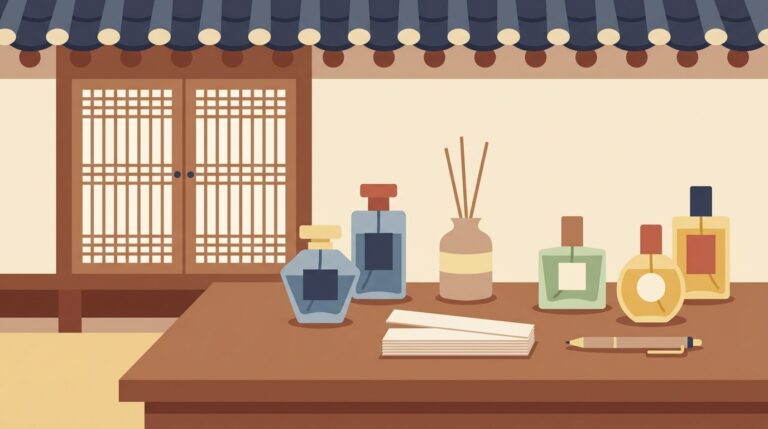
Picture this: You step off the bustling streets of Seongsu-dong, walking past industrial red-brick warehouses, and push open a heavy concrete door into a candlelit flagship boutique. Inside, hypnotic ambient soundscapes fill the air, kinetic sculptures rotate silently, and the delicate mist of cedarwood, incense, and damp soil washes over your senses. Welcome to Korea’s ultra-aesthetic niche fragrance universe—from Tamburins’ robotic art installations in Seongsu to Granhand’s cozy Hanok-inspired havens in Bukchon and boutique blending ateliers tucked into the quiet alleyways of Yeonnam-dong.
Now comes the tricky part. The perfumer smiles warmly, holds out a freshly sprayed scent strip, and asks, “어떤 노트 좋아하세요? 잔향 느낌은 어떠세요?” (What fragrance notes do you prefer? How do you feel about the dry-down?). Suddenly, your mind freezes. You know how to say “좋아요” (It’s good) or “꽃 냄새” (flower smell), but your tongue feels tied trying to describe that mysterious, temple-like serenity or the sharp citrus opening that softens into a cozy musk. Describing scent is poetic, intimate, and deeply cultural. By mastering sensory scent descriptors at a B2 level, you won’t just survive your next DIY perfume atelier in Seoul—you will be able to articulate your personality, vibe, and creative vision like a true fragrance connoisseur.
Phase 2: Core Expressions Deep Dive
1. 잔향이 은은하게 남아요 (Janhang-i euneun-hage nam-ayo)
- Pronunciation: [Jan-hyang-i eun-eun-ha-ge nam-ah-yo] (Sounds like: Zhan-hyahng-ee uhn-uhn-ha-gay nahm-ah-yo)
- Meaning: Literal: “The remaining scent stays subtly.” | Real Nuance: “The dry-down lingers gently and delicately on the skin.”
- K-Culture Moment: In romance dramas, a character leans in close to hug their love interest, pauses, and whispers this line when noticing their signature skin scent.
- Editor’s Insight: 잔향 (dry-down/lingering scent) combined with the sensory adverb 은은하게 (softly, delicately, not overpowering) is the holy grail compliment for perfumes in Korea, where heavy, choking projection is often considered rude.
- Situation Spectrum: Casual: ✅ | Semi-formal: ✅ | Formal: ✅
- 🤔 Think About It: Why does Korean culture value 은은함 (subtle nuance) over bold, punchy statements in both scents and communication?
2. 묵직하면서도 포근한 느낌이에요 (Mukjik-hamyeonseodo pogeun-han neukkim-ieyo)
- Pronunciation: [Muk-jik-ha-myeon-seo-do po-geun-han neuk-kim-ee-yo] (Sounds like: Mook-jeek-hah-myon-saw-doe poh-guhn-hahn nuhk-keem-ee-yo)
- Meaning: Literal: “It has a heavy yet cozy feeling.” | Real Nuance: “It has a rich, grounding depth, but feels warm and comforting rather than suffocating.”
- K-Culture Moment: Heard constantly in autumn and winter haul videos by Korean beauty vloggers trying sandalwood, amber, or vanilla base notes.
- Editor’s Insight: 묵직하다 captures the weight of base notes like vetiver and patchouli, while 포근하다 brings in the tactile imagery of wrapping yourself in a freshly laundered cashmere blanket.
- Situation Spectrum: Casual: ✅ | Semi-formal: ✅ | Formal: ✅
- 🤔 Think About It: How does your native language combine tactile sensations (weight, texture) to describe an invisible aroma?
3. 첫 향이 생각보다 톡 쏴요 (Cheot hyang-i saenggak-boda tok sswayo)
- Pronunciation: [Cheot hyang-i saeng-gak-bo-da tok swa-yo] (Sounds like: Chut hyahng-ee seng-gahk-boh-dah tohk swah-yo)
- Meaning: Literal: “The first scent shoots/stings more than expected.” | Real Nuance: “The opening top note is punchier and zestier than I anticipated.”
- K-Culture Moment: The reaction during a perfume workshop when a participant sniffs an undiluted bergamot, pink pepper, or aldehyde top accord right after spraying.
- Editor’s Insight: 톡 쏘다 is an onomatopoeic verbal phrase originally describing the sting of wasabi or fizzy soda carbonation. When applied to fragrance, it vividly communicates a sparkling, spicy, or zesty opening.
- Situation Spectrum: Casual: ✅ | Semi-formal: ✅ | Formal: ⚠️ (Use 자극적이에요 or 스파이시해요 in ultra-formal industry pitches)
- 🤔 Think About It: Notice how Korean uses physical, gustatory bodily sensations (톡 쏘다) to explain an olfactory experience.
Phase 3: Textbook Korean vs. Real Korean
Scenario 1: Praising a perfume’s endurance and scent trail
- 📖 교과서 한국어: 이 향수는 냄새가 정말 오래 지속됩니다. (I hyangsu-neun naemsae-ga jeongmal orae jisok-doemnida.) — “This perfume’s smell sustains for a really long time.”
- 🗣️ 진짜 한국어: 발향력도 대박이고 잔향이 진짜 미쳤어요! (Balhyangnyeok-do daebag-igo janhang-i jinjja michyeosseoyo!) — “The projection is insane, and the dry-down is out of this world!”
- 💡 왜 다를까? Textbook Korean uses the generic word 냄새 (smell/odor, which can sometimes mean bad smell) and rigid business verbs. Trend-savvy Koreans distinguish between 발향력 (projection/sillage) and 지속력 (longevity), praising sensational blends with energetic colloquial terms like 미쳤어요 (crazy good).
Scenario 2: Expressing a love for earthy, woody scents
- 📖 교과서 한국어: 저는 나무 냄새를 좋아해서 우디 계열을 원합니다. (Jeoneun namu naemsae-reul joahaeseo udi gyeyeor-eul wonhamnida.) — “I like tree smell, so I want the woody family.”
- 🗣️ 진짜 한국어: 비 온 뒤 숲속 느낌이나 절간 냄새 나는 우디 계열 좋아해요. (Bi on dwi supsok neukkim-ina jeolgan naemsae naneun udi gyeyeol joahaeyo.) — “I love woody accords that feel like a damp forest after rain or smell like a tranquil Buddhist temple.”
- 💡 왜 다를까? Modern Korean fragrance enthusiasts evoke imagery rather than raw ingredients. In Seongsu and Bukchon, 절간 냄새 (serene incense and aged cedarwood reminiscent of a quiet mountain temple) has become an affectionate cultural badge for sophisticated niche scents.
Phase 4: K-Culture Deep Dive & Non-Verbal Etiquette
4-1. Nunchi (눈치) & Scent Tasting Gestures
When entering flagship showrooms like Tamburins (성수), Nonfiction (북촌), or Pesade (한남), slow, deliberate pacing is customary. These venues operate like interactive galleries:
* The Scent Strip Etiquette: Never press the wet 시향지 (scent strip) directly against your nose or lips. Gently wave the paper strip 5–10 cm under your nose in a small circular motion. This lets alcohol evaporate so the pure top note reaches you.
* Resetting Olfactory Fatigue: When your nose gets overwhelmed after 3–4 scents, look around for a small glass jar containing roasted coffee beans (원두), or discreetly bury your nose into the clean fabric of your inner elbow or sleeve for two deep breaths. Shaking your head or rubbing your nose vigorously can signal distaste to the curator.
* Skin Chemistry Testing: After selecting a favorite from the paper strip, ask politely before spraying your wrist. When sprayed, never rub your wrists together—this crushes the delicate top note molecules. Simply dab your wrists lightly against each other or your neck.
4-2. Cultural Code: The Scent Architecture of 2030 Korea
In mega-dense metropolitan Seoul, your personal scent functions as your invisible aesthetic signature. Unlike past generations who wore mass-market designer perfumes to signal status, Generation MZ in Korea embraces boutique indie brands to assert their individual mood (무드). Scent flagships deliberately harmonize with their neighborhoods: Bukchon locations lean into serene Hanok eaves and contemplative Hinoki woods, while Seongsu locations highlight brutalist architecture, metallic installations, and bold, genderless musks.
Phase 5: Real-World Roleplay Scenario
- Location: Atelier de Yeonnam, a sunlit bespoke perfumery nestled in an ivy-covered Yeonnam-dong alley.
- Characters: 조향사 민지 (Perfumer Minji – calm, encouraging, refined) & 학습자 알렉스 (Alex – a fragrance lover building a custom 50ml scent).
Turn 1
* 조향사 민지: 어서 오세요! 오늘 알렉스님만의 시그니처 향수를 만들어 볼 텐데, 평소 선호하시는 무드가 있으신가요? 🎭 미소를 지으며 원료 차트를 건넨다.
* (Eoseo oseyo! Oneul Alex-nim-man-ui sigeunicheo hyangsu-reul mandeureo bol tende, pyeongso seonhohasineun mudeu-ga itseusin-gayo?)
* (Welcome! Today we will create your unique signature perfume. Is there a particular mood or vibe you usually prefer? 🎭 Smiles and hands over the ingredient chart.)
Turn 2
* 알렉스: 너무 달콤한 것보다는, 차분하고 비에 젖은 흙내음이 나는 자연스러운 향을 찾고 있어요. 🎭 진지하게 노트를 손가락으로 짚으며 말한다.
* (Neomu dalkomhan geot-bodaneun, chabunhago bi-e jeojeun heuknaeum-i naneun jayeonseureoun hyang-eul chatgo isseoyo.)
* (Rather than something overly sweet, I’m looking for a calm, natural scent reminiscent of petrichor and damp soil. 🎭 Points seriously at notes on the paper.)
Turn 3
* 조향사 민지: 아, 자연의 정취를 좋아하시는군요. 그럼 미들 노트로 이 아이리스와 시더우드 조합은 어떠세요? 🎭 시향지에 오일을 한 방울 떨어뜨려 부드럽게 흔든 뒤 건넨다.
* (A, jayeon-ui jeongchwi-reul joahasineungunyo. Geureom mideul noteu-ro i airiseu-wa sideoudeu johap-eun eotteoseyo?)
* (Ah, you love natural atmospheres! Then how about this combination of iris and cedarwood for your middle note? 🎭 Drops a bead of oil on a blotter, gently wafts it, and passes it over.)
Turn 4
* 알렉스: 와, 은은하면서도 마음이 편안해지네요. 그런데 베이스 노트가 너무 가벼우면 금방 날아가지 않을까요? 🎭 눈을 감고 향을 깊게 들이마신다.
* (Wa, euneun-hamyeonseodo ma-eum-i pyeonanhaejineyone. Geurende beiseu noteu-ga neomu gabyeoumyeon geumbang naragaji aneulkkayo?)
* (Wow, it’s subtle yet deeply comforting. But if the base note is too light, won’t it dissipate too quickly? 🎭 Closes eyes and inhales deeply.)
Turn 5
* 조향사 민지: 맞아요. 그래서 잔향을 묵직하게 잡아줄 앰버와 화이트 머스크를 추천드려요. 시간이 지나면 본인의 살냄새와 어우러져서 아주 포근해집니다. 🎭 머스크 시향지를 조심스레 건넨다.
* (Maj-ayo. Geuraeseo janhang-eul mukjik-hage jabajul aembeo-wa hwaiteu meoseukeu-reul chucheon-deuryeoyo. Sigani jinamyeon bonin-ui salnaemsae-wa eoureojyeoseo aju pogeun-haejimnida.)
* (Spot on! That’s why I recommend amber and white musk to anchor the dry-down with weight. Over time, it will merge with your natural skin scent into something wonderfully cozy. 🎭 Carefully hands over a musk strip.)
Turn 6
* 알렉스: 첫 향은 싱그럽고 상큼한 시트러스로 시작해서, 끝은 이렇게 따뜻하게 마무리되면 딱 좋겠어요! 🎭 설레는 표정으로 조향 비커를 바라본다.
* (Cheot hyang-eun singgeureopgo sangkeumhan siteureosu-ro sijakhaeseo, kkeut-eun ireoke ttatteuthage mamuri-doemyeon ttak jokgesseoyo!)
* (If the opening starts with a crisp, refreshing citrus, and finishes warm like this, that would be absolute perfection! 🎭 Looks at the blending beaker with excited eyes.)
Turn 7
* 조향사 민지: 아주 훌륭한 조화예요! 자, 스포이트로 탑 노트인 베르가못을 세 방울 떨어뜨려 볼까요? 🎭 얇은 유리 스포이트를 알렉스의 손에 쥐여준다.
* (Aju hullyunghan johwa-yeyo! Ja, seupoiteu-ro tap noteu-in bereugamot-eul se bang-ul tteoreotteuryeo bolkkayo?)
* (A magnificent accord! Now, shall we drop three drops of our bergamot top note using the pipette? 🎭 Places the slim glass pipette into Alex’s hand.)
Turn 8
* 알렉스: 네! 비율이 흐트러지지 않게 신중하게 한 방울씩 넣어볼게요. 🎭 숨을 죽이고 비커에 오일을 떨어뜨린다.
* (Ne! Biyur-i heuteureojiji anke sinjunghage han bang-ul-ssik neoeobolgeyo.)
* (Yes! I’ll drop them in carefully one by one so the ratio doesn’t get unbalanced. 🎭 Holds breath and drops the oil into the beaker.)
🔀 Interactive Branching Choice
You’re balancing the middle note. The perfumer asks: “흙내음을 조금 더 강조하고 싶으신가요, 아니면 플로럴의 산뜻함을 살리고 싶으신가요?”
- Choice A: “비 온 뒤 이끼 낀 숲길처럼 눅눅하면서도 딥한 우디 노트를 두 방울 더 넣을게요.” (Add 2 more drops of damp, deep woody oakmoss).
- Outcome (Best): The perfumer is thrilled by your poetic, specific visualization! The formula gains rich complexity, yielding a sophisticated bespoke scent.
- Choice B: “아무거나 어울리는 걸로 알아서 해주세요.” (Just do whatever you think fits).
- Outcome (Risk): The workshop is designed for personal agency. Passing full responsibility back to the perfumer robs you of the personalized atelier experience.
- Choice C: “그냥 제일 비싼 향료 듬뿍 넣어주세요!” (Just put in lots of the most expensive oil!).
- Outcome (Bad): High price does not equate to balanced scent architecture. Overloading precious resin or oud might completely overpower your top citrus notes!
Phase 6: 10-Second Emotional Shadowing Drill
Practice matching the cadence, breath, and emotional resonance of these phrases:
[🌿 차분하고 감각에 집중하며]- 비 온 뒤 / 흙내음처럼 / 묵직하고 / 편안한 느낌이에요.
- (Bi on dwi / heuknaeum-cheoreom / mukjik-hago / pyeon-an-han neukkim-ieyo.)
- “Like the earthy scent after rain / it feels grounded / and deeply comforting.”
[✨ 눈을 반짝이며 감탄하듯]- 첫 향은 / 상큼하게 톡 쏘는데 / 잔향은 / 살냄새처럼 은은해요!
- (Cheot hyang-eun / sangkeum-hage tok sso-neunde / janhang-eun / salnaemsae-cheoreom euneun-haeyo!)
- “The top note / opens with a zesty sparkle / while the dry-down / lingers subtly like natural skin!”
[🤝 정중하고 세련된 요청조로]- 베이스 노트의 비중을 / 조금만 높여서 / 지속력을 길게 가져갈 수 있을까요?
- (Beiseu noteu-ui bijung-eul / jogeum-man nopyeoseo / jisongnyeog-eul gilge gajyeogal su isseulkkayo?)
- “Could we slightly increase / the proportion of base notes / to extend the overall longevity?”
Phase 7: K-Culture Mini Dictionary
- 시향지 (Sihyangji) | Scent blotter / Testing strip
- How it’s used: Found stacked near tester bottles across flagships. Staff will spray these and hand them to you with a slight nod. Always hold by the dry bottom end.
- 잔향 (Janhang) | Dry-down / Lingering scent trail
- How it’s used: Crucial in Korean fragrance reviews. While opening notes create the first impression, Korean perfume lovers prioritize 잔향 to judge a perfume’s true character.
- 살냄새 (Sal-naemsae) | Natural skin scent
- How it’s used: Describes scents (often musky, ambrette, clean powdery, or subtle floral) that don’t smell like synthetic cologne, but rather like an individual’s fresh, clean, natural body warmth.
- 코르크 (Cologne / Scent fatigue ‘Nose Blindness’) & 원두 (Coffee Beans) | Olfactory palette cleanser
- How it’s used: In boutiques, whenever you experience olfactory fatigue from sniffing too many niche bottles, ask for 원두 (roasted coffee beans) to reset your smell receptors.
Phase 8: Traveler’s Survival Kit
Top 3 Survival Phrases for Scent Exploration
- 시향 한번 해봐도 될까요? (Sihyang hanbeon haebwado doelkkayo?)
- May I test-spray this scent?
- Pro Tip: Always ask this before spraying display bottles yourself in smaller, boutique ateliers.
- 잔향이 가장 오래 남는 제품이 어떤 건가요? (Janhang-i gajang orae namneun jepum-i eotteon geon-gayo?)
- Which fragrance has the longest-lasting dry-down?
- Pro Tip: Perfect when you want an Eau de Parfum (오 드 퍼퓸) that survives an entire day of Seoul sightseeing.
- 너무 달지 않고 중성적인 향 추천해 주세요. (Neomu dalji anko jungseongjeogin hyang chucheonhae juseyo.)
- Please recommend something unisex that isn’t overly sweet.
- Pro Tip: Korean niche brands excel at minimalist, gender-neutral earthy accords.
Editor’s Travel Note: Conquering the Flagships
- Workshop Reservations: For perfume workshops in Yeonnam-dong or Bukchon, reservations are mandatory on the Naver Map App for iOS and Android. Search for
원데이 향수 공방(One-day Perfume Workshop) and select an atelier with foreign language support if desired. - Flagship Hotspots: Head to Seongsu for conceptual art showrooms (Tamburins, Dior Concept Store, Point of View), Bukchon/Samcheong for tranquil courtyard blends (Granhand, Nonfiction), and Yeonnam-dong for intimate DIY scent crafting sessions.
Phase 9: A Step Deeper (한 발 더 깊이)
In Korean aesthetics, the concept of 여백의 미 (the beauty of empty space) dictates that what is unsaid, or unseen, often holds the deepest emotion. Fragrance follows the exact same philosophy. While Western perfume traditions have historically celebrated bold sillage that announces one’s arrival across an entire room, modern Korean fragrance culture revolves around intimate containment. The ultimate goal is 살냄새—a fragrance so seamlessly merged with your natural aura that others only detect it when stepping into your personal space. It is an olfactory expression of 배려 (consideration for others’ personal boundaries), proving that the quietest whispers can leave the most memorable impression.
💬 Your Turn: What does your dream signature scent smell like? Would you prefer a misty pine forest in Bukchon (비 온 숲속) or a zesty morning market (상큼한 시트러스)? Tell us in the comments using your new Korean vocabulary!
Phase 10: FAQ & Common Mistakes
Q: Can I wear my own perfume when attending a DIY blending workshop in Korea?
A: It is strongly recommended to come completely unscented! Any lotion, body spray, or perfume on your skin will interfere with your nose’s ability to evaluate subtle heart and base notes accurately during the session.
Q: Is it okay to take photos and videos inside Seongsu and Bukchon perfume flagships?
A: Yes! Most Korean perfume flagships are explicitly designed as lifestyle exhibition spaces and encourage respectful photography. However, keep your camera shutter muted (or use live photo) to maintain the serene atmosphere for other visitors.
Q: How long does a custom perfume need to mature (cure) after blending?
A: Most Korean perfumers will advise you to let your custom bottle rest for 숙성 기간 (maturation period) of about 1 to 2 weeks in a cool, dark spot before spraying, allowing the alcohol base and fragrance oils to blend seamlessly.
🚨 Common Mistakes Alert
- Mistake: Spraying directly onto clothing or rubbing your wrists violently together.
- Correct Action: Spray on pulse points (wrists, behind earlobes) and tap gently without friction to preserve delicate top accords.
- Mistake: Using the term 냄새가 좋아요 (The smell is good) in an upscale atelier.
- Correct Action: Use 향이 정말 좋아요 (The fragrance is wonderful). 향 refers to pleasant aromas and perfumes, whereas 냄새 can refer to odors or unappealing smells.
- Mistake: Evaluating a perfume immediately within the first 3 seconds of spraying.
- Correct Action: Wait at least 15–30 seconds for the initial alcohol punch to dissipate before taking your first whiff.
Phase 11: Action Missions
- 🥉 Bronze Mission (Solo Practice): Stand in front of your mirror with your favorite perfume bottle at home. Practice saying: “첫 향은 상큼하고, 잔향은 묵직하고 포근해요.” with fluid intonation.
- 🥈 Silver Mission (Social Share): Snap a photo of your scent tray or favorite perfume, post it on Instagram or Threads, and caption it in Korean describing the notes (e.g., 우디 계열, 은은한 잔향).
- 🥇 Gold Mission (Real World): Visit a Korean cosmetic store (like Olive Young) or a niche flagship boutique. Approach a staff member and ask: “시향지 하나 부탁드려도 될까요? 잔향이 은은한 걸로 추천해 주세요!”
🎮 K-Culture Mission: Watch an episode of a modern K-Drama set in Seoul (like Business Proposal or Queen of Tears). Notice how characters gift perfumes or light scented candles to shift the mood of a room—write down whenever they describe someone’s scent!
Phase 12: Interactive Quiz Challenge
Quiz 1: Situation Judgment
You want to tell the perfumer that you dislike overly sweet candy-like smells and prefer damp, calming earthy notes. Which sentence is the most natural and nuanced?
* (A) 사탕 냄새 싫어요. 흙 주세요.
* (B) 너무 달콤한 향보다는, 차분하고 비에 젖은 흙내음 같은 우디 계열이 좋아요.
* (C) 비싼 향료 넣으면 자연 냄새 나나요?
🔍 Click to view Answer & Explanation
- Correct Answer: (B)
- Explanation: (B) combines sensory descriptors (달콤한 향, 차분한, 비에 젖은 흙내음) and professional category phrasing (우디 계열) seamlessly at an upper-intermediate level. (A) sounds childish and abrupt, while (C) is culturally awkward.
Quiz 2: Fill in the Blank
Complete the sentence with the correct Korean word meaning “dry-down/lingering scent”:
이 향수는 처음에 톡 쏘지만, 시간이 지나면 ( )이/가 아주 은은하게 남아요.
🔍 Click to view Answer & Explanation
- Correct Answer: 잔향 (Janhang)
- Explanation: 잔향 specifically refers to the lingering base notes left on the skin after the top and middle notes have evaporated.
Quiz 3: True or False Cultural Etiquette
In Korean flagship scent showrooms, rubbing your wrists together immediately after spraying perfume helps activate the fragrance molecules for a better evaluation.
* (A) True
* (B) False
🔍 Click to view Answer & Explanation
- Correct Answer: (B) False
- Explanation: Rubbing creates friction and heat that breaks down top-note molecules and distorts the authentic pyramid structure of the fragrance. You should gently pat or let it air dry on your skin.







