

Phase 1: Empathy & Storytelling
안녕하세요! 매일한글 에디터입니다.
Imagine this: You step into a sunlit, pastel-toned artisan bakery in Seongsu-dong or Yeonnam-dong. The air is rich with the aroma of freshly baked butter, caramelized garlic, and roasted coffee. Before you know it, you are holding shiny silver tongs and a tray piled high with three different kinds of salt bread (소금빵), a giant sweet red bean bun, and a cream pastry. You intended to get just one pastry with your iced Americano, but the visual feast was simply irresistible!
As the staff member rings you up at the counter, they gently wrap your pastries in neat brown paper bags, flash a warm smile, and say: “남은 빵은 집에서 에어프라이어에 살짝 구워 드세요.” (Nameun ppang-eun jip-eseo eeopeuraieo-e saljjak guwo deuseyo.)
Suddenly, your mind races. Wait, ‘Air fryer’? ‘House’? Did they just give me a home cooking recipe at a cafe checkout?
Don’t worry! In Korea, bakery staff frequently share golden tips so you can experience that fresh-out-of-the-oven magic at home. In this guide, tailored specifically for A2 elementary learners, we’ll break down the secret language of Korean bakeries, the legendary Korean love affair with the air fryer, and natural phrases you can immediately use without breaking a sweat.
Phase 2: Top 3 Core Expressions Deep Dive
1. 남은 빵은 집에서 에어프라이어에 살짝 구워 드세요 (한글)
- Pronunciation: Nameun ppang-eun jip-eseo eeopeuraieo-e saljjak guwo deuseyo. (Pronounce saljjak like “sahl-jjak”, snapping on the double jj like the ‘j’ in ‘jump’ but crisper).
- Meaning: Literal: “As for leftover bread, at home, lightly bake and eat in the air fryer.” / Natural: “Lightly toast any leftover bread in your air fryer at home.”
- K-Culture Moment: You will hear this in almost every hip boutique bakery in Seoul when buying buttery treats like croffles or salt bread.
- Editor’s Insight: 살짝 (saljjak) is a magical Korean adverb meaning “lightly,” “briefly,” or “a little bit.” It prevents you from burning your precious carbs!
- Situation Spectrum: Casual: ⚠️ | Semi-formal: ✅ | Formal: ✅
- 🤔 Think About It: In many Western bakeries, the transaction ends at payment. Why do Korean staff proactively teach customers how to reheat food at home?
2. 포장해 드릴까요? (한글)
- Pronunciation: Pojanghae deurilkkayo? (Sounds like “Po-jahng-hae deu-ril-kka-yo?” with a light, melodic lilt on kka-yo).
- Meaning: Literal: “Shall I package it for you?” / Natural: “Would you like this to go?” or “Shall I wrap this up?”
- K-Culture Moment: Seen in every cafe scene in K-dramas when the lead character leaves half an artisanal cake behind after an emotional confession.
- Editor’s Insight: 포장 (pojang) specifically means packing, wrapping, or bagging. If you plan to eat in the cafe, you can reply: “먹고 갈게요” (Meokgo galgeyo – I will eat here). If you want it packed, just say: “네, 포장해 주세요” (Ne, pojanghae juseyo).
- Situation Spectrum: Casual: 🚫 | Semi-formal: ✅ | Formal: ✅
- 🤔 Think About It: Notice the polite auxiliary verb 드리다 (deurida – to give humbly). How does humble language shape hospitality in Korea?
3. 오늘 바로 드시는 게 좋아요 (한글)
- Pronunciation: Oneul baro deusineun ge joayo. (Pronounce baro like “bah-ro”, meaning immediately/right away).
- Meaning: Literal: “Eating right away today is good.” / Natural: “It’s best to enjoy it today.”
- K-Culture Moment: Typical advice from pastry chefs when purchasing items filled with fresh whipped cream or custard.
- Editor’s Insight: At level A2, the grammar pattern -(eu)neun ge joayo (-는 게 좋아요) is essential. It softens a direct command into a warm recommendation.
- Situation Spectrum: Casual: ⚠️ | Semi-formal: ✅ | Formal: ✅
- 🤔 Think About It: Compare “Eat this today!” with “It is better if you eat it today.” How does indirect phrasing create friendliness in Korean service?
Phase 3: Textbook Korean vs. Real Korean
Situation 1: Asking if leftover bread can be eaten tomorrow
- 📖 교과서 한국어: 이 빵을 내일 섭취해도 괜찮습니까? (I ppang-eul naeil seopchwihaedo gwaenchansseumnikka? – Is it acceptable to consume this bread tomorrow?)
- 🗣️ 진짜 한국어: 이거 내일 먹어도 돼요? (Igeo naeil meogeodo dwaeyo? – Can I eat this tomorrow?)
- 💡 왜 다를까? Textbook vocabulary like 섭취하다 (to ingest/consume) belongs in medical pamphlets or official news reports. Native speakers use the everyday verb 먹다 (to eat) with the beginner-friendly permission ending -아/어도 돼요.
Situation 2: Asking how to warm up the pastry
- 📖 교과서 한국어: 빵을 어떻게 재가열해야 합니까? (Ppang-eul eotteoke jaegayeolhaeya hamnikka? – How must I reheat the bread?)
- 🗣️ 진짜 한국어: 이거 어떻게 데워 먹어요? (Igeo eotteoke dewo meogeoyo? – How should I warm this up to eat?)
- 💡 왜 다를까? 재가열 (reheating) is stiff and mechanical. In daily life, Koreans say 데우다 (to heat/warm up) combined with 먹다 (데워 먹다 = warm up and eat).
Phase 4: K-Culture Deep Dive & Non-verbal Manners
4-1. 눈치 (Nunchi) & Gestures
- The Tray & Tongs Ballet: When entering a Korean bakery, you grab an individual tray (쟁반, jaengban) and tongs (집게, jipge) lined with parchment paper. Never touch pastry directly with your hands. When handing the tray to the clerk, use both hands (두 손) to place it gently on the checkout mat.
- The Empathetic Nod: When the cashier gives you storage tips like reheating in an air fryer, nod slightly while saying “아, 네! 감사합니다!” (A, ne! Gamsahamnida!). This acknowledgment shows respect for their culinary advice.
4-2. The Air Fryer (에어프라이어) Revolution
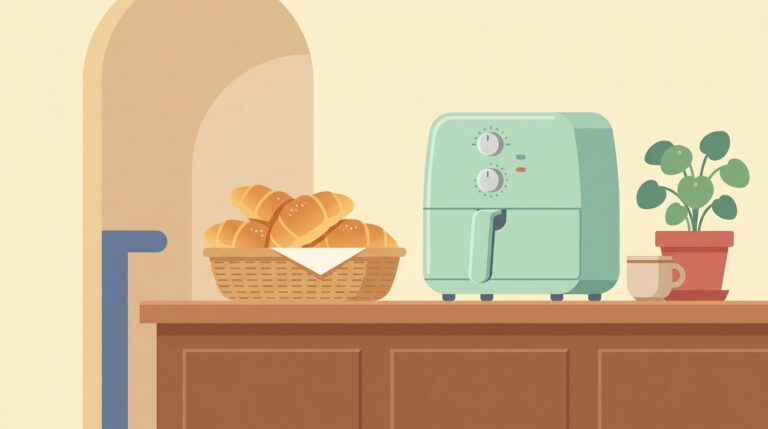
In Korea, the air fryer (commonly abbreviated as 에프, e-peu) is practically a national treasure found in almost every studio apartment and home. Koreans discovered that day-old croissants, garlic buns, and salt bread regain their signature texture—겉바속촉 (Geot-ba-sok-chok: crispy on the outside, moist on the inside)—in just 3 minutes at 180°C. Telling a customer to use an air fryer is considered the ultimate act of consideration!
Phase 5: Real-World Roleplay Scenario
- Setting: A warm, indie bakery in Mangwon-dong with indie acoustic music playing.
- Characters:
- Alex (A2 Learner): Holding a tray with two salt breads and a savory sausage pastry.
- Minsu (Friendly Baker): Smiling behind the cash register, wearing a beige linen apron.
— Dialogue —
- Minsu: 안녕하세요! 계산 도와드릴게요. (Annyeonghaseyo! Gyesan dowadeurilgeyo. – Hello! I can help you check out.)
🎭 두 손으로 쟁반을 받으며 미소 짓는다. - Alex: 네, 여기요! (Ne, yeogiyo! – Yes, here you go!)
🎭 쟁반을 카운터에 조심스럽게 내려놓는다. - Minsu: 소금빵 두 개랑 소시지빵 맞으시죠? 드시고 가세요? (Sogeumppang du gaerang sosijippang majeosijyo? Deusigo gaseyo? – Two salt breads and one sausage bread, right? Are you dining in?)
🎭 빵을 확인하며 포장지를 꺼낸다. - Alex: 아니요, 포장해 주세요. (Aniyo, pojanghae juseyo. – No, please pack it to go.)
🎭 손으로 테이크아웃 제스처를 취한다. - Minsu: 네! 봉투 필요하세요? (Ne! Bongtu piryohaseyo? – Sure! Do you need a plastic/paper bag?)
🎭 봉투를 가리키며 묻는다. - Alex: 네, 담아 주세요. 이거 내일 먹어도 돼요? (Ne, dama juseyo. Igeo naeil meogeodo dwaeyo? – Yes, please put it in a bag. Can I eat this tomorrow?)
🎭 빵 봉투를 보며 궁금한 표정을 짓는다. - Minsu: 그럼요! 남은 빵은 집에서 에어프라이어에 살짝 구워 드세요. (Geureomyo! Nameun ppang-eun jip-eseo eeopeuraieo-e saljjak guwo deuseyo. – Of course! Lightly toast any leftover bread in your air fryer at home.)
🎭 손가락으로 동그라미를 그리며 친절하게 설명한다. - Alex: 와, 꿀팁 감사해요! (Wa, kkultip gamsahaeyo! – Wow, thanks for the pro tip!)
🎭 가볍게 고개 숙여 인사하며 카드를 건넨다.
🔀 Interactive Choice Point
Minsu hands you your pastry bag and says, “에어프라이어에 180도로 3분만 돌리시면 제일 맛있어요!” (It’s best if you run it in the air fryer at 180 degrees for just 3 minutes!). How do you respond?
- Choice A: “네! 집 가서 바로 그렇게 해볼게요. 감사해요!” (Ne! Jip gaseo baro geureoke haebolgeyo. Gamsahaeyo!)
- 👉 Feedback (Best!): Perfect! It sounds energetic, natural, and validates the staff’s advice. You will earn an instant bright smile.
- Choice B: “싫어요. 그냥 차갑게 먹을 거예요.” (Sireoyo. Geunyang chagapge meogeul geoyeyo.)
- 👉 Feedback (Bad): Saying “I dislike that. I will just eat it cold” is unintentionally blunt and dismissive of the staff’s kindness.
- Choice C: “에어프라이어 없는데요? 프라이팬은요?” (Eeopeuraieo eomneundeyo? Peuraipaen-eunyo?)
- 👉 Feedback (Risk): While grammatically okay, starting abruptly with “I don’t have an air fryer” can sound slightly defensive. Better to soften it: “집에 에어프라이어가 없는데, 팬에 구워도 돼요?”
Phase 6: 10-Second Emotion Shadowing Drill
Repeat each sentence out loud, following the slashes (/) for natural rhythm and breath pauses:
[😊 밝고 친절하게 / Bright & Cheerful]- 남은 빵은 / 집에서 / 에어프라이어에 / 살짝 구워 드세요.
- Nameun ppang-eun / jip-eseo / eeopeuraieo-e / saljjak guwo deuseyo.
[🤔 호기심 가득하게 / Inquiring & Curious]- 이거 / 오늘 다 못 먹으면 / 내일 데워 먹어도 돼요?
- Igeo / oneul da mot meogeumyeon / naeil dewo meogeodo dwaeyo?
[🤩 감동받아서 신나게 / Touched & Enthusiastic]- 에프에 돌리니까 / 겉바속촉 / 진짜 맛있어요!
- E-peu-e dollinikka / geot-ba-sok-chok / jinjja masisseoyo!
Phase 7: K-Culture Mini Dictionary
- 소금빵 (Sogeumppang) | Salt Bread | A butter-dense Japanese-Korean pastry sprinkled with coarse sea salt on top. It sparked a nationwide craze in Korean boutique cafes.
- 에프 (E-peu) | Air Fryer (Slang/Abbreviation) | Short for 에어프라이어. Frequently used in recipes, YouTube cooking shorts, and casual talk (e.g., “에프에 5분 돌려!”).
- 겉바속촉 (Geot-ba-sok-chok) | Crispy outside, moist inside | An acronym from 겉은 바삭하고 속은 촉촉하다. The ultimate metric of culinary perfection for fried chicken and baked bread in Korea.
- 포장 (Pojang) | Takeout / To-go wrapping | Essential everyday word used in restaurants and bakeries. Adding ~해 주세요 forms the staple phrase 포장해 주세요.
Phase 8: Traveler’s Survival Kit
Top 3 Survival Phrases for Korean Bakeries
- 이거 하나 담아 주세요. (Igeo hana dama juseyo.) – Please put one of these in a bag.
- Pro Tip: Useful when pointing at pastries stored in glass display cabinets that customers cannot touch.
- 비닐봉투 한 장 주세요. (Binil-bongtu han jang juseyo.) – Please give me one plastic bag.
- Pro Tip: In Korea, disposable bags cost 50 to 100 KRW by law. Don’t be surprised if the clerk asks before charging you for one!
- 물티슈 있나요? (Multisyu innayo?) – Do you have wet wipes?
- Pro Tip: Korean pastries can get sticky! Cafes always have wet wipes at the self-bar (셀프바) or behind the counter.
Editor’s Travel Note
Before embarking on your bakery hop through Seongsu-dong or Yeonnam-dong, make sure you complete your 네이버 지도 앱 다운로드 to save curated cafe lists. Google Maps often lacks real-time operating hours for Korean indie cafes, whereas Naver Map shows live holiday notifications and whether signature pastries are sold out for the day!
Phase 9: One Step Deeper (Reflection)
In Korean food culture, caring for someone doesn’t end when the transaction finishes. Giving advice like “남은 빵은 에어프라이어에 구워 드세요” reflects 정 (Jeong)—a deep-rooted sense of communal warmth and empathy. The baker genuinely wants you to taste the pastry at its peak quality, even in the comfort of your hotel room or apartment kitchen tomorrow morning.
💬 Your Turn: In your home country, do bakery clerks give tips on reheating baked goods, or do they simply hand over the bag? Share your thoughts below!
Phase 10: FAQ & Common Mistakes
Q: Can I say “테이크아웃 해주세요” instead of “포장해 주세요” in a bakery?
A: Yes, absolutely! Koreans readily understand 테이크아웃 (Takeout), especially in beverage cafes. However, for pastries and solid food items, 포장해 주세요 (Pojanghae juseyo) sounds distinctly more natural and native.
Q: What does “돌려 드세요” mean when the baker explains reheating?
A: 돌리다 (dollida) literally means “to spin or rotate.” Because microwave plates rotate and air fryer dials turn, Koreans playfully say 돌려 드세요 to mean “microwave it” or “air-fry it.”
Q: Are tongs and trays mandatory even if I’m buying just one small scone?
A: Yes. Unless the pastry is behind a glass case served directly by staff, always take a tray and tongs. Picking up bread with your bare hands or a napkin is considered bad cafe etiquette.
🚨 Common Mistakes Warning Board
- Using 반말 (informal speech) casually: Saying “포장해 줘” instead of “포장해 주세요” can sound rude to staff.
- Leaving tongs on the pastry display: Always return tongs to the counter or tray after selecting your items.
- Confusing ‘데우다’ with ‘굽다’: 데우다 (dewuda) means warming up pre-cooked food. 굽다 (gupda) means baking or grilling raw items. Bakeries use both, but say 데워 드세요 for reheating.
Phase 11: Action Missions
- 🥉 Bronze Level: Stand in front of your mirror and practice: “포장해 주세요! 남은 빵은 에프에 돌려 먹을게요!” three times with a bright smile.
- 🥈 Silver Level: Share a photo of your favorite pastry on Instagram or Threads and caption it in Korean: “소금빵 겉바속촉 최고! 🥐✨”.
- 🥇 Gold Level: Visit a local Korean bakery in your area, pick two items, and ask at checkout: “이거 내일 먹을 때 어떻게 데워요?”
- 🎮 K-Culture Mission: Watch an episode of a Korean cafe vlog (카페 브이로그) on YouTube and listen for when the barista says “포장해 드릴게요” or “봉투 필요하세요?”.
Phase 12: Interactive Quiz Challenge
1. Situational Judgment
You bought three croissants, but you are completely full after eating one. You want to ask the staff how to reheat them tomorrow morning. Which sentence is best?
* A) 이거 내일 어떻게 태워요?
* B) 이거 내일 어떻게 데워 먹어요?
* C) 이거 내일 먹지 마세요.
👉 Click to view the Answer & Explanation
Correct Answer: B
* Explanation: 데워 먹어요 correctly means “warm up and eat.” Option A (태워요) means “how do I burn this?”, and Option C is an order telling them not to eat it!
2. Fill-in-the-Blank
Complete the sentence for “Please wrap this up to go”:
“이거 _________해 주세요.”
👉 Click to view the Answer & Explanation
Correct Answer: 포장 (Pojang)
* Full Sentence: 이거 포장해 주세요. (Igeo pojanghae juseyo.)
3. True / False Cultural Fact
In Korean bakeries, it is polite to hold items directly with your fingers if you are sure you will purchase them.
👉 Click to view the Answer & Explanation
Correct Answer: False (F)
* Explanation: Always use the provided tongs (집게) and tray (쟁반). Direct contact with fingers violates hygienic bakery norms in Korea.







