

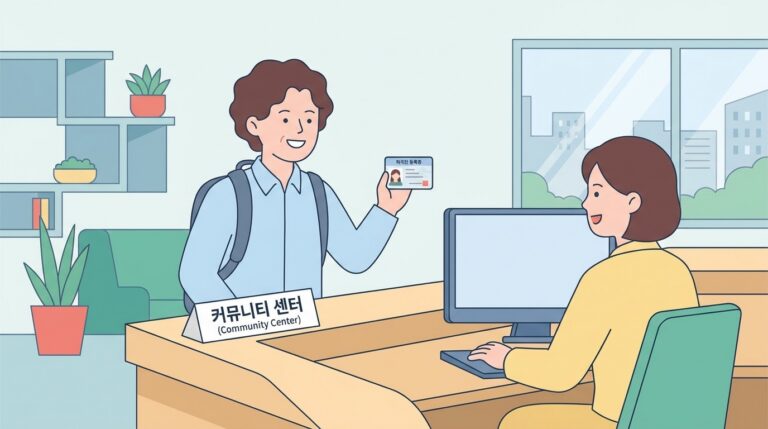
Moving in Korea: How to Report Your Address Change at the Community Center
Phase 1: 공감 (Story-Driven Opening)
안녕하세요! 매일한글 에디터입니다. (Hello! This is your Daily Hangul editor.)
Picture this: You have just completed the ultimate rite of passage in Seoul. Your tiny officetel or cozy one-room is stacked with brown delivery boxes, and you are sitting on the floor slurping down a bowl of celebratory jajangmyeon (black bean noodles) just like a main character in a slice-of-life K-drama. But suddenly, your phone buzzes with a reminder from your expat group: “Did you report your change of address yet? You only have 14 days!”
Panic sets in. You imagine standing before a stern government official at the local 주민센터 (jumin senteo, community center), shuffling through papers while a ticketing machine loudly beeps in fast Korean. What form do I ask for? How do I say “I just moved here” without sounding like a robotic translation app? Many beginner learners freeze at administrative counters because the vocabulary feels intimidating and bureaucratic.
Take a deep breath! Visiting your local community service center is actually one of the friendliest public service experiences in Korea once you know the exact key phrases. Today, based on real feedback from dozens of international students and expats who survived moving week, I will walk you step-by-step through reporting your address change (체류지 변경 신고, cheryuji byeongyeong singo). By the end of this guide, you will breeze in, hand over your Alien Registration Card, and walk out with your new address officially stamped in under ten minutes.
Phase 2: 핵심 표현 3선 심층 분석 (3 Core Expressions)
1. 체류지 변경 신고하러 왔어요 (Cheryuji byeongyeong singohareo wasseoyo)
- Pronunciation: [Che-ryu-ji byeon-gyeong sin-go-ha-reo wa-sseo-yo] (Think of Che as in “cherry”, ryu like “regular”, and wasseoyo like “what’s saw yo”).
- Meaning: Literal: “I came to report a change of sojourn place.” / Real Nuance: “Hi, I moved and I am here to update my registered address.”
- K-Culture Moment: You hear this phrase in neighborhood K-dramas whenever an independent protagonist arrives in a new town and checks into the local borough office.
- Editor’s Insight: The word 체류지 (cheryuji) specifically applies to foreign residents’ registered living location. While Koreans say 전입신고 (jeon-ip singo), clerks instantly recognize 체류지 변경 (cheryuji byeongyeong) for foreign registration.
- Situation Spectrum: Casual 🚫 | Semi-formal ✅ | Formal ✅
- 🤔 Think About It: In English, we usually say “I want to change my address.” In Korean, stating your arrival purpose with “-하러 왔어요” (-hareo wasseoyo, I came to do…) softens your entrance and sounds much more polite to front-desk officers.
2. 전월세 계약서 가져왔어요 (Jeon-wolse gyeyakseo gajyeowasseoyo)
- Pronunciation: [Jeon-wol-se gye-yak-seo ga-jyeo-wa-sseo-yo] (Rhymes with: Jeon as in “John”, wol like “wall”, se like “set”).
- Meaning: Literal: “I brought the Jeonse/monthly rent contract.” / Real Nuance: “Here is my rental lease agreement.”
- K-Culture Moment: The moment in Korean variety shows where someone proudly pulls out their official apartment contract after months of house hunting!
- Editor’s Insight: Korea uniquely splits rentals into 전세 (jeonse, lump-sum deposit) and 월세 (wolse, monthly rent). Combining them as 전월세 계약서 (jeon-wolse gyeyakseo) covers any housing lease you have signed.
- Situation Spectrum: Casual 🚫 | Semi-formal ✅ | Formal ✅
- 🤔 Think About It: Notice how Korean uses the compound verb 가져오다 (gajyeo-oda, to take and come). Why do you think Korean frequently combines physical actions with movement towards the listener?
3. 카드 뒷면에 새 주소 적어주세요 (Kadeu dwinmyeone sae juso jeogeojuseyo)
- Pronunciation: [Ka-deu dwin-myeo-ne sae ju-so jeo-geo-ju-se-yo] (Dwin-myeon sounds like “dween-myun”).
- Meaning: Literal: “Please write the new address on the back of the card.” / Real Nuance: “Could you update and print my new address on the back of my ARC?”
- K-Culture Moment: The clerk slides your card into a tiny high-tech thermal printer, and moments later your shiny new neighborhood appears on the back lines.
- Editor’s Insight: Foreigner registration cards have dedicated lines on the rear for address stickers or thermal printing. While the officer will do this automatically, using this phrase shows that you know the official procedure.
- Situation Spectrum: Casual 🚫 | Semi-formal ✅ | Formal ✅
- 🤔 Think About It: Adding “-주세요” (-juseyo, please give/do for me) turns a basic request into a respectful cooperative interaction. How does this compare to making requests in your native culture?
Phase 3: 교과서 한국어 vs 진짜 한국어 (Textbook vs. Real-Life Korean)
Situation 1: Explaining why you visited the desk
- 📖 교과서 한국어 (Textbook): 저는 주소를 이전 등록하고자 방문하였습니다. (Jeoneun jusoreul ijeon deungnokhagoja bangmunhayeossseumnida. – “I have visited with the intention of registering the transfer of my address.”)
- 🗣️ 진짜 한국어 (Real-life): 이번에 이사해서 주소 변경하러 왔어요. (Ibeone isahaeseo juso byeongyeonghareo wasseoyo. – “I moved recently, so I came to change my address.”)
- 💡 왜 다를까? (Why the difference?): Administrative Korean textbooks love Sino-Korean formal verbs (bangmunhada, ijeonhada), but real Koreans speak plainly and warmly with connective particles like “-해서” (-haeseo, because/so).
Situation 2: Submitting your lease document
- 📖 교과서 한국어 (Textbook): 임대차 계약 증명 서류를 제출합니다. (Imdaecha gyeyak jeungmyeong seoryureul jechulhamnida. – “I hereby submit the lease verification documents.”)
- 🗣️ 진짜 한국어 (Real-life): 계약서랑 외국인등록증 여기 있어요. (Gyeyakseorang oegugindeungnokjeung yeogi isseoyo. – “Here are my contract and registration card.”)
- 💡 왜 다를까? (Why the difference?): At the counter, efficiency is key. Using everyday connectors like “-랑” (-rang, and/with) alongside “여기 있어요” (yeogi isseoyo, here it is) sounds polite, natural, and friendly.
Phase 4: K-Culture 딥다이브 & 비언어적 매너 (Deep Dive & Manners)
4-1. 눈치 (Nunchi) & Polite Gestures
When you step into a 주민센터 (jumin senteo), do not walk straight to an open window! Look for the 번호표 (beonhopyo, numbered ticket dispenser) stand near the entrance. Press the button for 통합민원 (tonghap minwon, General Civil Services).
When your number is called with a cheerful chime, approach the desk and use the Two-Hand Rule (두 손 예절). Hand your Alien Registration Card (ARC) and lease contract over using both hands, or support your right wrist lightly with your left hand. This subtle body language displays instant respect and builds immediate rapport with the civil servant (jumugwan-nim).
4-2. Cultural Code: The 14-Day Clock & Moving Etiquette
In South Korea, moving into a new neighborhood is traditionally celebrated with 이사 떡 (isa tteok, moving rice cakes) shared among neighbors, or ordering delivery jajangmyeon while sitting on your unpackaged bubble wrap.
However, the legal world moves fast: under Korean immigration laws, foreign nationals must report a change of residence within 14 days of the move date stated on their lease. Failing to do so triggers progressive fines! Fortunately, you don’t always need to travel to the distant Immigration Office (출입국관리사무소); your nearest local Community Center (주민센터) handles address changes for registered foreigners quickly and cheaply.
Phase 5: 실전 롤플레이 시나리오 (Real-Life Roleplay)
Setting: The bright, click-clack atmosphere of the Yeonnam-dong Community Service Center in Seoul. Civil Servant Kim Min-su is sitting at desk #3 beneath an electronic display calling number 104.
- 민수 (Officer Kim): 104번 고객님, 어서 오세요. 어떤 일로 오셨어요?
(Baek-sa-beon gogaek-nim, eoseo oseyo. Eotteon illo osyeosseoyo?)
“Number 104, welcome. How can I help you today?”
🎭 [미소를 지으며 번호표를 받는다 / Smiling and taking your ticket] -
나 (You): 안녕하세요! 이번에 이사해서 체류지 변경 신고하러 왔어요.
(Annyeonghaseyo! Ibeone isahaeseo cheryuji byeongyeong singohareo wasseoyo.)
“Hello! I just moved, so I came to report my address change.”
🎭 [가방에서 서류 봉투를 꺼내며 / Taking out an envelope from your bag] -
민수 (Officer Kim): 네, 외국인등록증이랑 새 집 임대차 계약서 주시겠어요?
(Ne, oegugindeungnokjeung-irang sae jip imdaecha gyeyakseo jusigesseoyo?)
“Sure, could you give me your registration card and the lease agreement for your new home?”
🎭 [고개를 끄덕이며 서류를 정리한다 / Nodding while organizing documents] -
나 (You): 네, 등록증이랑 계약서 여기 있어요.
(Ne, deungnokjeung-irang gyeyakseo yeogi isseoyo.)
“Yes, here are my card and contract.”
🎭 [두 손으로 정중하게 건넨다 / Handing them over politely with both hands] -
민수 (Officer Kim): 네, 확인했습니다. 여기 신청서에 이름이랑 새 주소, 전화번호 적어주세요.
(Ne, hwaginhaessseumnida. Yeogi sincheongseoe ireum-irang sae juso, jeonhwabeonho jeogeojuseyo.)
“Yes, confirmed. Please write your name, new address, and phone number on this application form.”
🎭 [형광펜으로 칠한 부분을 가리킨다 / Pointing to the highlighted lines with a pen] -
나 (You): 다 작성했어요. 혹시 카드 뒷면에도 새 주소 바로 찍히나요?
(Da jakseonghaesseoyo. Hoksi kadeu dwinmyeonedo sae juso baro jikkhinayo?)
“I finished filling it out. Will the new address be printed on the back of the card right away?”
🎭 [펜을 내려놓고 양손으로 종이를 건네며 / Putting the pen down and passing the sheet back] -
민수 (Officer Kim): 네, 지금 바로 뒷면에 인쇄해 드릴게요. 잠시만 앉아서 기다려 주세요.
(Ne, jigeum baro dwinmyeone inswehae deurilgeyo. Jamsiman anjaseo gidaryeo juseyo.)
“Yes, I will print it on the back right now. Please take a seat and wait just a moment.”
🎭 [프린터에 카드를 넣으며 / Inserting the card into the small card printer] -
나 (You): 감사합니다! 수고하세요!
(Gamsahamnida! Sugohaseyo!)
“Thank you! Have a great day!”
🎭 [가볍게 목례를 하고 일어선다 / Giving a light bow and standing up]
🔀 인터랙티브 분기점 (Interactive Branch Point)
The officer looks at your lease contract and says: “본인 명의 계약서가 아닌데요?” (This contract isn’t under your name?) How do you respond?
- Choice A: “친구 집에서 같이 살아요. 거주숙소제공확인서 가져왔어요.” (Chingu jibeseo gachi sarayo. Geojusukso jegong hwaginsweo gajyeowasseoyo. – “I live with a friend. I brought the Confirmation of Accommodation form.”)
👉 Feedback [Best]: Excellent! If your name isn’t directly on the lease, submitting the Confirmation of Accommodation form signed by the master tenant resolves the issue on the spot. - Choice B: “몰라요. 그냥 등록해 주세요.” (Mollayo. Geunyang deungnokhae juseyo. – “I don’t know. Just register me.”)
👉 Feedback [Bad]: Never say this! Officers cannot legally register you without proof of residence under your name or an official host declaration. - Choice C: “계약서 친구 건데 나중에 다시 올게요.” (Gyeyakseo chingu geonde najunge dasi olgeyo. – “The contract belongs to a friend, so I’ll come back later.”)
👉 Feedback [Risk]: Safe, but you risk missing your 14-day legal deadline if you wait too long without obtaining the proper paperwork.
Phase 6: 10초 감정 섀도잉 드릴 (Shadowing Drill)
Practice these lines with rhythm, emotion, and pauses (/)!
[🙋 당당하고 공손하게 / Confident & Polite]
안녕하세요! / 이번에 이사해서 / 체류지 변경 신고하러 왔어요.
(An-nyeong-ha-se-yo! / I-beon-e i-sa-hae-seo / che-ryu-ji byeon-gyeong sin-go-ha-reo wa-sseo-yo.)-
[😊 차분하고 친절하게 / Calm & Helpful]
외국인등록증이랑 / 계약서 / 여기 있어요.
(Oe-guk-in-deung-nok-jeung-i-rang / gye-yak-seo / yeo-gi i-sseo-yo.) -
[✨ 감사와 활기를 담아 / Grateful & Energetic]
처리해 주셔서 감사합니다! / 좋은 하루 보내세요!
(Cheo-ri-hae ju-syeo-seo gam-sa-ham-ni-da! / Jo-eun ha-ru bo-nae-se-yo!)
Phase 7: K-Culture 미니 사전 (Mini Dictionary)
-
주민센터 (Jumin Senteo)
Translation: Community Service Center (also called 행정복지센터, Haengjeong Bokji Senteo).
Usage: The local municipal hub in every neighborhood where residents handle official administrative tasks like moving reports, certificates, and waste disposal stickers. -
외국인등록증 (Oegugin Deungnokjeung)
Translation: Alien Registration Card (ARC) / Residence Card.
Usage: Your primary official ID card in South Korea. Must always be updated on the back with your current home address. -
전월세 계약서 (Jeon-wolse Gyeyakseo)
Translation: Lease Agreement (Jeonse / Monthly Rent Contract).
Usage: The legally binding paper received from your real estate agent (부동산) proving your right to occupy your new home. -
확정일자 (Hwakjeong-ilja)
Translation: Fixed Date Stamp.
Usage: A legal stamp placed on your rental contract at the community center that gives your security deposit priority protection against property foreclosure.
Phase 8: 여행자와 거주자를 위한 생존 키트 (Survival Kit)
Top 3 Survival Phrases
- 1. 번호표 어디서 뽑아요? (Beonhopyo eodiseo ppobayo?)
Meaning: “Where do I pull a number ticket?”
Pro Tip: Use this if the ticketing machine area looks confusing or has multiple touchscreen choices. - 2. 외국인 등록증 주소 변경 돼요? (Oegugin deungnokjeung juso byeongyeong dwaeyo?)
Meaning: “Can I update my Alien Registration Card address here?”
Pro Tip: A quick way to make sure you are at the correct community center belonging to your legal district (Dong). - 3. 확정일자도 같이 받을 수 있나요? (Hwakjeong-iljado gachi badeul su innayo?)
Meaning: “Can I also get a fixed date stamp at the same time?”
Pro Tip: Essential for renters paying a security deposit (bojeunggeum).
Editor’s Travel & Living Note
Always make sure you visit the specific community center that oversees your exact residential neighborhood (동, Dong). Finding the right building is simple if you check 네이버 지도 앱 다운로드 to search for your local “행정복지센터” based on your street address. Remember to bring 1) your physical Alien Registration Card, 2) your original paper lease contract, and 3) your passport (just in case). No service fees are charged for basic address change updates!
Phase 9: “한 발 더 깊이” (Reflective Prompt)
In South Korea, your address is tightly woven into a centralized civil registry that powers lightning-fast internet setup, neighborhood waste collection, parcel deliveries, and national emergency alerts. This administrative efficiency is a cornerstone of Korea’s renowned Ppalli-Ppalli (빠르고 정확하게, fast and accurate) culture. In many Western countries, changing your address involves notifying ten different private institutions separately over several weeks. In Korea, one quick trip to your local community center binds you instantly to your new physical community.
💬 Your Turn: How does reporting an address change in your home country compare to the Korean community center system? Is it digital, paper-based, or handled through private postal redirects? Share your moving stories in the comments below!
Phase 10: FAQ & 흔한 실수 방지 (FAQ Schema)
Q: Can I report my address change at ANY community center in Seoul?
A: No. You must go to the specific Community Service Center (주민센터) that governs the neighborhood (동, Dong) where your new home is physically located, or visit the regional Immigration Office having jurisdiction over your district.
Q: What is the time limit for reporting my change of address?
A: Under the Korean Immigration Act, you must file your change of residence within 14 days from your official move-in date (the lease start date). Missing this deadline can lead to fines exceeding 100,000 KRW!
Q: My name is not on the lease because I am subletting or staying with a friend. What should I do?
A: You must bring a copy of the host’s lease agreement, a copy of the host’s ID card, and a completed “거주/숙소제공 확인서” (Geoju/sukso jegong hwaginsweo, Confirmation of Accommodation) signed by your host.
🚨 흔한 실수 (Common Mistakes) 경고판
- Going to the district office (구청, Gu-office) instead of the Community Center (주민센터): While Gu offices are large, address changes for foreigners are handled at the local neighborhood Dong center or Immigration.
- Bringing a digital smartphone photo of the contract: Officers require the physical paper contract with clear signatures and landlord details.
- Forgetting your physical registration card: You cannot complete the process with a phone scan of your ARC because the machine must physically imprint your new address on the back of the plastic card.
Phase 11: 액션 미션 & 참여 유도 (Action Missions)
- 🥉 Bronze Mission (Solo Practice): Stand in front of your mirror and practice saying: “체류지 변경 신고하러 왔어요” three times with a confident smile.
- 🥈 Silver Mission (Social Check): Take a photo of a local Korean street name sign in your neighborhood and post it to your study story with the caption: “우리 동네 새 주소!” (My new neighborhood address!).
- 🥇 Gold Mission (Real Life Action): Visit your local 주민센터 within your 14-day window, pull your ticket, and successfully finish your report using only Korean phrases from this guide!
- 🎮 K-Culture Mission: In your favorite modern Korean drama, spot a scene where someone receives mail or signs an apartment document. Listen carefully: can you hear words like 주소 (address) or 계약서 (contract)?
Phase 12: 인터랙티브 퀴즈 챌린지 (Interactive Quiz)
Test your knowledge before heading out to the counter!
- Situation Judgment: You just moved into your new apartment on October 1st. What is your legal deadline to report your address change?
- A) October 31st (End of the month)
- B) October 15th (Within 14 days)
- C) When your visa expires
- Fill-in-the-Blank:
이번에 이사해서 체류지 변경 ______ 왔어요. (신고하러 / 공부하러 / 밥먹으러) -
True or False: Foreigners must pay a 50,000 KRW registration tax at the counter to change their address on their Alien Registration Card. (True / False)
👉 Click to reveal answers and explanations!
-
Answer: B (October 15th)
Explanation: Korean law requires reporting the change within 14 days of your move-in date. -
Answer: 신고하러
Full Sentence: 이번에 이사해서 체류지 변경 신고하러 왔어요. (I came to report my address change because I moved recently.) -
Answer: False
Explanation: Basic address change reporting for foreign residents at the local 주민센터 is completely free of charge!







