

Phase 1: Empathy (Immersive Story Opening)
안녕하세요! 매일한글 에디터입니다. (Annyeonghaseyo! It’s your Daily Hangul editor.)
Picture this: You are standing inside a high-tech glass conference room overlooking the bustling streets of Pangyo Techno Valley—the Silicon Valley of South Korea. Across the table sit top automotive software architects and regulatory attorneys. On the wall-mounted 8K display, a simulated autonomous vehicle navigates Seoul’s rain-slicked Gangnam intersection. Suddenly, an unregistered delivery scooter dashes blindly from behind a double-parked delivery truck.
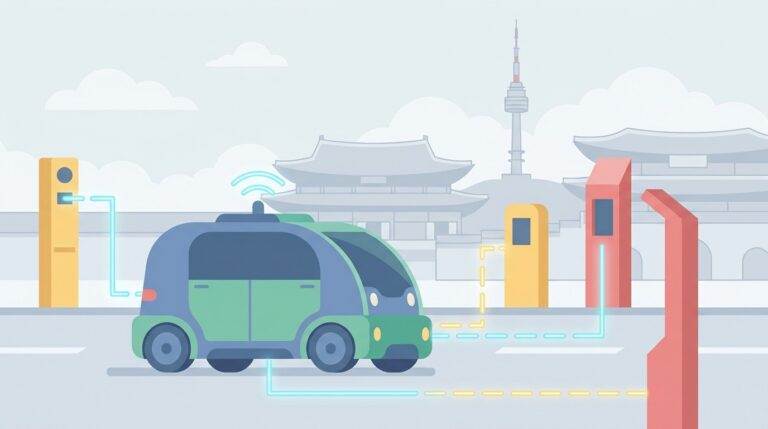
Every engineer in the room freezes. The camera sensors alone had zero line-of-sight. Yet, the simulated vehicle smoothly decathletes around the hazard. Why? Because the roadside telemetry unit and the preceding bus had already beamed an ultra-low latency V2X (Vehicle-to-Everything) packet warning milliseconds prior.
Your director turns to you, pen poised: “What is our official legal and algorithmic stance on V2X sensory redundancy when arguing liability distribution under the Korean Product Liability Act?”
If your stomach dropped just thinking about navigating this conversation in Korean, you are not alone. Even native Korean speakers stumble when translating cutting-edge engineering paradigms like End-to-End AI and Software-Defined Vehicles (SDVs) into precise, legally defensible, and culturally nuanced Korean business rhetoric. Many advanced foreign professionals know basic technical terms, but they lack the forensic vocabulary required to navigate high-stakes corporate negotiations in Korea’s automotive and telecommunications sectors.
That is exactly why we created this guide. Based on direct feedback from international mobility engineers, legal consultants, and tech executives working in Seoul and Pangyo, this lesson elevates your Korean from textbook fluency to authoritative, boardroom-level C2 mastery. Let’s conquer the future of Korean mobility together!
Phase 2: Core Expressions Deep Dive
1. 사각지대를 보완하다 (Sagakjidaereul bowanhada)
- Pronunciation: [Sa-gak-ji-dae-reul bo-wan-ha-da] (Think of sa like “salad”, gak like “gawk”, ji-dae like “gee-day”, and bo-wan sounding close to “bow-on”).
- Meaning: Literally “to complement blind spots.” In executive discourse, it signifies remediating inherent epistemic limitations or sensory deficiencies within a complex system through redundant mechanisms.
- K-Culture Moment: In the hit corporate drama Agency (대행사), executives frequently deploy this phrase during high-stakes pitch presentations when explaining how their multi-channel data strategy remedies blind spots overlooked by legacy competitors.
- Editor’s Insight: While “사각지대” physically means a mirror blind spot or physical occlusion, Koreans universally apply it to regulatory loopholes, cognitive biases, and systemic oversights. Coupling it with “보완하다” elevates your statement from merely pointing out a flaw to offering a mature, constructive solution.
- Situation Spectrum:
- Casual: ⚠️ (Sounds overly dramatic when talking about minor daily lapses)
- Semi-formal: ✅ (Widely used in team meetings)
- Formal / Boardroom: ✅ (The quintessential executive phrasing)
- 🤔 Think About It: In English, we often say “covering our bases” or “filling the gaps.” How does the Korean focus on visual occlusion (“사각지대” – dead-angle zone) reflect an engineering culture deeply rooted in physical foresight and meticulous spatial awareness?
2. 초저지연 통신망을 구축하다 (Chojeojiyeon tongsinmangeul guchukhada)
- Pronunciation: [Cho-jeo-ji-yeon tong-sin-mang-eul gu-chuk-ha-da] (Cho sounds like “choh” as in choke; jeo-ji-yeon glides like “jaw-jee-yawn”; gu-chuk snaps sharply like “goo-chook”).
- Meaning: “To construct/deploy an ultra-low latency telecommunication network.”
- K-Culture Moment: In the tech-noir thriller Start-Up, mentors and venture capitalists grill founders on whether their edge-computing infrastructure actually demonstrates deterministic latency rather than theoretical bandwidth.
- Editor’s Insight: “초저지연” (ultra-low latency) is the golden buzzword of Korea’s 5G-V2X initiatives. When combined with “구축하다” (to establish/build on an institutional or infrastructural scale), it signals massive engineering capability and nation-scale infrastructure backing.
- Situation Spectrum:
- Casual: 🚫 (Do not use this when your home Wi-Fi is fast!)
- Semi-formal: ⚠️ (Acceptable only within technical sync meetings)
- Formal: ✅ (Standard in R&D whitepapers, keynote addresses, and investor relations)
- 🤔 Think About It: Notice how Korean technical vocabulary borrows heavily from classical Sino-Korean roots (초=ultra, 저=low, 지연=delay). Why do Korean engineers favor these condensed four-character compounds over English loanwords in formal legal contracts?
3. 배상 책임 소지를 명확히 규명하다 (Baesang chaegim sojireul myeonghwakhi gyumyeonghada)
- Pronunciation: [Bae-sang chae-gim so-ji-reul myeong-hwak-hi gyu-myeong-ha-da] (Bae-sang rhymes with “pay-song”; so-ji sounds like “so-jee”; gyu-myeong hits like “gyoo-myoung”).
- Meaning: Literally “to clarify and definitively investigate/ascertain the grounds and locus of compensation liability.”
- K-Culture Moment: Seen across iconic legal dramas like Stranger (비밀의 숲), where prosecutors and corporate defense counsels spar over who holds algorithmic vs. operational culpability after unprecedented industrial accidents.
- Editor’s Insight: “소지” (grounds, room for, or potential locus) is a hallmark of C2 administrative Korean. Instead of bluntly asking “Who pays?” (누가 물어줘요?), this phrase dissects whether the fault lies with the vehicle manufacturer, software developer, infrastructure operator, or telecom provider with surgical precision.
- Situation Spectrum:
- Casual: 🚫 (Far too rigid and litigious for everyday life)
- Semi-formal: ⚠️ (Reserved exclusively for compliance or post-mortem incident analyses)
- Formal: ✅ (Indispensable in legal risk assessments and patent arbitration)
- 🤔 Think About It: Anglo-American law often frames liability around personal negligence or breach of duty. What does the Korean focus on “소지” (the inherent existence or spatial seed of responsibility) reveal about the collective obligation to anticipate risk?
Phase 3: Textbook Korean vs. Real Korean
Situation A: Explaining how V2X technology covers sensor blind spots
- 📖 교과서 한국어 (Textbook Korean):
- V2X 기술은 카메라가 못 보는 곳을 잘 보게 도와줍니다. (V2X gisureun kameraga mot boneun goseul jal boge dowajumnida.)
- “V2X technology helps one see well where the camera cannot see.”
- 🗣️ 진짜 한국어 (Real Boardroom Korean):
- V2X 기반의 인프라 연동을 통해 온보드 센서의 물리적 한계와 음영 구역을 선제적으로 상쇄할 수 있습니다. (V2X giban-ui impeura yeondong-eul tonghae onbodeu senseo-ui mulrijeok hangyewa eum-yeong guyeog-eul seonjejeog-euro sangswaehal su itseumnida.)
- “Through V2X-based infrastructural interworking, we can preemptively offset the physical limitations and shadow zones of onboard sensors.”
- 💡 왜 다를까? (Why the difference?):
Elementary Korean relies on generic helper verbs like “도와주다” (to help). In contrast, elite tech leadership in Korea demands terms like “선제적으로 상쇄하다” (preemptively offset/counterbalance) and “음영 구역” (shadow/occluded zones) to project analytical authority.
Situation B: Debating fault after an unexpected telemetry disconnection
- 📖 교과서 한국어 (Textbook Korean):
- 통신이 끊겨서 사고가 났다면 자동차 회사 잘못인지 통신사 잘못인지 따져봐야 합니다. (Tongsini kkeunkyeoseo sagoga natdamyeon jadongcha hoesa jalmosingi tongsinsa jalmosingi ttajyeobwaya hamnida.)
- “If an accident happened because the connection dropped, we should argue whether it is the car company’s fault or the telecom’s fault.”
- 🗣️ 진짜 한국어 (Real Boardroom Korean):
- 통신 지연 및 패킷 손실에 따른 사고 발생 시, 원인 제공 주체에 대한 구상권 청구 여부를 법리적으로 검토해야 합니다. (Tongsin jiyeon mit paekit sonsire ttareun sago balsaeng si, wonin jegong juche-e daehan gusang-gwon cheonggu yeobureul beomnijeog-euro geomtohaeya hamnida.)
- “In the event of an incident resulting from latency or packet loss, we must legally assess the viability of exercising the right of indemnity against the entity that furnished the root cause.”
- 💡 왜 다를까? (Why the difference?):
Saying “누구 잘못인지 따지다” sounds like an informal schoolyard argument. Professional Korean corporate governance utilizes codified civil terminology such as “구상권 청구” (claim for subrogation/indemnity) and “법리적 검토” (legal review).
Phase 4: K-Culture Deep Dive & Non-Verbal Etiquette
4-1. 눈치 (Nunchi) & Non-Verbal Posture in Autonomous Mobility Debates
When presenting technical shortcomings or legal liabilities in a Korean corporate setting, your posture dictates your credibility just as much as your algorithm does.
* The Angle of Analytical Humility: Never point your index finger directly at a slide displaying a failure rate or sensor fault; doing so inadvertently implies personal blame onto the hardware engineering team. Instead, use an open palm (손바닥), tilted slightly upward at a 45-degree angle, sweeping gently across the telemetry telemetry graph.
* The Strategic Nod (경청의 미학): In discussions concerning Korean safety regulations (such as Ministry of Land, Infrastructure and Transport guidelines), when a senior executive or external regulatory auditor points out an edge-case risk, do not jump in instantly with an objection. Pause for two full seconds, tilt your head down 5 degrees in focused contemplation, and preface your rebuttal with: “지적해 주신 우려 사항에 전적으로 공감하며…” (Fully empathizing with the concern you highlighted…). This demonstrates elite institutional nunchi.
4-2. Cultural Code Analysis: The Sangam DMC & Pangyo Autonomous Sandbox
South Korea operates some of the world’s most aggressive autonomous driving regulatory sandboxes, particularly in Sangam Digital Media City (DMC) and Pangyo Techno Valley. In these districts, autonomous shuttles operate alongside aggressive Seoul city buses and hurried motorcycle delivery couriers (baedal riders).
Because Korean urban environments possess world-record vehicular density, domestic SDV developers rely heavily on C-V2X (Cellular V2X) integrated with 5G smart road systems rather than relying purely on isolated camera-vision models. Culturally, Korean society values “신속 정확” (promptness and accuracy) and collective infrastructural reliability. Hence, attributing safety solely to single-car End-to-End AI models is viewed with cultural and judicial skepticism. Proving that your system “communicates seamlessly with community infrastructure” aligns with Korea’s deeply ingrained social consensus on collective civic responsibility.
Phase 5: Real-World Roleplay Scenario
Setting: The Strategic R&D Conference Hall at an automotive enterprise in Pangyo.
Characters:
* Dr. Min-jun Park (박민준 상무): Executive Vice President of Autonomous Safety Systems. Sharp, discerning, and risk-averse.
* You (Foreign Lead Systems Architect & Legal Tech Specialist): Confident, articulate, and prepared to demonstrate how V2X eliminates dead zones while shielding the company from unilateral product liability.
- 박민준 상무: 이번 테스트 주행에서 도출된 센서 사각지대 데이터, 어떻게 보완할 계획입니까? (Ibeon teseuteu juhaeng-eseo dochuldoen senseo sagakjidae deiteo, eotteoke bowanhal gyehoegimnikka?)
- “How do you plan to resolve the sensor blind spot data surfaced during this test run?”
- 🎭 Frowning intently, tapping his fountain pen against the tablet casing.
- You: 단독 라이다 센서의 한계를 극복하기 위해 V2I 기반의 노변 기지국 통신을 연동했습니다. (Dandok raida senseo-ui hangye-reul geukbokhagi wihae V2I giban-ui nobyeon gijiguk tongsineul yeondonghaetseumnida.)
- “To overcome the limits of standalone LiDAR sensors, we integrated V2I-based roadside base station communications.”
- 🎭 Presenting the comparative telemetry diagram on the main screen with a composed, open-handed gesture.
- 박민준 상무: 노변 기지국의 패킷 전송 주기가 순간적으로 지연되면 치명적인 사고로 이어질 수 있지 않습니까? (Nobyeon gijiguk-ui paekit jeonsong jugiga sunganjeog-euro jiyeondoemyeon chimyeongjeogin sagoro ieojil su itji anseumnikka?)
- “If the roadside base station’s packet transmission interval experiences instantaneous latency, couldn’t that lead to a fatal accident?”
- 🎭 Leaning forward, narrowing his eyes to test your composure.
- You: 바로 그 점 때문에 초저지연 V2X 통신망과 온보드 엣지 컴퓨팅을 이중화했습니다. (Baro geu jeom ttaemune chojeojiyeon V2X tongsinmang-gwa onbodeu etji keompyuting-eul ijonghwahaetseumnida.)
- “It is precisely for that reason that we engineered dual-redundancy combining ultra-low latency V2X with onboard edge computing.”
- 🎭 Maintaining steady, respectful eye contact without flickering defensiveness.
- 박민준 상무: 그렇다면 인프라 통신 결함으로 사고가 발생했을 때 법적 책임 소지는 어떻게 됩니까? (Geureotdamyeon impeura tongsin gyeolham-euro sagoga balsaenghaesseul ttae beopjeok chaegim sojineun eotteoke doemnikka?)
- “In that case, how is the locus of legal liability defined when an accident arises from infrastructural telecommunication defects?”
- 🎭 Crossing his arms, testing your legal acumen alongside your technical design.
- You: 제조물 책임법상 차량 자체의 결함이 아님을 입증할 수 있도록 데이터 로그를 블록체인에 동기화하고 있습니다. (Jejomul chaegimbeopsang charyang jache-ui gyeolhami animeul ipjeunghal su itdorok deiteo rogeureul beullokcheine dong-gihwahago itseumnida.)
- “We synchronize data logs via blockchain to legally demonstrate under the Product Liability Act that the failure did not originate within the vehicle itself.”
- 🎭 Projecting the cryptographically sealed timestamp protocol on the monitor.
- 박민준 상무: 즉, 도로교통공단과 통신사 측의 인프라 관리 하자로 구상권을 청구하겠다는 논리군요? (Jeuk, dorogyotonggongdan-gwa tongsinsa cheuk-ui impeura gwanri hajaro gusang-gwoneul cheongguhagetdaneun nolrigun-yo?)
- “In other words, your rationale is to claim the right of indemnity citing management defects on the part of the Road Traffic Authority and the telecom operator?”
- 🎭 His expression relaxes slightly as he takes down notes.
- You: 정확합니다. 배상 책임의 귀책사유를 객관화함으로써 당사의 리스크를 원천 차단하는 설계입니다. (Jeonghwakhamnida. Baesang chaegim-ui gwicheoksayureul gaekgwanhwahameurosseo dangsa-ui riseukeureul woncheon chadanhaneun seolgyeimnida.)
- “Precisely. By objectifying the underlying cause of liability, this architecture fundamentally preempts operational and corporate risk for our firm.”
- 🎭 Delivering the concluding assertion with a firm, courteous nod.
🔀 Interactive Branching Decision
At turn 4, when Executive Vice President Park asked about packet latency risks, which alternative answer could you offer?
- Option A: “통신망 문제는 통신사 소관이니 우리 책임이 아니라고 계약서에 쓰면 됩니다.” (Tongsinmang munjeneun tongsinsa sogwan-ini uri chaegimi anirago gyeyakseoe sseumyeon doemnida. – “Network issues fall under the telecom’s jurisdiction, so we just need to write into the contract that it is not our responsibility.”)
- Feedback [Bad]: Dangerously blunt. Shifting blame onto strategic telco partners without presenting architectural countermeasures reflects poorly on your system-engineering competence.
- Option B: “지연 시간을 최대 5밀리초 이내로 제어하는 초저지연 캐싱 알고리즘을 온보드 AI에 결합했습니다.” (Jiyeon siganeul choedae omillicho inaero jeeohaneun chojeojiyeon kaesing algorijeumeul onbodeu AI-e gyeolhaphaetseumnida. – “We combined an ultra-low latency caching algorithm that caps latency within 5ms into the onboard AI.”)
- Feedback [Best]: Masterful C2 execution! It gives an immediate, quantified technical counter-strategy while remaining cooperative.
- Option C: “인프라 통신은 원래 완벽할 수 없으니 라이다 센서 감도를 두 배로 올리겠습니다.” (Impeura tongsineun wonrae wanbyeokhal su eopseuni raida senseo gamdoreul du baero olligetseumnida. – “Since infrastructure telecom can never be perfect anyway, I will double the LiDAR sensor sensitivity.”)
- Feedback [Risk]: Conceding that infrastructure cannot be trusted undercuts the entire rationale for deploying V2X, triggering deeper anxiety from risk management.
Phase 6: 10-Second Emotion Shadowing Drill
Sharpen your cadence! Mimic the pitch variation and pauses indicated by /.
- [💡 확신에 찬 어조로 (With authoritative confidence)]
- 센서 사각지대는 / 개별 차량의 알고리즘만으로는 / 한계가 분명합니다.
- (Senseo sagakjidaeneun / gaebyeol charyang-ui algorijeumman-euroneun / hangyega bunmyeonghamnida.)
- “Sensor blind spots / via single-vehicle algorithms alone / present unequivocal limitations.”
- [⚖️ 냉철하고 단호하게 (With cool, judicial precision)]
- 초저지연 V2X 인프라와의 교신 데이터를 통하여 / 배상 책임의 귀책사유를 / 명확히 분리할 수 있습니다.
- (Chojeojiyeon V2X impeurawaui gyosin deiteoreul tonghayeo / baesang chaegim-ui gwicheoksayureul / myeonghwakhi bunrihal su itseumnida.)
- “By leveraging real-time telemetric data with ultra-low latency V2X infrastructure, / we can definitively demarcate / the underlying attribution of liability.”
- [🤝 전략적 설득을 담아 (With strategic diplomacy and vision)]
- 이것은 단순한 기술 융합을 넘어 / 자율주행 모빌리티 생태계의 / 법적 안정성을 담보하는 열쇠입니다.
- (Igeoseun dansunhan gisul yunghabeul neomeo / jayuljuhaeng mobilliti saengtaege-ui / beopjeok anjeongseong-eul dambohaneun yeolsoeimnida.)
- “Transcending mere technological convergence, / this is the foundational key / that guarantees legal stability across the entire autonomous mobility ecosystem.”
Phase 7: K-Culture Mini Dictionary
- 판교 테크노밸리 (Pangyo Tekeunobaelli) | Pangyo Techno Valley
- Known as the epicenter of Korea’s Software-Defined Vehicle (SDV) revolution and autonomous driving R&D. Saying you are collaborating with a team in Pangyo immediately confers high-level engineering credibility.
- 실증 사업 (Siljeung sa-eop) | Regulatory Sandbox Demonstration Project
- Refers to government-backed field validation pilots where autonomous vehicles cruise real Korean streets under temporary regulatory waivers. Crucial for negotiating operational deployments.
- 제조물 책임법 (Jejomul chaegimbeop) | Product Liability Act
- The landmark Korean civil statute governing manufacturing, design, and informational defects. Every legal defense of End-to-End AI models centers upon compliance with this statute.
- 찰나의 순간 (Chalna-ui sungan) | An infinitesimal split-second / A fleeting instant
- Derived from the Buddhist temporal unit ksana (찰나), this sophisticated idiom captures the microsecond intervals where V2X telemetry averts collisions or shifts liability.
Phase 8: Traveler and Expat Survival Kit
Top 3 Autonomous Mobility Field Expressions
- 한글: 이 노선은 자율주행 시범운행지구로 지정되어 있나요?
- Romanization: I noseoneun jayuljuhaeng sibeom-unhaengjiguro jijeongdoe-eo innayo?
- Pro Tip: Use this when boarding smart mobility shuttles in Sangam, Cheonggyecheon, or Sejong City to inquire if the route is an officially designated autonomous pilot zone.
-
한글: 관제 센터와의 통신 지연 여부를 실시간으로 모니터링하고 있습니까?
- Romanization: Gwanje senteowaui tongsin jiyeon yeobureul silsiganeuro moniteoringhago itseumnika?
-
Pro Tip: High-level inquiry for technical expos (e.g., Seoul Mobility Show) to impress booth engineers regarding control-center latency telemetry.
-
한글: 센서 오작동 시 수동 운전으로 즉각 전환되는 오버라이드 시스템이 갖춰져 있나요?
- Romanization: Senseo ojakdong si sudong unjeoneuro jeukgak jeonhwandoeneun obeoraideu sisutemi gatchwojyeo innayo?
- Pro Tip: Essential safety and legal query concerning whether the vehicle features a fail-safe manual override system upon sensory malfunction.
Editor’s Travel Note: Experiencing Korea’s Autonomous Ecosystem
Want to witness V2X and smart infrastructure in action? Download the Kakao T ride-hailing app platform to book the Cheonggyecheon Autonomous Shuttle cruising through downtown Seoul, or navigate to Sangam DMC via the Naver Map public transit route guide to ride the autonomous commuter buses. These real-world routes use dynamic C-V2X sensors embedded into roadside traffic lights to adjust their cruising speeds around Jaywalking pedestrians—providing the ultimate real-world showcase for today’s lesson!
Phase 9: One Step Deeper (Reflective Essay)
In Western jurisprudence, algorithmic accountability is frequently framed through the lens of individual rights: Who programmed the fault, and whose civil autonomy was infringed upon?
In South Korea, however, mobility law mirrors the collective communal fabric. An autonomous vehicle is not an atomized actor carving out its own path; it is an interdependent node operating within a cooperative civil infrastructure. When Koreans advocate for V2X over self-contained sensory suites, they reflect the philosophical ethos of “상부상조” (mutual assistance and communal interdependence). A car that communicates with traffic lights, roadside barriers, and neighboring delivery bikes embodies the expectation that safety is an interconnected social contract rather than an individual computation.
💬 Your Turn: Does your home country prioritize self-contained onboard AI sensors, or does it invest in community-wide infrastructural telemetry like Korea? Drop your perspective in the comments below using the phrase “제가 생각하기에는… (In my perspective…)”!
Phase 10: FAQ & Common Mistakes
Q: Can I use the term ‘블랙박스’ (Black box) when discussing autonomous crash telemetry in formal settings?
A: In casual Korean, “블랙박스” refers to standard commercial dashboard cameras. In formal autonomous vehicle liability discussions, you should utilize “사고기록장치” (Accident Data Recorder – EDR) or “주행 데이터 로거” (Driving Data Logger) to maintain technological accuracy and legal precision.
Q: What is the exact difference between V2V and V2I in spoken Korean?
A: V2V is translated as 차량 간 통신 (Vehicle-to-Vehicle communication), while V2I is 차량-인프라 간 통신 (Vehicle-to-Infrastructure communication). In professional engineering discussions, native speakers use either the acronyms pronounced in English (브이투브이, 브이투아이) or their Sino-Korean technical translations interchangeably.
Q: Is ‘귀책사유’ interchangeable with ‘책임’?
A: No. 책임 (Liability/Responsibility) is the broad consequence or duty, whereas 귀책사유 (Imputable cause / Locus of attribution) specifically identifies the legal fault, intentional breach, or negligence that triggered the liability. In C2 legal and executive discourse, using “귀책사유” showcases native-level sophistication.
🚨 Common Mistakes Alert
- Mistake: Using “고치다” (to fix) for engineering architecture.
- Correction: Use “개선하다” (to improve/ameliorate) or “보완하다” (to complement/remedy).
- Mistake: Translating “liability” as “벌금” (fine/penalty).
- Correction: Use “배상 책임” (compensation liability) or “손해배상 의무” (obligation for damages).
- Mistake: Calling low network delay “빠른 인터넷” (fast internet).
- Correction: Consistently deploy “초저지연 통신” (ultra-low latency communication).
Phase 11: Action Mission & Engagement
- 🥉 Bronze Level Mission: Stand in front of your mirror and practice the Phrase 6 Shadowing Drill until you can deliver all three sentences smoothly within 25 seconds without checking the romanization.
- 🥈 Silver Level Mission: Open LinkedIn or your personal study journal. Write a three-sentence summary of how V2X complements onboard autonomous sensors, utilizing the core phrase “사각지대를 보완하다” and tag
#매일한글 #DailyHangul. - 🥇 Gold Level Mission: Review a technical paper or media report on Korean mobility startups (e.g., 42dot, Hyundai Motional) and identify at least three instances where “구상권”, “귀책사유”, or “실증 사업” appear in their regulatory commentary.
- 🎮 K-Culture Mission: Watch an episode of a Korean business or legal drama (like Stranger or Start-Up). Listen carefully for how executives pivot blame by using the phrase “~에 기인한 것으로 판단됩니다” (It is determined to be attributable to…)!
Phase 12: Interactive Quiz Challenge
Test your C2 mastery! Select your answers, then toggle the solutions below.
1. Situational Judgment: You are representing your autonomous software company during an arbitration hearing after an intermittent packet drop caused a test vehicle to brake abruptly on the Olympic Highway. Which statement best shields your company with C2 eloquence?
* (A) 저희 센서는 아무 문제 없었고 통신망이 끊긴 거니까 통신사에 따지세요.
* (B) 해당 감속 이벤트는 노변 기지국의 패킷 유실에 기인한 것으로, 당사의 이중화 안전 로직이 사고를 선제적으로 방어한 결과입니다.
* (C) 비가 와서 통신이 안 된 것 같으니 다음 소프트웨어 업데이트 때 대충 고치겠습니다.
2. Fill-in-the-Blank: Complete the executive summary statement.
“자율주행 차량의 단독 센서가 가진 물리적 음영 구역을 해소하기 위해, 초저지연 V2X 인프라를 활용하여 센서의 ______________ 적극 추진하고 있습니다.”
* (A) 사각지대를 보완하는 방안을
* (B) 가격을 깎는 정책을
* (C) 고장을 숨기는 전략을
3. True or False Cultural Quiz:
* In Korean product liability legal doctrine for Level 4 autonomous systems, complete fault is universally attributed exclusively to the vehicle manufacturer without room for subrogation (구상권) against telecom or road operators.
* [True / False]
🔍 Click here to reveal answers and detailed explanations!
Answers & Explanations
- Answer: (B)
- Explanation: Option B strategically reframes an abrupt braking event as a successful demonstration of fail-safe dual redundancy in the face of infrastructural packet loss, deploying impeccable professional vocabulary (“기인한 것으로”, “선제적으로 방어한 결과”). Option A is childishly hostile, and Option C is career suicide.
- Answer: (A) 사각지대를 보완하는 방안을
- Explanation: “사각지대를 보완하다” is the precise idiomatic and technical collocate used to describe remedying sensor occlusions.
- Answer: False
- Explanation: Korean legal frameworks and international legal consensus for SDV ecosystems actively evaluate comparative fault and rights of indemnity (구상권 청구) across infrastructure providers (V2I), cellular network providers, and dynamic software vendors under the Product Liability Act and related Road Traffic regulations.
- Explanation: Korean legal frameworks and international legal consensus for SDV ecosystems actively evaluate comparative fault and rights of indemnity (구상권 청구) across infrastructure providers (V2I), cellular network providers, and dynamic software vendors under the Product Liability Act and related Road Traffic regulations.






