

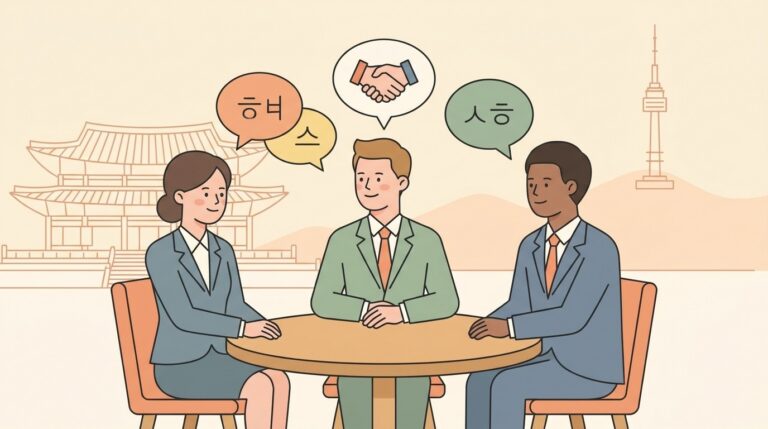
Mastering Advanced Korean Policy Discussions: Labor Market Dualism & Tripartite Social Dialogue
Phase 1: Empathy (A Story-Immersive Opening)
안녕하세요! 매일한글 에디터입니다. (Hello! This is your Daily Hangul editor.)
Have you ever tuned into an episode of the acclaimed workplace K-drama Awl (송곳) or Misaeng (미생) and felt completely overwhelmed when characters transitioned from casual office banter to intense debates about corporate governance, subcontracting, and wage disputes? Perhaps you were sitting in an advanced business meeting in Yeouido or reading an editorial in the Hankyoreh or Chosun Ilbo, wondering why negotiations are described with poetic yet weighty metaphors like “앉아서 대화의 물꼬를 트다” or “한 발씩 양보하다.”
Discussing structural socio-economic issues such as labor market dualism (노동시장 이중구조) and working-hour flexibility (근로시간 유연화) in Korean is notoriously tricky even for advanced learners. You do not want to sound like an aggressive activist on the picket line, nor do you want to sound like an aloof corporate executive disconnected from reality. Achieving a genuine C1 proficiency means mastering the art of diplomacy: expressing urgency, structural empathy, and pragmatic compromise with precision. This guide draws directly on real case studies from foreign analysts, NGO directors, and corporate leads working in Seoul, giving you the nuanced vocabulary to sound articulate, empathetic, and culturally astute.
Phase 2: Core Expressions Deep Dive
1. 한 발씩 양보하다 (Han bal-ssik yang-bo-ha-da)
- Pronunciation: [Han bal-ssik yang-bo-ha-da] (Think: Hahn + Bahl + Sheek + Yahng-boh-hah-dah, rolling smoothly like stepping back on a wooden floor).
- Meaning: Literal: “To step back one foot each.” / Nuance: “To meet each other halfway” or “to make mutual concessions in a deadlocked negotiation.”
- K-Culture Moment: Seen frequently in political dramas like Queenmaker (퀸메이커) when negotiators seek an exit strategy from a public relations catastrophe.
- Editor’s Insight: Notice the use of “한 발” (one step). In Korean collectivist dispute resolution, demanding full surrender (굴복) breaks the relationship. Offering “한 발” preserves face (체면) for both sides.
- Situation Spectrum: Casual: ⚠️ (Sounds too diplomatic; use “조금씩 봐주다” instead) | Semi-formal: ✅ | Formal: ✅
- 🤔 Think About It: Does your native culture frame negotiations as a zero-sum win-or-lose struggle, or does it also value the spatial metaphor of “stepping back together”?
2. 대화 테이블에 앉다 (Dae-hwa te-i-beul-e an-da)
- Pronunciation: [Dae-hwa te-i-beul-e an-da] (Dae-hwah tay-ee-beul-eh ahn-dah).
- Meaning: Literal: “To sit at the dialogue table.” / Nuance: “To commit to formal peaceful negotiations rather than engaging in collective strikes or unilateral retaliation.”
- K-Culture Moment: Front-page headlines on news broadcasts (JTBC 뉴스룸) covering negotiations between railway labor unions and the Ministry of Land, Infrastructure and Transport.
- Editor’s Insight: Notice that Korean combines the native/Sino concept of “대화” (dialogue) with the loanword “테이블” (table). It specifically denotes institutionalized social dialogue (거버넌스), contrasting sharply with outdoor street rallies (투쟁).
- Situation Spectrum: Casual: 🚫 | Semi-formal: ✅ | Formal: ✅
- 🤔 Think About It: Why has the English loanword “테이블” replaced native terms in institutional policy settings? What kind of modern neutrality does it convey?
3. 사회적 대타협을 이루다 (Sa-hoe-jeok dae-ta-hyeob-eul i-ru-da)
- Pronunciation: [Sa-hoe-jeok dae-ta-hyeob-eul i-ru-da] (Sah-hweh-jeok dae-tah-hyub-eul ee-roo-dah).
- Meaning: Literal: “To achieve a grand social compromise.” / Nuance: “To establish historic tripartite pacts between labor, business, and the state (e.g., the 1998 Tripartite Commission Model).”
- K-Culture Moment: Historical and economic retrospectives covering Korea’s structural transition after the 1997 IMF Asian Financial Crisis.
- Editor’s Insight: The prefix “대-” (大, great/grand) signifies that this is not just an ordinary contract signing between two parties, but an overarching structural consensus reshaping legal frameworks and national welfare nets.
- Situation Spectrum: Casual: 🚫 | Semi-formal: ⚠️ | Formal: ✅
- 🤔 Think About It: How does the expectation of “grand consensus” shape the public’s patience during strikes in South Korea compared to Western democracies?
Phase 3: Textbook Korean vs. Real Korean
Scenario 1: Warning that an adversarial deadlock benefits neither side
- 📖 교과서 한국어 (Textbook): 노조와 회사가 싸우면 둘 다 손해를 봅니다. (Nojowa hoesaga ssaumyeon dul da sonhaereul bomnida. / “If the labor union and company fight, both incur losses.”)
- 🗣️ 진짜 한국어 (Real C1 Native): 극한의 대립은 노사 모두에게 치킨게임이 될 뿐입니다. (Geukanui daeribeun nosa moduege chikingeimi doel ppunimnida. / “Extreme confrontation will merely turn into a game of chicken for both labor and management.”)
- 💡 왜 다를까? (Why the difference?): Highly educated Koreans frequently integrate strategic and economic idioms (like “치킨게임” for zero-sum collisions) to critique entrenched stalemates without sounding simplistic.
Scenario 2: Suggesting tripartite structural reform instead of street protests
- 📖 교과서 한국어 (Textbook): 데모를 그만두고 정부와 사장님과 대화해야 합니다. (Demoreul geumandugo jeongbuwa sajangnimgwa daehwahae-ya hamnida. / “You must stop demonstrating and talk with the government and company president.”)
- 🗣️ 진짜 한국어 (Real C1 Native): 소모적인 투쟁을 지양하고, 노사정이 상생을 위한 사회적 대화에 착수해야 합니다. (Somomjeogin tujaengeul jiyanghago, nosajeongi sangsaengeul wihan sahoejeok daehwae chaksuhae-ya hamnida. / “We must steer clear of wasteful struggle and initiate social dialogue for tripartite coexistence.”)
- 💡 왜 다를까? (Why the difference?): Using Sino-Korean verbs like 지양하다 (to avoid/sublate) and 착수하다 (to embark upon) signals high-level policy command and objective, balanced mediation.
Phase 4: K-Culture Deep Dive & Non-Verbal Etiquette
4-1. Nunchi (눈치) & Non-Verbal Manners in High-Stakes Negotiations
When participating in high-level business or social dialogue in Korea, your posture often speaks louder than your vocabulary. Avoid aggressive finger-pointing (삿대질), which is considered inflammatory and disrespectful in Korean conference rooms.
- The Resting Hand Position: Keep both hands folded loosely on the table or touching your notepad. This signals that you are active, alert, and not hiding unilateral decisions under the desk.
- The Empathetic Pause (침묵의 미학): When the opposite party (e.g., labor representatives voicing precarious contract conditions) speaks, do not interject immediately. Nod gently twice (고개를 끄덕이다) and pause for 2 seconds before countering. This demonstrates 경청 (active, respectful listening).
4-2. Cultural Code Analysis: The Legacy of “노사정 (No-Sa-Jeong)”
The word 노사정 brings together three fundamental pillars: 노 (노동계 / Labor), 사 (사용자·경영계 / Management), and 정 (정부 / Government). In Anglo-American economic models, collective bargaining is frequently bilateral (company vs. union). However, due to South Korea’s rapid compressed modernization (압축성장), the government has historically acted as both regulator and mediator.
In modern Korean society, “labor market dualism” refers to the profound gap between Tier 1 regular workers (대기업·공공부문 정규직) enjoying strong employment safety nets, and Tier 2 outsourced or non-regular workers (중소기업·비정규직). When a news anchor states that “사회적 대타협 거버넌스가 시급하다”, they are invoking an urgent call for regular unions to concede some working-hour rigidity while corporations expand protective social insurance (고용 안전망) for vulnerable non-regular workers.
Phase 5: Real-World Roleplay Scenario
Setting: A tripartite advisory conference room at the Government Complex Seoul (정부서울청사). Director Min (representing union workers) and Director Park (representing the employers’ federation) face deadlock over working-hour flexibilization.
- 민 위원 (Director Min): 노측 입장에서는 근로시간 유연화가 자칫 노동자의 건강권을 침해하고 실질 임금을 삭감하는 수단으로 악용될까 심히 우려스럽습니다. (No-cheuk ip-jang-eseoneun geun-ro-si-gan yu-yeon-hwa-ga ja-chit no-dong-ja-ui geon-gang-gweon-eul chim-hae-ha-go sil-jil im-geum-eul sak-gam-ha-neun su-dan-eu-ro ag-yong-doel-kka sim-hi u-ryeo-seu-reop-seum-ni-da.)
- 🎭 Action: Adjusts eyeglasses firmly, staring directly across the table.
- English: “From labor’s standpoint, we are deeply concerned that working-hour flexibility might be abused to infringe on workers’ health rights and slash real wages.”
- 박 전무 (Director Park): 하지만 사측 역시 급변하는 글로벌 공급망에 대응하려면 노동시장의 경직성을 해소하는 조치가 절실합니다. (Ha-ji-man sa-cheuk yeok-si geup-byeon-ha-neun geul-lo-beol gong-geup-mang-e dae-eung-ha-ryeo-myeon no-dong-si-jang-ui gyeong-jik-seong-eul hae-so-ha-neun jo-chi-ga jeol-sil-ham-ni-da.)
- 🎭 Action: Places his pen down deliberately on the document folder.
- English: “However, management also urgently requires measures to ease labor market rigidity if we are to respond to rapidly fluctuating global supply chains.”
- 당신 (You – Government Mediator): 양측의 현실적 고충에 십분 공감합니다. 그렇기에 이제는 소모적인 장외 투쟁을 멈추고 공식 대화 테이블에 앉아야 할 때입니다. (Yang-cheuk-ui hyeon-sil-jeok go-chung-e sip-bun gong-gam-ham-ni-da. Geu-reo-ki-e i-je-neun so-mo-jeok-in jang-oe tu-jaeng-eul meom-chu-go gong-sik dae-hwa te-i-beul-e an-ja-ya hal ttae-im-ni-da.)
- 🎭 Action: Making open-palm hand gestures directed symmetrically at both sides.
- English: “I fully understand the practical dilemmas on both sides. That is why it is time to halt wasteful street confrontations and commit to the formal dialogue table.”
- 민 위원 (Director Min): 정부가 확실한 고용 안전망 대책을 먼저 보장하지 않는다면 신뢰를 구축하기 어렵습니다. (Jeong-bu-ga hwak-sil-han go-yong an-jeon-mang dae-chaek-eul meon-jeo bo-jang-ha-ji an-neun-da-myeon sin-roe-reul gu-chuk-ha-gi eo-ryeop-seum-ni-da.)
- 🎭 Action: Crosses arms slightly, leaning back.
- English: “Unless the government first guarantees concrete employment safety-net measures, it will be difficult to build trust.”
- 당신 (You): (Here is your pivotal branching choice below!)
🔀 Interactive Choice Point
How will you mediate the deadlock?
- Option A: “사측의 요구만 받아들이면 파업이 커질 테니 경영계가 무조건 양보하십시오.” (If we only accept management’s terms, strikes will worsen, so management must concede unconditionally.)
- Option B: “경영계의 유연성 확보 요구와 노동계의 안전망 확충을 맞교환하는 패키지 딜을 구성합시다. 서로 한 발씩 양보해야 대타협이 가능합니다.” (Let’s construct a package deal trading management’s need for flexibility with labor’s expansion of safety nets. Mutual concessions are the only path to grand compromise.)
- Option C: “서로 타협할 의지가 없으시다면 정부 단독으로 행정명령을 발표하겠습니다.” (If neither side intends to compromise, the government will independently issue an administrative decree.)
Feedback Breakdown:
- Option A (Bad / Risk): 🚫 Violates neutrality. Accusing the employer federation of greed in tripartite discussions destroys the mediator’s credibility.
- Option B (Best): 🌟 Perfectly captures C1 policy diplomacy! It links flexibility (유연성) with protection (안전망) under a unified “package deal” (패키지 딜/빅딜) while invoking 한 발씩 양보하다.
- Option C (High Risk): ⚠️ Authoritarian overreach. Bypassing social governance undermines long-term labor peace and sparks nationwide constitutional challenges.
Phase 6: 10-Second Emotion Shadowing Drill
Sharpen your cadence, rhythm, and breath pauses. Use / to denote natural phrasing breaks.
- [🤝 설득력 있고 진중하게 / Persuasive and deliberate]
노사정이 / 투쟁 대신 / 대화 테이블에 앉아 / 한 발씩 양보해야 합니다.
(No-sa-jeong-i / tu-jaeng dae-sin / dae-hwa te-i-beul-e an-ja / han bal-ssik yang-bo-hae-ya ham-ni-da.) -
[⚖️ 균형 잡히고 차분하게 / Objective and poised]
근로시간 유연화와 / 고용 안전망 확충은 / 대립하는 가치가 아니라 / 함께 가야 할 과제입니다.
(Geun-ro-si-gan yu-yeon-hwa-wa / go-yong an-jeon-mang hwak-chung-eun / dae-rip-ha-neun ga-chi-ga a-ni-ra / ham-kke ga-ya hal gwa-je-im-ni-da.) -
[💼 단호하고 미래지향적으로 / Firm and forward-looking]
양극화된 노동시장의 / 이중구조를 해소하려면 / 사회적 대타협 거버넌스가 / 시급합니다.
(Yang-geuk-hwa-doen no-dong-si-jang-ui / i-jung-gu-jo-reul hae-so-ha-ryeo-myeon / sa-hoe-jeok dae-ta-hyeop geo-beo-neon-seu-ga / si-geup-ham-ni-da.)
Phase 7: K-Culture Mini Dictionary
- 노사정 (No-sa-jeong): Tripartite governance representing Labor (노동계), Management (사용자), and Government (정부). Essential for understanding national policy councils and collective wage bargaining rounds.
- 이중구조 (I-jung-gu-jo): Dual structure / Dualism. Used specifically to describe the deep chasm between unionized regular workers at conglomerates (대기업 정규직) and unprotected temporary/subcontracted staff (하청·비정규직).
- 근로시간 유연화 (Geun-ro-si-gan yu-yeon-hwa): Working-hour flexibility. Debates centering on reforming Korea’s statutory 52-hour working week (주 52시간제) through annualized or seasonal overtime banks.
- 고용 안전망 (Go-yong an-jeon-mang): Employment safety net. State social security provisions including unemployment benefits (실업급여), national job training schemes, and industrial accident insurance coverage.
Phase 8: Expat & Professional Survival Kit
Essential Workplace Survival Expressions
- 서로 한 발씩 물러서서 조율해 봅시다.
(Seo-ro han bal-ssik mul-leo-seo-seo jo-yul-hae bop-si-da.)
Pro Tip: Use this in corporate meetings when project teams hit an impasse over deadlines and resource allocation. - 노사 간 원만한 합의점에 도달했습니다.
(No-sa gan won-man-han ha-bui-jeom-e do-dal-haet-seum-ni-da.)
Pro Tip: The magic formal phrase to announce that an agreement has been concluded amicably without arbitration. - 고용 안정성과 유연성 사이의 균형이 관건입니다.
(Go-yong an-jeong-seong-gwa yu-yeon-seong sa-i-ui gyun-hyeong-i gwan-geon-im-ni-da.)
Pro Tip: A bulletproof analytical sentence whenever you are asked your perspective on Korean macroeconomic reforms.
Editor’s Field Note
Navigating real-world administrative issues in South Korea requires familiarity with institutional infrastructure. Bookmark the 고용노동부 공식 웹사이트 포털 to stay updated on statutory minimum wage and standard employment contracts. When looking up labor policy precedents or legal disputes, utilize the 국가법령정보센터 모바일 앱 다운로드 to reference the Labor Standards Act (근로기준법) with instant English translations.
Phase 9: “One Step Deeper” (Reflective Humanities Essay)
In Western industrial discourse, collective bargaining is frequently characterized as contractual rights advocacy grounded in legal mechanics. In South Korea, however, labor disputes carry deep historical echoes of emotional bonds (정, 靜) and collective grievance (한, 恨). Korea’s unprecedented transition from an agrarian economy to a global high-tech powerhouse was built on the backs of workers who sacrificed personal lives in the factories of Guro and Ulsan. Consequently, modern demands for tripartite compromise are not merely mathematical spreadsheets of hourly wages; they are deeply personal negotiations over human dignity, intergenerational fairness, and sustainable social contracts.
💬 Your Turn: In your home country, how is labor peace achieved? Does your society rely more on state-mandated legislation, bilateral court arbitration, or institutionalized tripartite dialogue like Korea’s? Share your thoughts below!
Phase 10: FAQ & Avoiding Misunderstandings
Q: Does the word “투쟁 (Struggle/Fight)” always mean physical violence in Korean labor contexts?
A: No. While “투쟁” (tu-jaeng) literally translates to “struggle” or “combat,” in Korean labor discourse it refers broadly to collective constitutional activism, including peaceful picket lines, wearing red headbands, strikes, or political petitioning. However, calling for people to move “from 투쟁 to 대화 테이블” signifies moving from public protest to closed-door institutional governance.
Q: Can I use “한 발씩 양보하다” when negotiating prices at traditional markets like Namdaemun?
A: It is slightly unnatural. At markets, use casual terms like “조금 깎아주세요” (Please give me a small discount) or “사이좋게 중간 가격으로 해요” (Let’s meet in the middle). Reserve “한 발씩 양보하다” for professional, interpersonal, or institutional disagreements.
Q: What is the formal nuance difference between “타협 (Compromise)” and “합의 (Agreement)”?
A: “타협” (ta-hyeop) emphasizes that both sides made concessions and sacrifices from their original hardline positions. “합의” (ha-bui) is broader, referring to legal or procedural mutual consent regardless of whether concessions were made.
🚨 흔한 실수 (Common Mistakes) Checklist
- ❌ Mistake 1: Translating “labor and management” as “노동자들과 사장님들” in official presentations.
- 👉 Correct Action: Use the formal institutional synthesis: 노사 (No-Sa) or 노사 양측 (Both labor and management).
- ❌ Mistake 2: Using “양보하세요!” (Please concede!) commanding your senior or counterpart.
- 👉 Correct Action: Suggest it mutually using inclusive politeness: “상호 절충점을 찾아 한 발씩 양보하는 것이 바람직하다고 봅니다.”
- ❌ Mistake 3: Conflating “유연화 (Flexibilization)” with “자유화 (Liberalization/Deregulation)”.
- 👉 Correct Action: In Korean labor debates, flexibility of working hours is specifically referred to as 근로시간 유연화.
Phase 11: Action Missions
- 🥉 Bronze Mission (Solo Practice): Record yourself reading the 3 shadowing sentences in Phase 6. Listen back to check whether you paused naturally at the slashes (
/). - 🥈 Silver Mission (Social Learning): Write a 2-sentence comment on a Korean news editorial (e.g., Naver News economics section) using the phrase “노사정이 한 발씩 양보하여 사회적 대타협을 이뤄야 합니다.”
- 🥇 Gold Mission (Real-World Application): In your next corporate meeting or Korean discussion group, utilize the phrase “대화 테이블에 앉아 절충안을 찾아봅시다” during a conflict over scheduling or duties.
- 🎮 K-Culture Mission: Watch Episode 1 or 2 of the drama Awl (송곳) or the movie Cart (카트). Identify at least 3 instances where “노조”, “사측”, or “교섭” appear in the dialogue.
Phase 12: Interactive Quiz Challenge
1. Situational Judgment
Which of the following statements represents the most diplomatic and professional way for a chairperson to open a tripartite labor forum?
* (A) “시간이 없으니 노조는 파업을 멈추고 사측 안을 수용하십시오.”
* (B) “소모적인 갈등 대신 노사정이 대화 테이블에 앉아 한 발씩 양보하는 지혜를 모읍시다.”
* (C) “어차피 법대로 판결 날 테니 대화는 형식적으로만 진행하겠습니다.”
🔍 정답 및 해설 보기 (Click to view answer)
정답: (B)
해설: (B) perfectly utilizes C1 diplomatic terminology, replacing zero-sum antagonism with tripartite compromise and mutual concession. (A) and (C) violate mediation neutrality.
2. Fill-in-the-Blank
“노동시장의 (________)를 해소하기 위해서는 대기업 정규직과 중소기업 비정규직 간의 격차를 완화해야 합니다.”
* (A) 사회적 타협
* (B) 이중구조
* (C) 거버넌스
🔍 정답 및 해설 보기 (Click to view answer)
정답: (B) 이중구조 (Dualism)
해설: The phenomenon of structural disparity between tier 1 regular employees and tier 2 subcontracted workers is known as “노동시장 이중구조.”
3. True / False Cultural Check
- Statement: In South Korea, “근로시간 유연화” means companies can eliminate national overtime regulations without any union dialogue or legal revisions.
🔍 정답 및 해설 보기 (Click to view answer)
정답: False
해설: Any reform of working hours involves intense parliamentary review, public hearings, and formal tripartite dialogue (노사정 협의) governed by the Labor Standards Act.







