

Phase 1: Empathy (Narrative Immersion Opening)
안녕하세요! 매일한글 에디터입니다.
Imagine sitting inside a bustling glass-walled café in Yeouido, Seoul’s Wall Street. The late afternoon sunlight reflects off the Han River while analysts, asset managers, and civil servants sip iced Americanos. Around you, whispered arguments drift across tables: “지금 내수 살리겠다고 금리 내렸다가는 집값 다시 폭등해요” (If we cut rates now to revive domestic consumption, housing prices will skyrocket again), followed by a colleague’s worried reply: “그래도 자영업자들 다 죽어 나가는데 어떡합니까?” (Still, small business owners are collapsing—what else can we do?).
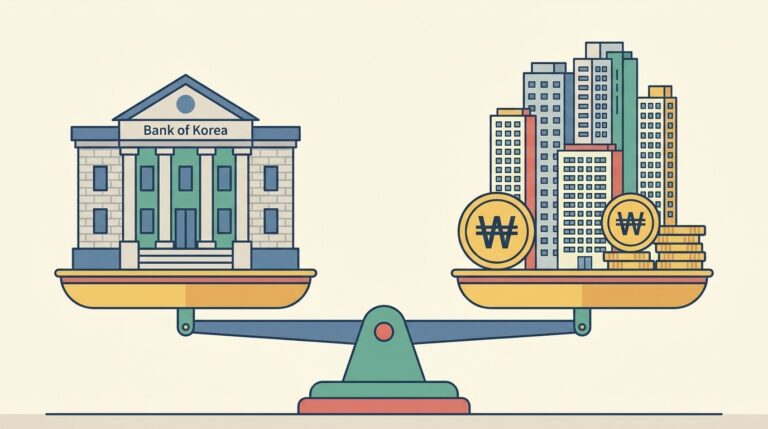
If you follow Korean news or high-stakes financial K-Dramas like Reborn Rich (재벌집 막내아들), you know that interest rates aren’t just an abstract statistic in Korea—they are a deeply personal cultural battleground. For advanced C1 learners, understanding the dilemma of the Bank of Korea’s Monetary Policy Board (금통위) is a masterclass in professional Korean. You are moving beyond simple daily exchanges into the realm of macroeconomic strategy, where cutting rates too early risks re-igniting the explosive real estate market (부동산 과열) and triggering foreign capital outflows (외자 유출). Today’s guide brings you into the inner sanctum of Korean economic debates with authentic phrasing, cultural subtext, and nuanced analysis.
Phase 2: Deep Dive into 3 Core Expressions
1. 내수 진작을 위해 (Naesu jinjaegeul wihae)
- Pronunciation: [Nae-su jin-ja-geul wi-hae] (Sounds like “Neigh-soo jin-jah-geul wee-hae”)
- Meaning: Literal: “For the sake of lifting up internal demand” | Real Nuance: “To stimulate domestic consumption and breathe life into struggling local businesses.”
- K-Culture Moment: Seen in economic policy briefings or during parliamentary audit scenes in political dramas when policymakers justify stimulus vouchers or rate cuts.
- Editor’s Insight: 진작 (振作) comes from Hanja meaning to shake awake and elevate depressed energy. Unlike the mechanical English verb “stimulate,” 진작 carries an organic, almost psychological wish to revitalize an exhausted market.
- Situation Spectrum: Casual 🚫 | Semi-formal ⚠️ | Formal ✅
- 🤔 Think About It: Does your native language view the national economy as an engine to be “fueled” or as a living organism to be “revitalized” like in Korean?
2. 성급히 금리를 내리면 (Seonggeuphi geumrireul naerimyeon)
- Pronunciation: [Seong-geu-pi geum-ni-reul nae-ri-myeon] (Notice the nasalization: 금리 is pronounced [geum-ni], not [geum-ri])
- Meaning: Literal: “If [we] hastily lower interest rates” | Real Nuance: “If monetary authorities pull the trigger prematurely without sufficient macroeconomic safeguards.”
- K-Culture Moment: Used by seasoned financial anchors and chief economists warning of secondary shocks during nightly business reports on SBS or KBS.
- Editor’s Insight: 성급히 combines impatience with a lack of mature preparation. In business debates, using this adverb asserts strategic foresight and warns your counterpart against reckless short-termism.
- Situation Spectrum: Casual ⚠️ | Semi-formal ✅ | Formal ✅
- 🤔 Think About It: In Korean corporate culture, highlighting the dangers of being 성급하다 (hasty) reflects the collective virtue of prudent deliberation (신중함).
3. 부동산 과열과 외자 유출 우려 (Budongsan gwayeolgwa oeja yuchul uryeo)
- Pronunciation: [Bu-dong-san gwa-yeol-gwa oe-ja yu-chul u-ryeo] (Sounds like “Boo-dong-san gwa-yeol-gwa way-ja yoo-chul oo-ryuh”)
- Meaning: Literal: “Real estate overheating and foreign capital outflow concerns” | Real Nuance: “The twin macroeconomic nightmares: a reinflated housing bubble alongside foreign investors dumping domestic assets for the US dollar.”
- K-Culture Moment: The climactic dilemma faced by Bank of Korea committee members in macroeconomic analysis shows like Issue Pick with the Sam (이슈 픽 쌤과 함께).
- Editor’s Insight: 우려 (憂慮) is far more formal and analytical than 걱정 (worry). In policy discourse, 우려 introduces systematic risks that require preventative countermeasures.
- Situation Spectrum: Casual 🚫 | Semi-formal ⚠️ | Formal ✅
- 🤔 Think About It: Why is real estate coupled so tightly with capital flight in Korea? Because Korea’s export-driven open economy sits vulnerable to global rate differentials.
Phase 3: Textbook Korean vs. Real Korean
Situation 1: Discussing How Low Rates Threaten the Housing Market
- 📖 교과서 한국어 (Textbook Korean):
- “기준금리를 인하하면 가계대출이 증가하여 부동산 가격이 급등할 가능성이 있습니다.” (Gijungeumrireul inhahamyeon gagyedaechuri jeunggahayeo budongsan gagyeogi geupdeunghal ganeungseongi itseumnida. / If the base rate is lowered, household debt will increase, creating the possibility that real estate prices will jump rapidly.)
- 🗣️ 진짜 한국어 (Real Korean – C1 Native Level):
- “여기서 섣불리 금리 내렸다간 영끌족 다시 자극해서 수도권 집값에 또 불붙어요.” (Yeogiseo seotbulli geumri naeryeottagan yeongkkeuljok dasi jageukhaeseo sudogwon jipggapse tto bulbuteoyo. / If we recklessly cut rates right now, it will trigger the ‘soul-borrowers’ again and light another fire under Seoul metropolitan housing prices.)
- 💡 왜 다를까? (Why the Difference?):
Native professionals use sensory idioms like 불붙다 (catch fire) and cultural neologisms like 영끌족 (those leveraging everything, down to their soul, to buy property) to communicate immediate market psychology rather than dry statistical probabilities.
Situation 2: Describing Foreign Capital Leaving Due to US-Korea Rate Gaps
- 📖 교과서 한국어 (Textbook Korean):
- “미국과의 금리 격차가 발생하면 외국인 투자 자금이 해외로 유출될 수 있습니다.” (Migukgwaui geumri gyeokchaga balsaenghamyeon oegukin tuja jageumi haeoero yuchuldoel su itseumnida. / If an interest rate gap with the United States occurs, foreign investment capital may flow abroad.)
- 🗣️ 진짜 한국어 (Real Korean – C1 Native Level):
- “한미 금리차 더 벌어지면 외인 자금 썰물처럼 빠져나가고 환율 방어선 무너집니다.” (Hanmi geumricha deo beoleojimyeon oein jageum sseolmulcheoreom ppajyeonagago hwanyul bang-eoseon muneojimnida. / If the Korea-US rate spread widens further, foreign capital will drain out like an ebbing tide, collapsing our foreign exchange defense line.)
- 💡 왜 다를까? (Why the Difference?):
Traders and macro analysts rely on evocative nature metaphors like 썰물처럼 빠져나가다 (drain like an ebb tide) and military jargon like 방어선 (defense line) to emphasize high stakes.
Phase 4: K-Culture Deep Dive & Nonverbal Manners
4-1. Nunchi & Professional Gestures
When debating monetary policy or real estate in Korea, remember that real estate is an emotional trigger tied to intergenerational wealth, marriage prospects, and social class.
* Restrained Hand Gestures: When voicing reservations about rate cuts, hold one hand slightly raised at chest level with the palm pressing downward softly. This nonverbally communicates, “Let us remain level-headed and exercise restraint.”
* Buffering with Hedges: Never state an economic outcome as an absolute fact. Soften authoritative assertions with hedging endings such as “~는 측면을 간과할 수 없죠” (We cannot overlook that aspect) or “~우려가 상존하는 게 현실입니다” (The reality is that concerns still coexist).
4-2. Cultural Code: The “Yeong-kkeul” Trajectory & BOK’s Tightrope
In Anglo-American economics, the transmission channel of monetary policy primarily focuses on corporate investment and consumer sentiment. In South Korea, however, the primary shockwave runs directly into 아파트 (Apartment complexes) and 가계부채 (Household debt).
With South Korea’s unique 전세 (Jeonse / lump-sum housing lease) system and mortgage-heavy middle class, lowering rates does not merely encourage factory investment—it immediately tempts millions of retail investors back into competitive bidding wars in Seoul. Conversely, keeping rates high threatens small merchants (자영업자) facing delinquency. This tension forms what analysts call the “한국형 통화정책의 딜레마” (Korean-style Monetary Policy Dilemma).
Phase 5: Real-World Roleplay Scenario
Setting: A 34th-floor executive briefing room overlooking Yeouido. Strategy debrief before the quarterly monetary board review.
Characters:
* Team Lead Kang (강 팀장): Veteran macro strategist, former BOK economist with a calm, penetrating gaze.
* Alex (알렉스): Senior global portfolio analyst delivering his strategic report.
Dialogue:
1. 강 팀장: 🎭 [서류를 넘기며 안경을 고쳐 쓴다] “알렉스 님, 이번 금통위 결정을 앞두고 시장 의견이 완전히 갈리고 있어요. 어떻게 보고 계십니까?” (Alex nim, ibeon geumtongwi gyeoljeongeul apdugo sijang uigyeoni wanjeonhi galligo isseoyo. Eotteoke bogo gyesimnikka? / “Alex, market opinions are completely divided ahead of this Monetary Policy Committee decision. What is your reading?”)
2. 알렉스: 🎭 [태블릿 차트를 가리키며 신중한 어조로] “내수 부진만 놓고 보면 당장 인하 시그널을 주는 게 맞지만, 그렇게 단순한 상황이 아닙니다.” (Naesu bujinman noko bomyeon dangjang inha sigeuneoreul juneun ge matjiman, geureoke dansunhan sanghwangi animnida. / “Looking strictly at the sluggish domestic demand, signaling an immediate cut would be correct, but the situation is not that simple.”)
3. 강 팀장: 🎭 [미간을 살짝 찌푸리며 끄덕인다] “역시 수도권 부동산 동향이 걸리죠?” (Yeoksi sudogwon budongsan donghyangi geollijyo? / “As expected, the trend in metropolitan real estate is the sticking point, right?”)
4. 알렉스: 🎭 [손바닥을 아래로 누르듯 제스처하며] “네. 반대로 내수 진작을 위해 성급히 금리를 내리면 부동산 과열과 외자 유출 우려가 커져요.” (Ne. Bandaero naesu jinjaegeul wihae seonggeuphi geumrireul naerimyeon budongsan gwayeolgwa oeja yuchul uryeoga keojyeoyo. / “Exactly. Conversely, if we prematurely cut rates to stimulate domestic demand, risks of property overheating and capital flight increase significantly.”)
5. 강 팀장: 🎭 [커피를 한 모금 마시며 한숨을 쉰다] “한미 금리차 역전 폭이 사상 최대 수준인데, 여기서 원화 가치가 더 밀리면 수입 물가도 다시 튈 텐데요.” (Hanmi geumricha yeokjeon pogi sasang choedae sujuninge, yeogiseo wonhwa gachiga deo millimyeon suip mulgado dasi twil tendeyo. / “The Korea-US rate inversion gap is at a historic high; if the Korean Won weakens further from here, import prices will spike again too.”)
6. 알렉스: 🎭 [고개를 끄덕이며 진지하게] “맞습니다. 자칫 경기 부양하려다 환율과 가계부채라는 두 마리 토끼를 다 놓칠 위험이 있습니다.” (Matseumnida. Jachit gyeonggi buyangharyeoda hwanyulgwa gagyebuchaeraneun du mari tokkireul da notchil wiheomi itseumnida. / “Spot on. In attempting to revive the economy, we risk losing both hares at once: exchange rate stability and household debt control.”)
7. 강 팀장: 🎭 [시계를 확인하며 펜을 쥔다] “그렇다면 최종 브리핑 결론을 어떤 톤으로 가져가는 게 맞겠습니까?” (Geureotamyeon choejong beuriping gyeolloneul eotteon toneuro gajyeoganeun ge matgetseumnikka? / “Then in what tone should we structure the final briefing conclusion?”)
8. 알렉스: 🎭 [단호하면서도 균형 잡힌 표정으로 결론을 제시한다]
🔀 Interactive Choice Point
How should Alex finish his strategic recommendation in Turn 8?
- Option A: “내수 침체가 심각하니, 리스크를 감수하고서라도 50bp 이상의 공격적인 선제 금리 인하를 건의해야 합니다.” (Naesu chimchega simgakhani, riseukeureul gamsuhagoseorado 50bp isang-ui gonggyeokjeogin seonje geumri inhareul geon-uihaeya hamnida.)
- Option B: “내수 진작의 필요성은 인정하되, 집값 자극과 외자 유출 리스크를 방어할 수 있는 ‘신중한 동결 및 매파적 동결’ 기조를 제안해야 합니다.” (Naesu jinjak-ui piryoseong-eun injeonghadae, jipggap jageukgwa oeja yuchul riseukeureul bang-eohal su inneun ‘sinjunghan donggyeol mit maepajeok donggyeol’ gijoreul jeanhaeya hamnida.)
- Option C: “미국 연준이 금리를 내리기 전까지는 우리가 무엇을 해도 의미가 없으니 아예 결론을 유보합시다.” (Miguk yeonjuni geumrireul naerigi jeonkkajineun uriga mueoseul haedo uimiga eopseuni aye gyeolloneul yubohapsida.)
Feedback:
* Option A (Risk): Irresponsible for an institutional strategist in Korea. Suggesting an aggressive big cut while ignoring the mortgage surge and capital flight destroys your professional credibility.
* Option B (Best!): Professional and balanced. Demonstrates high-level economic understanding by balancing domestic necessity with financial stability using the key industry concept 매파적 동결 (Hawkish freeze).
* Option C (Bad): Passive and defeatist. It abdicates analytical duty and dismisses the domestic factors unique to Korea’s financial system.
Phase 6: 10-Second Emotion Shadowing Drill
Practice these lines focusing on natural prosody, breathing pauses marked by /, and emotional cues.
- Sentence 1: [🧐 신중하고 분석적인 톤으로]
- “내수 진작도 절실하지만, / 섣부른 금리 인하는 / 부동산 뇌관을 건드릴 수 있어요.” (Naesu jinjakdo jeolsilhajiman, / seotbureun geumri inhaneun / budongsan noegwaneul geondeuril su isseoyo. / While stimulating domestic demand is urgent, a hasty rate cut could detonate the real estate detonator.)
- Sentence 2: [😰 긴장감을 담아 위기를 경고하며]
- “한미 금리차가 더 벌어지면, / 외자 유출 압박과 고환율을 / 버텨내기 어렵습니다.” (Hanmi geumrichaga deo beoleojimyeon, / oeja yuchul apbakgwa gohwanyureul / beotyeonaegi eoryeopseumnida. / If the Korea-US rate differential widens further, enduring the capital outflow pressure and weak currency will be difficult.)
- Sentence 3: [⚖️ 차분하고 권위 있게 결론을 내리며]
- “결국 경기 부양과 금융 안정 사이에서 / 줄타기를 할 수밖에 없는 / 진퇴양난의 국면입니다.” (Gyeolguk gyeonggi buyanggwa geumyung anjeong saieseo / jultagireul hal subakke eomneun / jintoeyangnan-ui gungmyeon-imnida. / Ultimately, it is an impasse where authorities have no choice but to walk a tightrope between economic stimulation and financial stability.)
Phase 7: K-Culture Mini Dictionary
- 금통위 (Geum-tong-wi) [금융통화위원회]
- Translation: Monetary Policy Board (of the Bank of Korea)
- Real Usage: Korea’s equivalent of the US Federal Reserve’s FOMC. When the media says “금통위가 열린다” (The MPC convenes), stocks, bond yields, and currency markets freeze in anticipation.
- 영끌족 (Yeong-kkeul-jok)
- Translation: The “borrowing-to-the-soul” cohort
- Real Usage: Young Koreans who secured maximum personal loans, credit lines, and housing mortgages to buy apartments before prices rose out of reach. Often cited as the demographic most vulnerable to high rates.
- 한미 금리차 (Han-mi geum-ri-cha)
- Translation: South Korea–US Benchmark Interest Rate Spread
- Real Usage: A headline fixture in Korean economic dailies. A wider spread often triggers fears of foreign capital flight from Korean financial markets.
- 진퇴양난 (Jin-toe-yang-nan)
- Translation: Dilemma / Catch-22 (Hanja idiom)
- Real Usage: Commonly applied when describing the central bank’s position: lowering rates heats property markets, yet raising rates suppresses retail business survival.
Phase 8: Traveler & Professional Survival Kit
Survival Expressions TOP 3 (Financial & Banking Context)
- “외국인 명의로 정기 예금 개설이나 외환 송금 한도가 어떻게 되나요?”
(Oegukin myeong-uiro jeonggi yegeum gaeseorina oehan songgeum handoga eotteoke doenayo?)- Pro Tip: When visiting commercial banks like Shinhan or Hana Bank, specify your visa status and request documentation for overseas wire limits to avoid anti-money laundering blockades.
- “환율 우대(Spread discount)는 최대 몇 퍼센트까지 적용 가능한가요?”
(Hwanyul udaeneun choedae myeot peosenteukkaji jeok-yong ganeunghangayo?)- Pro Tip: In major exchange counters around Myeongdong or Incheon Airport, asking politely for 환율 우대 can shave fees off spot currency exchanges.
- “대출 금리가 변동형인가요, 아니면 고정금리 기준인가요?”
(Daechul geumriga byeondonghyeong-ingayo, animyeon gojeonggeumri gijuningayo?)- Pro Tip: Essential when discussing lease deposit loans (전세대출) or asset financing with bilingual loan managers.
Editor’s Travel Note: Financial Navigation in Seoul
- If you want to track economic figures live in Korea, consult the official Bank of Korea Economic Statistics System (ECOS) or read English-language summaries from local outlets like the Korea JoongAng Daily.
- For local payments, international cards often fail on domestic platforms. Download the NAMANE Card mobile app before landing, which acts as a reloadable prepaid card and transit pass usable across Korean convenience stores and subway systems without a local bank account.
Phase 9: One Step Deeper (Thought Piece)
In Korean society, real estate is not treated merely as an investment asset; it functions as social armor, a guarantor of generational mobility, and an emblem of adulthood. When macro-monetary debates unfold, public sentiment reacts with raw emotional immediacy. If monetary easing triggers another surge in housing valuations, younger generations face social disenfranchisement; yet if tight monetary policy persists, aging micro-entrepreneurs face default. Talking about interest rates in Korea is ultimately a conversation about fairness, systemic anxiety, and how a fast-developing society negotiates collective economic security.
💬 Your Turn: How does your home country weigh central bank decisions? Does public debate focus more on employment, mortgage burdens, or foreign investment? Share your perspective in the comments below!
Phase 10: FAQ & Common Mistakes
Q: Why does cutting interest rates automatically risk capital outflows in Korea?
A: South Korea operates an open, trade-reliant capital market. When Korea cuts its rate while the US Fed maintains higher rates, the resulting interest yield gap (금리차) incentivizes foreign institutional investors to liquidate Won-denominated assets and transfer funds into higher-yielding US Dollar securities, exerting downward pressure on the Korean Won.
Q: What is the difference between ‘금리 인하’ and ‘기준금리 동결’?
A: 금리 인하 (Geumri inha) refers to an actual rate cut, reducing the benchmark cost of borrowing. 기준금리 동결 (Gijungeumri donggyeol) means freezing or holding the benchmark rate steady at its current level.
Q: Can I use the word ‘영끌’ in an academic or formal economic essay?
A: While widely understood and featured in mainstream financial journalism, 영끌 remains a colloquial neologism. In formal white papers or executive board presentations, replace it with formal terminology such as “과도한 차입에 의한 자산 매입” (Asset acquisition through excessive leverage) or “가계부채 레버리지 확대” (Expansion of household debt leverage).
🚨 Common Mistakes Alert
- Mistake: Pronouncing 금리 literally as [Geum-ri].
- Correct Action: Apply nasal assimilation rules! ㅁ followed by ㄹ softens to [금니 (Geum-ni)].
- Mistake: Using 내수 (Naesu) when referring to company-internal matters.
- Correct Action: 내수 (內需) strictly denotes domestic macroeconomic consumption. For intra-company affairs, use 사내 (社內 – sanae) or 내부 (內部 – naebu).
- Mistake: Saying “집값이 올랐어요” in an executive board setting.
- Correct Action: Elevate your register to C1 level: “수도권 주택 가격의 상승 압력이 가중되고 있습니다” (Upward pressure on metropolitan housing prices is intensifying).
Phase 11: Action Mission & Engagement
- 🥉 Bronze Mission (Solo Practice): Read the 3 sentences in Phase 6 out loud three times. Record your voice on your smartphone and ensure you pronounce 금리 correctly as [금니] without hesitation.
- 🥈 Silver Mission (Social Application): Share a one-sentence summary of today’s dilemma on your social media or language notebook: “내수 진작과 부동산 안정 사이의 줄타기, 이것이 바로 한국의 통화정책 딜레마입니다.”
- 🥇 Gold Mission (Real Engagement): Go to YouTube, search for “금통위 기준금리 분석” (Monetary Policy Committee Base Rate Analysis), watch a 3-minute clip from SBS Biz or Yonhap News, and identify the terms 내수 진작, 외자 유출, and 가계부채.
Phase 12: Interactive Quiz Challenge
Test your mastery of C1 economic Korean with these 3 questions!
1. [Context Choice] Select the most appropriate word to fill in the blank in this formal macroeconomic briefing:
“섣부른 금리 인하는 자칫 수도권 부동산 시장을 _______ 외자 유출 압박을 키울 수 있습니다.”
(A) 안정시키고 (Anjeongsikigo)
(B) 자극하여 (Jageukhayeo)
(C) 소멸시켜 (Somyeolsikyeo)
(D) 방어하여 (Bangeohayeo)
2. [Fill in the Blank] Write the professional Korean term for the generational phenomenon of taking maximum mortgage leverage to purchase apartments:
“저금리 기조가 이어지자 2030 세대의 ( ) 현상이 다시 심화되었다.”
3. [True / False] In Korean, the benchmark rate decision body comparable to the US FOMC is called ‘금통위’ (금융통화위원회). (True / False)
클릭하여 정답 및 해설 확인 (Click for Answers & Explanations)
- 정답: (B) 자극하여 (Jageukhayeo)
- 해설: In policy contexts, premature rate cuts “provoke” or “stimulate” (자극하다) unstable real estate markets negatively. (A) and (D) contradict the warning, while (C) makes no contextual sense.
- 정답: 영끌 (또는 영끌족)
- 해설: 영끌 describes the phenomenon of borrowing all financial resources down to one’s soul to buy assets.
- 정답: True
- 해설: 금통위 is the widely used abbreviation for the Bank of Korea’s 금융통화위원회 (Monetary Policy Board).
- 해설: 금통위 is the widely used abbreviation for the Bank of Korea’s 금융통화위원회 (Monetary Policy Board).







