

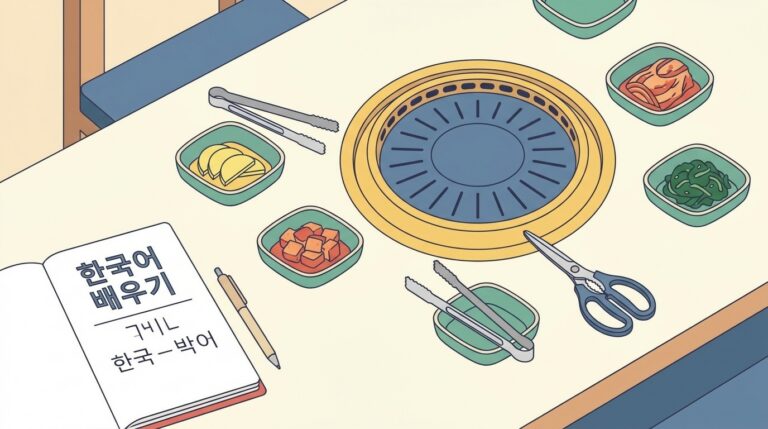
Phase 1: 공감 (Empathetic Opening)
안녕하세요! 매일한글 에디터입니다. (Hello! I’m your Daily Hangul editor.)
Picture this: you are sitting inside a bustling, neon-lit K-BBQ restaurant in the heart of Seoul. The mouthwatering aroma of sizzling pork belly fills the room, and your stomach is growling. The server drops a huge, thick slab of meat right onto the scorching iron grill. You instinctually look around for a knife and fork, but all you see on the table are chopsticks and a spoon! Glancing at the local table next to you, you notice someone effortlessly snipping the juicy meat into bite-sized pieces with a sturdy pair of kitchen scissors while holding it steady with sleek metal tongs. You need those exact tools right now, but your mind goes blank. How do you ask without feeling awkward? Don’t worry! Every Korean learner has frozen at this exact moment. Based on real dining stories from hundreds of beginner travelers, this friendly guide will help you command the grill with zero hesitation!
Phase 2: 핵심 표현 3선 심층 분석 (3 Core Expressions Deep Dive)
1. 가위랑 집게 좀 주세요
- Pronunciation: Gawirang jipge jom juseyo (Sound analogy: “Gaw-wee-rang” like boomerang + “jeep-geh” + “chom” + “joo-say-yo”)
- Meaning: Literal: “Scissors and tongs a little give me please” vs. Real Nuance: “Could we please get scissors and tongs?”
- K-Culture Moment: In food-centric K-dramas like Let’s Eat or Weightlifting Fairy Kim Bok-joo, the ultimate dining veteran always wields scissors and tongs like a culinary conductor before cooking for friends.
- Editor’s Insight: “랑 (rang)” is the cozy, spoken word for “and”. The magic word here is “좀 (jom)”—literally “a little”, but pragmatically functioning like English “please” to soften any command into a sweet request.
- Situation Spectrum:
- Casual: ⚠️ (too polite for your closest sibling)
- Semi-formal: ✅ (ideal for restaurants, bars, and casual spots)
- Formal: ⚠️ (too conversational for official banquet ceremonies)
- 🤔 Think About It: In many Western countries, bringing kitchen scissors to a dinner table might feel unusual. Why do you think Korean dining culture embraces scissors as an essential tool?
2. 반찬 좀 더 주세요
- Pronunciation: Banchan jom deo juseyo (Sound analogy: “Barn-chahn” + “chom” + “duh” without the ‘h’ + “joo-say-yo”)
- Meaning: Literal: “Side dishes a little more give please” vs. Real Nuance: “Could we please have a refill on the side dishes?”
- K-Culture Moment: That heart-warming scene in Korean variety shows where foreign guests are flabbergasted when mountain-high plates of kimchi, pickled radish, and seasoned spinach keep getting refilled for free.
- Editor’s Insight: In Korea, complimentary side dish refills are the norm, not a luxury! Asking for more banchan is perceived as praise: it tells the restaurant owner, “Your cooking is so delicious that I emptied the dish!”
- Situation Spectrum:
- Casual: ⚠️
- Semi-formal: ✅
- Formal: ⚠️
- 🤔 Think About It: How does the custom of providing free, unlimited side dishes reflect Korea’s traditional value of communal sharing and hospitality?
3. 물은 셀프예요?
- Pronunciation: Mureun selpeu-yeyo? (Sound analogy: “Moo-reun” + “sell-peuh-yeh-yo”)
- Meaning: Literal: “As for water, is it self?” vs. Real Nuance: “Is water self-service here?”
- K-Culture Moment: The humble neighborhood K-drama diner where characters naturally walk up to a tall metal water dispenser with small stackable cups instead of waiting for service.
- Editor’s Insight: “셀프 (selpeu)” comes from the English word “self”. When you spot a wall sticker saying “물은 셀프” (Water is self-service), asking this confirms whether you should grab your own cold jug from the refrigerator.
- Situation Spectrum:
- Casual: ⚠️
- Semi-formal: ✅
- Formal: ✅
- 🤔 Think About It: Notice how English loanwords are transformed into compact functional Korean words (like ‘self’ meaning ‘self-service’). Does your native language adapt foreign terms similarly?
Phase 3: 교과서 한국어 vs 진짜 한국어 (Textbook vs. Real Korean)
Situation 1: Asking for utensils at a loud restaurant
- 📖 교과서 한국어 (Textbook Korean): 가위와 집게를 주시겠습니까? (Gawiwa jipgereul jusigesseumnikka?)
- 🗣️ 진짜 한국어 (Real Korean): 저기요, 가위랑 집게 좀 주세요! (Jeogiyo, gawirang jipge jom juseyo!)
- 💡 왜 다를까?: Textbook Korean relies on formal written conjunctions like “와/과 (wa/gwa)” and stiff honorific verb endings. Real diners grab attention with a cheerful “저기요 (Excuse me)” and natural spoken connectors like “랑 (rang)”.
Situation 2: Asking for extra side dishes
- 📖 교과서 한국어 (Textbook Korean): 반찬의 추가 제공을 요청합니다. (Banchaneui chuga jegongeul yocheonghamnida.)
- 🗣️ 진짜 한국어 (Real Korean): 이모님, 김치 리필 좀 해주세요~ (Imo-nim, gimchi ripil jom haejuseyo~)
- 💡 왜 다를까?: Nobody speaks like an administrative document in a diner! Locals address friendly restaurant staff as “이모님 (Imo-nim, Auntie)” and blend the loanword “리필 (refill)” with polite warmth.
Phase 4: K-Culture 딥다이브 & 비언어적 매너 (Deep Dive & Non-Verbal Manners)
4-1. 눈치 (Nunchi) & Gestures
- Look for the Call Button First: Before shouting across the dining room, glance at the corners of your table or the napkin dispenser. If you see a small circular button (벨, call bell), give it one gentle press. A soft “Ding-Dong” will notify the staff!
- Hand Gesture Etiquette: If there’s no bell, look in the staff’s general direction, raise your hand slightly with your palm flat and fingers gathered together, and say “저기요 (Jeogiyo)”. Never snap your fingers, wave both arms frantically, or point your index finger directly at a server.
- Two-Hand Rule: When the staff passes you the sharp scissors and metal tongs, always receive them using both hands—or support your right forearm with your left hand—as a silent sign of respect.
4-2. Culture Code: The Magic of Korean Kitchen Scissors
To foreign travelers, scissors belong in an office desk drawer or an arts-and-crafts kit. But in Korea, the curved stainless steel kitchen shears are a culinary superpower! From snipping chewy Naengmyeon (cold buckwheat noodles) so you don’t choke, to effortlessly dicing thick pork belly and long ribbons of aged kimchi over hot coals, scissors represent Korea’s celebrated “Palli-Palli” (빨리빨리, fast and efficient) dining culture. It eliminates clumsy knife-and-board prep, letting everyone feast communally without delay.
Phase 5: 실전 롤플레이 시나리오 (Real-World Roleplay Scenario)
Setting: A buzzing K-BBQ hotspot near Hongdae Station. Charcoal smoke drifts into the evening air.
Characters: You (a hungry traveler) and Imo Min-ji (a warm, quick-moving restaurant owner).
- Imo Min-ji: 어서 오세요! 몇 분이세요? (Eoseo oseyo! Myeot bun-iseyo?) [🎭 Wiping down a round steel table with practiced speed.]
- You: 두 명이에요! 삼겹살 2인분 주세요. (Du myeong-ieyo! Samgyeopsal i-inbun juseyo.) [🎭 Smiling and showing two fingers.]
- Imo Min-ji: 네, 고기 불판에 올렸어요. 노릇노릇하게 구우세요! (Ne, gogi bulpane ollyeosseoyo. Noreut-noreuthage gu-useyo!) [🎭 Laying down thick pork belly slabs that sizzle loudly.]
- You: 저기요, 가위랑 집게 좀 주세요! (Jeogiyo, gawirang jipge jom juseyo!) [🎭 Raising one hand politely while making eye contact.]
- Imo Min-ji: 아이고, 내가 깜빡했네! 여기 가위랑 집게 있어요. (Aigo, naega kkamppakhaenne! Yeogi gawirang jipge isseoyo.) [🎭 Swiftly handing over the shiny utensils.]
- You: 감사합니다! 혹시 물은 셀프예요? (Gamsahamnida! Hoksi mureun selpeu-yeyo?) [🎭 Receiving the utensils with both hands respectfully.]
- Imo Min-ji: 네, 저기 냉장고에서 물통 가져가시면 돼요! (Ne, jeogi naengjanggo-eseo multong gajyeogasimyeon dwaeyo!) [🎭 Pointing toward a stainless refrigerator with a grin.]
- You: 네, 알겠습니다. 반찬도 맛있어서 더 먹을게요! (Ne, algetseumnida. Banchando masisseoseo deo meogeulgeyo!) [🎭 Nodding happily with a grateful bow.]
🔀 Interactive Decision Branch
What would you do if your meat started smoking, but you still lacked tools?
* Option A: Wave your arms and yell, “야! 가위 빨리 줘! (Ya! Gawi ppalli jwo! – Hey, give scissors fast!)”
– Feedback: Bad. Dropping honorifics (“야”) will shock the staff and instantly sour the room’s atmosphere.
* Option B: Press the table bell or raise your hand calmly and say, “저기요, 가위랑 집게 좀 주세요.”
– Feedback: Best! Natural, respectful, and crystal clear. You will get your tools in seconds.
* Option C: Sit quietly and wait 15 minutes hoping the busy server notices your struggle.
– Feedback: Risk. In dynamic Korean BBQ joints, proactive communication is expected; waiting silently will turn your premium pork into charcoal!
Phase 6: 10초 감정 섀도잉 드릴 (10-Second Emotional Shadowing Drill)
Practice out loud! Pay attention to the rhythm pauses (/) and emotional tone:
[🙋♂️ Polished & Confident]
저기요, / 가위랑 집게 / 좀 주세요! (Jeogiyo, / gawirang jipge / jom juseyo!)-
[😊 Bright & Friendly]
이모님! / 반찬 좀 / 더 주세요~ (Imo-nim! / banchan jom / deo juseyo~) -
[🧐 Inquiring & Courteous]
실례지만, / 물은 / 셀프예요? (Sillyejiman, / mureun / selpeu-yeyo?)
Phase 7: K-Culture 미니 사전 (Mini Dictionary)
- 가위 (Gawi) | Kitchen Scissors | Heavy-duty shears designed for cutting barbecue meat, whole kimchi heads, and chewy noodles.
- 집게 (Jipge) | Tongs | Steel tongs used to grip, turn, and stabilize meats on the hot grill.
- 리필 (Ripil) | Refill | Konglish loanword used universally across casual diners for replenishing side dishes or drinks.
- 셀프 (Selpeu) | Self-service | Signboard term notifying patrons to fetch their own water, aprons, or condiment sauces.
Phase 8: 여행자를 위한 생존 키트 (Traveler’s Survival Kit)
Survival Expressions TOP 3
- 이거 리필 돼요? (Igeo ripil dwaeyo?) – Can I refill this? (Pro Tip: Point directly at your empty banchan dish when saying this.)
- 앞치마 좀 주세요 (Apchima jom juseyo) – Please give me an apron. (Pro Tip: Essential armor before handling popping pork fat or spicy red stews!)
- 불 좀 줄여주세요 (Bul jom juryeojuseyo) – Please lower the flame. (Pro Tip: Use this if your grill gets too hot and charcoal sparks fly.)
Editor’s Travel Note
When hunting for authentic grill spots in Seoul’s back alleys, Google Maps often fails to show walking routes accurately. Make sure to complete your [Naver Map app download for local navigation] beforehand to easily navigate alleyways. Also, keep an eye out for hidden table drawers: silverware and napkins are frequently tucked inside sliding trays directly beneath your tabletop!
Phase 9: “한 발 더 깊이” (Deeper Cultural Reflection)
In Western individualist dining, every patron typically receives their own plated meal, a personal fork, and a personal knife. Korean dining, however, is founded on the spirit of “Jeong (정)”—an unspoken bond of communal affection and sharing. Cutting meat right at the table using scissors and tongs is not merely convenient; it is an act of care. The designated “grill master” slices the meat into easy bites so friends and family can eat comfortably from a shared center. Language mirrors this collective spirit: we say “가위 좀 주세요” with the softening word “좀” to honor mutual consideration.
💬 Your Turn: Have you ever used scissors to eat food back in your home country, or did seeing kitchen scissors at a dining table surprise you on your first Korean food journey? Share your thoughts in the comments!
Phase 10: FAQ & 오해 방지 (FAQ & Common Mistakes)
Q: Is asking for free side dish refills considered greedy in Korea?
A: Absolutely not! Banchan hospitality is deeply rooted in Korean culinary culture. Eating all your side dishes and requesting a refill signals that the food is mouthwatering. Feel completely free to ask!
Q: Can I address any female server as “이모” (Imo)?
A: “이모 (Auntie)” works wonderfully in casual, mom-and-pop taverns and BBQ places. However, in modern franchises, hotel restaurants, or trendy bistros, it is safer to use “저기요 (Jeogiyo, Excuse me)” or “사장님 (Sajang-nim, Boss)” to maintain polite professionalism.
Q: Do I need to pay extra when I ask for tongs or scissors?
A: No, never! All dining utensils, scissors, tongs, wet hand towels, and standard side dish refills are completely free of charge in Korea.
🚨 흔한 실수 (Common Mistakes) 경고판
- Shouting “야! (Ya!)” to call the waitstaff: “Ya” means “Hey!” in casual slang and sounds disrespectful to service workers. Stick to “저기요 (Jeogiyo)”.
- Attempting to cut completely raw meat: Raw pork belly is rubbery and tough. Allow the meat to sear on the hot grill for 1–2 minutes first; once the crust firms up, the scissors will glide through effortlessly.
- Frantically searching for a steak knife: Korean tables do not stock table knives. Scissors are your official knives—embrace them!
Phase 11: 액션 미션 & 참여 유도 (Action Missions)
- Bronze Mission (Solo Practice): Look into a mirror and practice saying: “저기요, 가위랑 집게 좀 주세요!” three times with a bright, friendly smile.
- Silver Mission (Social Share): Snap a photo of your favorite K-food or BBQ meal and share it on Instagram with the hashtag #DailyHangulBBQ and write the Korean phrase you learned today in the caption.
- Gold Mission (Real Life): Visit a Korean restaurant in your area (or in Korea!), skip English, and successfully request extra banchan or utensils in Korean!
- 🎮 K-Culture Mission: Watch an episode of a food-focused K-Drama (like Hospital Playlist or Itaewon Class) and spot the exact second scissors appear on the dining table!
Phase 12: 인터랙티브 퀴즈 챌린지 (Interactive Quiz Challenge)
Test your knowledge with these three practical quick-fire questions:
- Situational Judgment: You want an extra plate of delicious seasoned bean sprouts (Kongnamul). Which sentence should you say?
- A) 김치 버려주세요 (Gimchi beoryeojuseyo)
- B) 반찬 좀 더 주세요 (Banchan jom deo juseyo)
- C) 물은 셀프예요? (Mureun selpeu-yeyo?)
- Fill in the Blank: Complete the utensil request: “가위___ 집게 좀 주세요.” (Hint: the spoken particle for ‘and’)
-
True or False: In Korea, it is considered bad dining etiquette to use scissors to cut food at your table.
👉 Click here to reveal the answers and explanations!
- Answer: B) 반찬 좀 더 주세요 (Banchan jom deo juseyo)
Explanation: Option A asks to throw away kimchi, while Option C asks if water is self-service. - Answer: 랑 (rang)
Explanation: “랑” attaches to nouns ending in vowels like “가위” to mean “and” in casual conversational Korean. - Answer: False
Explanation: Kitchen scissors are an essential, respected culinary tool found on nearly every Korean grill and noodle table!







