

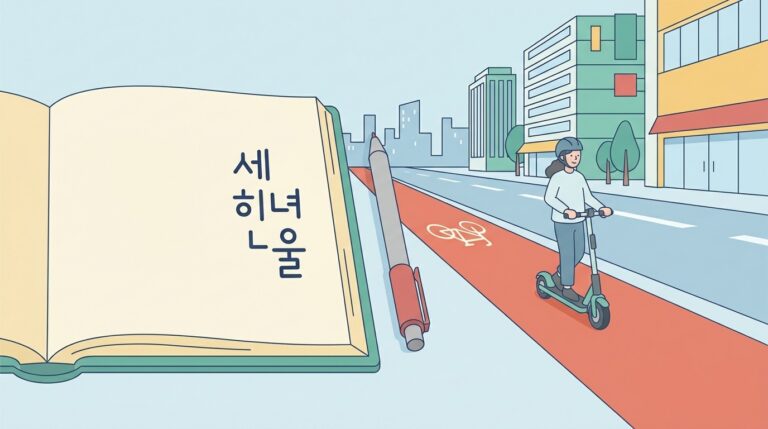
Phase 1: Empathy (Story-Driven Opening)
안녕하세요! 매일한글 에디터입니다. (Hello! I’m your Daily Hangul editor.)
Picture this: You have just finished a steaming bowl of sundubu-jjigae in Mangwon-dong, and you want to catch the sunset along the Han River. You spot a sleek electric scooter parked neatly near a subway station. You unlock it with your app, feel the brisk Seoul breeze against your cheeks, and cruise down a spacious sidewalk. Life feels like a glossy scene straight out of a trendy K-drama—until a walking pedestrian jolts backward, a police whistle rings out, and an elderly local sternly calls out: “인도로 다니면 안 돼요! (Indoro danimyeon an dwaeyo!)”
Instantly, your heart races. Did you do something wrong? Yes, and it is a trap that catches thousands of travelers and expats in Korea every single month. In South Korea, riding an e-scooter on a pedestrian sidewalk is strictly illegal and socially frowned upon. Learning how to express and understand road safety rules like riding only on bike lanes or the far-right edge of the motor road is not just about avoiding a steep 30,000 KRW police fine; it is about respecting Korean community harmony (배려, baeryeo). Today, we will guide you through authentic, real-world Korean expressions so you can glide across Seoul smoothly, safely, and with total cultural confidence!
Phase 2: Core 3 Expressions In-Depth Analysis
1. 인도로 다니면 안 돼요 (Indoro danimyeon an dwaeyo)
- Pronunciation: [In-do-ro da-ni-myeon an dwae-yo] (Sounds like “een-dough-raw dah-nee-myun ahn dway-yo”)
- Meaning: Literal: “If you go by way of the sidewalk, it does not work.” / Natural: “You must not ride on the pedestrian sidewalk.”
- K-Culture Moment: You will hear this in community safety campaigns, YouTube travel vlogs, or from safety marshals patrolling bustling districts like Hongdae or Gangnam.
- Editor’s Insight:
인도(indo) refers specifically to footpaths built for walking humans (보도, bodo). The grammatical form-(으)면 안 돼요is the foundational Korean way to set boundaries or express a prohibition politely without sounding aggressive. - Situation Spectrum: Casual: ⚠️ (with close friends, say
인도로 가면 안 돼) | Semi-formal: ✅ | Formal: ✅ - 🤔 Think About It: In your home country, are sidewalks multi-use or strictly reserved for pedestrians? Notice how Korean divides paths based on vulnerability: walking humans always come first.
2. 자전거 도로로 가야 해요 (Jajeon-geo dororo gaya haeyo)
- Pronunciation: [Ja-jeon-geo do-ro-ro ga-ya hae-yo] (Think: “Jah-jun-guh dough-raw-raw gah-yah hay-yo”)
- Meaning: Literal: “You must go by bicycle road.” / Natural: “You have to ride in the bike lane.”
- K-Culture Moment: Seen frequently on Seoul City public informational reels when discussing personal mobility (PM) guidelines.
- Editor’s Insight: The marker
-로/으로marks direction or method of transit. In Korea, electric scooters fall under the same lane category as bicycles. If there is a designated bike track (often colored reddish-brown or painted with bicycle icons), that is your primary legal haven. - Situation Spectrum: Casual: ⚠️ (use
가야 돼) | Semi-formal: ✅ | Formal: ✅ - 🤔 Think About It: Why does Korean use the obligation ending
-아/어야 해요(must/should) instead of an aggressive command? It balances civic duty with cooperative gentleness.
3. 차도 우측 가장자리로 달리세요 (Chado ucheuk gajangjariro dalliseyo)
- Pronunciation: [Cha-do u-cheuk ga-jang-ja-ri-ro dal-li-se-yo] (Pronounce like “Chah-dough oo-chook gah-jahng-jah-ree-raw dahl-lee-say-yo”)
- Meaning: Literal: “Please run along the right edge of the car road.” / Natural: “Please ride along the far-right edge of the street.”
- K-Culture Moment: What rental app safety pop-ups display before unlocking a scooter in urban hubs.
- Editor’s Insight:
차도means vehicle road,우측is Sino-Korean for the right side, and가장자리is pure Korean for outer border or margin. When there is no bike path, staying along the right margin protects both you and speeding vehicles. - Situation Spectrum: Casual: 🚫 | Semi-formal: ✅ | Formal: ✅
- 🤔 Think About It: Navigating car traffic on a scooter can feel intimidating. How does using specific directional vocabulary like
우측 가장자리give you clear survival parameters in a foreign traffic system?
Phase 3: Textbook Korean vs. Real Korean
Scenario 1: Telling a friend not to use the sidewalk
- 📖 Textbook Korean:
보도에서 전동 킥보드 주행은 법적으로 금지되어 있습니다.(Riding an electric kickboard on the pedestrian pavement is legally prohibited.) - 🗣️ Real Korean:
킥보드는 인도에서 타면 절대 안 돼요!(You really can’t ride kickboards on the sidewalk!) - 💡 Why the Difference? While government pamphlets write
보도(bodo) and주행(juhaeng), real Koreans use인도(indo) and the everyday verb타다(tada, to ride). Adding절대(jeoldae, absolutely/never) reflects how seriously locals view pedestrian safety today.
Scenario 2: Directing someone where to ride when there is no bike lane
- 📖 Textbook Korean:
차도의 최우측 구역을 준수하여 운행하십시오.(Please operate while observing the outermost right zone of the road.) - 🗣️ Real Korean:
차도 맨 오른쪽으로 붙어서 가세요.(Stick right to the far-right side of the road and go.) - 💡 Why the Difference? Native speakers favor vivid spatial prepositions like
맨 오른쪽(the very right) and the verb붙다(to stick closely), making split-second traffic decisions instantly understandable.
Phase 4: K-Culture Deep Dive & Non-Verbal Manners
4-1. 눈치 (Nunchi) & Road Etiquette
In Korea’s dense urban centers, personal mobility requires top-tier nunchi (the art of reading the room and environmental cues).
* Subway Exits: Never zoom past subway exits (출구). Commuters stream out rapidly looking at their smartphones. If you approach an exit, slow down to a pedestrian crawl or dismount.
* The Dismount Rule (끌고 가기): When crossing zebra crossings (횡단보도), Korean law requires riders to step off and push the scooter across on foot. Riding across pedestrian crosswalks will draw sharp glares or police whistles.
* Sound Courtesy: Use your bell only as a gentle last resort. Repeated aggressive bell ringing (따릉따릉) at pedestrians behind their backs is seen as rude. Instead, slow down and wait for an opening.
4-2. The ‘Kik-rani’ Cultural Phenomenon
If you watch Korean variety shows or news, you might hear the satirical buzzword 킥라니 (Kik-rani). It combines kickboard and gorani (고라니, the Korean water deer infamous for darting unexpectedly across country roads). Because careless riders were suddenly leaping into intersections without helmets, Korea dramatically reformed its Road Traffic Act.
Today, you must possess a valid driver’s license (or motorized bicycle license), wear a helmet (헬멧 착용), and avoid sidewalks entirely. Being a considerate scooter rider is now part of being a hip, civic-minded explorer in Korea.
Phase 5: Real-World Roleplay Scenario
Setting: Near Han River Park entrance in Yeouido. You and your Korean classmate, Minjun, are unlocking shared scooters.
- Turn 1 (Minjun): 날씨 진짜 좋다! 한강까지 킥보드 타고 갈래? (Nalssi jinjja jota! Hangang-kkaji kikbodeu tago galle?)
(The weather is so nice! Want to ride kickboards down to the Han River?)
🎭 Unlocking his scooter app with a bright smile - Turn 2 (You): 좋아! 그런데 여기 인도에서 바로 타면 돼? (Joa! Geurende yeogi indo-eseo baro tamyeon dwae?)
(Sounds great! But can we just ride right here on the sidewalk?)
🎭 Pointing at the wide pavement ahead - Turn 3 (Minjun): 앗, 안 돼! 인도로 달리면 절대 안 돼요. (At, an dwae! Indoro dallimyeon jeoldae an dwaeyo.)
(Ah, no! You must never ride on the sidewalk.)
🎭 Gently shaking his head and waving his hand - Turn 4 (You): 아, 진짜? 그럼 우리는 어디로 가야 해? (A, jinjja? Geureom uri-neun eodiro gaya hae?)
(Oh, really? Then where are we supposed to go?)
🎭 Looking around at the street layout curiously - Turn 5 (Minjun): 저기 분홍색 선 보여? 자전거 도로로 가야 해요. (Jeogi bunhongsaek seon boyeo? Jajeon-geo dororo gaya haeyo.)
(See that pink line over there? We have to go via the bicycle lane.)
🎭 Pointing toward the clearly marked bike lane along the curb - Turn 6 (You): 그렇구나! 만약 자전거 도로가 없으면 어떻게 해? (Geureokuna! Manyaek jajeon-geo doroga eopseumyeon eotteoke hae?)
(I see! What if there isn’t a bike path?)
🎭 Fastening helmet strap carefully - Turn 7 (Minjun): 그럴 땐 차도 우측 가장자리로 달려야 해. (Geureol ttaen chado ucheuk gajangjariro dallyeoya hae.)
(In that case, you have to ride along the far-right edge of the road.)
🎭 Guiding his scooter down to the road entrance - Turn 8 (You): 오케이, 안전하게 차도 맨 오른쪽으로 붙어서 가자! (Okei, anjeonhage chado maen oreunjjok-euro buteoseo gaja!)
(Got it, let’s ride safely sticking to the very right of the road!)
🎭 Smiling and pushing off smoothly
🔀 Interactive Choice Point
You arrive at a crowded pedestrian crossing without a bike lane paint mark. What do you do?
* Option A: Ring your bell loudly and weave between pedestrians while riding fast.
* Option B: Step off your scooter and walk it across the crosswalk on foot (끌고 가기).
* Option C: Turn directly into the oncoming car lane to avoid pedestrians.
- Feedback:
- Option A (Risk): ❌ Highly illegal and dangerous! You can be fined, and pedestrians will be rightfully upset.
- Option B (Best): ✅ Perfect! Walking your personal mobility device across intersections aligns with traffic laws and displays peak cultural respect.
- Option C (Bad): ❌ Extremely hazardous! Never ride against oncoming automobile traffic.
Phase 6: 10-Second Emotional Shadowing Drill
Practice these lines out loud with the designated pitch breaks (/) and emotions!
[⚠️ Firm & Protective]
인도로 / 달리면 / 절대 안 돼요!
(Indoro / dallimyeon / jeoldae an dwaeyo!)-
[💡 Informative & Helpful]
자전거 도로가 있으면 / 거기로 가야 해요.
(Jajeon-geo doroga isseumyeon / geogiro gaya haeyo.) -
[🛵 Focused & Calm]
차도에서는 / 맨 오른쪽 가장자리로 / 붙어서 달리세요.
(Chado-eseoneun / maen oreunjjok gajangjariro / buteoseo dalliseyo.)
Phase 7: K-Culture Mini Dictionary
- 킥라니 (Kik-rani) | Noun | A slang compound of “Kickboard” + “Water Deer (Gorani)”, used colloquially to describe reckless scooter riders who leap into traffic.
- 자전거 전용도로 (Jajeon-geo jeonyong-doro) | Noun | Dedicated bike path. When you see this blue sign with a white bicycle, this is the legal path for PM scooters too.
- 끌고 가기 (Kkeulgo gagi) | Phrase/Action | Dismounting and pushing your device by hand. Mandatory on crowded pedestrian crosswalks.
- 따릉이 (Ddareungi) | Noun | Seoul’s beloved public bicycle rental system. Even if you don’t ride electric kickboards, learning bike path rules unlocks fun Ddareungi adventures along the Han River!
Phase 8: Traveler’s Survival Kit
Survival Expressions TOP 3
여기 자전거 도로 있어요?(Yeogi jajeon-geo doro isseoyo? / Is there a bike lane here?)- Pro Tip: Use this when asking locals if the nearby route is scooter-friendly.
잠깐 끌고 갈게요.(Jamkkan kkeulgo galgeyo. / I’ll walk it across for a moment.)- Pro Tip: Say this politely if moving through a congested pedestrian pocket.
헬멧 꼭 써야 해요?(Helmet kkok sseoya haeyo? / Do I really have to wear a helmet?)- Pro Tip: The answer in Korea is always: 네, 필수예요! (Yes, it’s mandatory!).
Editor’s Travel Note
- License Verification: Shared scooter apps (such as Beam, Swing, or Kickgoing) require verification of an official driver’s license or International Driving Permit (IDP). Check your eligibility beforehand.
- Navigation Guide: Standard Google Maps does not provide detailed cycling routes in Korea. Instead, install the Naver Map app on your phone and toggle the “Bicycle” navigation route to find dedicated paths away from busy pedestrian zones.
Phase 9: “한 발 더 깊이” (One Step Deeper)
Korean public infrastructure is built on dense collective harmony. Because millions of people traverse narrow city quarters every hour, footpaths (인도) are treated as sacred sanctuaries for children, elders, and relaxed walkers. When electric scooters entered the scene, society actively chose to prioritize pedestrian peace over rider convenience. Riding on the road edge or bike lane is not a restrictive hassle—it is a conscious act of social care (배려) that earns you reciprocal respect from everyone around you.
💬 Your Turn: How does your city manage shared scooters? Have you ever had a close encounter with one on the sidewalk? Drop your stories in the comments below in English or Korean!
Phase 10: FAQ & Common Mistakes
Q: Can tourists ride electric kickboards on pedestrian sidewalks if they ride very slowly?
A: No. Legally and culturally, speed does not matter. Electric scooters must never be operated on pedestrian sidewalks regardless of your speed, unless the path is explicitly designated as a combined pedestrian-bike lane (보행자·자전거 겸용 도로).
Q: Where should I ride if there is no bike path available?
A: You must ride along the far-right edge (우측 가장자리) of the automobile roadway. Always proceed in the same direction as car traffic—never ride against oncoming cars.
Q: Can two people ride one electric scooter together if they are small?
A: Absolutely not. Tandem riding (2인 탑승) is strictly illegal in South Korea and incurs an immediate 40,000 KRW police fine. Shared mobility devices are designed for one rider only.
🚨 흔한 실수 (Common Mistakes) Checklist
- ❌ Riding across crosswalks: Riding through zebra crossings while mounted is illegal. -> Correct Action: Dismount and walk (
끌고 가기). - ❌ Discarding helmets: Thinking helmets are optional. -> Correct Action: Wear a certified helmet at all times to avoid the 20,000 KRW fine.
- ❌ Leaving scooters blocking station entrances: Parking scooters across tactical paving for the visually impaired or directly in front of subway doors. -> Correct Action: Park neatly by street bike racks or designated white parking boxes.
Phase 11: Action Missions
- 🥉 Bronze Mission: Speak today’s 3 core sentences aloud 5 times in front of the mirror, emphasizing
인도로 달리면 절대 안 돼요! - 🥈 Silver Mission: Open your preferred map app and locate the nearest designated bike lane (
자전거 도로) in a Korean city you want to visit (e.g., Yeouido or Busan Haeundae). - 🥇 Gold Mission: If you are currently in Korea, rent a Ddareungi bike or scooter and practice dismounting before every single crosswalk.
- 🎮 K-Culture Mission: Watch a recent Seoul-based drama or YouTube vlog. Spot how food delivery couriers and scooter riders share the road edge with city buses!
Phase 12: Interactive Quiz Challenge
1. 상황 판단 (Scenario Judgment)
You are riding an e-scooter and the bicycle lane suddenly ends on a busy street. What should you do?
(A) Hop up onto the pedestrian sidewalk and ring your bell continuously.
(B) Ride smoothly along the far-right edge of the car road.
(C) Turn into the center lane next to the city buses.
2. 빈칸 채우기 (Fill in the Blank)
전동 킥보드는 인도에서 타면 ( ) 안 돼요!
(You must never ride electric scooters on the sidewalk!)
Hint: A word meaning “never” or “absolutely”.
3. True or False 문화 퀴즈
In Korea, it is completely legal for two close friends to ride a shared kickboard together if both wear helmets. (True / False)
👉 Click to reveal Quiz Answers & Explanations
- Answer: (B) – When bike paths terminate, you must keep to the far-right edge (
우측 가장자리) of the vehicle street. - Answer: 절대 (jeoldae) – Complete sentence:
전동 킥보드는 인도에서 타면 절대 안 돼요! - Answer: False – Riding tandem (two people on one device) is illegal in Korea and carries a strict fine, regardless of helmet use!







