

안녕하세요! 매일한글 에디터입니다.
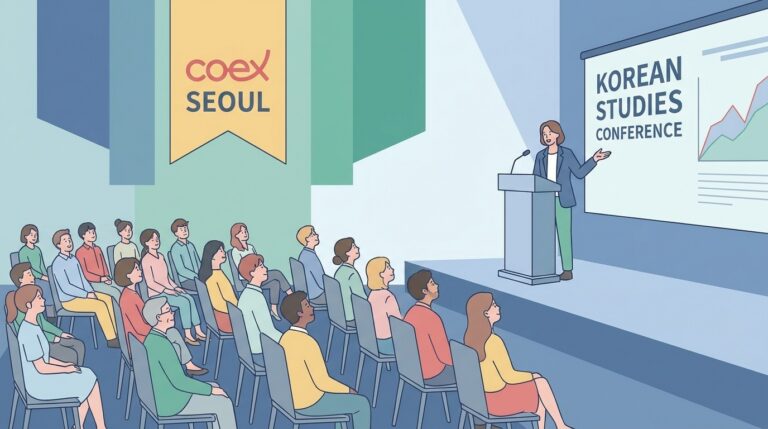
Have you ever stood before a packed conference room at COEX in Gangnam or BEXCO in Busan, slide deck loaded, only to realize that half your audience consists of engineers, another third of sociologists, and the rest venture capitalists or policymakers? You spent weeks polishing rigorous, differential equations, but thirty seconds into your presentation, eyes glaze over, and phones quietly slip out under tables.
I’ve been there—and so have dozens of our C1-level researchers and global executives at Daily Hangul. In high-stakes Korean academic gatherings, stepping up as a keynote speaker or panel moderator isn’t just an exercise in academic gatekeeping; it’s an art of communal synthesis. Korean intellectual forums—much like the beloved intellectual variety show Alssulsinjap (알쓸신잡)—prize the ability to transcend micro-methodologies and cast a compelling, overarching inquiry that invites everyone to the table. Today, drawing on authentic feedback from seasoned international scholars, we’ll master how to pivot gracefully from dense technical jargon to unifying, high-level vision in fluent C1 Korean.
Phase 2: Core Expressions Deep Dive
1. 세부적인 수식보다는 거시적인 화두를 던지고 싶었습니다.
- Pronunciation: Sebujeogin susikbodaneun geosijeogin hwadureul deonjigo sipeotseumnida. (Think: seh-boo-jeok-in soo-sheek-boh-dah-noon guh-she-jeok-in hwah-doo-reul dun-jee-goh she-put-soom-nee-dah)
- Meaning:
- Literal: Rather than detailed formulas, I wanted to throw a macroscopic topic.
- Nuance: “Rather than bogging us down in granular equations, I aimed to pose an overarching philosophical question for our collective inquiry.”
- K-Culture Moment: Evokes the iconic tone of legendary Korean professors on educational broadcasts like EBS Great Minds (위대한 수업), where speakers gracefully steer viewers away from technical weeds toward existential societal impact.
- Editor’s Insight: The word 화두 (hwadu) originated from Seon (Zen) Buddhism, meaning a meditative riddle or core topic. Saying 화두를 던지다 (to cast a topic) frames your talk not as an authoritarian lecture, but as an intellectual gift offered to colleagues.
- Situation Spectrum:
- Casual: 🚫
- Semi-formal: ⚠️
- Formal (Academic/Keynote): ✅
- 🤔 Think About It: In English academic culture, asserting your novel mathematical proof often demonstrates rigor. In Korean academic circles, does framing your work as a humble 화두 (shared contemplation) cultivate a more inclusive intellectual harmony?
2. 학제 간 경계를 넘어 모두가 공감할 수 있는 통찰을 모색해 보고자 합니다.
- Pronunciation: Hakje gan gyeonggyereul neomeo moduga gonggamhal su inneun tongchareul mosaekhae bogoja hamnida. (Rhythm: hak-jeh-gahn gyung-gyeh-reul nuh-muh moh-doo-gah gong-gahm-hahl soo een-noon tong-chah-reul moh-sack-heh boh-goh-jah hahm-nee-dah)
- Meaning:
- Literal: Across interdisciplinary borders, I seek to explore insights that everyone can sympathize with.
- Nuance: “My goal today is to bridge disparate disciplinary divides and extract core insights that resonate across all our respective fields.”
- K-Culture Moment: Think of a climactic presentation scene in K-Dramas like Start-Up or Search: WWW, where the presenter synthesizes tech specs and consumer psychology to captivate an entire boardroom.
- Editor’s Insight: 학제 간 (hakje-gan) means “interdisciplinary,” and 모색하다 (mosaekhada) means to seek or feel out a solution prudently. It exudes seasoned academic maturity without sounding boastful.
- Situation Spectrum:
- Casual: 🚫
- Semi-formal: ⚠️
- Formal (Symposium/Panel Moderation): ✅
- 🤔 Think About It: Notice how Korean keynotes pair 공감 (empathy/resonance) directly with 통찰 (insight). Why do you think emotional resonance is treated as an intellectual metric in Korean presentation culture?
3. 지엽적인 방법론을 넘어 근본적인 질문으로 시야를 넓혀볼까요?
- Pronunciation: Jiyeobjeogin bangbeomnoneul neomeo geunbonjeogin jilmuneuro siyareul neolpyeobolkkayo? (Sound analogy: jee-yup-juh-geen bahng-bum-noh-nool nuh-muh goon-bohn-juh-geen jeel-moo-nuh-roh she-yah-reul null-pyuh-bohl-kkah-yoh)
- Meaning:
- Literal: Shall we broaden our horizon past peripheral methodology to fundamental questions?
- Nuance: “Shall we zoom out from methodological minutiae and broaden our perspective toward fundamental, first-principle questions?”
- K-Culture Moment: Used by savvy panel moderators on serious debate shows like MBC 100-Minute Debate (100분 토론) when panellists get bogged down in petty academic skirmishes.
- Editor’s Insight: 지엽적 (jiyeobjeok) literally translates to “branches and leaves,” metaphorically contrasting the minor details against the massive trunk (뿌리/줄기) of the core issue. Ending with ~볼까요? softens the intervention, maintaining exquisite diplomatic decorum.
- Situation Spectrum:
- Casual: ⚠️
- Semi-formal: ✅
- Formal (Panel Moderation): ✅
- 🤔 Think About It: In your native language, how do moderators interrupt speakers who dive too deep into technical details? Is it direct (“Let’s get back on track”), or does it use soft landscape metaphors like “branches and roots”?
Phase 3: Textbook Korean vs. Real-World Korean
Scenario 1: Transitioning from Technical Data to Audience Takeaways
- 📖 교과서 한국어 (Textbook Korean):
“이제 수식 설명을 마치고 전체적인 결론을 말씀드리겠습니다.”
(Now I will finish explaining the equations and tell you the overall conclusion.) - 🗣️ 진짜 한국어 (Real-World High-Level Korean):
“미시적인 수식 검증보다는, 이 모델이 우리 사회에 시사하는 거시적 함의에 주목해 주셨으면 합니다.”
(Rather than microscopic equation proofs, I invite you to focus on the macroeconomic and philosophical implications this model suggests for our society.) - 💡 왜 다를까? (Cultural Insight):
Textbook Korean uses blunt structural markers (수식 설명을 마치고). Elite Korean conference delivery utilizes polished dichotomy pairings like 미시적 (microscopic) vs. 거시적 (macroscopic) and invites the audience (주목해 주셨으면 합니다) with deferential elegance.
Scenario 2: Refocusing an Overly Technical Panelist
- 📖 교과서 한국어 (Textbook Korean):
“시간이 없으니 복잡한 설명은 그만하시고 핵심만 말해주세요.”
(We don’t have time, so stop complex explanations and just speak the core point.) - 🗣️ 진짜 한국어 (Real-World High-Level Korean):
“박사님의 정밀한 데이터 분석은 자료집을 참고하도록 하고, 플로어의 다양한 연구자분들을 위해 큰 틀에서의 시사점을 짚어주실 수 있을까요?”
(Let us refer to the proceedings for the doctor’s precise data analysis, and could you highlight the implications within the bigger picture for the diverse researchers on the floor?) - 💡 왜 다를까? (Cultural Insight):
Telling a senior Korean scholar to cut their speech short directly causes a severe loss of 체면 (face). Praising their data as “precise” while deferring details to the printed proceedings protects their dignity while steering the discourse back to the audience.
Phase 4: K-Culture Deep Dive & Non-Verbal Etiquette
4-1. 눈치 (Nunchi), Gazes, and Open Gestures on Stage
When delivering a high-level keynote or moderating in Korea, physical demeanor establishes your intellectual ethos before you utter a single syllable:
* The Open Two-Hand Invitation (열린 두 손): Never point a laser pointer or single finger at the screen when discussing big ideas. Keep your palms slightly turned upward at waist-to-chest level when articulating overarching questions. This signals openness (개방성) and collective deliberation.
* The 45-Degree Nodule Gaze (경청의 시선): When moderating, keep your eyes on the speaker for the first 30 seconds, then subtly scan the audience to gauge their 눈치 (nunchi – the room’s energy vibe). If you notice furrowed brows or glazed looks, gently adjust your body posture forward to signal that a transition is impending.
* The Deferential Pause (여운의 침묵): In Korean intellectual oratory, jumping straight into slides is viewed as unrefined. Take the podium, adjust the microphone smoothly with both hands, bow respectfully at 15 degrees, pause for two full seconds, look out at the balcony, and deliver your opening 화두.
4-2. Cultural Code: The Alssulsinjap (알쓸신잡) Effect & Academic Humility
South Korea loves shows like Alssulsinjap—where an astrophysicist, a novelist, an architect, and a brain scientist dine together and discuss a single temple or historical event. The gold standard of intellectual prestige in contemporary Korea is not exhibiting impenetrable disciplinary jargon (전문 용어 남발); it is the ability to interpret complex phenomena in accessible metaphors that kindle interdisciplinary curiosity. Furthermore, Korean academic culture values 겸양의 미덕 (the virtue of modesty): framing your findings as “one small perspective to add to our ongoing conversation” builds immediate trust and warmth across all generations of scholars.
Phase 5: Real-World Roleplay Scenario
Setting: The Grand Ballroom at COEX, Seoul. The annual Global Convergent Science Summit. You are serving as the Moderator for a panel featuring Dr. Han (한 박사), an AI biostatistician who has spent the last eight minutes detailing esoteric gradient-descent optimization formulas, causing the social scientists in the hall to drift away.
Characters:
* Moderator (You): The poised, interdisciplinary conference chair.
* Dr. Han (한 박사): A brilliant but hyper-specialized senior researcher.
- Dr. Han: “여기 보시는 4번 수식의 세부 파라미터 최적화 가중치를 보시면, 손실 함수가 0.003% 수렴하는 것을 알 수 있습니다…”
(Yeogi bosineun 4-beon susigui sebu paramiteo choejeokhwa gajungchireul bosimyeon, sonsil hamsuga 0.003% su-ryeomhaneun geoseul al su itseumnida…)
“If you examine the fine-grained parameter optimization weights in formula 4, you can see the loss function converging at 0.003%…”
(🎭 Dr. Han clicks through dense slide after dense slide, peering closely over his glasses.) -
Moderator (You): “한 박사님, 알고리즘의 정밀성을 입증하는 대단히 흥미로운 수치입니다.”
(Han baksanim, algorijeumui jeongmilseongeul ipjeunghaneun daedanhi heungmiroun suchi-imnida.)
“Dr. Han, that is a profoundly intriguing figure proving the extreme precision of your algorithm.”
(🎭 You raise your right hand slightly, palm open, nodding with warm admiration.) -
Dr. Han: “아, 네, 이 알고리즘을 구축하느라 꼬박 3년이 걸렸거든요. 수식 5번부터 8번도 설명드리자면…”
(A, ne, i algorijeumeul guchukhaneura kkobak 3-nyeoni geollyeotgeodeunyo. Susik 5-beonbuteo 8-beondo seolmyeongdeurijamyeon…)
“Ah, yes, it took three solid years to build this algorithm. If I may explain formulas 5 through 8 as well…”
(🎭 He clicks eagerly toward another slide packed with tiny Greek symbols.) -
Moderator (You): “기술적인 증명 과정은 배부된 프로시딩스(자료집)를 통해서도 동료 연구자분들이 깊이 감탄하며 확인할 수 있을 것 같습니다.”
(Gisuljeogin jeungmyeong gwajeongeun baebudoen peurosidingseu[jaryojip]reul tonghaeseodo dongnyo yeongujabundeuri gipi gamtanhamyeo hwagakhal su isseul geot gatseumnida.)
“I believe our fellow researchers will be able to verify and deeply admire the technical proof process in the distributed conference proceedings.”
(🎭 Gently shifting your gaze to include the entire room, speaking in a calm, melodic tone.) -
Dr. Han: “그렇습니까? 학술지 게재 전이라 구체적으로 짚고 싶었습니다만…”
(Geureoseumnikka? Haksulji gaejae jeon-ira guchejeogeuro jipgo sipeotseumnidaman…)
“Is that so? Since it’s prior to journal publication, I wished to address it in detail…”
(🎭 Dr. Han pauses, adjusting his collar, realizing the room is looking at him expectant of broader context.) -
Moderator (You): “네, 그래서 오늘은 세부 수식을 넘어, 이 모델이 가져올 학제 간 파급 효과라는 거시적 화두를 던져주시면 어떨까요?”
(Ne, geuraeseo oneureun sebu susigeul neomeo, i moderi gajyeool hakje gan pageup hyogwaraneun geosijeok hwadureul deonjyeojusimyeon eotteolkkayo?)
“Indeed; therefore today, rather than diving into micro equations, how about offering an overarching question on the interdisciplinary ripple effects this model will usher in?”
(🎭 You offer an inviting smile while sweeping your hand across the audience.) -
Dr. Han: “거시적 화두라… 듣고 보니, 이 기술이 인간의 윤리적 의사결정을 어떻게 보완할지가 진짜 본질적인 질문이겠군요.”
(Geosijeok hwadura… Deutgo boni, i gisuri inganui yunrijeok uisagyeoljeongeul eotteoke bowanhaljiga jinjja bonjiljeogin jilmuni-getgunyo.)
“An overarching topic… Now that you mention it, how this technology will complement human ethical decision-making is indeed the truly essential question.”
(🎭 Dr. Han brightens up, puts the clicker down on the lectern, and looks directly into the audience’s eyes.) -
Moderator (You): “바로 그 지점입니다. 청중 모두가 함께 고민해볼 아주 뜻깊은 통찰의 출발점이 될 것 같습니다.”
(Baro geu jijeomimnida. Cheongjung moduga hamkke gominhaebol aju tteutgip-eun tongcharui chulbaljeomi doel geot gatseumnida.)
“Precisely that point. That will be a deeply meaningful springboard of insight for every member of this audience to reflect upon together.”
(🎭 You nod approvingly and gesture to the floor, sparking murmured applause and eager note-taking.)
🔀 Interactive Decision Point
Suppose Dr. Han seems visibly reluctant to abandon his equation slides. How do you respond as moderator?
- Option A: “박사님, 발표 시간이 초과되었으니 수식 설명은 즉시 중단하시고 요약본으로 넘어가 주세요.”
- Option B: “방대한 수식 뒤에 숨겨진 ‘인류를 위한 한 문장의 메시지’가 무엇인지, 모든 청중이 가장 궁금해하고 있는 순간입니다.”
- Option C: “다른 전공자분들은 수식을 이해하기 어려우니, 그 부분은 건너뛰고 쉬운 이야기로 해주시죠.”
Feedback on Choices:
* Option A (Bad): Far too abrupt. In Korean academic settings, ordering a senior professor to stop immediately will publicly embarrass him, creating instant freeze in the room’s atmosphere.
* Option B (Best): Brilliant! You frame his technical work not as useless, but as harboring a profound, anticipated treasure (“one-sentence message for humanity”). It appeals to his intellectual pride while pulling the discourse to a macroscopic level.
* Option C (Risk): High risk. While pragmatic, telling the speaker that “others can’t understand formulas” subtly belittles the audience’s intellect and paints the speaker as inconsiderate. Keep it focused on the breadth of impact, not audience deficiency.
Phase 6: 10-Second Emotion Shadowing Drill
Practice these lines using the pacing slashes (/) for breath pauses and emotional guidance tags:
- [🎯 명료하고 지적인 어조로 – Crisp & Intellectual]
“세부적인 수식보다는 / 다양한 전공의 청중 모두가 공감할 수 있는 / 거시적 통찰을 제시하고자 합니다.”
(Sebujeogin susikbodaneun / dayanghan jeongongui cheongjung moduga gonggamhal su inneun / geosijeok tongchareul jesihagoja hamnida.) -
[🤝 온화하고 포용적인 미소로 – Warm & Inclusive Harmony]
“개별 기술의 완성도를 넘어, / 우리 사회 전체가 함께 고민해야 할 / 시대적 화두를 / 던져보고 싶습니다.”
(Gaebyeol gisurui wanseongdoreul neomeo, / uri sahoe jeonchega hamkke gominhaeya hal / sidajeok hwadureul / deonjyeobogo sipeotseumnida.) -
[⚖️ 균형 잡힌 좌장의 카리스마로 – Balanced Moderator Charisma]
“지엽적인 방법론적 논쟁을 잠시 내려놓고, / 이번 연구가 학제 간 협력에 미칠 파급력에 / 초점을 맞춰볼까요?”
(Jiyeobjeogin bangbeomnonjeok nonjaengeul jamsi naeryeonoko, / ibeon yeonguga hakje gan hyeomnyeoge michil pageumnyeoge / chojeomeul matchwobolkkayo?)
Phase 7: K-Culture Mini Dictionary
-
화두 (Hwadu)
- Translation: Central Overarching Theme / Contemplative Question
- Usage: Extensively used in keynotes, political speeches, and corporate summits (“새로운 시대의 화두를 던지다” – to pose a core question for a new era).
- 학제 간 (Hakje-gan)
- Translation: Interdisciplinary
- Usage: Essential for grants, symposiums, and keynote abstracts (“학제 간 융합 연구” – interdisciplinary convergent research).
- 지엽적이다 (Jiyeobjeogida)
- Translation: Peripheral / Minor / Getting bogged down in trivia
- Usage: Often used constructively in debates to steer away from rabbit holes (“지엽적인 논쟁을 지양하고…” – Refraining from peripheral debates…).
- 통찰 (Tongchal)
- Translation: Penetrating Insight / Vision
- Usage: Highly regarded in Korean academic and corporate boardrooms, often paired with deep foresight (“거시적 통찰” – macroscopic insight).
Phase 8: Presenter & Traveler Survival Kit
Top 3 Academic Survival Phrases
- “마이크 음량과 슬라이드 화면 상태는 양호한가요?”
(Maikeu eumryanggwa seullaideu hwamyeon sangtaeneun yanghohangayo?)
Pro Tip: Ask the A/V staff this before your session begins. It sounds professional and respectful. - “질의응답은 시간 관계상 세 분의 질문을 먼저 모아서 받아보겠습니다.”
(Jirui-eungdabeun sigan gwangyesang se bunui jilmuneul meonje moaseo badabogesseumnida.)
Pro Tip: A classic Korean moderator move when short on time—batching questions protects the schedule gracefully. - “심도 있는 발표를 준비해 주신 연사분께 따뜻한 격려의 박수를 부탁드립니다.”
(Simdo inneun balpyoreul junbihae jusin yeonsabunkke ttatteuthan gyeongnyeoui baksureul butakdeurimnida.)
Pro Tip: Perfect closing line for a panel session that guarantees a warm audience round of applause.
Editor’s Travel Note
- Conference Navigation in Seoul: If you are speaking at COEX (Samseong-dong), navigate its massive subterranean labyrinth by utilizing 네이버 지도 앱 다운로드. Set your destination to “COEX Conference Room E” or “Auditorium” rather than just “COEX” to save 20 minutes of frantic hallway walking.
- Post-Session Networking (회식 Etiquette): Academic dinners in Korea often follow keynotes. When clinking glasses (건배) with older senior professors, subtly lower the rim of your glass beneath theirs and turn your head slightly to the side when taking a sip. It silently demonstrates impeccable cultural 눈치.
Phase 9: A Step Deeper (한 발 더 깊이)
In many Western academic arenas, intellectual vitality is demonstrated through rigorous, point-by-point cross-examination, where intellectual friction is welcomed as the mother of truth. In Korea, however, a premier symposium is traditionally viewed as an orchestra of convergent harmony. Presenters who win the highest esteem are rarely those who aggressively demolish counterarguments with barrage calculations; rather, they are the holistic visionaries who find the common philosophical denominator uniting diverse disciplines. Language, here, is not just a tool for logical verification, but a social adhesive that establishes collective solidarity (공감대 형성).
💬 Your Turn: Have you ever sat through a keynote that felt completely unapproachable? What metaphor would you use in Korean to reframe that topic into an inspiring, shared question? Leave your creative thought below!
Phase 10: FAQ & Avoiding Misunderstandings
Q: Can I use “화두 (Hwadu)” in informal casual conversation with Korean friends?
A: Rarely. Saying “오늘 저녁 메뉴에 대한 화두를 던져볼게” (I shall cast a contemplative inquiry regarding tonight’s dinner) sounds playfully theatrical or mock-serious. Keep 화두 for study groups, academic forums, essays, and career-related discussions.
Q: What is the polite way for a moderator to cut off a long-winded question from the floor?
A: Avoid saying “말씀을 짧게 해주세요” (Make your words short). Instead, use the inclusive synthesizer phrase: “귀한 의견 감사드립니다. 연사분의 답변 시간을 확보하기 위해, 핵심 질문을 중심으로 압축해 주시면 감사하겠습니다.” (Thank you for your valuable insight. To ensure adequate time for our speaker’s response, we would be grateful if you could distill the core question.)
Q: Is it rude to skip the derivation of my mathematical models on my slides in Korea?
A: Not at all! In fact, Korean audiences across multi-disciplinary venues appreciate it when you say: “세부 수식 증명은 논문 본문에 상술되어 있으니, 이 자리에서는 그 결과가 지니는 산업적·사회적 시사점에 집중하겠습니다.” (The detailed derivations are specified in the paper text, so on this stage, I will concentrate on the industrial and societal implications of the findings.)
🚨 흔한 실수 (Common Mistakes) 경고판
- Mistake: Using “수식 같은 건 몰라도 됩니다” (You don’t need to know things like equations).
- Risk: Condescending! It inadvertently insults the audience’s aptitude.
- Correct Action: Say “수식의 수학적 엄밀함을 넘어…” (Going beyond the mathematical rigor of the formulas…).
- Mistake: Calling someone’s question “지엽적인 질문” to their face.
- Risk: Highly confrontational. 지엽적 should describe general methodology, never an individual person’s sincere question.
- Correct Action: Say “매우 구체적이고 정밀한 지적을 해주셨습니다만…” (You have raised an exceedingly specific and precise point, however…).
- Mistake: Starting a keynote with blunt English directness like “오늘 발표는 A, B, C 세 부분입니다.”
- Risk: Dry and mechanical.
- Correct Action: Open with your motivation and philosophical overarching theme (“오늘 이 자리에 선 것은, 급변하는 기술 혁신 속에서 우리가 잊지 말아야 할 근본적인 질문을 나누기 위함입니다”).
Phase 11: Action Mission & Engagement
- 🥉 Bronze Mission (Solo Drill): Record a voice memo of yourself speaking Expression #1 (“세부적인 수식보다는 거시적인 화두를 던지고 싶었습니다”) with natural pauses, taking 5 seconds to deliver it smoothly.
- 🥈 Silver Mission (Community Share): Summarize your current thesis, work project, or favorite hobby in one C1 Korean sentence using the word 화두 or 통찰, and post it on your study feed or in the comments.
- 🥇 Gold Mission (Live Action): In your next meeting, seminar, or class, politely redirect an over-detailed tangent by using: “그 부분에 대한 정밀한 분석도 유의미하지만, 거시적인 관점에서 시야를 넓혀보는 건 어떨까요?”
- 🎮 K-Culture Mission: Watch an episode of an intellectual Korean YouTube channel (like EBS 컬처 or 삼프로TV). Count how many times speakers transition between micro-events (미시적) and macro-trends (거시적).
Phase 12: Interactive Quiz Challenge
Test your situational mastery and cultural intuition below!
- [Situational Judgement] You are moderating a heated debate where two scholars are fiercely arguing over a microscopic coding variable. Which phrase best de-escalates the tension while uplifting the room?
- (A) “싸우지 마시고 제 말에 집중해 주시기 바랍니다.”
- (B) “두 분의 정밀한 방법론적 치열함에 감사드리며, 이제 이 논쟁이 지닌 거시적인 사회적 함의로 논의를 확장해 볼까요?”
- (C) “코딩 디테일은 중요하지 않으니 그만 말씀해 주세요.”
- [Fill-in-the-Blank] Complete the keynote transition sentence:
- “이번 발표에서는 기술적인 세부 사항에 매몰되기보다는, 학제 간 경계를 허무는 새로운 ________(을/를) 모색해 보고자 합니다.”
- Options: ① 간식 ② 통찰 ③ 수식 ④ 비난
- [True / False Cultural Check] In Korean keynote culture, spending 20 minutes explaining every line of mathematical formulas proves you are humble and respectful of the audience’s time.
- (True / False)
🔍 Click to reveal answers & explanations!
- Question 1 Answer: (B)
Explanation: Option (B) honors both speakers’ passion as “methodological rigor” (방법론적 치열함) while gracefully orchestrating an intellectual pivot to overarching implications (거시적인 사회적 함의). Options (A) and (C) are patronizing and dismissive. - Question 2 Answer: ② 통찰 (Tongchal)
Explanation: 통찰 (Insight/Deep vision) fits seamlessly into the high-register phrasing of seeking interdisciplinary breakthroughs. (간식 = snack, 수식 = formula, 비난 = criticism). - Question 3 Answer: False
Explanation: Trapping a multidisciplinary audience in granular formulas often signals a lack of 배려 (consideration) for the listeners’ diverse backgrounds. The most respected keynotes illuminate macroscopic vision that inspires everyone in attendance!






