

Inside Korea’s High-Tech Eye Clinics: How to Talk About Pre-Op DNA Tests Like a Local
Phase 1: Empathy & Storytelling Opening
안녕하세요! 매일한글 에디터입니다. (Hello! I’m your Daily Hangul editor.)
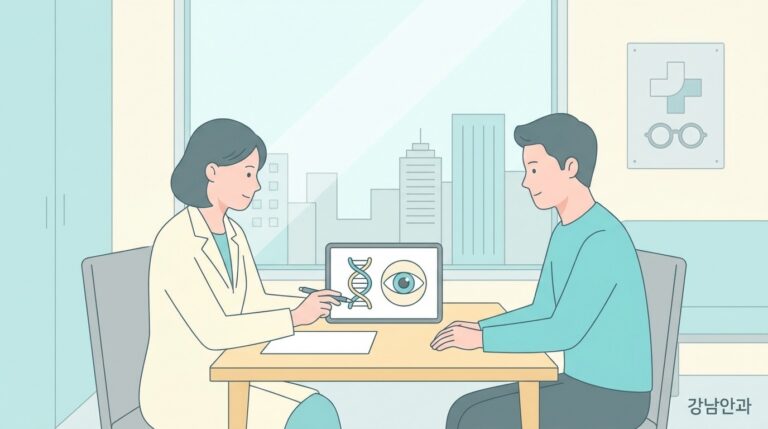
Imagine stepping out of Exit 10 at Gangnam Station into a gleaming world of glass towers. You’ve finally booked an appointment at one of Seoul’s world-renowned eye centers for SMILE LASIK. You expect the usual vision charts, bright lens flashes, and that familiar puff-of-air glaucoma check. But then, an eye coordinator in crisp scrubs leads you into a private consultation suite, pulls out a sterile cotton swab, and gently asks you to open your mouth for a cheek-swab DNA test.
Your heart skips a beat. Wait… a DNA test for laser eye surgery? Did I misunderstand something? Is there an emergency with my genes?
Don’t worry! In South Korea, pre-op examinations are famous for their uncompromising, hyper-meticulous safety standards. Korean ophthalmic clinics routinely run genetic screenings—specifically targeting Avellino corneal dystrophy (아벨리노 각막이상증)—because operating on a carrier of this gene can trigger severe corneal clouding and permanent vision loss. Far from being a red flag, this oral swab is proof of cutting-edge preventative medicine.
Today, we’re unpacking the intermediate (B2) Korean medical vocabulary, polite patient etiquette, and authentic clinic phrases you need to navigate these comprehensive pre-op tests with complete confidence.
Phase 2: Core Expressions Deep Dive
1. 유전성 각막 이상증 검사를 진행할게요. (Yujeonseong gakmak isangjeung geomsa-reul jinhaenghalgeyo.)
- Pronunciation: Yoo-jeon-seong gahk-mahk ee-sahng-jeung gehm-sah-reul jeen-haeng-hahl-geh-yo (Think of “yoo” like “you”, “jeon” rhyming with “dawn”, and “gak” like the start of “goggle”).
- Meaning: Literal: “We will proceed with the hereditary corneal dystrophy test.” | Real Nuance: “We’re going to administer the standard genetic safety screening for your cornea.”
- K-Culture Moment: You’ll frequently hear this exact phrasing in Gangnam eye clinic consultation vlogs on YouTube when coordinators transition from basic visual acuity tests to advanced bio-screening.
- Editor’s Insight: The verb 진행하다 (jinhaenghada, to proceed/conduct) combined with the soft polite future ending -(으)ㄹ게요 creates a professional, reassuring bedside manner in medical settings.
- Situation Spectrum: Casual 🚫 | Semi-formal ✅ | Formal ✅
- 🤔 Think About It: In many Western clinics, genetic swab testing isn’t standard routine unless there’s family history. Why do Korean clinics prefer preemptive, standardized genetic screening for everyone before elective eye procedures?
2. 구강 상피세포 검사로 안전성을 검증했어요. (Gugang sangpise-po geomsaro anjeonseong-eul geomjeunghaesseoyo.)
- Pronunciation: Goo-gahng sahng-pee-seh-po geom-sah-ro ahn-jeon-seong-eul geom-jeung-haess-eo-yo.
- Meaning: Literal: “We verified safety via an oral epithelial cell test.” | Real Nuance: “We double-checked your surgical safety with a quick inner-cheek swab test.”
- K-Culture Moment: A doctor delivering test results right before scheduling the laser procedure in a Korean medical drama or documentary.
- Editor’s Insight: Notice the marker -로 (-ro, via / by means of). In intermediate Korean, pairing technical nouns like 구강 상피세포 (buccal mucosa/oral epithelial cells) with 검증하다 (geomjeunghada, to verify/validate) proves you have command over formal diagnostic vocabulary.
- Situation Spectrum: Casual ⚠️ | Semi-formal ✅ | Formal ✅
- 🤔 Think About It: How does utilizing Sino-Korean terms (구강 instead of 입, 상피세포 instead of 볼 안쪽 살) instantly shift the authority and precision of medical discussions in Korean?
3. 부작용이나 재수술 가능성에 대해 짚고 넘어가고 싶어요. (Bujagyong-ina jaesusul ganeungseong-e daehae jipgo neomeogago sipeoyo.)
- Pronunciation: Boo-jahk-yong-ee-nah jae-soo-sool gah-neung-seong-eh dae-hae jeep-go nuh-muh-gah-go sheep-uh-yo.
- Meaning: Literal: “I want to point out and move past potential side effects or re-operation possibility.” | Real Nuance: “I’d like to thoroughly address potential complications and re-treatment rates before we proceed.”
- K-Culture Moment: Discerning patients in Korea using assertive, respectful language during one-on-one doctor evaluations to ensure complete clarity before signing consents.
- Editor’s Insight: 짚고 넘어가다 (jipgo neomeogada) is an indispensable B2 idiomatic verb phrase meaning “to thoroughly address, clarify, and inspect a matter without glossing over it.”
- Situation Spectrum: Casual ⚠️ | Semi-formal ✅ | Formal ✅
- 🤔 Think About It: When advocating for your health in another language, how does using an idiom like 짚고 넘어가다 sound significantly more natural and thoughtful than a blunt “Explain the risks”?
Phase 3: Textbook Korean vs. Real Korean
Scenario 1: Inquiring if the DNA test is mandatory
- 📖 교과서 한국어 (Textbook): 이 유전자 검사는 꼭 해야 합니까? (I yujeonja geomsa-neun kkok haeya hamnikka? – Must I do this genetic test?)
- 🗣️ 진짜 한국어 (Real Korean): 혹시 아벨리노 검사는 필수 검사항목에 포함되어 있나요? (Hoksi Abellino geomsa-neun pilsu geomsa-hangmog-e pohamdoe-eo innayo? – By any chance, is the Avellino test included as a mandatory part of the checkup?)
- 💡 왜 다를까? (Why is it different?): Starting with 혹시 (hoksi, by any chance) softens directness, while terms like 필수 검사항목 (mandatory test item) sound polished and medically articulate rather than skeptical.
Scenario 2: Confirming normal test results
- 📖 교과서 한국어 (Textbook): 결과가 다 괜찮습니까? (Gyeolgwaga da gwaenchansseumnikka? – Are all results okay?)
- 🗣️ 진짜 한국어 (Real Korean): 검사 결과에서 특별한 이상 소견은 전혀 없는 거죠? (Geomsa gyeolgwa-eseo teukbyeolhan isang sogyeon-eun jeonhyeo eomneun geojyo? – There are no abnormal diagnostic findings at all in the test results, right?)
- 💡 왜 다를까? (Why is it different?): Native speakers use 이상 소견 (abnormal diagnostic findings) rather than generic words like 문제 (problem), and end with -는 거죠? (-neun geojyo?) to invite mutual affirmation.
Phase 4: K-Culture Deep Dive & Non-Verbal Manners
4-1. 눈치 (Nunchi) & Clinic Body Language
- Swab Etiquette: When the medical assistant approaches with the sterile cotton tip, gently tilt your chin up, open your mouth wide, and keep your gaze steady. Avoid flinching backwards or speaking while the swab touches the inside of your cheek. A light nod before and after says, “Thank you for being meticulous with my safety.”
- Doctor Consultation Posture: When discussing test charts with the ophthalmologist (원장님, wonjangnim), sit upright with both hands resting politely on your lap or the edge of the desk. When receiving physical test results or digital tablet summaries, hold the sheet or screen with both hands as a token of mutual respect.
4-2. Cultural Code: The Paradox of “빨리빨리” and “철저한 안전”
Korea is famed for “Ppalli-Ppalli” (hurry, hurry) efficiency—you can undergo more than 50 eye diagnostic tests within 90 minutes. However, this velocity is anchored by absolute hyper-thoroughness (철저함, cheoljeoham). A cheek-swab DNA test for Avellino dystrophy takes less than 2 hours to process via on-site PCR units in Gangnam clinics. Patients demand speed, but will instantly walk out if a clinic cuts corners on safety. Embracing both extremes is the secret behind Korea’s medical tourism boom!
Phase 5: Real Roleplay Scenario
Setting: Consultation Room 3 at a specialized eye clinic in Gangnam, Seoul.
Characters:
* 민 실장 (Coordinator Min): A sharp, empathetic senior medical coordinator.
* 크리스 (Chris): An intermediate Korean learner preparing for SMILE LASIK.
— Dialogue Start —
Turn 1
* 민 실장: 크리스 님, 기본 시력 검사랑 각막 두께 측정이 아주 순조롭게 끝났어요. (Keuriseu nim, gibon siryeok geomsarang gakmak dukke cheukjeong-i aju sunjoropge kkeutnasseoyo.)
* [English]: Chris, your baseline visual acuity and corneal thickness measurements went very smoothly.
* 🎭 행동 지문: [검사 결과 차트를 모니터에 띄우며 친절하게 미소 짓는다.]
Turn 2
* 크리스: 다행이네요! 그런데 혹시 아벨리노 검사는 필수 검사항목인가요? (Dahaeng-ineyo! Geureonde hoksi Abellino geomsa-neun pilsu geomsa-hangmog-ingayo?)
* [English]: What a relief! But by any chance, is the Avellino test included as a mandatory part of the checkup?
* 🎭 행동 지문: [자료를 주의 깊게 바라보며 차분한 어조로 질문한다.]
Turn 3
* 민 실장: 네, 맞아요. 유전성 각막 이상증 유무를 확인하지 않고 수술하면 실명 위험이 있어서 무조건 필수예요. (Ne, majayo. Yujeonseong gakmak isangjeung yumu-reul hwaginhaji anko susulhamyeon silmyeong wiheom-i isseoseo mujogeon pilsu-yeyo.)
* [English]: Yes, exactly. If surgery is performed without checking for hereditary corneal dystrophy, there is a risk of vision loss, so it’s strictly mandatory.
* 🎭 행동 지문: [멸균 면봉 키트를 꺼내 테이블 위에 조심스레 올려놓는다.]
Turn 4
* 크리스: 그렇군요. 그럼 이 검사는 피를 뽑지 않고 구강 상피세포로 진행하는 건가요? (Geureokunyo. Geureom i geomsa-neun pireul ppopji anko gugang sangpise-poro jinhaenghaneun geongayo?)
* [English]: I see. Then is this test done with oral epithelial cells without drawing blood?
* 🎭 행동 지문: [면봉을 쳐다보며 고개를 끄덕인다.]
Turn 5
* 민 실장: 네! 입안 볼 안쪽을 면봉으로 가볍게 긁어서 DNA를 채취할게요. 아프지 않으니 편하게 아- 해보세요. (Ne! Iban bol anjjog-eul myeonbong-euro gabyeopge geulgeoseo DNA-reul chaechwihalgeyo. Apeuji aneuni pyeonhage a- haeboseyo.)
* [English]: Yes! We’ll lightly swab the inside of your cheek to collect DNA. It doesn’t hurt at all, so just open comfortably and say ‘ah’.
* 🎭 행동 지문: [손소독제를 바른 뒤 조심스럽게 면봉으로 볼 안쪽을 채취한다.]
Turn 6
* 크리스: 생각보다 정말 간단하네요! 결과는 당일에 바로 확인할 수 있나요? (Saenggakboda jeongmal gandanhaniyo! Gyeolgwa-neun dang-ir-e baro hwaginhal su innayo?)
* [English]: That was much simpler than I thought! Can we check the results on the same day?
* 🎭 행동 지문: [입을 다물고 안도하며 묻는다.]
Turn 7
* 민 실장: 네, 원내 유전자 분석실에서 두 시간 안에 완료돼요. 이상 소견이 없어야 최종 원장님 진료가 가능합니다. (Ne, wonnae yujeonja bunseoksil-eseo du sigan ane wanryodwaeyo. Isang sogyeon-i eopseoya choejong wonjangnim jinryoga ganeunghamnida.)
* [English]: Yes, it’s processed in our on-site lab within two hours. You can only have the final doctor consultation once we confirm there are no abnormal findings.
* 🎭 행동 지문: [채취한 샘플 튜브 뚜껑을 닫으며 라벨을 붙인다.]
Turn 8
* 크리스: 철저하게 안전성을 검증해 주시니 마음이 놓이네요. 원장님 뵐 때 부작용 가능성에 대해서도 꼭 짚고 넘어가고 싶어요. (Cheoljeohage anjeonseong-eul geomjeunghae jusini maeumi no-ineyo. Wonjangnim boel ttae bujagyong ganeungseong-e daehaeseodo kkok jipgo neomeogago sipeoyo.)
* [English]: It gives me peace of mind that you verify safety so thoroughly. When I see the head doctor, I also want to thoroughly address potential side effects.
* 🎭 행동 지문: [두 손을 모아 가볍게 인사하며 감사를 표한다.]
— Dialogue End —
🔀 Interactive Decision Point
After Coordinator Min explains the timeline, she asks: “Are there any other questions before we send the sample to the lab?” How will you respond?
- Option A: “부작용 생기면 무료로 재수술해 주는 거죠? 당장 계약서 써요.” (If side effects happen, you do re-surgery for free, right? Let’s sign the contract immediately.)
- Feedback [Bad 🚫]: Sounds overly blunt and combative. Demanding free touch-ups before completing diagnostics breaches clinic rapport.
- Option B: “유전성 각막 이상증 검사 결과가 정상으로 나오면, 그때 수술 방식별 부작용 위험률을 비교해 볼 수 있을까요?” (Once the hereditary corneal dystrophy test comes out normal, could we compare the side-effect risk rates between each surgery type then?)
- Feedback [Best ✅]: Stellar B2 fluency! Polite, logically structured, and demonstrates responsible patient discernment.
- Option C: “DNA 검사 결과는 그냥 문자메시지로 대충 보내주셔도 괜찮아요.” (You can just casually text me the DNA test results.)
- Feedback [Risk ⚠️]: Genetic diagnostic reports require in-person physician sign-offs in Korea; asking for casual texts shows unfamiliarity with local medical law.
Phase 6: 10-Second Emotion Shadowing Drill
Master the rhythmic flow, pauses (/), and natural pitch drops of medical consultations:
[🧐 신중하고 꼼꼼하게 (Thoughtful and Meticulous)]
혹시 / 아벨리노 각막이상증 검사는 / 필수 항목에 포함되어 있나요?
(Hoksi / Abellino gakmak-isangjeung geomsa-neun / pilsu hangmog-e pohamdoe-eo innayo?)-
[😌 안도하며 신뢰를 담아 (Relieved and Trusting)]
구강 상피세포 검사로 / 수술 안전성을 철저히 확인해 주셔서 / 안심이 돼요.
(Gugang sangpise-po geomsaro / susul anjeonseong-eul cheoljeohi hwaginhae jusyeoseo / ansim-i dwaeyo.) -
[💬 단호하면서도 정중하게 (Assertive yet Polite)]
수술 날짜를 잡기 전에 / 부작용이나 재수술 가능성에 대해 / 짚고 넘어가고 싶어요.
(Susul naltjareul japgi jeone / bujagyong-ina jaesusul ganeungseong-e daehae / jipgo neomeogago sipeoyo.)
Phase 7: K-Culture Mini Dictionary
- 아벨리노 각막이상증 (Abellino gakmak-isangjeung): Avellino corneal dystrophy. A dominant genetic condition where corneal trauma or laser exposure triggers severe protein deposits and blindness.
- 구강 상피세포 (Gugang sangpi-sepo): Oral epithelial cells / buccal mucosa. Used universally across Korean clinics for painless cheek-swab genetic DNA extractions.
- 당일 수술 / 원데이 라식 (Dang-il susul / Won-de-i rasik): Same-day surgery. A popular package in Korea where all 50+ pre-op exams, DNA lab tests, consultations, and the laser procedure occur in one 5-hour window.
- 동의서 서명 (Dong-uiseo seomyeong): Signing the surgical informed consent form. Done after the surgeon details residual refractive error, dry eye risks, and light halos.
Phase 8: Traveler’s Medical Survival Kit
Survival Phrases TOP 3
안약 넣고 잠시 눈 감고 계실게요.(Anyaek neotgo jamsi nun gamgo gyesilgeyo.)- Meaning: “We’ll apply eye drops; please keep your eyes closed for a moment.”
- Pro Tip: You will hear this phrase at least 10 times during pupil dilation and numbing!
검사 결과 이상 소견이 전혀 없다고 나왔어요.(Geomsa gyeolgwa isang sogyeon-i jeonhyeo eopdago nawasseoyo.)- Meaning: “The test results show zero abnormal findings.”
- Pro Tip: Memorize this so you immediately recognize your all-clear green light.
수술 보증서도 함께 발급되나요?(Susul bojeongseodo hamkke balgeupdoenayo?)- Meaning: “Is a surgical warranty certificate issued as well?”
- Pro Tip: Top clinics issue legal warranty cards detailing free post-op checks and re-treatment policies.
Editor’s Travel Note
- Navigation Guide: Most major eye clinics are clustered within a 2-minute walk from Gangnam Station (Lines 2 & Sinbundang) or Apgujeong Station (Line 3). Search the clinic’s Korean name using the 네이버 지도 앱 다운로드 rather than Google Maps to find the correct building entrance and floor level.
- Contact Lens Caution: Soft contacts must be removed 4–7 days before exams, and hard lenses at least 10–14 days prior. If you arrive wearing contacts, they cannot run accurate corneal topography or gene screenings!
Phase 9: 한 발 더 깊이 (Think Deeper)
In many Western healthcare systems, patient autonomy centers around personal choice and questioning the necessity of every diagnostic line item. In Korea, however, medical safety relies heavily on exhaustive institutional protocols (시스템적 안전). When a clinic requires an Avellino DNA swab for 100% of patients, it isn’t viewed as an unnecessary upsell; rather, it reflects a communal medical ethic where doctors refuse to accept even a 0.001% risk of avoidable harm. By agreeing to these standardized screenings, patient and doctor enter a shared pact of mutual trust and thorough preparation.
💬 Your Turn: Have you ever encountered a medical safety procedure abroad that felt completely foreign or surprisingly thorough? Would you opt for an on-site genetic test before eye surgery? Drop your thoughts below!
Phase 10: FAQ & Common Mistakes
Q: Can I still get laser eye surgery if my DNA swab test shows Avellino corneal dystrophy?
A: No. If you test positive for the heterozygous or homozygous Avellino gene mutation, LASIK, LASEK, and SMILE are strictly contraindicated, as laser ablation causes white deposits to cloud the cornea. Instead, Korean ophthalmologists recommend non-laser alternatives like ICL (Implantable Contact Lens / 안내렌즈삽입술) which do not touch the corneal stroma.
Q: How long do oral swab genetic test results take in Korea?
A: Thanks to dedicated in-clinic diagnostic equipment in Gangnam and Seocho medical hubs, PCR test turnaround is typically between 90 minutes and 2 hours. You can easily grab a quiet tea or lunch nearby while waiting.
Q: Is the oral epithelial cell DNA test painful?
A: Not in the slightest! The coordinator simply rubs a sterile, oversized cotton swab against your inner left and right cheeks for about 10 seconds. There are no needles, blood, or scrapes involved.
🚨 흔한 실수 (Common Mistakes) Warning Board
- Mistake: Confusing
각막(Gakmak – Cornea) with망막(Mangmak – Retina).- Correct Action: Keep them distinct! Vision correction lasers reshape your
각막(cornea).
- Correct Action: Keep them distinct! Vision correction lasers reshape your
- Mistake: Asking the surgeon casually,
저 문제없죠?(Am I problem-free?).- Correct Action: Use elevated diagnostic phrasing:
이상 소견은 없나요?(Are there any abnormal findings?).
- Correct Action: Use elevated diagnostic phrasing:
- Mistake: Confusing
상피세포(epithelial cells) with regular피부(skin).- Correct Action: Refer specifically to
구강 상피세포(oral mucosal cells) when asking about cheek swabs.
- Correct Action: Refer specifically to
Phase 11: Action Mission & Challenge
- 🥉 Bronze Level: Stand in front of your mirror and practice the phrase:
구강 상피세포 검사로 안전성을 검증했어요.Say it smoothly in one breath! - 🥈 Silver Level: Open your social media or language notebook and post: “Before getting laser eye surgery in Korea, checking for 아벨리노 각막이상증 with a cheek swab is essential!” with the correct Korean spelling.
- 🥇 Gold Level: During your next language exchange or clinic visit, use the idiom
짚고 넘어가고 싶어요to ask an insightful question about health or procedures. - 🎮 K-Culture Mission: Search YouTube for
스마일라식 유전자 검사 브이로그(SMILE LASIK genetic test vlog). Watch how coordinators guide the cheek swab and observe the patient’s reaction!
Phase 12: Interactive Quiz Challenge
1. Situational Judgment
You are reviewing your pre-op charts with the eye doctor. You want to thoroughly verify the re-treatment rate if under-correction occurs. Which sentence sounds most natural and fluent?
* A) 재수술 어떻게 해줄 건지 빨리 말해주세요.
* B) 재수술 가능성이나 보증 범위에 대해 짚고 넘어가고 싶습니다.
* C) 눈이 다시 나빠지면 그냥 안경 쓸게요.
2. Fill-in-the-Blank
Complete the sentence using the intermediate medical term for “abnormal findings”:
검사 결과에서 특별한 ________(이_ __)은 발견되지 않았습니다.
(No specific abnormal findings were detected in the exam results.)
3. True or False
In Korean eye clinics, patients diagnosed as genetic carriers of Avellino corneal dystrophy can still safely proceed with SMILE LASIK as long as they wear sunglasses afterwards. (True / False)
👉 Click to reveal answers & explanations!
- Answer: B.
재수술 가능성이나 보증 범위에 대해 짚고 넘어가고 싶습니다.uses the natural intermediate idiom짚고 넘어가다with formal clinic politeness. (Option A is excessively rude; Option C evades the discussion). - Answer: 이상 소견 (Isang sogyeon). This Sino-Korean compound is the standard clinical term for abnormal medical indications.
- Answer: False. Laser corneal surgeries like LASIK, LASEK, and SMILE will trigger devastating corneal clouding in Avellino carriers. They must choose non-corneal surgeries like ICL lens implants.







