

Phase 1: 공감 (Story-Driven Opening)
안녕하세요! (Annyeonghaseyo!) I’m your Daily Hangul editor and cultural navigator.
Picture this: You are walking through the buzzing underground tunnels of Gangnam Station after a wonderful day of cafe hopping and shopping. K-Pop melodies are humming through the shops, commuters are moving briskly, and life feels cinematic. Suddenly, a middle-aged man collapses a few feet in front of you. Gasps echo through the corridor. Your heart leaps into your throat. You want to rush forward and shout for an automated external defibrillator (AED) or yell for someone to dial emergency services—but your mind completely freezes. What is the emergency number in Korea? How do you shout ‘Please help!’ without stumbling over formal verb endings?
If you have ever watched medical K-Dramas like Hospital Playlist or Ghost Doctor, you know how tense these critical moments are. When adrenaline hits, textbook Korean flies straight out the window. That is why this guide exists. Based on real feedback from foreign residents and travelers across Korea, we stripped away confusing grammar and narrowed down the absolute life-saving essentials to pure, actionable survival instincts. You don’t need to be fluent to save a life; you just need three instinctive phrases and the cultural confidence to take charge.
Phase 2: 핵심 표현 3선 심층 분석 (Top 3 Core Expressions)
1. 도와주세요! (Dowajuseyo!)
- Pronunciation: Doh-wah-joo-seh-yo (Sounds like: Door + wah + Juice + say-yo)
- Meaning: Literal: “Please give help!” | Actual Nuance: “Help me!” or “Please help here!”
- K-Culture Moment: The timeless call for help echoing in every dramatic cliffhanger when a character finds someone in danger.
- Editor’s Insight: At the A1 beginner level, this is your golden universal master key. Even if you forget every medical term, shouting this at the top of your lungs will immediately halt pedestrians around you.
- Situation Spectrum: Casual: ⚠️ (too urgent for casual talk) | Semi-formal: ✅ | Formal: ✅
- 🤔 Think About It: In English, people often shout a noun like “Help!”, but Korean naturally pairs actions with giving (juseyo = please give). Why do you think Korean expresses assistance as an act of giving?
2. 119에 전화해 주세요! (Irilgu-e jeonhwahae juseyo!)
- Pronunciation: Ee-reel-goo-eh jeon-hwa-hae joo-seh-yo (Tip: Think of “Eel” + “Real” + “Goo” for 119 [1-1-9])
- Meaning: Literal: “Please make a telephone call to 1-1-9!” | Actual Nuance: “Someone call 911/emergency services right now!”
- K-Culture Moment: You see dispatchers in Korean thriller dramas pick up the headset and say, “119 상황실입니다” (This is the 119 command center).
- Editor’s Insight: Korea does not use 911! The medical and fire emergency dispatch is 119 (Police is 112). Memorizing Irilgu (1-1-9) is non-negotiable for anyone stepping foot in Korea.
- Situation Spectrum: Casual: ⚠️ | Semi-formal: ✅ | Formal: ✅
- 🤔 Think About It: In an emergency, shouting into the air rarely works due to bystander paralysis. How might pairing this sentence with direct eye contact change the outcome?
3. AED 가져와 주세요! (AED gajyeowa juseyo!)
- Pronunciation: AED gah-jyeo-wah joo-seh-yo (Phonetic: Just say the letters “A-E-D” + gah-jyeo-wah joo-seh-yo)
- Meaning: Literal: “Please bring the AED!” | Actual Nuance: “Quickly retrieve the defibrillator!”
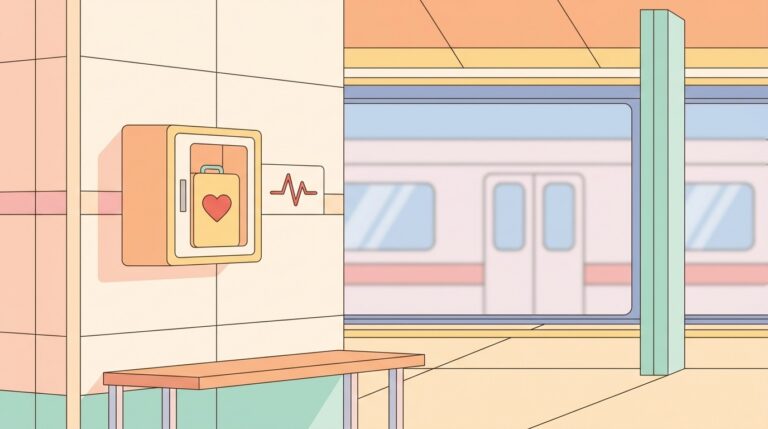
- K-Culture Moment: In public campaign videos across Seoul subway stations, bright red emergency AED boxes flash with clear visual instructions.
- Editor’s Insight: While the formal Korean term is jadong-simjang-chung-gyeokgi (자동심장충격기), even native Koreans stick to the universal acronym AED in real crises. Keep it simple and sharp!
- Situation Spectrum: Casual: ⚠️ | Semi-formal: ✅ | Formal: ✅
- 🤔 Think About It: Many medical terms in Korea adopt international acronyms for rapid communication. Notice how this bridges the gap between travelers and locals!
Phase 3: 교과서 한국어 vs 진짜 한국어 (Textbook vs. Real-Life Korean)
Situation 1: Calling out someone who has collapsed
- 📖 교과서 한국어 (Textbook): “사람이 의식을 잃고 쓰러졌습니다.” (Sarami uisigeul ilko sseureojyeotseumnida. – A person has lost consciousness and collapsed.)
- 🗣️ 진짜 한국어 (Real-Life): “여기 사람 쓰러졌어요! 빨리요!” (Yeogi saram sseureojyeosseoyo! Ppalliyo! – A person collapsed over here! Quick!)
- 💡 왜 다를까? (Why the difference?): In urgent situations, long grammatical markers and passive formal vocabulary waste breath. Real native speakers cut straight to location (yeogi = here) and the imperative for speed (ppalliyo = quickly!).
Situation 2: Asking if someone knows CPR
- 📖 교과서 한국어 (Textbook): “심폐소생술을 할 줄 아십니까?” (Simpyesosaengsureul hal jul asimnikka? – Do you possess the knowledge of cardiopulmonary resuscitation?)
- 🗣️ 진짜 한국어 (Real-Life): “CPR 하실 줄 아는 분 계세요?” (CPR hasil jul aneun bun gyeseyo? – Is there anyone here who knows CPR?)
- 💡 왜 다를까? (Why the difference?): Locals use the universal abbreviation “CPR” along with the respectful noun bun (person) to scan a crowd efficiently.
Phase 4: K-Culture 딥다이브 & 비언어적 매너 (Deep Dive & Non-Verbal Manners)
4-1. 눈치 (Nunchi) & Bystander Etiquette
In Korea, shouting “Somebody help!” to a general crowd often triggers the bystander effect (banggwanja hyogwa). To trigger immediate action with cultural sharpness (nunchi):
1. Direct Eye Contact & Clothing Pointing: Do not point vaguely. Point directly at a specific person and identify an item: “파란 모자 쓰신 분! 119에 전화해 주세요!” (Person in the blue hat! Call 119!)
2. Hand Gesture: When pointing, use your whole hand facing slightly upward rather than an aggressive single index finger if possible, but in a life-or-death moment, direct clarity trumps etiquette.
4-2. Culture Code: Safety Culture & Subway Stations
Seoul’s subway network is renowned for having AED units installed at almost every station—usually near the Station Office (yeokmuwon-sil) or main ticket gates. Korea has a robust Good Samaritan Law (Seonhan Samariain Beop) protecting bystanders who administer emergency aid like CPR. You can step forward with peace of mind knowing Korean society encourages immediate civic action.
Phase 5: 실전 롤플레이 시나리오 (Real-Life Roleplay Scenario)
Setting: Hongdae Station Platform. An elderly commuter suddenly falls unconscious. You rush to the person’s side while a friendly station attendant (역무원 김 반장님 – Station Attendant Mr. Kim) runs over with a radio.
- Turn 1 (You): 🎭 (Kneeling down, raising hand, calling out)
“여기 사람 쓰러졌어요! 도와주세요!”
(Yeogi saram sseureojyeosseoyo! Dowajuseyo!)
“Someone collapsed over here! Please help!” -
Turn 2 (Mr. Kim): 🎭 (Rushing over, inspecting the fallen person)
“어디 봐요! 저기요, 괜찮으세요? 반응이 없네!”
(Eodi bwayo! Jeogiyo, gwaenchaneuseyo? Baneungi eomne!)
“Let me see! Excuse me, are you okay? There is no response!” -
Turn 3 (You): 🎭 (Checking breathing, looking urgent)
“숨을 안 쉬어요! CPR 해야 돼요!”
(Sumeul an swieoyo! CPR haeya dwaeyo!)
“He isn’t breathing! We need to do CPR!” -
Turn 4 (Mr. Kim): 🎭 (Speaking into two-way radio)
“네, 제가 흉부 압박 하겠습니다!”
(Ne, jega hyungbu apbak hagesseumnida!)
“Yes, I will begin chest compressions!” -
Turn 5 (You): 🎭 (Turning toward a bystander wearing glasses, pointing directly)
“안경 쓰신 분, 119에 전화해 주세요!”
(An-gyeong sseusin bun, irilgu-e jeonhwahae juseyo!)
“You with glasses, please call 119!” -
Turn 6 (Bystander): 🎭 (Pulling out phone immediately)
“네! 지금 바로 전화할게요! 홍대입구역이죠?”
(Ne! Jigeum baro jeonhwahalgeyo! Hongdaeipgu-yeogijyo?)
“Yes! Calling right now! This is Hongik Univ. Station, right?” -
Turn 7 (You): 🎭 (Shouting clearly toward the ticket counter)
“AED 가져와 주세요! 빨리요!”
(AED gajyeowa juseyo! Ppalliyo!)
“Please bring the AED! Quickly!” -
Turn 8 (Mr. Kim): 🎭 (Counting chest compressions steadily)
“하나, 둘, 셋, 넷… 잘하셨어요! 조금만 버팁시다!”
(Hana, dul, set, net… Jalhasyeosseoyo! Jogeumman beotipsida!)
“One, two, three, four… Great job! Let’s hold on together!”
🔀 인터랙티브 분기점 (Interactive Choice)
What should you do next as Mr. Kim performs compressions?
* Option A: Freeze and wait quietly until the paramedics arrive.
* Option B: Locate the green-and-white station emergency locker and yell “AED 여기 있어요!” (AED yeogi isseoyo! – The AED is here!).
* Option C: Leave the scene to look for your subway train because you feel awkward.
- Feedback:
- Option A (Risk): Doing nothing can cause precious minutes to slip away during ventricular fibrillation.
- Option B (Best! ⭐): Pinpointing and fetching the AED instantly doubles survival rates. You’re an everyday hero!
- Option C (Bad): Leaving someone in distress misses a critical chance to save a life, and station attendants may need you as a witness.
Phase 6: 10초 감정 섀도잉 드릴 (10-Second Emotion Shadowing Drill)
Practice these aloud! Focus on pauses (/) and emotional tone:
[🚨 긴급하고 절박하게 - Urgent & desperate]
“도와주세요! / 여기 / 사람 쓰러졌어요!”
(Dowajuseyo! / Yeogi / saram sseureojyeosseoyo!)-
[🗣️ 또박또박 단호하게 - Clear & commanding]
“거기 파란 옷 입은 분! / 119에 / 전화해 주세요!”
(Geogi paran ot ibeun bun! / Irilgu-e / jeonhwahae juseyo!) -
[⚡ 빠르고 다급하게 - Fast & decisive]
“빨리요! / AED / 가져다주세요!”
(Ppalliyo! / AED / gajyeodajuseyo!)
Phase 7: K-Culture 미니 사전 (Mini Dictionary)
- 심폐소생술 (Simpyesosaengsul) | CPR (Cardiopulmonary Resuscitation)
- Every Korean school student and military serviceman learns this term by heart.
- 자동심장충격기 (Jadong-simjang-chung-gyeokgi) | Automated External Defibrillator (AED)
- The official terminology written on public emergency medical boxes across South Korea.
- 119 (I-ril-gu) | 119 Emergency Hotline
- The nationwide emergency number for fire and medical emergencies (Police is 112).
- 구급차 (Gugeupcha) | Ambulance
- Essential to recognize when hearing sirens in busy downtown traffic.
Phase 8: 여행자를 위한 생존 키트 (Traveler Survival Kit)
Survival Expressions TOP 3
- 숨을 안 쉬어요! (Sumeul an swieoyo!)
- Meaning: “They are not breathing!”
- Pro Tip: Use this when reporting the patient’s status to emergency dispatchers.
- 맥박이 없어요! (Maekbagi eopseoyo!)
- Meaning: “There is no pulse!”
- Pro Tip: Keep two fingers on the neck carotid artery while stating this.
- 여기 어디예요? (Yeogi eodiyeyo?)
- Meaning: “Where am I? / What is this location?”
- Pro Tip: Ask nearby locals this phrase so you can relay the exact address to the 119 dispatcher.
Editor’s Travel Note
- Essential App Download: Before arriving in Seoul, download the official Emergency Ready App on Google Play (안전디딤돌). It operates in English and guides you to the nearest AEDs and English-speaking emergency rooms.
- 119 Foreign Language Support: If you dial 119, state “English please!” Korea’s National Fire Agency automatically bridges a 3-way translation service with interpreting volunteers 24/7.
Phase 9: “한 발 더 깊이” (Deep Cultural Reflection)
In Korean society, there is a profound philosophical concept called Uri (우리 – “Us / We”). When someone falls ill on the street in Korea, you will often notice complete strangers dropping their bags, coordinating crowd control, and checking vitals together. The community acts as an extended family. Knowing even broken Korean emergency words allows you to become part of this collective blanket of protection.
💬 Your Turn: In your home country, what is the default emergency number, and how do people typically react when someone collapses in public? Share your thoughts below!
Phase 10: FAQ & 오해 방지 (FAQ Schema)
Q: Can foreigners call 119 without speaking fluent Korean?
A: Absolutely yes. When you call 119, simply repeat “English, please!” The dispatch system links with the BBB Korea translation service or Danuri Center within seconds to provide real-time three-way interpretation.
Q: Am I legally protected if I break ribs while performing CPR in Korea?
A: Yes. South Korea’s Emergency Medical Service Act contains a Good Samaritan clause that shields good-faith civilian responders from civil and criminal liabilities.
Q: Is 911 routed to Korean emergency dispatch if I dial it on a roaming phone?
A: Most modern mobile carriers automatically forward 911 calls to 112 (Police) or 119 (Fire/Medical) within Korea. However, dial 119 directly to avoid precious transfer delays.
🚨 흔한 실수 (Common Mistakes) 경고판
- Mistake: Shouting “911에 전화하세요!” (Call 911!)
- Correct Action: Train your tongue to shout “119 (Irilgu)” so everyone immediately recognizes the command.
- Mistake: Yelling for help into the air without choosing a specific person.
- Correct Action: Single out an individual: “검은색 티셔츠 입은 분! 119 전화해 주세요!” (Person in black T-shirt, call 119!).
- Mistake: Memorizing hard medical terminology instead of simple imperatives.
- Correct Action: Rely on short, punchy verbs like “도와주세요!” (Help!) and “빨리요!” (Quickly!).
Phase 11: 액션 미션 & 참여 유도 (Action Missions)
- 🥉 Bronze Mission: Stand in front of your mirror and practice shouting “도와주세요!” (Dowajuseyo!) 3 times with decisive facial urgency.
- 🥈 Silver Mission: Save emergency numbers (119 for Medical, 112 for Police, 1339 for Medical Information) onto your phone’s lock screen.
- 🥇 Gold Mission: Spot the nearest AED inside a subway station or convenience store during your next trip to Korea and photograph its location for personal awareness.
- 🎮 K-Culture Mission: Watch an episode of a medical drama (such as Hospital Playlist) and listen for characters shouting “CPR 시작합시다!” or “119 불렀어요?”
Phase 12: 인터랙티브 퀴즈 챌린지 (Interactive Quiz Challenge)
1. Situation Quiz
A passenger collapses at Myeongdong Station. You want to ask a bystander in a brown coat to contact medical dispatch. What is the most effective command?
* A) 저기요, 911에 전화해 주세요.
* B) 갈색 코트 입으신 분, 119에 전화해 주세요!
* C) 심폐소생술을 읽어주세요.
2. Fill-in-the-Blank
Fill in the missing letters: “빨리 ________ 가져다주세요!” (Please bring the automated external defibrillator quickly!)
* Hint: 3 letters in English.
3. True or False
Korea does not protect foreign tourists from liability when they attempt good-faith civilian CPR. (True / False)
👉 Click here to reveal answers and explanations!
- Answer: B | Always specify the clothing item and dial 119, not 911!
- Answer: AED | You can simply pronounce it as English letters: AED 가져다주세요!
- Answer: False | Korea’s Emergency Medical Service Act protects all good-faith civilian rescuers regardless of nationality under the Good Samaritan principle.







