

Beyond the Price Tag: Master Value-Driven Living & ‘Meaning Out’ in Fluent Korean
Phase 1: Empathy (Story-Driven Opening)
안녕하세요! 매일한글 에디터입니다.
Picture this: You are standing in a sunlit boutique shop in Seongsu-dong, Seoul’s capital of aesthetic trends. On your left sits an ultra-cheap, mass-produced facial serum with an eye-catching 1+1 sticker. On your right is a sleek, locally produced glass bottle marked with a certified bunny logo—cruelty-free, vegan, and fair-trade, but noticeably pricier. As the clerk walks over with a warm smile, you want to convey that you are actively seeking ethically sourced cosmetics and prefer eco-friendly refill stations, regardless of the markup. But suddenly, your mind freezes. Textbook phrases like “저는 환경을 보호합니다” feel oddly stiff, almost like reading from a middle school science paper, while trying to translate “cruelty-free value-driven consumer” on the fly results in an awkward jumble.
You are not alone. Many upper-intermediate and advanced Korean learners hit a stylistic plateau when talking about modern lifestyle philosophies. Korea’s conscious consumption wave—famously dubbed 미닝아웃 (Meaning Out) by the MZ generation—has sparked a sophisticated vocabulary that seamlessly blends ethical conviction with urban elegance. In this guide, tailored specifically for C1 learners and based on real-world classroom feedback, you will master the exact expressions, cultural nuances, and conversational confidence needed to navigate Korea’s thriving sustainable ecosystem like a conscious local insider.
Phase 2: 3 Core Expressions Deep-Dive
1. 조금 비싸더라도 가치 소비를 지향하는 편이에요. (Jogeum bissadeorado gachi sobireul jihyanghaneun pyeon-ieyo.)
- Pronunciation: Jogeum bi-ssa-deo-ra-do ga-chi so-bi-reul ji-hyang-ha-neun pyeon-i-e-yo (Think of “gachi” like got-chee and “jihyang” flowing like jee-hyang).
- Meaning: Literal: “Even if it is a bit expensive, I tend to pursue value consumption.” / Actual Nuance: “I don’t mind spending a bit more if it aligns with my personal values and ethics.”
- K-Culture Moment: Often overheard in contemporary K-vlogs or modern lifestyle variety shows (I Live Alone) when celebrities tour zero-waste grocery stores and explain why they prioritize ethical independent labels.
- Editor’s Insight: At the C1 level, replacing simple words like 사다 (to buy) or 좋아하다 (to like) with 지향하다 (to pursue/strive toward an ideal) and 가치 소비 (value-based consumption) instantly elevates your Korean from conversational to sophisticated and articulate.
- Situation Spectrum:
- Casual (Friends): ⚠️ (Slightly formal for intimate banter; say 난 좀 비싸도 착한 브랜드가 좋더라 instead)
- Semi-formal (Clerks/Acquaintances): ✅ (Perfect balance of courtesy and clarity)
- Formal (Interviews/Discussions): ✅
- 🤔 Think About It: In English, we often say “I vote with my wallet.” How does the Korean formulation 가치 소비 (consuming one’s core values) reflect a shift toward public personal identity in modern Korean consumer culture?
2. 동물 실험을 배제한 크루얼티 프리 라인인가요? (Dongmul silheomeul baejehan keurueolti peuri rain-ingayo?)
- Pronunciation: Dong-mul sil-heo-meul bae-je-han keu-ru-eol-ti peu-ri ra-in-in-ga-yo (Flow the sil-heom naturally into sil-heo-meul; “cruelty-free” sounds like keu-ru-eol-ti peu-ri).
- Meaning: Literal: “Is this a cruelty-free line that excludes animal testing?” / Actual Nuance: “Could you tell me if this specific product line is certified cruelty-free?”
- K-Culture Moment: A customer inquiring at an upscale clean-beauty pop-up in Hannam-dong or browsing the dedicated Clean Beauty corner at a flagship Olive Young.
- Editor’s Insight: Note the advanced structure ~을/를 배제한 (excluding/eliminating [X]). Using Sino-Korean verbs like 배제하다 rather than everyday verbs like 안 하다 demonstrates an impressive grasp of technical and ethical Korean register.
- Situation Spectrum:
- Casual: ⚠️ (A bit technical; 동물 실험 안 한 거야? works better)
- Semi-formal: ✅ (Ideal for retail inquiries)
- Formal: ✅
- 🤔 Think About It: In Korea, foreign loanwords like “Cruelty-Free” often sit alongside rigorous Sino-Korean compounds (동물 실험 배제). Why do you think cosmetic brands display both terms side-by-side?
3. 개인 용기를 챙겨왔는데 리필 스테이션에서 소분해 갈 수 있나요? (Gaein yonggireul chaenggyeowassneunde ripil seuteisyeoneseo sobunhae gal su innayo?)
- Pronunciation: Gae-in yong-gi-reul chaeng-gyeo-wat-neun-de ri-pil seu-te-i-syeo-ne-seo so-bun-hae gal su in-na-yo (Notice how yong-gi has a fun double meaning in Korean: “container” or “courage”!).
- Meaning: Literal: “I brought my personal container; can I portion it out and take it from the refill station?” / Actual Nuance: “I brought my own jar—can I refill and purchase it by weight here?”
- K-Culture Moment: Young eco-activists visiting zero-waste grocery hubs like Almang Sangjeom in Mangwon-dong participating in the viral #용기내챌린지 (#BraveContainerChallenge).
- Editor’s Insight: 소분하다 (to dispense/divide into small portions) is the exact industry and zero-waste verb you need. Asking 소분해 갈 수 있나요? shows you know how bulk refill systems operate in urban Korea.
- Situation Spectrum:
- Casual: ✅
- Semi-formal: ✅
- Formal: ✅
- 🤔 Think About It: How does the linguistic pun behind the 용기내 (Bring a container / Have courage) challenge capture Korea’s uniquely communal, social-media-driven activist spirit?
Phase 3: Textbook Korean vs. Real-World Korean
Scenario 1: Ordering Coffee at an Eco-Conscious Roastery
- 📖 교과서 한국어 (Textbook Korean):
“이 커피는 공정무역 원두입니까? 저는 환경에 좋은 커피를 마시고 싶습니다.”
(Is this coffee fair-trade beans? I want to drink coffee that is good for the environment.) - 🗣️ 진짜 한국어 (Real-World C1 Korean):
“혹시 싱글 오리진 라인 중에 공정무역 인증받은 원두도 선택 가능한가요?”
(Could I choose fair-trade certified beans among your single-origin selections?) - 💡 왜 다를까? (Why the Difference?):
Native Korean speakers rarely proclaim abstract ideals like “I want good coffee for the earth” at retail counters. Instead, they make precise, contextual inquiries using industry terminology like 인증받은 (certified) and 선택 가능한가요? (is it an available option?).
Scenario 2: Refusing Disposable Cutlery/Packaging
- 📖 교과서 한국어 (Textbook Korean):
“쓰레기가 많이 나옵니다. 포장하지 마세요.”
(A lot of trash comes out. Please do not package it.) - 🗣️ 진짜 한국어 (Real-World C1 Korean):
“일회용품은 일절 안 주셔도 괜찮아요. 텀블러에 바로 담아주세요!”
(You really don’t need to give me any disposables at all. Please put it straight into my tumbler!) - 💡 왜 다를까? (Why the Difference?):
Using the adverb 일절 (strictly/not at all) softens the refusal into a decisive, courteous preference without sounding accusatory or blunt to service workers.
Phase 4: K-Culture Deep Dive & Non-Verbal Manners
4-1. 눈치 (Nunchi) & Gestures: Refill Etiquette
When visiting a refill shop or zero-waste cafe in trend-conscious districts like Seongsu or Yeonnam, remember that sustainable service workflows often require extra steps from clerks (e.g., taring empty containers, weighing dry beans or liquid soaps).
* The Two-Handed Container Handoff: Always hand over your sanitized, dry container with both hands, lightly tilting your head. This acknowledges that you are asking the staff for a slightly non-standard task.
* The Tare Check Eye-Contact: When placing your empty container on the digital scale, casually make brief eye contact and say: “영점 먼저 잡을게요!” (Let me tare the scale first!). This demonstrates professional courtesy and saves them time.
4-2. Cultural Code Analysis: The ‘Meaning Out’ (미닝아웃) Boom
In the West, ethical consumerism is often rooted in individual lifestyle philosophy. In Korea, however, ethical consumption has evolved through 미닝아웃 (Meaning Out)—a portmanteau of “Meaning” and “Coming Out”. For Korea’s hyper-connected youth, spending money is a public declaration of political, social, and environmental stance. Choosing a cruelty-free mist or buying fair-trade cold brew isn’t just a private choice; it is shared via aesthetic Instagram Stories, unboxings, and community challenges. Clean beauty brands (like Aromatica or Manyo Factory) succeed not just by being effective, but by providing clear ethical stamps (K-Vegan, EWG Green) that allow consumers to wear their conscience on their sleeve.
Phase 5: Real-World Roleplay Scenario
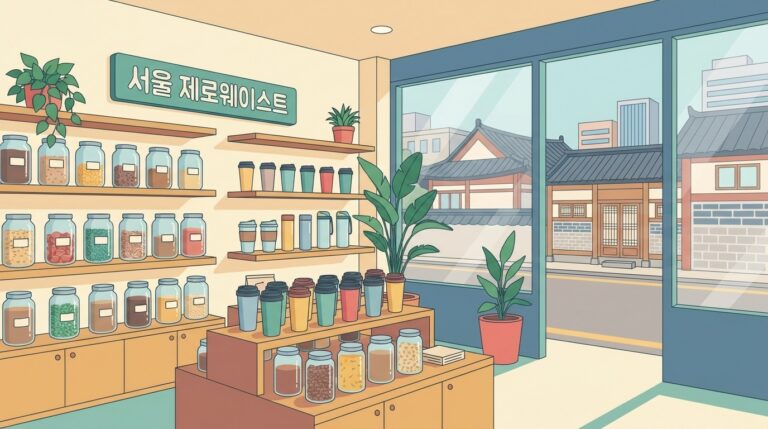
Setting: Earth & Soul (지구와 마음), an eco-refill store and roastery cafe in Yeonnam-dong. Sunbeams highlight jars of dry ingredients, liquid shampoos on tap, and certified bean dispensers.
Characters:
* Min-ji (Staff): A cheerful, knowledgeable barista and refill curator in a linen apron.
* Learner (You): An ethical consumer aiming to refill coffee beans and purchase cruelty-free lotion.
민지 (Min-ji): 어서 오세요! 천천히 둘러보시고 궁금한 점 있으시면 편하게 말씀해 주세요.
(Eoseo oseyo! Cheoncheonhi dulleobosigo gunggeumhan jeom isseusimyeon pyeonhage malsseumhae juseyo.)
“Welcome! Take your time looking around, and feel free to let me know if you have any questions.”
🎭 [Wipes down the wooden counter with a friendly smile]
학습자 (You): 안녕하세요! 혹시 여기 진열된 원두 중에 공정무역 원두도 구비되어 있나요?
(Annyeonghaseyo! Hoksi yeogi jinyeoldoen wondu junge gongjeongmuyeok wondudo gubidoeeo innayo?)
“Hello! By any chance, among the coffee beans displayed here, do you carry fair-trade beans as well?”
🎭 [Glances politely toward the roasted bean dispensers]
민지 (Min-ji): 네, 그럼요! 이 콜롬비아 수프레모랑 에티오피아 예가체프 두 종류가 공정무역 인증을 거친 원두예요.
(Ne, geureomyo! I kollombia supeuremorang eti-opia yegachepeu du jongnyuga gongjeongmuyeok injeung-eul geochin wonduyeyo.)
“Yes, absolutely! Both this Colombia Supremo and Ethiopia Yirgacheffe are fair-trade certified beans.”
🎭 [Gently gestures toward two airtight amber glass jars]
학습자 (You): 다행이네요. 가격대가 조금 나가더라도 가치 소비를 지향하는 편이라 이걸로 할게요.
(Dahaeng-ineyyo. Gagyeokdaega jogeum nagadeorado gachi sobireul jihyanghaneun pyeon-ira igeollo halgeyo.)
“What a relief. Even if it’s slightly pricier, I tend to prioritize conscious consumption, so I’ll go with this one.”
🎭 [Nods appreciatively while taking out a clean glass jar from a canvas bag]
민지 (Min-ji): 멋지시네요! 준비해 오신 다회용 용기가 있으시면 저울에 영점 맞춰서 담아 드릴게요.
(Meotjisineyyo! Junbihae osin dahoeyong yonggiga isseusimyeon jeo-ure yeongjeom matchwoseo dama deurilgeyo.)
“That’s wonderful! If you brought a reusable container, I’ll tare the scale and fill it up for you.”
🎭 [Readies the scale tongs and scoop]
학습자 (You): 네, 여기 있어요. 그리고 옆에 있는 핸드크림은 동물 실험을 배제한 비건 라인이 맞나요?
(Ne, yeogi isseoyo. Geurigo yeope inneun haendeukeurimeun dongmul silheomeul baejehan bigeon rain-i mannayo?)
“Yes, here it is. And for the hand cream next to it, is this indeed a cruelty-free vegan line that excludes animal testing?”
🎭 [Hands over the jar with both hands, lightly pointing to the tester lotion]
민지 (Min-ji): 맞아요! 한국비건인증원 인증을 받았고, 전 성분 식물성 추출물로만 채운 크루얼티 프리 제품이에요.
(Majayo! Hangukbigeon-injeung-won injeung-eul badatgo, jeon seongbun singmulseong chuchulmulroman chaeun keurueolti peuri jepum-ieyo.)
“That’s right! It is certified by the Korea Agency of Vegan Certification and Services, and it’s a cruelty-free product formulated entirely with plant extracts.”
🎭 [Taps the certification label on the bottle proudly]
학습자 (You): 정말 마음에 드네요. 이것도 리필 용기에 50ml만 소분해서 같이 결제해 주세요!
(Jeongmal maeume deuneyo. Igeotdo ripil yonggie osip-milli-man sobunhaeseo gachi gyeoljehae juseyo!)
“I really love that. Please dispense 50ml of this into a refill pouch and check it out together!”
🎭 [Hands over a compact refill pouch with a pleased expression]
🔀 Interactive Decision Point
Suppose Min-ji tells you: “손님, 오늘은 공정무역 원두가 거의 소진되어서 100g만 남아있는데 어떻게 하시겠어요?” (Customer, we’re almost out of fair-trade beans today, so only 100g is left. What would you like to do?)
- Option A: “괜찮아요, 남은 100g이라도 다 담아주시고 부족한 건 다음번에 또 사러 올게요!” (That’s fine! Please give me all of the remaining 100g, and I’ll come back for the rest next time!)
- Option B: “에이, 그럼 그냥 제일 싼 일반 원두로 아무거나 채워주세요.” (Oh well, then just fill it with whatever standard bean is cheapest.)
- Option C: “공정무역 원두가 아니면 의미가 없으니까 전부 다 환불해 주세요.” (Unless it’s fair-trade beans, there’s no meaning, so refund everything.)
Feedback Analysis:
* Selection A (Best): Shows cultural warmth, flexibility, and sustained commitment to your values without creating awkward tension. The staff will deeply appreciate your consideration.
* Selection B (Risk): While practical, abruptly pivoting from a passionate ethical stance to “whatever is cheapest” ruins the natural communicative rapport you built at the C1 level.
* Selection C (Bad): Far too confrontational and defensive for an artisanal store setting; it breaches standard Korean nunchi etiquette.
Phase 6: 10-Second Emotion Shadowing Drill
Practice reading these sentences aloud. Pay special attention to pauses (/) and pitch inflections mapped to the emotional indicators!
[🌿 확신에 차고 부드럽게 / Confident & Gentle]
“조금 비싸더라도 / 환경과 사회에 기여하는 / 가치 소비를 실천하고 싶어요.”
(Jogeum bissadeorado / hwangyeong-gwa sahoee giyeohaneun / gachi sobireul silcheonhago sipeoyo.)-
[🐰 정중하고 명확하게 / Courteous & Inquiring]
“피부가 민감해서 그러는데, / 혹시 동물 실험을 배제한 / 크루얼티 프리 라인일까요?”
(Pibuga mingamhaeseo geureoneunde, / hoksi dongmul silheomeul baejehan / keurueolti peuri rain-ilkkayo?) -
[☕ 상냥하고 센스 있게 / Bright & Eco-Conscious]
“영점 먼저 잡아주시면 / 챙겨온 용기에 / 딱 200g만 / 소분해 갈게요!”
(Yeongjeom meonjeo jabajusimyeon / chaenggyeoon yonggie / ttak ibaek-geuram-man / sobunhae galgeyo!)
Phase 7: K-Culture Mini Dictionary
| Term (Hangul + Romanization) | Translation | Cultural & Practical Usage |
|---|---|---|
| 미닝아웃 (Meaning Out) | Value-driven consumption / Public expression of beliefs through purchases | A trendy buzzword used across Korean marketing and media to describe buyers prioritizing ethics, veganism, and human rights over price discounts. |
| 용기내 챌린지 (Yonggi-nae Challenge) | “Brave Container” eco-challenge | A clever Korean pun where 용기 means both “courage” and “container.” Refers to bringing personal Tupperware/pots to takeout restaurants to avoid single-use plastics. |
| 비건 인증 (Bigeon Injeung) | Official Vegan Certification | Look for the official seal by the 한국비건인증원 (Korea Agency of Vegan Certification) on cosmetics and groceries. It guarantees zero animal testing and zero animal-derived ingredients. |
| 제로웨이스트 샵 (Zero-Waste Shop) | Zero-waste refill station / bulk goods store | Specialized urban stores that dispense detergents, cosmetics, and dry grains by weight without plastic packaging. |
Phase 8: Survival Kit for Travelers
Top 3 On-the-Go Phrases
- 개인 텀블러에 담아주시면 할인되나요?
(Gaein teombeullore dama jusimyeon harindoenayo?)
“Do I get a discount if you put it into my personal tumbler?”
💡 Pro Tip: Major Korean coffee chains (Starbucks, Mega Coffee, Compose) and independent cafes routinely offer a 100~500 KRW discount for personal tumblers! - 일회용 포장 용기는 빼고 주셔도 돼요.
(Ilhoeyong pojang yonggineun ppaego jusyeodo dwaeyo.)
“You can leave out the disposable packaging containers.” - 혹시 우유 대신 오트 밀크나 두유로 변경할 수 있나요?
(Hoksi uyu daesin oteu milkeuna duyuro byeongyeonghal su innayo?)
“Could I switch the dairy milk to oat milk or soy milk?”
Editor’s Travel Note: Conscious Travel in Seoul
- Finding Refill & Vegan Spots: Forget Google Maps when in Korea. Download and open the 네이버 지도 앱 (Naver Map App). Search for keywords like 제로웨이스트샵 (Zero-waste shop), 리필스테이션 (Refill station), or 비건 식당 (Vegan restaurant) to get real-time operating hours and reviews.
- Smart Recycling & Discarding: Seoul subway stations rarely feature general trash cans anymore to discourage household trash dumping. However, you will find designated bins for plastic bottles (페트병) and cans (캔류). Always empty liquids completely before recycling!
Phase 9: “One Step Deeper” (Cultural Reflection)
In South Korea, where ultra-fast delivery services like Rocket Delivery (로켓배송) and 24-hour convenience stores dominate daily life, choosing a slower, zero-waste lifestyle is a deliberate form of modern rebellion. Sustainable consumerism in Seoul is not just an individual preference; it reflects a communal consciousness that balances hyper-convenience with environmental accountability. By mastering these nuanced, respectful expressions, you step beyond the role of a passive tourist and actively engage in the cultural dialogues shaping Korea’s future.
💬 Your Turn: What ethical choices do you prioritize when shopping back home—cruelty-free ingredients, fair-trade sourcing, or minimal packaging? Share your thoughts in Korean in the comments below!
Phase 10: FAQ & Common Mistakes
Q: Can I bring any random plastic container to a Korean refill station?
A: Yes, but it must be completely washed and bone-dry! Refill stations dispensing cosmetic liquids, cleansers, or bulk cooking oils must comply with strict hygiene laws. If your bottle has residual moisture or food scents, staff may gently refuse to refill it to avoid contamination.
Q: Is “크루얼티 프리” (Cruelty-Free) recognized everywhere in Korea?
A: In urban cosmetic retailers like Olive Young, Chicor, and department stores, retail staff understand 크루얼티 프리 immediately. However, in neighborhood pharmacies or smaller local shops, it is far safer and more precise to say: “동물 실험 안 한 제품인가요?” (Is this product made without animal testing?).
Q: How do I know if a cosmetic brand is truly vegan and not just “greenwashing”?
A: Look for the text 비건 인증 (Certified Vegan) accompanied by the official stamp from the Korea Agency of Vegan Certification (한국비건인증원) or the French Eve Vegan mark on the back label. You can ask the clerk: “공식 비건 인증 마크가 있는 제품인가요?”
🚨 Common Mistakes Alert
- Translating “Vote with my wallet” literally: Saying 지갑으로 투표해요 sounds bizarre in Korean. Instead, use the authentic idiom: 가치 소비를 실천하다 (Practice value-driven consumption).
- Confusing ‘채식’ (Vegetarian) with ‘비건’ (Vegan) in cosmetics: Don’t say 채식 화장품. The established standard term in the K-Beauty industry is strictly 비건 뷰티 (Vegan Beauty) or 크루얼티 프리 (Cruelty-Free).
- Overusing dry textbook grammar in stores: Avoid ~하도록 하십시오. Use polite C1 ending styles like ~해주실 수 있나요? or ~으로 부탁드릴게요!.
Phase 11: Action Missions
- 🥉 Bronze Level (Solo Practice): Record yourself reading the Phase 6 Emotion Shadowing sentences aloud. Ensure your pronunciation of 공정무역 and 가치 소비 sounds effortless.
- 🥈 Silver Level (Community / SNS): Next time you take your personal tumbler to a cafe, take a picture and post it on your social media with the hashtag:
#가치소비 #용기내챌린지 #매일한글. - 🥇 Gold Level (Real-World Mission): Visit an Olive Young or an eco-boutique in Korea (or online shopping platform) and ask or search: “동물 실험을 배제한 크루얼티 프리 라인을 찾고 있어요.”
- 🎮 K-Culture Scavenger Hunt: Watch an episode of a modern lifestyle K-drama (like Run On or Work Later, Drink Now). Spot whether the characters carry reusable tumblers or mention 환경 보호 (environmental protection)!
Phase 12: Interactive Quiz Challenge
Test your mastery of C1-level ethical Korean! Check your answers below.
1. Situational Judgment:
You are ordering hand soap at a zero-waste store in Mapo-gu. You have your own empty bottle. Which phrase is the most natural, courteous C1 statement?
– (A) 쓰레기 싫으니까 비닐에 넣지 마라.
– (B) 제가 용기를 챙겨왔는데, 영점 확인하고 소분해 주실 수 있나요?
– (C) 이것은 공정무역 비누입니까? 비싸면 안 삽니다.
2. Fill in the Blank:
“비용이 조금 더 들더라도 자신의 신념을 표출하며 물건을 구매하는 현상을 요즘 MZ세대 사이에서는 ‘____________’이라고 부른다.”
3. True or False:
In modern Korean cafes, asking to replace regular dairy milk with oat milk using 오트 밀크로 변경 가능한가요? is considered rude or overly demanding. (T/F)
👉 Click to view answers and explanations!
1. Answer: (B)
Explanation: (B) exhibits perfect etiquette, incorporates advanced vocabulary (용기, 영점, 소분하다), and uses polite semi-formal verb endings. (A) uses disrespectful blunt imperative forms, and (C) is culturally abrasive and contextually awkward.
2. Answer: 미닝아웃 (Meaning Out)
Explanation: 미닝아웃 is the exact socio-cultural term describing value-driven consumer activism in modern South Korea.
3. Answer: False
Explanation: Substituting cow’s milk with alternative dairy (대체유) like soy (두유) or oat (오트 밀크) is a widely accepted, everyday customer request in Korean cafes today!






