

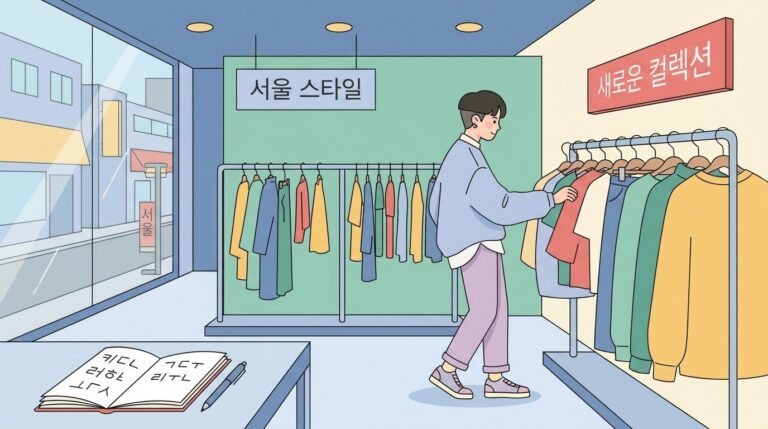
Phase 1: 공감 (Story 몰입형 오프닝)
안녕하세요! 매일한글 에디터입니다.
Imagine stepping into a sleek, multi-story SPA flagship store right in the beating heart of Hongdae or Gangnam—think SPAO, 8Seconds, Topten, or Musinsa Standard. The music is pumping the latest NewJeans or RIIZE track, the lighting makes every oversized blazer look like a runway masterpiece, and stylish locals are gliding past racks with laser-focused determination. You spot an incredible cable-knit vest or wide-leg cargo pants that scream effortlessly chic K-street style. You grab it, rush toward the fitting room, and suddenly hit a wall of quiet panic:
Wait, why is the clerk handing me a translucent mesh baggie before I step inside? What do I say if I need to try on a different size without losing my spot in line? And how do I politely ask for a fresh, unopened piece from the back storage instead of taking the rack item handled by hundreds of people?
If you have ever felt your Korean freeze up the moment an ultra-stylish store clerk approaches you with a polite greeting, you are not alone. In fast-paced Korean fast-fashion hubs, shopping is practically an Olympic sport. Interactions happen at lightning speed, unspoken etiquette rules dictate fitting room protocol, and textbook phrases like “이 옷을 주십시오 (Please give me this clothing)” will make you sound like a time traveler from the Joseon dynasty. Based on hundreds of real feedback sessions from our intermediate learners navigating Seoul’s shopping districts, we designed this guide to give you the exact conversational tools, cultural radar (nunchi), and confidence you need to conquer Korea’s fast-fashion empire like an insider.
Phase 2: 핵심 표현 3선 심층 분석
1. 이거 혹시 다른 색상도 있나요? (Igeo hoksi dareun saeksangdo innayo?)
- Pronunciation: [I-geo hok-si da-reun saek-sang-do in-na-yo?] (Sound metaphor: Imagine saying “E-go hawk-she dah-run sack-sahng-dough in-nah-yo?”)
- Meaning: Literal: “Does this by chance also have another color?” | Real Nuance: “Excuse me, does this piece come in other colors?”
- K-Culture Moment: Seen constantly in lifestyle K-Dramas where the protagonist browses a trendy minimalist shop in Seongsu-dong, holds up a neutral trench coat, and seeks a pop of pastel color.
- Editor’s Insight: The word 혹시 (hoksi) is your magical politeness cushion. Koreans rarely make blunt requests in customer service interactions. Adding 혹시 cushions your question from sounding like a demanding demand to a soft, considerate inquiry.
- Situation Spectrum: Casual ⚠️ | Semi-formal ✅ | Formal ✅
- 🤔 Think About It: In many Western countries, asking directly “Do you have this in black?” is standard and polite. Why does Korean culture value softening particles like 혹시 (by chance) even when asking a retail employee whose job is to assist you?
2. 새 상품으로 꺼내주실 수 있나요? (Sae sangpum-euro kkeonaejusil su innayo?)
- Pronunciation: [Sae sang-pum-eu-ro kkeo-nae-ju-sil su in-na-yo?] (Sound metaphor: “Say sahng-poom-oo-roh caw-neh-joo-sheal soo in-nah-yo?”)
- Meaning: Literal: “Can you pull it out as a new product for me?” | Real Nuance: “Could you grab me a fresh, unopened piece from the back?”
- K-Culture Moment: When beauty and fashion YouTubers do their “Seoul Haul” vlogs, they always emphasize asking for a fresh piece at SPA checkouts because display items get tried on dozens of times daily.
- Editor’s Insight: In Korean fast-fashion retail, display garments are called 디피 상품 (dipi sangpum), short for “display.” Unless the rack has packaged stock underneath, staff usually keep pristine inventory in the stockroom. Asking for a 새 상품 ensures your white tee has no makeup stains or stretched collars!
- Situation Spectrum: Casual 🚫 | Semi-formal ✅ | Formal ✅
- 🤔 Think About It: Notice the causative-honorific construction -어/아 주실 수 있나요. How does phrasing your need as asking someone’s personal favor soften commercial transactions in Korean society?
3. 피팅룸에서 입어보고 구매 결정할게요. (Pitingrum-eseo ibeobogo gumae gyeoljeonghalgeyo.)
- Pronunciation: [Pi-ting-rum-e-seo i-beo-bo-go gu-mae gyeol-jeong-hal-ge-yo.] (Sound metaphor: “Fitting-room-eh-saw ee-baw-boh-go goo-meh gyawl-jung-hahl-geh-yoh.”)
- Meaning: Literal: “I will try it on in the fitting room and decide on purchasing.” | Real Nuance: “I’m going to try this on first before I make up my mind.”
- K-Culture Moment: Often heard when an attentive store clerk asks if you need a shopping basket or are ready to pay at high-traffic SPA stores in Myeongdong.
- Editor’s Insight: The grammar pattern -고 결정하다 (decide after doing) clearly and courteously signals to sales staff that you want space to evaluate the fit without aggressive sales pressure. It marks you instantly as a seasoned, thoughtful shopper.
- Situation Spectrum: Casual ⚠️ | Semi-formal ✅ | Formal ✅
- 🤔 Think About It: How does taking time to deliberate on a purchase reflect modern Korean consumer literacy in an age of hyper-fast trend turnover?
Phase 3: 교과서 한국어 vs 진짜 한국어
Situation 1: Checking if the fit works & requesting another size
- 📖 교과서 한국어 (Textbook):
이 옷의 크기가 작습니다. 더 큰 옷을 보여주세요.
(I osui keugiga jaksumnida. Deo keun oseul boyeojuseyo.)
“The size of this clothing is small. Please show me a bigger clothing.” - 🗣️ 진짜 한국어 (Real-life Native):
핏이 조금 타이트해서 그런데, 한 치수 큰 걸로 입어볼 수 있을까요?
(Pisi jogeum taiteuhaeseo geureonde, han chisu keun geollo ibeobol su isseulkkayo?)
“The fit is a bit too tight; could I try this on one size up?” - 💡 왜 다를까? (Why the difference?):
Native speakers talk about fashion using modern loanwords like 핏 (fit) and specific terminology like 치수 (clothing size/dimension) rather than generic words like 크기 (size/dimension of objects). Using -해서 그런데 (It’s because…, so…) offers a gentle premise before making the request, preventing you from sounding critical of the garment.
Situation 2: Asking about exchange & return policy with a receipt
- 📖 교과서 한국어 (Textbook):
영수증이 있습니다. 물건을 환불하고 싶습니다.
(Yeongsujeungi itsumnida. Mulgeoneul hwanbulhago sipsumnida.)
“I have a receipt. I wish to refund the goods.” - 🗣️ 진짜 한국어 (Real-life Native):
영수증 지참했는데, 택 안 떼면 단순 변심 환불도 가능한가요?
(Yeongsujeung jichamhaenneunde, taek an ttemyeon dansun byeonsim hwanbuldo ganeunghangayo?)
“I brought the receipt—if the tags are still attached, is a change-of-mind refund allowed?” - 💡 왜 다를까? (Why the difference?):
The term 단순 변심 (change of heart / simple change of mind) is standard customer service terminology in Korea. Real shoppers mention 택 (tag) immediately, as fast-fashion stores have strict hygiene policies: no tag, no refund!
Phase 4: K-Culture 딥다이브 & 비언어적 매너
4-1. 눈치 (Nunchi) & Fitting Room Etiquette
Korean fast-fashion brands process thousands of shoppers every single hour, which means fitting room etiquette operates like a well-oiled machine. Here is how your nunchi (situational awareness) saves the day:
* The Infamous Face Cover (페이스 커버): If you are trying on tops, especially white shirts, knitwear, or crewnecks, the staff will hand you a spun-bond non-woven bag. Slip this completely over your head before pulling the shirt over your face! This prevents foundation, lip tint, or sunscreen from smudging the sample. Trying on white clothes without a face cover is considered a major faux pas.
* Shoes Off or Shoes On?: Look down before stepping onto the fitting room mat. In most Korean SPA stores (like Musinsa Standard or SPAO), there is a raised wooden step or a clean carpet inside the booth. Take your shoes off outside the curtain or step onto the designated runner.
* The Item Limit: Most fitting rooms have a strict 3벌에서 5벌 제한 (limit of 3 to 5 garments) at a time. Do not attempt to sneak eight pairs of pants in; count your garments upfront and show two fingers or three fingers to the staff attendant with a brief nod.
4-2. The Cultural Code: Collaboration Craze & Musinsa Culture
Korean fast fashion has evolved far beyond cheap dupes. Brands like SPAO dominate pop culture with unexpected collaborations: limited-edition pajama collections featuring Crayon Shin-chan, Harry Potter, or popular idol groups sell out within seconds in what locals call 오픈런 (open run) situations.
Meanwhile, platforms like Musinsa Standard (무탠다드) in Hongdae and Seongsu feature high-tech fitting rooms equipped with customizable studio LED lighting and phone mounts explicitly designed for shoppers to shoot their OOTD (Outfit Of The Day) TikToks and Instagram Reels. Fast-fashion stores in Korea aren’t just retail spaces; they are interactive content studios.
Phase 5: 실전 롤플레이 시나리오
Setting: Musinsa Standard flagship store in Hongdae on a lively Saturday afternoon. House music plays softly in the background. You’re holding an oversized tailored blazer that you love, but you want to check sizes and availability.
Characters:
* You (쇼핑객 / Shopper): An intermediate Korean learner hunting for clean K-style staples.
* 민지 (Minji / Store Associate): Attentive, wearing an all-black uniform with a lanyard badge and walkie-talkie headset.
- 민지: 안녕하세요! 도움이 필요하시면 편하게 말씀해 주세요.
(Annyeonghaseyo! Doumi piryohasimyeon pyeonhage malsseumhae juseyo.)
“Hello! If you need any assistance, please feel free to let me know.”
🎭 두 손을 모으고 밝게 미소 지으며 눈을 맞춘다.(Bows head slightly, hands clasped, smiling pleasantly.) -
You: 저기요, 죄송한데 이 재킷 혹시 다른 색상도 있나요?
(Jeogiyo, joesonghande i jaekit hoksi dareun saeksangdo innayo?)
“Excuse me, sorry to bother you, but does this jacket come in other colors too?”
🎭 옷걸이를 가리키며 조심스럽게 점원을 부른다.(Points gently toward the hanger while calling staff politely.) -
민지: 네, 고객님! 이 제품은 차콜, 베이지, 블랙 이렇게 세 가지로 나와요.
(Ne, gogaeknim! I jepumeun chakol, beiji, beullaek ireoke se gajiro nawayo.)
“Yes, valued customer! This model comes in three colors: charcoal, beige, and black.” -
You: 아, 그래요? 블랙 M 사이즈로 한 번 피팅해 볼 수 있을까요?
(A, geuraeyo? Beullaek em saijeuro han beon pitinghae bol su isseulkkayo?)
“Ah, really? Could I try on the black one in a size Medium?”
🎭 진열대를 가볍게 둘러보며 사이즈 라벨을 확인한다.(Glances at the rack while checking the size label.) -
민지: 네, 이쪽 피팅룸 라인으로 안내해 드릴게요. 페이스 커버 한 장 챙겨 들어가시면 됩니다!
(Ne, ijjok pitingrum rain-euro annaehae deurilgeyo. Peiseu keobeo han jang chaenggyeo deureogasimyeon doemnida!)
“Sure! I’ll guide you to this fitting room line. Please grab one face cover on your way in!”
🎭 부드럽게 손짓하며 피팅룸 입구와 페이스 커버 비치대를 가리킨다.(Gestures smoothly toward the fitting entrance and the dispenser.) -
You: 감사합니다. 입어보고 사이즈 괜찮으면 새 상품으로 꺼내주실 수 있나요?
(Gamsahamnida. Ibeobogo saijeu gwaenchanheumyeon sae sangpum-euro kkeonaejusil su innayo?)
“Thank you. If the fit works after trying it on, could you grab me a fresh piece from the back?” -
민지: 물론이죠! 피팅 끝나시고 말씀해 주시면 재고 확인해서 새 상품으로 준비해 드릴게요.
(Mullonijyo! Piting kkeunnasigo malsseumhae jusimyeon jaego hwaginhaeseo sae sangpum-euro junbihae deurilgeyo.)
“Of course! Just let me know when you finish trying it on, and I’ll check stock and get a brand-new one ready for you.”
🎭 허리를 굽혀 살짝 인사하며 피팅룸 번호표를 건넨다.(Nods politely and hands over a fitting room numbered tag.) -
You: 네! 입어보고 금방 나올게요.
(Ne! Ibeobogo geumbang naolgeyo.)
“Great! I’ll try it on and come out right away.”
🔀 인터랙티브 분기점 (Interactive Choice)
You exit the fitting room. The jacket fits across the shoulders, but the sleeves are noticeably too long, and you aren’t sure whether you should buy it or try a small. What do you say to Minji?
- Choice A: “이거 너무 이상해요. 팔이 왜 이렇게 길어요? 안 살래요.”
(Igeo neomu isanghaeyo. Pari wae ireoke gireoyo? An sallaeyo.)
Translation: “This is so weird. Why are the arms so long? I won’t buy it.” - Choice B: “핏이 생각보다 오버사이즈네요. 혹시 한 치수 작은 스몰로 한 번 더 입어볼 수 있을까요?”
(Pisi saenggakboda obeosaijeuneyo. Hoksi han chisu jageun seumollo han beon deo ibeobol su isseulkkayo?)
Translation: “The fit is more oversized than I thought. Could I try it on once more in a Small, one size down?” - Choice C: “그냥 이거 새 상품으로 계산해 주세요.”
(Geunyang igeo sae sangpum-euro gyesanhae juseyo.)
Translation: “Just ring me up for a new one of this.”
Feedback:
- Choice A (Bad): 🚫 Overly blunt and confrontational. In Korea, blaming the garment design directly to the retail clerk creates unnecessary awkwardness. Use soft critiques focused on your personal fit instead.
- Choice B (Best): ✅ Perfect! You identified the silhouette using standard Korean fashion vocabulary (오버사이즈 / oversize), framed it with modesty, and politely asked for a comparison size.
- Choice C (Risk): ⚠️ You will end up spending 89,000 KRW on a jacket with sleeve lengths you dislike! Fast-fashion alterations in Seoul take extra time and money—always test the adjacent size when in doubt.
Phase 6: 10초 감정 섀도잉 드릴 (Shadowing Drill)
Read these phrases out loud, respecting the pauses (/) and matching the emotional cues! Repeat 3 times.
[😊 밝고 자연스럽게 - Bright & Friendly]
저기요! / 이 셔츠 / 다른 색상도 혹시 있나요?
(Jeogiyo! / I syeocheu / dareun saeksangdo hoksi innayo?)
“Excuse me! / This shirt / does it happen to come in other colors?”-
[🤔 신중하고 정중하게 - Considerate & Polite]
핏이 조금 타이트해서 그런데, / 한 치수 큰 걸로 / 교체해 주실 수 있나요?
(Pisi jogeum taiteuhaeseo geureonde, / han chisu keun geollo / gyochaehae jusil su innayo?)
“The fit feels a bit tight, so… / could you swap this / for one size larger?” -
[✨ 기대감 넘치고 확신 있게 - Upbeat & Decisive]
마음에 드네요! / 혹시 피팅했던 거 말고 / 새 상품으로 꺼내주실 수 있어요?
(Maeume deuneyo! / Hoksi pitinghaetteon geo malgo / sae sangpum-euro kkeonaejusil su isseoyo?)
“I love it! / By any chance, rather than the one I tried on, / could you grab a brand new one?”
Phase 7: K-Culture 미니 사전 (핵심 키워드 4개)
-
핏 (Pit) | Fit / Silhouette
Derived from the English word “fit,” but used much more dynamically in Korea. You’ll hear phrases like 오버핏 (over-fit / loose, boxy silhouette), 슬림핏 (slim-fit), and 핏이 예쁘다 (the cut looks gorgeous on you). It describes how the garment harmonizes with the body line. -
품절대란 (Pum-jeol-dae-ran) | Sold-out Frenzy / Viral Shortage
Literally meaning “out-of-stock crisis,” this refers to items that go viral overnight on Instagram or TikTok (like SPAO seasonal fleeces or specific wide trousers) and become completely unavailable across all physical branches. -
페이스 커버 (Pei-seu keo-beo) | Non-woven Makeup Shield Cover
A disposable mesh hood supplied at fitting room entrances. In Korean fashion culture, protecting merchandise from cosmetic powders, lip stains, and hair oil is a fundamental shopper courtesy. -
기본템 (Gi-bon-tem) | Wardrobe Essentials / Basic Staples
A portmanteau of 기본 (basic/fundamental) and 아이템 (item). It refers to plain white t-shirts, neutral mock-neck knits, straight-leg denim, and minimalist trench coats that form the backbone of Korean everyday aesthetics.
Phase 8: 여행자를 위한 생존 키트
Survival Expressions TOP 3
-
텍스 리펀 영수증 끊어주세요.
(Tekseu ripeon yeongsujeung kkeoneojuseyo.)
Pro Tip: At major flagship branches like SPAO Gangnam or Musinsa Standard, immediate tax refunds (사후 면세) are processed right at the checkout if you present your physical passport! -
피팅룸 몇 벌까지 가지고 들어갈 수 있나요?
(Pitingrum myeot beolkkaji gajigo deureogal su innayo?)
Pro Tip: If you’re carrying winter outerwear, let the attendant know you are only trying on the inner shirts so they don’t count your personal coat toward your item quota. -
계산대 줄이 여기가 끝인가요?
(Gyesandae juri yeogiga kkeutingayo?)
Pro Tip: Weekend queues in Hongdae can weave through three aisles. Ask this politely to avoid accidentally cutting in line (새치기).
Editor’s Travel Note
- Map Navigation: Google Maps frequently lags or provides incorrect building entrances in Seoul. Always use the 네이버 지도 앱 다운로드 to pinpoint flagship SPA locations, check real-time business hours, and find floor-by-floor directory maps.
- Musinsa App Advantage: If you download the 무신사 앱 다운로드, you can scan QR tags on clothes racks in the Hongdae, Seongsu, or Gangnam offline stores. It displays real-time customer reviews, size feedback from people with your exact height and weight, and remaining warehouse inventory!
Phase 9: “한 발 더 깊이” (생각 질문)
Korean fast fashion reflects a fascinating societal dynamic between hyper-speed adaptation and subtle collective harmony. In a culture deeply tuned to seasonal transitions, social visual cues, and the desire to stay relevant without appearing ostentatious, SPA brands thrive because they translate runway looks into accessible 기본템 within weeks. While critics point to the environmental strain and uniformity of mass-produced looks, Korean youth uniquely personalize these garments through micro-styling—swapping silver hardware, layering silhouettes, and mixing high-end vintage with everyday SPA essentials. Fast fashion in Seoul is not just about consumerism; it is an accessible visual language through which young people communicate identity in a fast-moving society.
💬 Your Turn: In your home culture, do people prefer timeless classic garments, or do you enjoy riding fast-fashion trend waves like Seoulites? Share your favorite clothing shopping habit in the comments below!
Phase 10: FAQ & 오해 방지 (FAQ Schema)
Q: Can I return or exchange fast-fashion clothes bought in Seoul at a different branch?
A: In most major Korean SPA chains (such as Topten, SPAO, and 8Seconds), nationwide branch exchanges and refunds are permitted within 14 to 30 days, provided you have your original paper receipt, the payment card used, and all tags intact. However, small boutique pop-ups and discounted sale items are often strictly final sale.
Q: Why do store staff follow closely or fold clothes right next to me while I shop?
A: Don’t feel pressured! In Korean retail culture, this is considered attentive service and store upkeep (매장 정돈), not suspicion or surveillance. A simple friendly nod and “그냥 둘러볼게요 (Geunyang dulleobolgeyo – I’m just looking around)” will gently grant you all the personal browsing space you need.
Q: Are shoe sizes and clothing sizes standardized to Western measurements?
A: No. Korean sizes generally run smaller in the shoulders, bust, and hip width, while pant legs are often tailored narrower. An American or European “Medium” frequently corresponds to a Korean “Large (100)” or even “XL (105).” Always check the numerical chest/waist measurements (in centimeters) printed inside the garment.
🚨 흔한 실수 (Common Mistakes) 경고판
- Mistake 1: Trying on white or ivory tops without asking or using a face cover.
Correct Action: Always check for the “흰색 의류 피팅 불가 (White garments cannot be tried on)” sign. If permitted, invariably request and put on a 페이스 커버. - Mistake 2: Leaving unpurchased clothes on fitting room floors or benches.
Correct Action: Bring all items back out on their hangers and hand them directly to the attendant, separating them with: “이건 구매하고, 이건 다시 둘게요 (I’ll buy this one, and put this one back).” - Mistake 3: Cutting off clothing tags before trying clothes on at your hotel.
Correct Action: Keep every single plastic string, price tag, and receipt completely intact until you are 100% sure you will keep the item.
Phase 11: 액션 미션 & 참여 유도
Ready to transform knowledge into instinct? Complete this 3-tier action challenge:
- 🥉 Bronze Mission (Solo Practice): Stand in front of your home mirror. Hold up an outfit and practice saying: “핏이 조금 타이트해서 그런데, 한 치수 큰 걸로 입어볼 수 있을까요?” 3 times without stumbling.
- 🥈 Silver Mission (SNS & Community): Snap an OOTD photo of your favorite everyday outfit. Post it on your Instagram Story or our study board with the caption: “오늘의 기본템 코디! (Today’s basic-item styling!)”.
- 🥇 Gold Mission (Real-world Execution): On your next visit to a Korean store (or Korean online shop customer service chat), use “혹시 다른 색상도 있나요?” or “새 상품으로 꺼내주실 수 있나요?” to complete your purchase.
🎮 K-Culture Mission: Watch an episode of a modern youth K-Drama (like Record of Youth or Cheer Up). Spot a scene where characters go shopping or browse a clothing rack, and listen closely for the words 핏 (fit), 사이즈 (size), or 색상 (color)!
Phase 12: 인터랙티브 퀴즈 챌린지
Test your fast-fashion shopping mastery! Click the dropdown toggles to reveal answers and explanations.
1. Situational Judgment
You tried on a pair of wide trousers at SPAO in Gangnam. You love the cut, but someone spilled a tiny droplet of coffee near the pocket of the display piece you tried. What is the most polite and natural phrase to say to the staff?
* A) 이거 더러우니까 깎아주세요. (Igeo deoreounikka kkak-ajuseyo.)
* B) 디피 상품에 오염이 있어서 그런데, 새 상품으로 꺼내주실 수 있나요? (Dipi sangpume oyeomi isseoseo geureonde, sae sangpum-euro kkeonaejusil su innayo?)
* C) 옷이 이상해요. 환불해 주세요. (Osi isanghaeyo. Hwanbulhae juseyo.)
🔍 정답 확인 (Click to View Answer)
정답: B
해설: Option B accurately and politely explains the issue using the natural context setter -어서 그런데 (there is a stain, so…) and asks for fresh inventory with 새 상품으로 꺼내주실 수 있나요. Option A is overly aggressive in demanding a discount, while Option C is inappropriate since you haven’t bought it yet!
2. Fill-in-the-Blank
Complete the sentence requesting a different size using natural retail vocabulary:
“바지 허리가 조금 작아서 그런데, 혹시 한 ( ) 큰 걸로 입어볼 수 있을까요?”
Hint: The native Korean word for clothing/shoe measurement or size increment.
🔍 정답 확인 (Click to View Answer)
정답: 치수 (chisu)
해설: While English loanwords like 사이즈 (size) are understood, native speakers frequently use 치수 in the phrase 한 치수 큰 것 / 한 치수 작은 것 (one size up / one size down).
3. True / False Cultural Check
True or False: You can freely walk into the fitting room wearing outdoor shoes and try on white knit turtlenecks without a face cover in Korean SPA department stores.
🔍 정답 확인 (Click to View Answer)
정답: False (거짓)
해설: In almost all Korean fitting rooms, shoppers must observe the shoe boundary (often stepping onto clean mats or leaving shoes outside) and MUST wear a non-woven 페이스 커버 (face cover) to prevent makeup smears on tops.







