

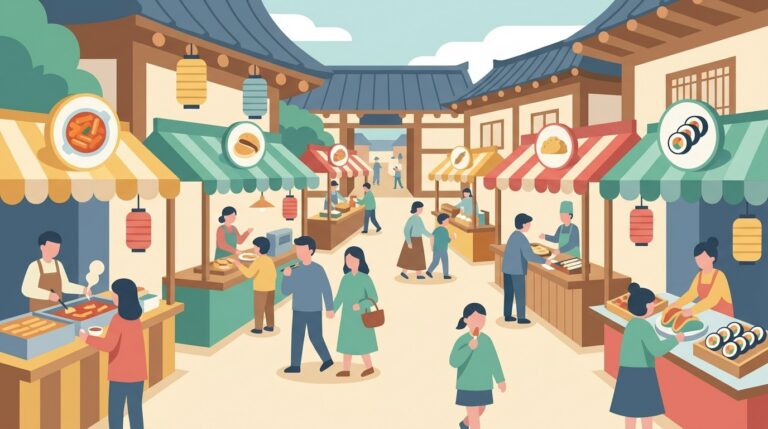
Surviving the Crowds at a Korean Traditional Market: Easy Phrases for Beginners
Phase 1: Empathy (A Friday Night at the Market)
안녕하세요! 매일한글 에디터입니다. (Hello! It’s your Daily Hangul editor.)
Imagine this: You have just arrived at Seoul’s famous Gwangjang Market on a breezy Friday evening. The hypnotic aroma of sizzling mung bean pancakes (bindaetteok) fills the air, steam rises from massive pots of spicy tteokbokki, and the energy is electric. But there is just one problem—you take three steps past the entrance and find yourself swept up in a tidal wave of locals and travelers. Elbows brush against elbows. You want to get closer to that legendary twisted donut stall, but you freeze.
Panic sets in. You find yourself whispering “Excuse me… sorry…” in English, but the roar of vendors and shoppers drowns out your voice. You feel stranded like an island in a sea of hungry people. Does this sound familiar?
Take a deep breath! Navigating busy Korean hotspots is a rite of passage for every traveler. Based on real-world classroom sessions with hundreds of beginner learners, we know that speaking up in a crowded space is one of your biggest anxieties. That is why today, we are giving you the exact, bite-sized survival phrases that will transform your market panic into smooth, confident local interactions. Let’s dive in!
Phase 2: Core Expressions (3 Must-Know Phrases)
1. 사람이 많아요 (Saram-i manayo)
- Pronunciation: Saram-i manayo (Phonetic analogy: Think of saying “Sah-rahm-ee mah-nah-yoh” smoothly)
- Meaning: Literal: “People are many.” | Real Nuance: “It’s so crowded!” or “There are a lot of people here!”
- K-Culture Moment: Seen in almost every K-drama travel episode when the lead couple visits a festival or Myeongdong street and must hold hands tightly so they do not get separated.
- Editor’s Insight: This phrase pairs 사람 (saram, person/people) + subject particle 이 (-i) + 많아요 (manayo, to be many/much). It is polite, objective, and wonderfully neutral. You will hear locals mutter this constantly while looking around in amazement.
- Situation Spectrum: Casual: ⚠️ (Say 사람 많아 to close peers) | Semi-formal: ✅ (Perfect for stalls, friends, and everyday chats) | Formal: ⚠️ (사람이 많습니다 is reserved for news anchors)
- 🤔 Think About It: In English, we usually describe the space (“The market is crowded”). Korean, however, spotlights the people existing in that space (“People are many”). Why do you think Korean prioritizes the presence of living beings over the container?
2. 잠시만요 (Jamsimanyo)
- Pronunciation: Jamsimanyo (Phonetic analogy: “Jahm-shee-mahn-yoh”—think jam + see + man + yo)
- Meaning: Literal: “Just a moment.” | Real Nuance: “Excuse me, coming through!” or “One second, please.”
- K-Culture Moment: The magic phrase muttered in packed Seoul subway stations during rush hour or when passing between hot street food carts.
- Editor’s Insight: Beginners often scramble to remember formal apologies, but 잠시만요 is your ultimate public super-power. It serves as a gentle, polite verbal cushion that parts the crowd without making anyone feel blamed.
- Situation Spectrum: Casual: ⚠️ (Say 잠깐만 to buddies) | Semi-formal: ✅ (Everyday public MVP) | Formal: ⚠️ (잠시만 기다려 주십시오 for high-end service)
- 🤔 Think About It: Instead of saying “I am sorry for hitting you,” Koreans say “Please grant me a moment of your time.” Notice how this keeps the atmosphere light and moving forward.
3. 복잡해요 (Bokjapaeyo)
- Pronunciation: Bokjapaeyo (Phonetic analogy: “Bohk-jah-peh-yoh”)
- Meaning: Literal: “It’s complicated/intricate.” | Real Nuance: “It’s chaotic!” / “It’s hectic and packed!”
- K-Culture Moment: Cast members on reality shows like Running Man arriving at a bustling market game mission and holding their heads laughing.
- Editor’s Insight: While 사람이 많아요 simply states the number of bodies, 복잡해요 captures the dizzying, bustling sensory overload of sights, sounds, and narrow paths.
- Situation Spectrum: Casual: ⚠️ (복잡해) | Semi-formal: ✅ | Formal: ⚠️ (복잡합니다)
- 🤔 Think About It: In Korean culture, physical congestion and mental complexity share the same root word. Doesn’t that match how you feel when walking through a noisy street?
Phase 3: Textbook Korean vs. Real-Life Korean
Situation 1: Pointing out the crowd
- 📖 교과서 한국어 (Textbook): 시장에 사람들이 대단히 많이 있습니다. (Sijange saramdeuri daedanhi mani itsseumnida. / There are exceptionally numerous people present in the market.)
- 🗣️ 진짜 한국어 (Real-Life): 와, 사람 진짜 많아요! (Wa, saram jinjja manayo! / Wow, there are seriously so many people!)
- 💡 왜 다를까? (Why the difference?): In daily conversation, native speakers drop the plural suffix (-들) when it is obvious from context. They also ditch stuffy words like 대단히 in favor of expressive street adverbs like 진짜 (jinjja – really/seriously).
Situation 2: Trying to pass through a narrow stall
- 📖 교과서 한국어 (Textbook): 실례합니다만 제가 지나가겠습니다. (Sillyehamnidaman jega jinagagetseumnida. / Excuse me, but I shall now proceed to pass through.)
- 🗣️ 진짜 한국어 (Real-Life): 죄송합니다, 잠시만 지나갈게요~ (Joesonghamnida, jamsi-man jinagalgeyo~ / Sorry, just sneaking past you quickly~)
- 💡 왜 다를까? (Why the difference?): The textbook version sounds like a historical drama royal announcement! Real shoppers blend a fast, soft apology with an active, cheerful statement of motion.
Phase 4: K-Culture Deep Dive & Non-Verbal Manners
4-1. 눈치 (Nunchi) & The Polite “Hand-Blade”
When traditional market alleys get jammed, body language is 80% of communication. If you push forward with stiff shoulders or turn your back aggressively, vendors and halmonis (grandmothers) might click their tongues.
Instead, use the universal Korean market gesture: 손날 세우기 (the gentle vertical hand-blade). Hold one open hand up near your chest like a polite guiding wedge, tuck your shoulders in slightly, bow your neck 15 degrees, and whisper: 잠시만요~ (Jamsimanyo~). You will instantly see people pull their bags aside to let you glide through!
4-2. The “Heung” (흥) of Traditional Markets
In Western cities, tight crowds are often perceived as a frustrating inconvenience. But in Korea’s traditional market culture, crowds represent vitality, good fortune, and shared warmth (정, Jeong). A stall with no crowd is viewed with suspicion; a stall with people packed shoulder-to-shoulder means the food is fresh, hot, and delicious! Treat the crowd as a festive celebration of street cuisine.
Phase 5: Real-Life Roleplay Scenario
Setting: A vibrant, narrow alley inside Mangwon Market on a bustling Saturday afternoon.
Characters: You (an eager food lover) & Merchant Halmeoni (a veteran market vendor flipping hotteok).
- You: 와, 오늘 시장에 사람이 진짜 많아요! (Wa, oneul sijange saram-i jinjja manayo! – Wow, there are really so many people in the market today!) [🎭 Looking around wide-eyed with awe]
- Merchant Halmeoni: 주말이라 그래요! 학생, 뭐 줄까? (Jumarira geuraeyo! Haksaeng, mwo julkka? – It’s because it is the weekend! Young friend, what can I get you?) [🎭 Expertly flipping golden, puffed hotteok on the flat grill]
- You: 호떡 하나 주세요. 그런데 줄이 어디예요? (Hotteok hana juseyo. Geureonde juri eodiyeyo? – One hotteok, please. But where is the line?) [🎭 Puzzled by the swirl of waiting customers]
- Merchant Halmeoni: 저기 노란 간판 뒤로 서면 돼요! (Jeogi noran ganpan dwiro seomyeon dwaeyo! – You can line up right behind that yellow sign over there!) [🎭 Pointing with her cooking spatula]
- Passerby: (Bumping lightly into you) 어이쿠! (Eoiku! – Oops!) [🎭 Squeezing past with grocery bags]
- You: 아, 죄송합니다! 잠시만요! (A, joesonghamnida! Jamsimanyo! – Oh, I’m sorry! Just a moment!) [🎭 Making the gentle hand-blade gesture and stepping sideways]
- Merchant Halmeoni: 복잡하니까 조심해서 와요, 다치지 말고! (Bokjaphanikka josimhaeseo wayo, dachiji malgo! – It’s hectic, so be careful coming over, don’t get hurt!) [🎭 Smiling warmly with maternal care]
- You: 네, 감사합니다! (Ne, gamsahamnida! – Yes, thank you so much!) [🎭 Giving a respectful bow and lining up happily]
🔀 Interactive Choice Point
You need to move through three people chatting in front of the cash basket. What do you do?
* Choice A: Shout loudly: “저기요! 비키세요!” (Jeogiyo! Bikiseyo! – Hey! Move!)
* Feedback (Bad): Extremely rude! 비키세요 is an abrasive command that will earn you cold glares.
* Choice B: Tuck your shoulders, flash your hand-blade, and softly say: “잠시만요, 지나갈게요~” (Jamsimanyo, jinagalgeyo~)
* Feedback (Best): Perfect 100-point response! People will smile and naturally shift aside for you.
* Choice C: Push through with your elbows while remaining completely silent.
* Feedback (Risk): Risky behavior. Koreans tolerate closeness, but pushing without words creates instant discomfort.
Phase 6: 10-Second Emotion Shadowing Drill
Read these aloud while mimicking the emotional tone marks:
[😮 깜짝 놀라며 경이롭게 / Surprised & Amazed]
와! / 오늘 사람 / 진짜 많아요!
(Wa! / Oneul saram / jinjja manayo! – Wow! There are really so many people today!)-
[🙏 조심스럽고 상냥하게 / Careful & Gentle]
죄송합니다, / 잠시만요~ / 지나갈게요!
(Joesonghamnida, / jamsimanyo~ / jinagalgeyo! – Excuse me, just a moment~ passing through!) -
[😅 정신없지만 유쾌하게 / Flustered yet Cheerful]
여기 / 진짜 / 복잡해요!
(Yeogi / jinjja / bokjapaeyo! – It is seriously chaotic here!)
Phase 7: K-Culture Mini Dictionary
- 시장 (Sijang) | Traditional Market | The beating cultural heart of local neighborhood food, produce, and authentic everyday community.
- 줄 (Jul) | Line / Queue | You will hear 줄 서세요 (Jul seoseyo – Please line up) or ask 줄 끝이 어디예요? (Where is the end of the line?).
- 핫플 (Hatpeul) | Hot Place | Trendy, viral spots featured heavily on social media that draw big weekend crowds.
- 덤 (Deom) | Generous Extra / Bonus | The delightful tradition where market vendors toss an extra snack or treat into your bag for free out of affection.
Phase 8: Traveler Survival Kit
Top 3 Survival Lines for the Market
- 잠시만요! (Jamsimanyo! – Excuse me / Just a second!)
- Pro Tip: Keep this at the tip of your tongue whenever you feel boxed in.
- 줄 서는 곳이 어디예요? (Jul seoneun gosi eodiyeyo? – Where do we line up?)
- Pro Tip: Crowds can blur lines. Asking this prevents accidental line-cutting.
- 카드 돼요? (Kadeu dwaeyo? – Do you take card?)
- Pro Tip: Most large stalls accept cards, but tiny carts prefer cash or domestic transfers.
Editor’s Travel Note
Before stepping into labyrinths like Gwangjang or Busan Jagalchi, make sure you complete your Naver Map app download on your phone. Western map apps often fail inside dense Korean market corridors! Also, keep a few 1,000 KRW and 5,000 KRW bills easily accessible in an outer pocket so you do not hold up the line fumbling through your wallet.
Phase 9: One Step Deeper (The Beauty of “Bukjeok-bukjeok”)
In Korean, there is a vivid onomatopoeia for a bustling crowd: 북적북적 (Bukjeok-bukjeok). While modern life often teaches us to prize personal space, the Korean market celebrates togetherness. When bodies bump gently around a bubbling tteokbokki plate, social barriers drop. You sit shoulder-to-shoulder with strangers, share tissue boxes, and pass water cups. It is a living reminder that you are part of a vibrant community.
💬 Your Turn: Have you ever visited a traditional market in Korea or your own home country? How do you usually react when an alley gets packed? Tell us in the comments!
Phase 10: FAQ & Common Mistakes
Q: Is it considered rude to brush shoulders with strangers in Korean markets?
A: Not at all! In tight market passages, light contact is fully understood as unavoidable. Just avoid aggressive pushing, and offer a quick nod or a gentle 잠시만요 (Jamsimanyo) if contact is heavy.
Q: What is the difference between 잠깐만요 (Jamkkanmanyo) and 잠시만요 (Jamsimanyo)?
A: Both mean “just a second.” However, 잠시만요 sounds slightly softer and more refined, making it the preferred choice when weaving past people in public.
Q: Can I use “실례합니다” (Sillyehamnida) when walking through a crowd?
A: While textbooks love 실례합니다 (“Pardon me”), native speakers rarely use it in physical crowds. It sounds overly stiff, like an apology before an interview! Stick with 잠시만요.
🚨 흔한 실수 (Common Mistakes) Warning Board
- Mistake: Shouting “비키세요!” (Bikiseyo! – Move out of the way!).
- Correct Action: Say “잠시만 지나갈게요~” (Jamsi-man jinagalgeyo~ – Just stepping past you~).
- Mistake: Saying “사람이 커요” (Saram-i keoyo) to describe a crowd.
- Correct Action: 커요 means “big in physical size.” To express “many people,” always use 사람이 많아요 (Saram-i manayo).
- Mistake: Standing frozen and silent in the middle of a lane.
- Correct Action: Raise your gentle hand-blade gesture, say 잠시만요, and take confident small steps.
Phase 11: Action Missions
- 🥉 Bronze Mission (Solo Practice): Stand before a mirror, look wide-eyed, and repeat 사람 진짜 많아요! 5 times until the melody feels natural.
- 🥈 Silver Mission (Social Connection): Drop a sentence in our comments below using the word 복잡해요 to describe your city’s traffic or subway!
- 🥇 Gold Mission (Real-World Test): Next time you enter a crowded store, supermarket, or your next trip to Korea, politely clear your way using 잠시만요~!
- 🎮 K-Culture Mission: Watch a street food vlog or K-drama market scene this week and count how many times you hear vendors or visitors utter 사람 많다 or 잠시만요.
Phase 12: Interactive Quiz Challenge
1. Situation Judgment: You are trying to step around a busy vendor stacking pancake boxes in a crowded aisle. What should you say?
* a) 비키세요! (Bikiseyo!)
* b) 잠시만요, 지나갈게요~ (Jamsimanyo, jinagalgeyo~)
* c) 사람이 작아요! (Saram-i jagayo!)
2. Fill in the Blank:
시장 맛집에 사람이 [ ]. (There are a lot of people at the famous market restaurant.)
* a) 커요 (keoyo)
* b) 많아요 (manayo)
* c) 조용해요 (joyonghaeyo)
3. True or False: In Korea, a bustling crowd (북적북적) in a traditional market is culturally viewed as a sign of fresh food and vibrant energy.
* True / False
👉 Click here to reveal the answers and explanations!
- 1. Answer: b) 잠시만요, 지나갈게요~ is polite, smooth, and friendly. (Option a is too bossy; Option c means “people are small”!)
- 2. Answer: b) 많아요. We describe crowded headcounts using 많다 (to be many), not 크다 (to be large).
- 3. Answer: True! High crowds signal that the merchant’s ingredients turn over rapidly, promising hot and delicious street food!







