

Master the Art of Logical Critique: Deconstructing Hasty Generalizations in Korean
Phase 1: Empathy & Storytelling Opening
안녕하세요! 매일한글 에디터입니다.
Picture this: You are relaxing at a cozy craft brewery in Euljiro with your Korean colleagues after a long week. The conversation drifts from project milestones to everyday observations. Suddenly, someone mentions, “요즘 20대들은 끈기가 전혀 없어요. 우리 팀 인턴만 봐도 알 수 있죠.” (People in their 20s these days have no perseverance at all. Just look at the intern on our team.) You instantly feel that something is logically amiss. In English, you might casually retort, “Isn’t that a sweeping generalization?” But in Korean, especially in an environment where hierarchy, nunchi, and interpersonal harmony reign supreme, blurt out the wrong phrase and you might sound confrontational, pretentious, or pedantic.
Critiquing flawed logic without fracturing social rapport is the ultimate hallmark of C2-level Korean proficiency. Many advanced learners tell us they know how to identify fallacies intellectually, yet freeze up when they need to articulate them eloquently in Korean discussions. This guide is crafted directly from field coaching sessions with foreign diplomats, researchers, and global executives living in Seoul. By mastering these nuanced rhetorical devices, you will transition from merely speaking fluent Korean to debating with intellectual gravitas and effortless cultural tact.
Phase 2: Core 3 Expressions Deep-Dive
1. 성급한 일반화의 오류 (Seong-geup-han il-ban-hwa-ui o-ryu)
- Pronunciation: [Seong-geup-han il-ban-hwa-ui o-ryu] (Sounds like: sung-güp-hahn eel-bahn-hwah-wee oh-ryoo)
- Meaning: Literal: “The error of hasty generalization” | Nuance: The formal, academic term for jumping to a broad conclusion from insufficient premises.
- K-Culture Moment: Frequently heard on Korean current affairs debate shows like 100-Minute Discussion (100분 토론) or inside high-stakes courtroom dramas like Stranger (비밀의 숲) when a prosecutor counters biased assumptions.
- Editor’s Insight: While logically precise, using this exact phrase in casual chat can sound like you are grading a thesis. Reserve it for formal presentations, professional critique, or intellectual banter.
- Situation Spectrum: Casual 🚫 | Semi-formal ⚠️ | Formal ✅
- 🤔 Think About It: Why does Korean debate culture favor referencing the philosophical name of a fallacy rather than saying “You are wrong”? It externalizes the blame to the logic itself rather than attacking the speaker’s ego.
2. 일반화하기엔 표본이 너무 협소합니다 (Il-ban-hwa-ha-gi-en pyo-bon-i neo-mu hyeop-so-ham-ni-da)
- Pronunciation: [Il-ban-hwa-ha-gi-en pyo-bon-i neo-mu hyeop-so-ham-ni-da] (Sounds like: eel-bahn-hwah-gee-en pyoh-bohn-ee nuh-moo hyup-soh-hahm-nee-dah)
- Meaning: Literal: “The sample is too narrow to generalize” | Nuance: “That is an anecdote, not an established trend.”
- K-Culture Moment: Commonly used in strategic planning meetings at tech hubs in Pangyo or corporate boardrooms in Yeouido when an executive tries to base marketing strategy on personal experience.
- Editor’s Insight: The word 협소하다 (hyeop-so-ha-da) denotes narrowness in both physical space and figurative scope. It replaces the basic word 작다 (small) to instantly elevate your Korean to executive standard.
- Situation Spectrum: Casual ⚠️ | Semi-formal ✅ | Formal ✅
- 🤔 Think About It: How does emphasizing sample size (표본) shift the conversation from an emotional disagreement to an objective, empirical inquiry?
3. 일부의 사례를 전체로 확대해석할 우려가 있습니다 (Il-bu-ui sa-rye-reul jeon-che-ro hwak-dae-hae-seok-hal u-ryeo-ga it-seum-ni-da)
- Pronunciation: [Il-bu-ui sa-rye-reul jeon-che-ro hwak-dae-hae-seok-hal u-ryeo-ga it-seum-ni-da] (Sounds like: eel-boo-wee sah-ryeh-reul jun-cheh-roh hwahk-deh-heh-suk-hahl oo-ryuh-gah eet-seum-nee-dah)
- Meaning: Literal: “There is concern about over-interpreting isolated cases as representative of the whole.” | Nuance: “Let’s be careful not to extrapolate too much from an isolated incident.”
- K-Culture Moment: Often articulated by panel members in social documentary broadcasts or talk shows like You Quiz on the Block when addressing public prejudices.
- Editor’s Insight: Notice the ending ~할 우려가 있습니다 (~hal u-ryeo-ga it-seum-ni-da; “there is a concern that”). Framing critique through potential unintended consequences (우려) is the gold standard of Korean polite dissent.
- Situation Spectrum: Casual 🚫 | Semi-formal ✅ | Formal ✅
- 🤔 Think About It: In many Western debates, direct refutation is valued. In Korea, why is softening a critique through anticipatory concern considered higher eloquence?
Phase 3: Textbook Korean vs. Real Korean
Situation 1: Calling out a stereotype during an informal dinner
- 📖 교과서 한국어: 그것은 성급한 일반화입니다. (Geu-geos-eun seong-geup-han il-ban-hwa-im-ni-da. / That is a hasty generalization.)
- 🗣️ 진짜 한국어: 그건 케바케(case-by-case)인데, 너무 단정 짓는 거 아니에요? (Geu-geon ke-ba-ke-in-de, neo-mu dan-jeong jit-neun geo a-ni-e-yo? / That really varies from case to case, don’t you think you’re making too definitive a claim?)
- 💡 왜 다를까? Outside of formal speeches, using Latin-origin textbook logic phrases sounds stiff. Real speakers use compound slang like 케바케 (case by case) combined with rhetorical questions (아니에요?) to cushion the blow while remaining firm.
Situation 2: Debating consumer trends in a business sprint
- 📖 교과서 한국어: 모든 소비자가 그렇게 행동하지는 않습니다. (Mo-deun so-bi-ja-ga geu-reoh-ge haeng-dong-ha-ji-neun an-seum-ni-da. / Not all consumers act like that.)
- 🗣️ 진짜 한국어: 극단적인 몇몇 특이점을 전체 트렌드로 보기엔 무리가 있어 보여요. (Geuk-dan-jeok-in myeot-myeot teuk-i-jeom-eul jeon-che teu-ren-deu-ro bo-gi-en mu-ri-ga iss-eo bo-yeo-yo. / It seems unreasonable to view a few extreme outliers as a collective trend.)
- 💡 왜 다를까? Advanced professionals replace broad negatives (하지 않습니다) with domain-specific analytical vocabulary like 특이점 (outlier / singularity) and soft modal hedges like ~에 무리가 있다 (~is a stretch).
Phase 4: K-Culture Deep Dive & Non-Verbal Manners
4-1. Nunchi & Physical Buffering in Intellectual Discourse
Critiquing logic in Korea requires calibrated body language:
* The Slight Head Tilt (경청의 갸우뚱): Never stare straight ahead with wide eyes when pointing out a flaw; it signals aggression. Tilt your head slightly (5 to 10 degrees), blink thoughtfully, and nod once before speaking. This conveys, “I am carefully processing your logic, not rejecting your person.”
* The Open Palm Cushion (손바닥 제스처): Never point your index finger at a presentation slide or person. Keep your palm upward and slightly curved inward as you say “일부의 사례” (isolated examples). This physical posture invites collaborative problem-solving.
4-2. Cultural Code: The Rise of “Hasty Generalization” in the MBTI & Generation Discourse
Modern Korea is consumed by classification typologies: MBTI personality types, generational labels (MZ세대), and blood types. Korean variety programs like I Live Alone (나 혼자 산다) or YouTube talk channels frequently oscillate between affectionate stereotyping and self-aware deconstruction. While Koreans enjoy categorizing behaviors for social bonding, overstepping into prejudice triggers severe online backlash (갈라치기, divisive framing). Demonstrating that you can pinpoint a logical fallacy without dampening social warmth shows you possess true cultural dexterity.
Phase 5: Real-World Roleplay Scenario
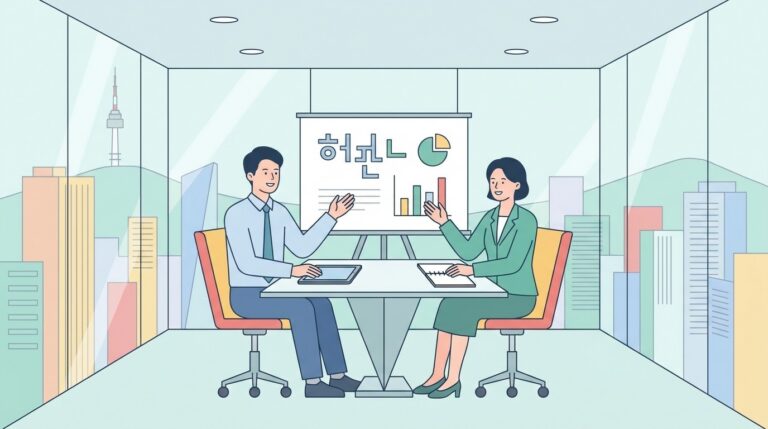
Setting: A marketing strategy meeting at an agency in Seongsu-dong. Team Lead Min-woo is reviewing recent Gen Z cosmetics consumption patterns.
- Min-woo: 이번 F/W 시즌에는 팝업스토어 예산을 전부 숏폼 챌린지에 몰아주죠. 요즘 20대들은 오프라인 매장 자체를 아예 안 가잖아요. (I-beon F/W si-jeun-e-neun pap-eop-seu-to-eo ye-san-eul jeon-bu syot-pom chael-lin-ji-e mor-a-ju-jyo. Yo-jeum i-sip-dae-deul-eun o-peu-ra-in mae-jang ja-che-reul a-ye an ga-jan-a-yo. / Let’s shift our entire fall/winter pop-up budget into short-form video challenges. People in their 20s these days don’t visit brick-and-mortar stores at all.)
- Sophia (You): 🎭 Gently tilts head, pen placed neatly on the notepad 팀장님 말씀의 취지는 디지털 채널의 파급력을 극대화하자는 뜻으로 이해했습니다. (Tim-jang-nim mal-sseum-ui chwi-ji-neun di-ji-teol chae-neol-ui pa-geup-ryeok-eul geuk-dae-hwa-ha-ja-neun tteus-eu-ro i-hae-haess-seum-ni-da. / I understand that your intention is to maximize the viral impact of our digital channels.)
- Min-woo: 네, 그렇죠. 지난주 강남 플래그십 스토어만 봐도 한산하더라고요. (Ne, geu-reoh-jyo. Ji-nan-ju Gang-nam peul-lae-geu-sip seu-to-eo-man bwa-do han-san-ha-deo-ra-go-yo. / Exactly. Just looking at our Gangnam flagship store last week, it was practically deserted.)
- Sophia (You): 🎭 Subtly raises palm upward in a neutral gesture 다만 특정 매장의 일시적 비수기를 근거로 삼기에는, 일반화하기에 표본이 다소 협소하지 않을까요? (Da-man teuk-jeong mae-jang-ui il-si-jeok bi-su-gi-reul geun-geo-ro sam-gi-e-neun, il-ban-hwa-ha-gi-e pyo-bon-i da-so hyeop-so-ha-ji anh-eul-kka-yo? / However, using a temporary lull at one specific store as evidence—wouldn’t the sample be somewhat too narrow to generalize?)
- Min-woo: 🎭 Frowns thoughtfully, adjusting his glasses 흠, 표본이 협소하다? 성수동 팝업들은 여전히 잘된다는 건가요? (Heum, pyo-bon-i hyeop-so-ha-da? Seong-su-dong pap-eop-deul-eun yeo-jeon-hi jal-doen-da-neun geon-ga-yo? / Hmm, sample too narrow? Are you saying Seongsu pop-ups are still doing well?)
- Sophia (You): 🎭 Smiles warmly while pointing toward the quarterly industry report 맞습니다. 일부 오프라인 매장의 침체를 오프라인 전체의 소멸로 확대해석할 우려가 있습니다. 데이터상 체험형 팝업은 전년 대비 방문율이 24% 증가했거든요. (Mat-seum-ni-da. Il-bu o-peu-ra-in mae-jang-ui chim-che-reul o-peu-ra-in jeon-che-ui so-myeol-ro hwak-dae-hae-seok-hal u-ryeo-ga it-seum-ni-da. De-i-teo-sang che-heom-hyeong pap-eop-eun jeon-nyeon dae-bi bang-mun-yul-i i-sip-sa peo-sen-teu jeung-ga-haess-geon-yeo. / Exactly. There is a risk of over-interpreting stagnation at a few stores as the total demise of physical retail. Data indicates experiential pop-ups grew foot traffic by 24% year-on-year.)
- Min-woo: 아, 듣고 보니 내가 너무 성급하게 단정 지었네요. 두 채널을 믹스하는 안으로 다시 짜봅시다. (A, deut-go bo-ni nae-ga neo-mu seong-geup-ha-ge dan-jeong ji-eoss-ne-yo. Du chae-neol-eul mik-seu-ha-neun an-eu-ro da-si jja-bop-si-da. / Ah, hearing that, I jumped to conclusions too hastily. Let’s reconfigure a proposal mixing both channels.)
- Sophia (You): 🎭 Nods respectfully 네! 균형 잡힌 전략을 도출해보겠습니다. (Ne! Gyun-hyeong jap-hin jeon-ryak-eul do-chul-hae-bo-gess-seum-ni-da. / Great! I will draw up a well-balanced strategy.)
🔀 Interactive Decision Point
How would you phrase your counter-argument if Min-woo insists, “My nephew never goes into physical stores!”?
* Option A: “조카 한 명의 행동으로 세대 전체를 규정하는 건 명백한 성급한 일반화의 오류입니다.” (Calling out the formal fallacy directly)
* Option B: “조카분의 성향도 흥미롭지만, 개인적 일화를 전체 소비 패턴으로 확장하기엔 변수가 많아 보입니다.” (Framing the nephew’s case as personal anecdote with diverse variables)
* Option C: “팀장님 조카분이 특이한 경우예요. 보통 사람들은 그렇게 안 살아요.” (Asserting the nephew is an abnormal case)
Feedback:
* Option A (Risk): Grammatically immaculate, but culturally abrasive. Calling out the textbook name of a fallacy against a senior manager can make you appear dismissive of his real-world observation.
* Option B (Best): Pure C2 excellence. Acknowledges the anecdote’s validity (흥미롭지만), categorizes it objectively (개인적 일화), and softens dissent with analytical terms (확장하기엔 변수가 많다).
* Option C (Bad): Disrespectful and informal. Dismissing someone’s family member as “abnormal” (특이한 경우) violates professional etiquette.
Phase 6: 10-Second Emotional Shadowing Drill
Notice the natural pauses marked with / and capture the emotional cadence indicated in brackets:
[🧐 차분하고 분석적으로]
단 하나의 사례만을 근거로 삼기에는, / 일반화의 위험이 / 다소 커 보입니다.
(Dan ha-na-ui sa-rye-man-eul geun-geo-ro sam-gi-e-neun, / il-ban-hwa-ui wi-heom-i / da-so keo bo-im-ni-da.)
To rely on merely a single case as evidence, / the risk of generalization / seems rather substantial.-
[🤝 상대방의 체면을 세워주며 부드럽게]
말씀하신 취지에는 깊이 공감하지만, / 이를 보편적인 현상으로 보기엔 / 무리가 있지 않을까요?
(Mal-sseum-ha-sin chwi-ji-e-neun gip-i gong-gam-ha-ji-man, / i-reul bo-pyeon-jeok-in hyeon-sang-eu-ro bo-gi-en / mu-ri-ga iss-ji anh-eul-kka-yo?)
I deeply empathize with your core intention, / but to interpret this as a universal phenomenon, / wouldn’t that be a stretch? -
[💡 단호하지만 정중하게 대안을 제시하며]
일부 표본의 특수성을 / 전체의 보편성으로 치환하기보다는, / 데이터의 외연을 조금 더 넓혀보시죠.
(Il-bu pyo-bon-ui teuk-su-seong-eul / jeon-che-ui bo-pyeon-seong-eu-ro chi-hwan-ha-gi-bo-da-neun, / de-i-teo-ui oe-yeon-eul jo-geum deo neolp-hyeo-bo-si-jyo.)
Rather than substituting the distinct traits of a small sample for universality, / let us broaden the scope of our data a bit further.
Phase 7: K-Culture Mini Dictionary
- 일반화 (Il-ban-hwa) | Generalization
- Usage: Academic, journalistic, and professional debates. Often paired with 성급한 (hasty) or 과도한 (excessive).
- 침소봉대 (Chim-so-bong-dae) | Exaggeration / Making a mountain out of a molehill
- Usage: A classical 4-character idiom (사자성어) describing someone taking a tiny needle (침) and depicting it as a giant club (봉). Used when someone inflates a micro-incident into a catastrophic societal breakdown.
- 케바케 (Ke-ba-ke) | Case-by-case (사바사: Person-by-person)
- Usage: Indispensable conversational slang used by all demographics to reject sweeping stereotypes without sounding confrontational.
- 표본오차 (Pyo-bon-o-cha) | Sampling Error
- Usage: Commonly used during Korean election cycles and statistical marketing reports to challenge the reliability of sensational polling numbers.
Phase 8: Survival Kit for Travelers & Expat Professionals
Top 3 Analytical Survival Expressions
- 다 그런 건 아니에요. (Da geu-reon geon a-ni-e-yo.) | Pro Tip: Use this casual phrase with friends when they proclaim “All foreigners do X” or “All Koreans love spicy food.”
- 상황에 따라 편차가 큽니다. (Sang-hwang-e tta-ra pyeon-cha-ga keum-ni-da.) | Pro Tip: Sophisticated professional phrase meaning “There is significant variance depending on conditions.”
- 속단하기는 이릅니다. (Sok-dan-ha-gi-neun i-reum-ni-da.) | Pro Tip: A crisp rhetorical idiom meaning “It is premature to jump to conclusions.”
Editor’s Travel & Life Note
When navigating Korean business gatherings, reading between the lines is paramount. If a debate heats up, never whip out foreign research metrics immediately. Instead, look up contemporary consumer survey trends directly via Big Kinds news analytics portal or track authentic public sentiment using the Naver Data Lab search volume tool. When citing these local sources in discussion, Koreans perceive your logic not as foreign opposition, but as deeply committed contextual intelligence.
Phase 9: A Step Deeper (Reflective Essay)
Korean rhetorical tradition values synthesis over conquest. In classical Western debate, dialectics often aim to dismantle the opponent’s premises until one side stands victorious. In Korean discourse, however, pointing out a logical fallacy such as hasty generalization is rarely about inflicting intellectual defeat; it is an act of calibration (조율). Because interpersonal harmony (화합) is historically viewed as the bedrock of collective well-being, logical refinement is expressed as “expanding the field of vision together” rather than “proving you blind.” To argue brilliantly in Korean is to leave the other person feeling enlightened, not diminished.
💬 Your Turn: Have you ever encountered someone making a sweeping generalization about your culture or habits in Korea? How did you respond? Share your thoughts below in Korean!
Phase 10: FAQ & Common Mistakes
Q: Can I use the English word “Generalization” in a Korean meeting?
A: Yes, Koreans in corporate or agency environments frequently understand “제너럴라이제이션” (generalization), but relying on it weakens your professional presence. Using precise Korean vocabulary like 일반화 (il-ban-hwa) or 확대해석 (hwak-dae-hae-seok) demonstrates command over high-level business discourse.
Q: What is the most polite way to say “You are making an assumption” to a superior?
A: Never use the word 가정 (assumption) or 착각 (delusion) directly toward a senior colleague. Instead, redirect the subject toward data: “조사 시점에 따라 결과가 다르게 해석될 여지가 있어 보입니다” (There seems to be room for the outcome to be interpreted differently depending on the sampling period).
Q: How do young Koreans informally counter stereotypes among friends?
A: You will often hear: “에이, 일반화 오졌다” (Whoa, what an extreme generalization – youth slang) or simply “사람마다 다르지!” (Everyone’s different!).
🚨 Common Mistakes in Critique
- Mistake 1: Using “틀렸습니다” (You are wrong). In Korean logic, opinions are rarely “wrong” (틀리다); they are simply “different” (다르다) or “at risk of bias” (편향될 소지가 있다). Saying someone is 틀렸다 in a critique invites an emotional wall.
- Mistake 2: Overusing “절대로” (Never/Absolutely). Absolute negations weaken your own critique by committing the exact same fallacy of absolutism. Use 반드시 그렇지만은 않다 (It is not necessarily always the case).
- Mistake 3: Omitting the Epistemic Buffer. Direct declarative endings like ~입니다 can sound dogmatic during refutations. Always buffer high-level critiques with ~것 같습니다 (~it seems that) or ~우려가 있습니다 (~there is a concern that).
Phase 11: Action Mission & Engagement
- Bronze Level: Practice the Phase 6 Shadowing Drill out loud twice in front of a mirror, focusing on holding the gentle head tilt while keeping eye contact relaxed.
- Silver Level: Find an article or social media post that makes an exaggerated claim about Gen Z or K-Pop fans, and draft a 2-sentence polite critique in Korean using “확대해석할 우려가 있습니다.”
- Gold Level: During your next language exchange or Korean work meeting, counter a mild generalization using the phrase: “케바케인 측면이 있어서, 표본을 좀 더 넓혀봐야 할 것 같아요.”
- 🎮 K-Culture Mission: Watch an episode of a Korean courtroom drama or the YouTube debate series Money Grapher (머니그라피), and spot when speakers use the words 표본 (sample), 단정 (definitive conclusion), or 케이스 (case) to dissect an argument.
Phase 12: Interactive Quiz Challenge
Test your situational mastery!
1. Situational Judgment:
Your team director claims: “I tried mint chocolate tteokbokki yesterday and it tasted terrible. This proves the new culinary fusion trend has failed.” Which response is the most sophisticated and polite critique?
* (A) 틀린 말씀입니다. 성급한 일반화의 오류입니다.
* (B) 단일 메뉴에 대한 인상이 전체 퓨전 트렌드의 성패를 판단하기엔 다소 표본이 협소할 수 있어 보입니다.
* (C) 민트초코를 싫어하시는 건 부장님 개인 취향일 뿐입니다.
2. Fill-in-the-Blank:
일부의 특수한 사례를 마치 전체의 법칙인 양 ( ________ )할 우려가 있으니, 추가 검증을 거칩시다.
* Hint: Over-interpretation / over-extrapolation
3. True or False:
In Korean corporate debates, using the phrase “케바케” is considered standard, formal Korean suitable for board presentations.
Reveal Answers & Explanations
1. Answer: (B)
Explanation: Option (B) expertly frames the critique around statistical terminology (단일 메뉴에 대한 인상, 표본이 협소) while maintaining highest honorifics and polite modal endings. Option (A) is socially jarring, and Option (C) sounds insolent.
2. Answer: 확대해석 (Hwak-dae-hae-seok)
Explanation: 확대해석 refers to blowing an interpretation out of realistic proportions. The full sentence reads: “일부의 특수한 사례를 마치 전체의 법칙인 양 확대해석할 우려가 있으니, 추가 검증을 거칩시다.” (There is a risk of over-interpreting isolated anomalous cases as universal laws, so let us conduct additional verification.)
3. Answer: False
Explanation: While 케바케 (case-by-case) is ubiquitous in daily conversations and casual office banter, formal board presentations require terms like “개별적 편차” (individual variation) or “사안별 특수성” (case-by-case specificity).







