

Phase 1: 공감 (Story-driven Opening)
안녕하세요! 매일한글 에디터입니다.
Picture this: You have just landed an exciting job or internship at a dynamic company in Seoul, or perhaps you’re immersed in your favorite workplace K-Drama like Misaeng or King the Land. You step into the sleek office, and suddenly your ears buzz with an unfamiliar symphony of greetings: “Kim Daeri-nim, did you finish the deck?”, “Park Gwajang-nim is on line two!”, and “Timjang-nim just entered the conference room!”
Back home, you might casually wave at your department head and say, “Hey Sarah, good morning!” But in a Korean office, walking up to your senior colleague and saying “Sarah-ssi”—or worse, just “Sarah”—can cause an instant, breathless silence. The room freezes over their iced americanos, and you are left wondering what cultural tripwire you just stepped on.
Addressing people by their job titles (jik-ham) is one of the most intimidating hurdles for Korean learners. In Korea, names are rarely thrown around casually at work. Your title isn’t merely corporate jargon; it represents your hard-earned status, your place in the collective team, and the mutual respect that keeps the organization running smoothly.
Over the past decade guiding international professionals and K-culture enthusiasts, I have seen brilliant people feel paralyzed simply because they did not know how to call their desk neighbor. Mastering these titles is your golden ticket: it instantly radiates social intelligence (nunchi), dissolves workplace awkwardness, and earns you immediate respect from native speakers. Let’s break down the code together!
Phase 2: 핵심 표현 3선 심층 분석 (Top 3 Core Expressions)
1. 대리님 (Daeri-nim)
- Pronunciation: [Dae-ri-nim] (Sounds like “Day-ree-neem”)
- Meaning: Literal: “Deputy / Representative” | Real Nuance: Assistant Manager. The energetic workhorse of any Korean office who actually gets things done and mentors rookies.
- K-Culture Moment: In Misaeng: Incomplete Life, whenever rookie intern Jang Geu-rae is overwhelmed by corporate chaos, the person who patiently guides him through spreadsheets and office life is Kim Dong-sik Daeri-nim.
- Editor’s Insight: If you are an entry-level worker, your Daeri-nim is your workplace big sibling. Always attach the honorific suffix
-님(-nim) when addressing them directly. Only executive bosses call them “김 대리” (Kim Daeri) without the suffix. - Situation Spectrum: Casual ⚠️ (Only outside office with mutual close consent) | Semi-formal ✅ | Formal ✅
- 🤔 Think About It: In many Western societies, using a title can feel stiff or distant. Why do you think Korean culture finds safety and warmth in explicitly naming someone’s professional role?
2. 과장님 (Gwajang-nim)
- Pronunciation: [Gwa-jang-nim] (Sounds like “Gwa-jahng-neem”, gwa rhymes with “spa”)
- Meaning: Literal: “Section Chief” | Real Nuance: Manager. A seasoned professional who bridges upper management and junior staff, bearing major project responsibilities.
- K-Culture Moment: Think of Chief Kim in Good Manager (김과장), juggling corporate politics while fiercely defending his team from unfair demands.
- Editor’s Insight: Always structure the address as [Family Name] + [Title] + [님], such as “박 과장님” (Park Gwajang-nim). Never reverse it to “과장 박” and never use “박씨” (Park-ssi), which can sound condescending or dismissive.
- Situation Spectrum: Casual 🚫 | Semi-formal ✅ | Formal ✅
- 🤔 Think About It: Titles reflect time invested and collective responsibility. How does publicly acknowledging someone’s rank change the tone of accountability in team discussions?
3. 팀장님 (Timjang-nim)
- Pronunciation: [Tim-jang-nim] (Sounds like “Team-jahng-neem”)
- Meaning: Literal: “Head of the Team” | Real Nuance: Team Leader. The direct decision-maker who approves your vacation leaves, signs off on proposals, and leads daily scrums.
- K-Culture Moment: Every romance K-Drama features a capable, sharply-dressed Timjang-nim striding through automatic glass doors with a leather tablet case.
- Editor’s Insight: Notice that Timjang is an operational position (jik-chaek), whereas Daeri or Gwajang are structural ranks (jik-geup). If a Manager (Gwajang) is appointed to lead a team, everyone calls them “팀장님” because operational role takes precedence in daily conversation!
- Situation Spectrum: Casual 🚫 | Semi-formal ✅ | Formal ✅
- 🤔 Think About It: The syllable 장 (jang) originates from the Chinese character meaning leader or elder. Can you think of other roles ending in 장, such as 반장 (banjang, class president) or 회장 (hoejang, chairman)?
Phase 3: 교과서 한국어 vs 진짜 한국어 (Textbook vs. Real Korean)
Situation 1: Calling a colleague to ask for help on a document
- 📖 교과서 한국어: “김철수 씨, 이 서류 좀 봐주세요.” (Gim Cheol-su ssi, i seoryu jom bwajuseyo.) — “Mr. Cheolsu Kim, please look at this document.”
- 🗣️ 진짜 한국어: “김 대리님, 혹시 이 서류 잠깐 확인해 주실 수 있으세요?” (Gim daerinim, hoksi i seoryu jamkkan hwaginhae jusil su isseuseyo?) — “Daeri-nim Kim, could you perhaps take a quick look at this document?”
- 💡 왜 다를까? Textbooks often translate “-씨” (-ssi) as a neutral “Mr./Ms.”, but in an authentic Korean office, calling a peer or senior “[Name]-씨” sounds cold, distant, or even passive-aggressive. Using Family Name + Title + 님 shows natural professional polish.
Situation 2: Greeting your manager upon arriving at the office
- 📖 교과서 한국어: “좋은 아침입니다, 박 과장.” (Joeun achimimnida, Bak gwajang.) — “Good morning, Section Chief Park.”
- 🗣️ 진짜 한국어: “과장님, 좋은 아침입니다! 출근 잘하셨어요?” (Gwajangnim, joeun achimimnida! Chulgeun jalhasyeosseoyo?) — “Gwajang-nim, good morning! Did you have a smooth commute?”
- 💡 왜 다를까? Dropping “-님” when greeting your senior sounds shockingly abrupt. Furthermore, native speakers naturally follow up greetings by asking about the commute (chulgeun) rather than sticking to a solitary greeting.
Phase 4: K-Culture 딥다이브 & 비언어적 매너 (Deep Dive & Manners)
4-1. 눈치 (Nunchi) & Gestures
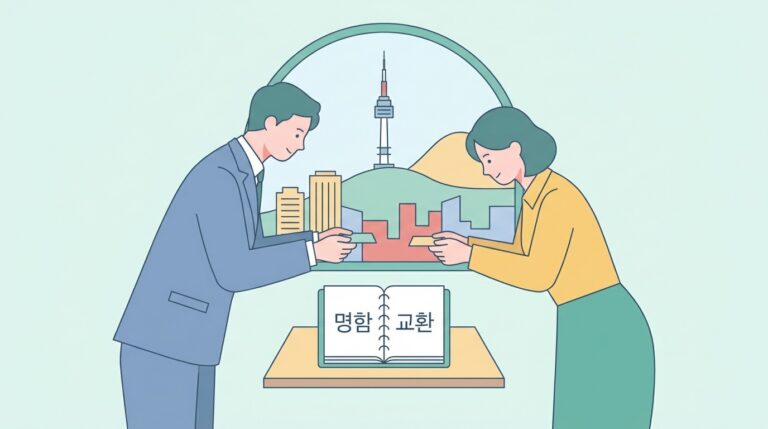
- The Two-Handed Business Card Exchange (Myeong-ham): When you meet a new business partner, exchange cards using both hands. The moment you read their title, acknowledge it verbally with a gentle smile: “아, 김 대리님이시군요! 반갑습니다.” (Ah, you are Daeri-nim Kim! Pleased to meet you.) Place their card on the table beside your notebook during the meeting—never shove it into your back pocket!
- Eye Contact and Posture: When addressing a Gwajang-nim or Timjang-nim, keep your hands softly clasped in front of your waist. Maintain warm, attentive eye contact, but lower your gaze slightly if they are offering constructive feedback.
4-2. Cultural Code
In South Korean corporate hierarchy, titles dictate much more than office emails. They determine who sits where at the restaurant, who enters the elevator first, and who gets served water at a company dinner (hoesik). Calling someone by their exact title is considered an expression of care that honors the sweat and late-night overtime they sacrificed to earn that promotion.
Phase 5: 실전 롤플레이 시나리오 (Interactive Roleplay)
Setting: A vibrant open-plan marketing office in Teheran-ro, Gangnam. It’s 2:30 PM, right after the post-lunch coffee rush.
Characters: You (a motivated foreign associate) & Kim Daeri (your direct mentor, quick-witted and hardworking).
- You: “김 대리님, 바쁘신데 잠깐 질문 드려도 괜찮을까요?” (Gim daerinim, bappeusinde jamkkan jilmun deuryeodo gwaenchaneulkkayo? / 🎭 Holding a printed report with both hands, speaking in a considerate tone)
- Kim Daeri: “네, 민호 씨! 무슨 일이에요? 편하게 말해요.” (Ne, Minho ssi! Museun irieyo? Pyeonhage malhaeyo. / 🎭 Spins around on her swivel chair with a reassuring smile)
- You: “이 기획서 검토가 끝났는데, 박 과장님께 바로 보고드릴까요?” (I gihoekseo geomtoga kkeutnanneunde, Bak gwajangnimkke baro bogodeurilkkayo? / 🎭 Gesturing open-palmed toward the document)
- Kim Daeri: “아, 과장님 지금 임원 회의 중이시니까, 제가 먼저 한번 살펴볼게요.” (A, gwajangnim jigeum imwon hoeui jung-isinikka, jega meonjeo hanbeon salpyeobolgeyo. / 🎭 Receives the paper with two hands, scanning the first page)
- You: “감사합니다, 대리님! 혹시 수정할 부분이 있으면 언제든 말씀해 주세요.” (Gamsahamnida, daerinim! Hoksi sujeonghal bubuni isseumyeon eonjedeun malsseumhae juseyo. / 🎭 Giving a crisp 30-degree nod of gratitude)
- Kim Daeri: “민호 씨는 피드백 반영이 정말 빠르네요. 꼼꼼히 보고 코멘트 남겨둘게요.” (Minho ssineun pideubaek banyeong-i jeongmal ppareuneyo. Kkomkkomhi bogo komenteu namgyeodulgeyo. / 🎭 Nods approvingly with a warm chuckle)
- You: “대리님 덕분에 업무에 훨씬 빨리 적응하고 있습니다.” (Daerinim deokbune eommu-e hwolssin ppalli jeogeunghago itseumnida. / 🎭 Smiling politely with shoulders relaxed)
- Kim Daeri: “좋아요! 이따 오후 4시에 머리 식힐 겸 커피 한잔하러 가요.” (Joayo! Itta ohu nesie meori sikil gyeom keopi hanjanhareo gayo. / 🎭 Taps desk lightly and turns back to her monitor)
🔀 인터랙티브 분기점 (Interactive Decision Point)
Kim Daeri finishes reviewing your document and tells you that Manager Park (박 과장) has just walked out of the conference room. How do you approach Manager Park to submit the final report?
- Choice A: Walk up and say: “박씨, 기획서 다 됐어요!” (Bak-ssi, gihoekseo da dwaesseoyo!)
- 👉 Feedback [Bad ❌]: Disaster! Addressing a manager with surname + 씨 strips away their title and honorifics entirely. It sounds insolent and disrespectful in an office setting.
- Choice B: Walk up, bow slightly, and say: “과장님, 요청하신 기획서 검토 완료되어 전달드립니다.” (Gwajangnim, yocheonghasin gihoekseo geomto wallyeodoeeo jeondaldeurimnida.)
- 👉 Feedback [Best ⭐]: Flawless! Using “과장님” paired with high-formal verbs demonstrates outstanding professionalism and social awareness.
- Choice C: Approach him and say: “박 과장, 여기 기획서 있습니다.” (Bak gwajang, yeogi gihoekseo itseumnida.)
- 👉 Feedback [Risk ⚠️]: Calling someone by their title without “-님” is a privilege reserved exclusively for their higher superiors (like the CEO or Director). Coming from a junior, it sounds condescending.
Phase 6: 10초 감정 섀도잉 드릴 (10-Second Shadowing Drill)
Repeat these sentences aloud, paying attention to the emotion marker and pausing at each /.
[😊 기쁘고 활기차게]
“과장님! / 이번 분기 제안서 / 드디어 최종 승인 났습니다!”
(Gwajangnim! / Ibeon bungi jean-seo / deudieo choejong seung-in natseumnida!)
“Manager! / Our proposal for this quarter / has finally received final approval!”-
[🥺 아쉽고 공손하게]
“대리님, / 오늘 프로젝트 야근 / 끝까지 함께하지 못해 정말 죄송합니다.”
(Daerinim, / oneul peurojekteu yageun / kkeutkkaji hamkkehaji mothae jeongmal joesonghamnida.)
“Daeri-nim, / I am truly sorry / that I cannot stay until the end for tonight’s project overtime.” -
[🫡 깍듯하고 자신감 있게]
“팀장님, / 지시하신 시장 조사 자료 / 내일 오전 회의 전까지 / 완벽히 준비하겠습니다.”
(Timjangnim, / jisihasin sijang josa jaryo / naeil ojeon hoeui jeonkkaji / wanbyeokhi junbihagetseumnida.)
“Team Leader, / the market research report you requested / before tomorrow morning’s meeting / I will have thoroughly prepared.”
Phase 7: K-Culture 미니 사전 (Mini Dictionary)
- 직급 (Jik-geup) | Hierarchical Corporate Rank
The ladder-based rank system (사원 → 대리 → 과장 → 차장 → 부장) used to determine tenure, compensation, and official corporate seniority. - 직책 (Jik-chaek) | Operational Position
The functional leadership role one executes on a team (e.g., 팀장, 실장, 본부장). This takes priority in verbal address over structural rank. - 님 (-nim) | Honorific Suffix
The essential verbal crown attached to professional titles (대리님, 과장님) and respected roles, transforming a simple noun into a respectful honorific. - 회식 (Hoe-sik) | Company Dinner / Team Gathering
An evening dining experience with coworkers where interpersonal hierarchies, seated arrangements, and precise title usage are tested over Korean barbecue and drinks.
Phase 8: 여행자와 직장인을 위한 생존 키트 (Survival Kit)
서바이벌 표현 TOP 3
- “담당자님, 혹시 문의 하나 드려도 될까요?” (Damdangjanim, hoksi munei hana deuryeodo doelkkayo?)
- Pro Tip: When visiting a corporate front desk, city hall, or bank and you do not know the staff member’s exact rank, 담당자님 (Person-in-charge-nim) is the universally polite lifesaver.
- “제가 직함을 어떻게 불러드리면 좋을까요?” (Jega jikhameul eotteoke bulleodeurimyeon joeulkkayo?)
- Pro Tip: If a colleague’s role seems ambiguous after swapping business cards, ask this sincere question. They will appreciate your cultural sensitivity!
- “선배님, 조언해 주셔서 정말 감사합니다.” (Seonbaenim, joeonhae jusyeoseo jeongmal gamsahamnida.)
- Pro Tip: In creative studios, university laboratories, or media production where traditional ranks are blurry, calling a senior mentor 선배님 builds instant rapport.
Editor’s Travel & Business Note
Navigating Seoul for business appointments requires punctuality. Be sure to check the Naver Map subway and transit guide to calculate exact arrival times down to the minute. In Korea, arriving late to a meeting with a Gwajang-nim is considered a major breach of etiquette. Furthermore, save new coworkers in your phone contacts directly as “Kim Daeri” or “Park Gwajang” to prevent accidental first-name slip-ups over chat apps!
Phase 9: “한 발 더 깊이” (Cultural Reflection)
In Western workplace culture, tearing down titles and inviting everyone to use first names is celebrated as a step toward equality and flat organizational communication. In Korea, however, linguistic titles are rooted in deeply relational values. Addressing someone as “김 대리님” is not an attempt to diminish their personal individuality; rather, it is a conscious recognition of their collective contribution, the hours they have poured into their vocation, and their respected place within the community.
💬 Your Turn: How are managers and colleagues addressed in your home country? Do you prefer flat, first-name workplace cultures, or do formal titles create clearer, healthier boundaries? Share your experiences in the comments below!
Phase 10: FAQ & 흔한 실수 (FAQ & Common Mistakes)
Q: Can I use -씨 (-ssi) if my coworker is the exact same age as me?
A: Inside the office, keep “-씨” to an absolute minimum. Even if you are the same age, using their title (김 대리님) or combining their full name with 님 (e.g., 민호 님) is far safer and aligns with modern Korean corporate etiquette.
Q: What should I call a colleague who has no managerial title yet?
A: Entry-level employees without rank are officially 사원 (sawon), but calling them “김 사원” directly can sound patronizing if you are not an executive. Instead, address them respectfully as [Full Name] + 님 (e.g., “지민 님”).
Q: Should I call someone “김 대리님” when reporting about them to the CEO?
A: Traditionally, the grammatical rule known as Apjonbeop (압존법) dictated lowering a junior colleague when speaking to a higher senior (“김 대리가 보고했습니다”). However, modern workplace etiquette has evolved; most Korean companies now encourage keeping the title and honorific intact (“김 대리님이 전달해 주셨습니다”) to maintain mutual workplace respect.
🚨 흔한 실수 (Common Mistakes) 경고판
- Mistake 1: Dropping the -님 suffix when talking to a superior. (Saying “박 과장, 커피 드세요!”)
- Correct Action: Always keep “-님” attached: “박 과장님, 커피 드세요!”
- Mistake 2: Using casual terms like ‘오빠’ (Oppa) or ‘언니’ (Eonni) at the office.
- Correct Action: Even if you are close friends on weekends, revert strictly to professional titles during office hours.
- Mistake 3: Reversing name and title order. (Saying “과장 박” or “대리 김”)
- Correct Action: Always adhere to the Korean order: [Family Name] + [Job Title] + [Honorific 님] → 박 과장님.
Phase 11: 액션 미션 & 참여 유도 (Action Missions)
- 🥉 Bronze Mission (Solo Practice): Stand before a mirror, practice a polite slight bow, and pronounce “김 대리님, 안녕하세요!” five times until the syllables roll smoothly off your tongue.
- 🥈 Silver Mission (Social Sharing): Pick your favorite Korean drama character who works in an office. Post their name and their title formula ([Actor/Character Name] + [Title] + 님) on social media, tagging #DailyHangul!
- 🥇 Gold Mission (Real-world Application): In your next email, message, or conversation with a Korean coworker or language partner, address them using their proper professional title or the respectful [Name] 님 format.
- 🎮 K-Culture Mission: Watch one episode of the corporate drama Misaeng or Agency. Keep a tally of how many times you hear the word ending in “-님” and spot the moment a character transitions between titles!
Phase 12: 인터랙티브 퀴즈 챌린지 (Interactive Quiz)
1. Situational Judgment:
You are an associate who needs Manager Lee (이 과장) to sign off on an urgent budget expense. Which phrase is the most culturally appropriate?
* A) 이씨, 여기 빨리 사인해 줘!
* B) 이 과장님, 서류 서명 부탁드려도 괜찮을까요?
* C) 과장 이, 예산 결재 서류 여기 있어.
2. Fill in the Blank:
Complete the golden formula for addressing a Korean colleague respectfully:
[ Family _________ ] + [ Job _________ ] + [ -_________ ]
3. True or False:
Calling your direct supervisor “오빠” (Oppa) during a formal team meeting is completely fine as long as you went to the same college.
👉 Click here to reveal the answers and explanations!
- Answer: B — “이 과장님, 서류 서명 부탁드려도 괜찮을까요?” combines the proper surname + title + honorific suffix alongside a polite request form.
- Answer: Name / Title / 님 (nim) — Example: 김 (Family Name) + 대리 (Job Title) + 님 (Honorific suffix) = 김 대리님.
- Answer: False — Personal titles like Oppa or Nuna must remain strictly outside the workplace. Inside the office, professional boundaries demand job titles to preserve team order!







