

Phase 1: Empathy (Immersive Storytelling Opening)
안녕하세요! 매일한글 에디터입니다. (Hello! It’s your Daily Hangul editor.)
Picture this: You are settling into a sunlit officetel in Mapo after binge-watching lifestyle vlogs by minimalist Korean creators like Hamimommy or Honeyjubu. Inspired by their pristine aesthetic, you look at your kitchen counter and spot stubborn water stains around the faucet and a scorched patina on your stainless pot. You head to a local supermarket, ready to tackle it, only to find yourself swamped by rows of white powders labeled 베이킹소다 (baking soda), 구연산 (citric acid), and 과탄산소다 (sodium percarbonate). When native Koreans casually discuss eco-friendly domesticity, they don’t just speak about ‘cleaning’—they invoke an entire philosophy of sal-lim (살림), the art of restoring life to everyday spaces. At a C2 mastery level, discussing housekeeping goes beyond rudimentary verbs like 닦다 (to wipe); it requires you to articulate physical nuances, chemical interactions, and the subtle sensory satisfactions that native speakers cherish. Based on years of feedback from advanced learners who want to sound truly native rather than textbook-bound, this guide will equip you with the linguistic precision and cultural fluency needed to master eco-friendly cleaning like an authentic Korean household pro.
Phase 2: In-Depth Breakdown of 3 Key Expressions
1. 찌든 때를 말끔히 불리다
- Pronunciation: [Jji-deun ttae-reul mal-kkeum-hi bul-li-da] (Pronounce jji with a tense, snappy j, like the ‘zz’ in ‘pizza’, and bul-li-da like ‘pool-lee-dah’)
- Meaning: Literally “to soak and swell caked-on grime cleanly”; practically means to thoroughly loosen and dissolve stubborn, set-in dirt or grease before wiping.
- K-Culture Moment: Frequently heard on reality shows like I Live Alone (나 혼자 산다) when a cast member reveals a neglected frying pan and swears by soaking it in boiling baking soda water.
- Editor’s Insight: The verb 불리다 (bullida) originates from swelling grains in water. Using it for grime (때) conveys patience—allowing the alkaline solution to soften the grease organically rather than scrubbing abrasively.
- Situation Spectrum: Casual (✅) | Semi-formal (✅) | Formal (✅)
- 🤔 Think About It: Why does Korean use organic culinary metaphors like ‘불리다’ (swelling) to describe chemical cleaning processes?
2. 구연산수로 물때를 잡다
- Pronunciation: [Gu-yeon-san-su-ro mul-ttae-reul jap-da] (Sound out gu-yeon-san-soo-ro; imagine the tense ttae like the ‘t’ in ‘stop’)
- Meaning: Literally “to catch water stains with citric acid water”; idiomatically means to effectively eliminate and control limescale using a diluted citric acid solution.
- K-Culture Moment: Common in morning talk shows (무엇이든 물어보세요) where home living experts demonstrate descaling electric kettles or glass shower partitions.
- Editor’s Insight: The verb 잡다 (to catch/grip) here functions as a colloquial mastery verb—meaning to tackle a persistent domestic nuisance at its root.
- Situation Spectrum: Casual (✅) | Semi-formal (✅) | Formal (⚠️ – slightly idiomatic for official reports, but standard in broadcast media)
- 🤔 Think About It: In English, we ‘remove’ or ‘wipe away’ stains, but in Korean, we often ‘catch’ (잡다) odors and stains. What does this suggest about the dynamic relationship between the cleaner and the dirt?
3. 과탄산소다로 삶아 빤 듯한 효과를 내다
- Pronunciation: [Gwa-tan-san-so-da-ro sal-ma ppan deu-than hyo-gwa-reul nae-da] (Gwa-tan-san-so-da, followed by sal-ma ppan, where sal-ma sounds like ‘sahl-mah’)
- Meaning: Literally “to produce the effect of having boiled-washed laundry using sodium percarbonate”; practically means achieving clinical, dazzling-white fabric restoration without actual stovetop boiling.
- K-Culture Moment: Revered in mom-cafe communities and lifestyle channels when discussing yellowed pillowcases or dishcloths.
- Editor’s Insight: The cultural baseline of pure cleanliness in Korea is 삶는 빨래 (boiling laundry in a designated steel pot, or 삼숙이). This expression praises an eco-friendly chemical for replicating that arduous traditional labor effortlessly.
- Situation Spectrum: Casual (✅) | Semi-formal (✅) | Formal (✅)
- 🤔 Think About It: Why does the standard of Korean domestic perfection remain anchored to traditional thermal boiling (삶기)?
Phase 3: Textbook Korean vs. Real Native Korean
Scenario 1: Recommending a method for removing kitchen stove grease
- 📖 Textbook Korean: 베이킹 소다를 물에 섞어서 가스레인지의 기름때를 닦아내세요. (Beikingsodareul mure seokkeoseo gaseureinjieui gireumttaereul dakkanaeseyo. / Mix baking soda with water and wipe the gas stove grease.)
- 🗣️ Real Native Korean: 기름때는 베이킹소다 반죽으로 싹 불려 닦아내는 게 국룰이에요. (Gireumttaeneun beikingsoda banjugeuro ssak bullyeo dakkanaeneun ge gungrurieyo. / For greasy residue, slathering on a baking soda paste to soften it up completely is the golden rule.)
- 💡 Why is it different? Advanced native conversation favors sensory adverbs like 싹 (thoroughly/cleanly) and internet-born cultural idioms like 국룰 (unwritten universal rule) to express seasoned domestic competence.
Scenario 2: Admiring the spotless finish of descaled kitchenware
- 📖 Textbook Korean: 냄비 바닥이 아주 깨끗해졌습니다. (Naembi badagi aju kkaekkeuthaejyeotseumnida. / The bottom of the pot has become very clean.)
- 🗣️ Real Native Korean: 탄 자국까지 뽀득뽀득하게 환골탈태했네! (Tan jagukkkaji ppodeuk-ppodeukhage hwangoltaltaehaenne! / Even the scorched marks have transformed completely, leaving it squeaky clean!)
- 💡 Why is it different? C2 Korean leans heavily on mimetic words (뽀득뽀득 – squeaking cleanly under finger pressure) and literary four-character idioms (환골탈태 – complete rebirth/metamorphosis) to add dramatic flair to everyday domestic wins.
Phase 4: K-Culture Deep Dive & Non-Verbal Manners
4-1. 눈치 (Nunchi) & Sensory Verification
When a Korean roommate, mother-in-law, or host inspects a clean countertop or dish, visual cleanliness is only half the battle. The quintessential non-verbal proof of mastery is the acoustic and tactile test: running your thumb firmly across the surface to produce a high-pitched squeak (뽀득 소리). If it slides silently or feels slick, residue remains. Additionally, when handling natural powders around others, never shake the powder high in the air; keep the jar close to the basin and pour gently to avoid airborne dust, demonstrating considerate spatial awareness (배려).
4-2. The Cultural Trajectory of “Sal-lim” (살림)
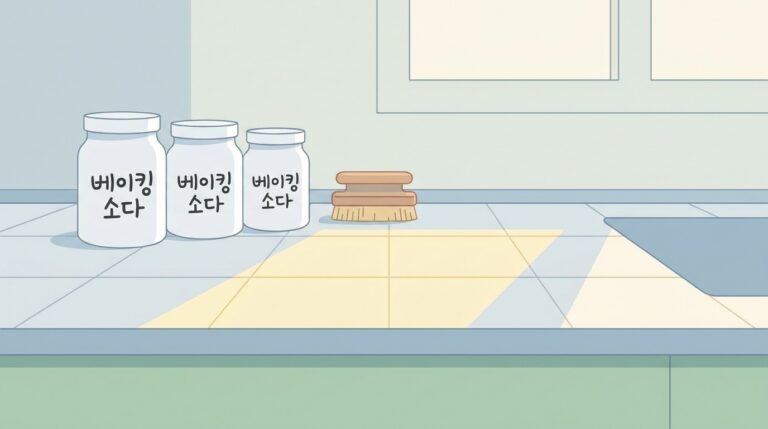
To understand why natural cleaning powders are ubiquitous in modern Korea, one must examine the 2011 humidifier disinfectant scandal (가습기 살균제 사건), a traumatic national event that permanently shifted consumer sentiment away from synthetic aerosol chemicals toward transparent, food-grade mineral compounds. Today, possessing an array of glass jars labeled 베이킹소다, 구연산, and 과탄산소다 is a cultural signifier of sophisticated, conscious living—an aesthetic championed by Sallim-stagram (살림스타그램) influencers who blend slow living with mindful environmental stewardship.
Phase 5: Real-World Roleplay Scenario
Setting: Alex (a C2 learner sharing a flat in Yeonnam-dong) is standing in the kitchen with Min-seo, a design editor and domestic minimalist, inspecting a badly mineral-encrusted stainless kettle and stained dishcloths.
Characters:
* Alex: Eager to master the holy trinity of natural cleaning agents without using chlorine bleach.
* Min-seo: Friendly, detail-oriented flatmate who treats housekeeping as a mindful therapeutic craft.
- Min-seo: 🎭 (전기포트 뚜껑을 열어 내부 바닥의 하얀 얼룩을 가리키며 혀를 살짝 찬다)
이 포트 바닥에 하얗게 앉은 석회질 좀 봐. 수돗물 미네랄 때문에 물때가 제대로 꼈네.
I poteu badage hayake anjeun seokhoejil jom bwa. Sudonmul minerael ttaemune multtaega jedaero kkkyeonne.
“Look at this white limescale settling on the bottom of the kettle. The tap water minerals have left a serious buildup.” -
Alex: 🎭 (찬장에서 구연산 봉투를 꺼내며 자신감 넘치는 미소를 짓는다)
이럴 땐 알칼리성 물때를 산성으로 중화해야 하니까, 구연산 한 스푼 넣고 끓이면 바로 잡히지?
Ireol ttaen alkalliseong multtaereul sanseongeuro junghwahaeya hanikka, guyeonsan han seupun neoko kkeurimyeon baro japhiji?
“At times like this, since we need to neutralize alkaline limescale with acid, boiling a spoonful of citric acid will knock it right out, right?” -
Min-seo: 🎭 (감탄하며 눈을 동그랗게 뜬다)
정답! 끓고 나서 한 십 분 불려두면 굳이 솔질 안 해도 속 시원하게 떨어져 나와.
Jeongdap! Kkeulko naseo han sip bun bullyeodumyeon guji soljil an haedo sok siwonhage tteoreojyeo nawa.
“Bingo! If you let it soak for about ten minutes after boiling, it lifts off effortlessly without any scrubbing.” -
Alex: 🎭 (싱크대 옆 누렇게 변색된 행주들을 가리키며 턱을 괸다)
그럼 이 누렇게 찌든 행주들은 어떻게 소독할까? 락스는 냄새 때문에 머리 아픈데.
Geureom i nureoke jjideun haengjudeureun eotteoke sodokhalkka? Rakseuneun naemsae ttaemune meori apeunde.
“Then how should we sanitize these yellowed, grime-soaked dishcloths? Chlorine bleach gives me a headache because of the harsh odor.” -
Min-seo: 🎭 (싱크대 하부장에서 과탄산소다 통을 꺼내며)
표백에는 과탄산소다가 특효약이지. 따뜻한 물에 풀어서 한 시간 정도 푹 담가두면 삶아 빤 것처럼 뽀얘져.
Pyobaeogeneun gwatansansodaga teukhyoyagiji. Ttatteuthan mure pureoseo han sigan jeongdo puk damgadumyeon salma ppan geotcheoreom pboyaejyeo.
“Sodium percarbonate is the ultimate silver bullet for bleaching. Dissolve it in hot water and submerge them for an hour; they’ll turn snow-white as if boiled.” -
Alex: 🎭 (환기창을 활짝 열며)
과탄산소다 반응할 때 활성산소 기체가 발생하니까, 맞바람 통하게 환기부터 시켜둘게.
Gwatansansoda baneunghal ttae hwalseongsanso gichega balsaenghanikka, matbaram tonghage hwangibuteo sikyeodulge.
“Since active oxygen gas is released when sodium percarbonate reacts, let me open opposite windows first to create a cross-breeze.” -
Min-seo: 🎭 (물개박수를 치며 활짝 웃는다)
우와, 환기까지 신경 쓰다니 살림 내공이 장난 아닌데? 진짜 한국 사람 다 됐어!
Uwa, hwangikkaji singyeong sseudani sallim naegongi jangnan aninde? Jinjja hanguk saram da dwaesseo!
“Wow, paying attention to ventilation too? Your homemaking prowess is no joke! You’ve become a true local!” -
Alex: 🎭 (마른 수건으로 싱크대 주변의 물기를 완벽하게 훔쳐내며)
살림은 템발이 아니라 원리를 아는 과학이라잖아. 잔여물 없이 뽀득뽀득하게 마무리해 보자!
Sallimeun tembari anira wonrireul aneun gwahagirajana. Janyeomul eopsi ppodeuk-ppodeukhage mamurihae boja!
“They say good housekeeping isn’t about fancy gadgets, but understanding the scientific principles. Let’s finish it off squeaky clean with zero residue!”
🔀 Interactive Decision Point
Suppose Min-seo asks if she can mix baking soda and citric acid together in boiling water inside an enclosed drain pipe to clear a clog. How do you respond?
- Option A: “베이킹소다랑 구연산을 섞으면 중화돼서 세척력이 떨어지니까, 각각 따로 시간차를 두고 반응시키는 게 훨씬 과학적이야.” (Mixing baking soda and citric acid neutralizes them and decreases cleaning power, so reacting them sequentially is far more scientific.)
- Option B: “거품이 부글부글 나면 세균이 다 죽는 거니까 무조건 많이 들이붓는 게 최고지!” (When it fizzes vigorously, all bacteria die, so pouring in as much as possible is the best way!)
- Option C: “친환경 세제는 효과 없으니까 그냥 독한 화학 배수구 뚫어뻥을 붓자.” (Eco-friendly cleaners are useless, so let’s just pour harsh chemical drain unclogger.)
Feedback:
* Option A (Best): Flawless chemical and linguistic understanding! Native eco-cleaners know that spontaneous fizzing produces water and sodium citrate, neutralizing cleaning efficacy. Explaining this demonstrates sophisticated C2 intellect.
* Option B (Bad): A common misconception. Bubbles look dramatic, but mutual neutralization degrades surfactant capability. Sounds naive.
* Option C (Risk): Socially abrasive. Dismissing their eco-friendly lifestyle choice disrupts domestic rapport (Nunchi fail).
Phase 6: 10-Second Emotional Shadowing Drill
Practice these lines focusing on pause boundaries (/) and distinct emotional inflections:
[🧐 분석적이고 자신감 있게 / Analytical & Confident]
“기름때에는 / 알칼리성 베이킹소다가 특효약이고, / 물때는 산성인 구연산수로 / 잡는 게 이치에 맞지.”
(Gireumttaeeneun / alkalliseong beikingsodaga teukhyoyagigo, / multtaeneun sanseong-in guyeonsansuro / jamneun ge ichie matji.)
Pause after each topical marker to sound deliberative and authoritative.-
[✨ 감탄하며 개운한 어조로 / Refreshed & Amazed]
“과탄산소다에 불려놨더니 / 누런 얼룩이 싹 빠지고 / 뽀득뽀득 광이 나네!”
(Gwatansansodae bullyeonwatdeoni / nureon eollugi ssak ppajigo / ppodeuk-ppodeuk gwangi nane!)
Emphasize ‘싹’ (ssak) crisply and stress the rhythm of ‘뽀득뽀득’ (ppodeuk-ppodeuk).
Phase 7: K-Culture Mini Dictionary
-
만능세제 (Man-neung-se-je) | DIY Universal Cleaner
Usage: Refers to a viral Korean home-cleaning formula typically made by blending baking soda, dish soap, water, and vinegar in specific ratios. Used widely across Korean lifestyle blogs to tackle grout and stove grease in one stroke. -
뽀득뽀득 (Ppo-deuk-ppo-deuk) | Squeaky-clean (Onomatopoeia/Mimetic)
Usage: The holy grail adjective-adverb of dishwashing and surface wiping. Denotes total absence of lipid film. If your dishes don’t feel ppo-deuk-ppo-deuk, a Korean elder will assume they need rinsing again. -
애벌빨래 (Ae-beol-ppal-lae) | Pre-wash / Stain spot-treatment
Usage: The preparatory act of rubbing sodium percarbonate paste or laundry bar soap onto collars and cuffs before putting them into the main cycle. -
살림력 (Sal-lim-nyeok) | Domestic Competence / Homemaking Acumen
Usage: A composite of sal-lim (housekeeping) and ryeok (power/capability). Having high sal-lim-nyeok is a prestigious social compliment regardless of gender, signaling resourcefulness, organization, and mindfulness.
Phase 8: Traveler’s Survival Kit
TOP 3 Survival Phrases for Eco-Cleaners in Korea
- “친환경 다목적 세제 코너가 어디에 있나요?”
Chinhwangyeong damokjeok seje koneoga eodie innayo?
Pro Tip: Use this at hypermarkets like E-Mart or Homeplus when locating non-toxic, eco-certified lines. - “과탄산소다랑 구연산 대용량 리필용으로 주세요.”
Gwatansansodarang guyeonsan daeyongryang ripil-yongeuro juseyo.
Pro Tip: Buying bulk refill pouches (ripil-yong) is significantly cheaper than rigid plastic dispensers. - “스프레이 공병이랑 계량스푼도 같이 살 수 있을까요?”
Seupeurei gongbyeong-irang gyeryangseupundo gachi sal su isseulkkayo?
Pro Tip: Essential at Daiso for acquiring the spray bottles and measuring spoons required to make citric acid water.
Editor’s Travel Note
When hunting for raw cleaning compounds in Korea, don’t waste time wandering boutique supermarkets. Head straight to the nearest multi-story store located via the Daiso store locator on Naver Map. Daiso stocks dedicated, color-coded bags of baking soda (green/blue), citric acid (orange), and sodium percarbonate (pink) for under 3,000 KRW each. Remember that payment at Daiso is largely unmanned: scan the product barcodes at the self-checkout kiosk and settle the bill instantly using your international debit/credit card or mobile T-Money.
Phase 9: A Step Deeper (Humanities Thought Essay)
In Western linguistic traditions, housekeeping is frequently termed ‘chores’—implying mundane, repetitive toil that steals time from meaningful life. In stark contrast, the Korean root word for domestic life, 살림 (Sal-lim), is the substantive noun form of the verb 살리다 (Sallida)—literally meaning to revive, resurrect, or breathe life into. When a Korean homemaker clears mineral stains with citric acid or rejuvenates greyed cotton with sodium percarbonate, the action is culturally perceived not as an onerous task, but as an act of vital revitalization: restoring dull objects back to their vibrant essence and sustaining the wellbeing of the household collective.
💬 Your Turn: Does your native culture frame cleaning as an uninspiring chore, or does it carry an underlying spiritual or revitalizing philosophy like sal-lim? Share your thoughts below in Korean!
Phase 10: FAQ & Common Pitfalls
Q: Can I mix baking soda and citric acid together in one spray bottle for daily storage?
A: Absolutely not. While the initial bubbling reaction looks impressive, baking soda (a weak base) and citric acid (a weak acid) neutralize each other into water and a harmless salt, destroying the specific grease-cutting alkaline nature of baking soda and the limescale-dissolving acidity of citric acid. Prepare a fresh citric acid water spray (구연산수) for scales, and use baking soda as a mechanical scrubbing paste separately.
Q: Why shouldn’t I use sodium percarbonate (과탄산소다) in cold water?
A: Sodium percarbonate requires warm water (at least 40°C–60°C) to break down into sodium carbonate and hydrogen peroxide, which yields active oxygen for whitening. Using cold water will leave undissolved granules that adhere stubbornly to clothing fibers.
Q: Is it safe to use citric acid on marble kitchen countertops?
A: No! Natural marble contains calcium carbonate. Acidic solutions like citric acid (or vinegar) will chemically etch the stone, stripping its gloss and causing permanent dull patches. Restrict citric acid to stainless steel, glass, and ceramic tiles.
🚨 Common Mistakes Warning Board
- Mistake: Boiling sodium percarbonate in a closed, unventilated room.
Correct Action: Sodium percarbonate generates rapid oxidation gases. Always crack open windows (맞바람 환기) and wear rubber gloves (고무장갑). - Mistake: Using citric acid on aluminum pots.
Correct Action: Acid corrodes aluminum, causing black discoloration. Use citric acid exclusively on high-grade stainless steel (스테인리스). - Mistake: Storing mixed citric acid spray at room temperature for months.
Correct Action: Without artificial preservatives, water-diluted citric acid can develop mold over time. Mix small batches and consume within 2–3 weeks.
Phase 11: Action Missions
- 🥉 Bronze Mission (Solo Shadowing): Stand in front of your bathroom mirror with a cloth and say out loud three times with crisp inflection: “구연산수로 수전 물때를 싹 잡아서 뽀득뽀득하게 만들었어요!”
- 🥈 Silver Mission (Digital Engagement): Take a photo of an eco-friendly cleaning item in your home, post it to your Instagram story, and caption it in Korean using the term
#살림력and#찌든때제거. - 🥇 Gold Mission (Real-world Application): Visit a Korean mart or Daiso, locate the natural cleaning aisle, and ask an associate where to find replacement spray nozzles using natural honorific phrasing: “실례지만 구연산수 담을 분무기 공병은 몇 번 코너에 있나요?”
🎮 K-Culture Media Mission: Watch an episode of tvN’s Three Meals a Day (삼시세끼) or Youn’s Stay (윤스테이). Spot how cast members scrub greasy iron cauldrons (가마솥) or wash dishes, noting when they mention natural abrasives or hot-water scalding.
Phase 12: Interactive Quiz Challenge
Question 1 (Situational Judgment)
Your roommate left an electric kettle caked with chalky white mineral residue at the base. What is the most culturally and chemically proficient approach?
* A) Pour sodium percarbonate with cold water and let it sit sealed.
* B) Boil water with a tablespoon of citric acid, let it sit for 10 minutes, then rinse.
* C) Scrub vigorously with an abrasive wire sponge and laundry bleach.
Question 2 (Fill in the Blank)
행주에 찌든 누런 얼룩을 하얗게 만들려면 뜨거운 물에 ( )를 풀어 담가두는 것이 가장 효과적이다.
Question 3 (True or False Cultural Insight)
True or False: In Korean culture, the word ‘살림’ shares the same linguistic root as ‘살리다’ (to revive or save life).
👉 Click here to reveal the answers and explanations!
-
Answer: B
Explanation: Limescale is alkaline calcium/magnesium residue, which is dissolved seamlessly by acidic citric acid (구연산). Wire sponges will scratch stainless steel coatings. -
Answer: 과탄산소다 (Sodium Percarbonate)
Explanation: Sodium percarbonate dissolves into hydrogen peroxide and washing soda in hot water, providing the oxygen-bleaching effect native Koreans describe as 삶아 빤 듯한 효과. -
Answer: True
Explanation: As explored in Phase 9, 살림 directly stems from the verb 살리다, highlighting the traditional philosophy that caring for a house brings vitality to the living space.






