

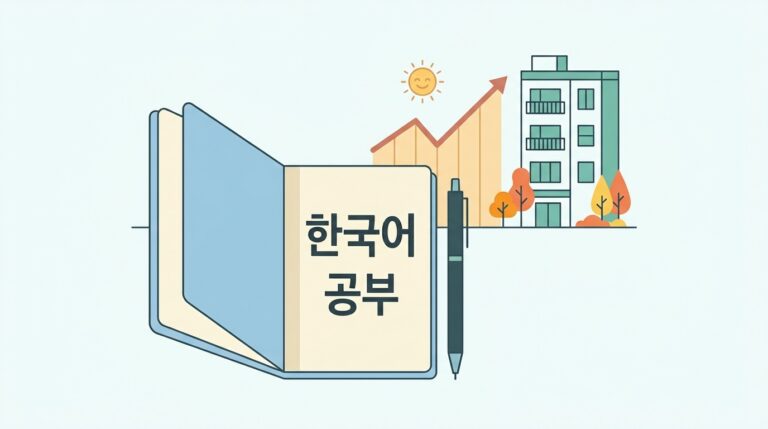
Tackling Korean Property Taxes Like a Local: Inside the Assessed Price Roadmap
Phase 1: Empathy & Narrative Immersion
안녕하세요! 매일한글 에디터입니다. (Hello! I’m your Daily Hangul editor.)
Picture this scene from a Seoul weekend drama: A family is gathered around the dinner table, clinking glasses of barley tea, when the father suddenly drops his spoon. An official mail notification from the local district office has landed on the entryway console. It is July, the dreaded month of the first installment of property tax (재산세, jaesanse). Eyes widen, voices drop to a hush, and someone whispers, “로드맵 바뀐다더니 공시가 진짜 내려간 거 맞아?” (They said the roadmap was changing—did the assessed values actually drop?).
If you have lived in Korea long enough or navigated investments in the peninsula, you know that real estate is not merely personal finance; it is a full-fledged cultural battlefield and national sport. Foreign residents and seasoned professionals reaching the C2 level often hit an invisible wall right here. You can debate literature or dissect Korean political structures, but the moment conversations pivot to the “공시 가격 현실화 로드맵” (Official Assessed Price Realization Roadmap) and its direct impact on comprehensive real estate holding taxes, standard vocabularies crumble.
This guide was forged from real inquiries and missteps observed in executive language coaching sessions in Yeouido and Gangnam. By mastering these intricate policy expressions and their cultural subtext, you will move beyond mechanical proficiency and step straight into the nuanced economic psyche of contemporary Korea.
Phase 2: In-Depth Breakdown of 3 Core Expressions
1. 공시 가격 현실화 로드맵 (Gongsi gagyeok hyeonsilhwaryul rodeumaep)
- Pronunciation: Gong-see gah-gyeok hyeon-seel-hwa roh-deu-maep (Think of the crisp gong of a temple bell followed by the brisk rhythm of see-gah).
- Meaning: Literal: “Publicly Announced Price Realization Roadmap.” Nuance: The state’s structured statutory schedule to elevate government-assessed real estate prices to match actual market transaction values (시세, sise).
- K-Culture Moment: Evoked in economic debates and news broadcasts like JTBC Newsroom when analyzing why average middle-class apartment owners experienced sudden surges in their health insurance premiums and local tax obligations.
- Editor’s Insight: “현실화” (realization) sounds positive—bringing things to “reality.” However, in the context of Korean tax politics, it became synonymous with “hidden tax hikes” (우회 증세, uhoe jeungse). Knowing this contrast distinguishes a C2 speaker from an intermediate learner.
- Situation Spectrum: Casual: ⚠️ | Semi-formal: ✅ | Formal: ✅
- 🤔 Think About It: Does your home country calculate asset taxes based strictly on annual market price assessments, or do you use historical acquisition costs? Why might raising assessed values trigger more emotional pushback than raising standard tax percentages?
2. 세부담 상한제 (Sebudam sanghanje)
- Pronunciation: Seh-boo-dahm sahng-hahn-jeh (Rhymes loosely with say-boo-calm followed by song-hahn-jay).
- Meaning: Literal: “Tax Burden Upper Limit System.” Nuance: A legislative ceiling preventing property taxes from spiking past a fixed percentage (e.g., 105% to 150%) compared to the preceding fiscal year, safeguarding homeowners from volatile market surges.
- K-Culture Moment: Frequently referenced in fiscal planning dramas like Agency or real estate YouTube panel discussions when calculating whether holding an asset in an overheated speculative zone (투기과열지구) remains financially viable.
- Editor’s Insight: When policy makers alter or scrap the realization roadmap, the “세부담 상한” acts as the shock absorber. Using this term shows you understand the arithmetic balancing acts of Korean municipal governance.
- Situation Spectrum: Casual: ⚠️ | Semi-formal: ✅ | Formal: ✅
- 🤔 Think About It: In Korean society, stability and predictability in asset preservation often override pure market dynamics. How does this reflect the post-war emphasis on housing security?
3. 조세 저항 (Jose jeohang)
- Pronunciation: Joh-seh juh-hahng (Blend the soft joh-say with the open, resonant juh-hahng).
- Meaning: Literal: “Tax Resistance.” Nuance: Collective public pushback, civil discontent, or legal complaints against perceived unjust or punitive taxation mechanisms.
- K-Culture Moment: Used by newspaper columnists to describe voter backlashes in apartment-dense districts like Songpa, Bundang, and Mapo during general elections.
- Editor’s Insight: 조세 저항 is rarely violent protest; rather, it manifests at the ballot box, through petition drives on the presidential office bulletin board, or via organized appeals during the public review period for assessed home prices (공시가격 열람 기간).
- Situation Spectrum: Casual: ⚠️ | Semi-formal: ✅ | Formal: ✅
- 🤔 Think About It: Notice how the word 저항 (resistance)—often reserved for historical independence movements—is applied here to tax policy. What does this reveal about property ownership as an existential matter in Korea?
Phase 3: Textbook Korean vs. Real Native Korean
Situation 1: Discussing the Government’s Policy Revision
- 📖 교과서 한국어:
정부는 공시 가격 현실화 계획을 전면 재검토하기로 결정했습니다.
(Jeongbuneun gongsi gagyeok hyeonsilhwa gyehoegeul jeonmyeon jaegeomtohagiro gyeoljeonghaessseumnida.)
“The government has decided to comprehensively re-examine the official price realization plan.” - 🗣️ 진짜 한국어:
공시가 로드맵 사실상 폐기되면서 세부담이 확 줄어들게 생겼어요.
(Gongsiga rodeumaep sasilsang pyegidoemyeonseo sebudami hwak jureodeulge saenggyeosseoyo.)
“With the assessed value roadmap virtually scrapped, our tax burden looks set to drop dramatically.” - 💡 왜 다를까?: Native speakers replace formal bureaucratic verbs like 전면 재검토하다 with decisive colloquial markers like 사실상 폐기되다 (practically discarded) and emotive adverbs like 확 (suddenly/substantially) to emphasize direct personal financial impact.
Situation 2: Reacting to an Unanticipated Property Tax Assessment
- 📖 교과서 한국어:
부동산 가격 변동으로 인해 재산세 납부액이 크게 증가했습니다.
(B不動san gagyeok byeondongeuro inhae jaesanse napbuaegi keuge jeunggahae-ssseumnida.)
“Due to changes in real estate prices, the amount of property tax paid has significantly increased.” - 🗣️ 진짜 한국어:
집값은 떨어졌는데 공시가만 올라서 완전 세금 폭탄 맞았잖아요.
(Jipgapseun tteoreojyeonneunde gongsigaman ollaseo wanjeon segeum poktan majatjanayo.)
“Home prices actually fell, but the assessed value jumped, so we got totally hit with a tax bomb!” - 💡 왜 다를까?: The vivid idiom 세금 폭탄을 맞다 (to be hit by a tax bomb) captures the collective visceral reaction of citizens when fiscal valuation models decouple from ground-level market sentiment.
Phase 4: K-Culture Deep Dive & Non-verbal Manners
4-1. Nunchi & Gestures: Navigating Tax Conversations
Real estate wealth in Korea is an emotional minefield. If you discuss paying property taxes (재산세) or the national comprehensive real estate holding tax (종합부동산세, commonly abbreviated as 종부세), posture matters:
* The Humble Tilt: Never gloat about asset valuations. When acknowledging a large tax bill, lower your shoulders, offer a dry self-deprecating smile, and shake your head slightly. This signals that you feel the squeeze alongside everyone else.
* Avoid Exact Tiering: Unless speaking with your certified tax accountant (세무사), avoid quoting your exact evaluated bracket. Use generalized markers like “작년 수준으로 동결돼서 다행이에요” (I’m relieved it was frozen at last year’s level) to practice graceful, socially cohesive nunchi.
4-2. Cultural Code Analysis: The Myth of “Real Estate Invincibility” (부동산 불패)
From classic family sagas to high-stakes legal thrillers like Reborn Rich, property in Korea represents far more than shelter. Rapid post-1970s urbanization turned apartment complexes in Gangnam and the broader Seoul Metropolitan Area into primary vehicles for intergenerational wealth transfer.
Because of the belief in 부동산 불패 (the myth that Korean real estate never truly fails over the long run), the formula by which the state evaluates property—the 공시 가격—is scrutinized intensely. The “Realization Roadmap” introduced by previous leadership aimed to push assessed values up to 90% of open-market prices. When housing markets chilled, paper assessments remained elevated, forcing homeowners without immediate liquidity to pay hefty levies. Hence, the current political imperative to adjust the roadmap is framed as restoring economic balance and fairness.
Phase 5: Real-Life Roleplay Scenario
- Setting: The calm, wood-paneled office of a veteran certified tax accountant (세무사) near Seocho Court Station in Seoul. Rain taps softly against the large glass window.
- Characters:
- Alex: An expat senior corporate director who owns an apartment in Mapo-gu.
- 세무사 박진우 (Park Jin-woo): An insightful, sharp-eyed tax professional with 25 years of field experience.
Turn 1
Alex: 박 세무사님, 이번에 공시 가격 로드맵 손질한다는 뉴스 봤는데 제 고지서에도 영향이 있을까요?
(Bak semusanim, ibeone gongsi gagyeok rodeumaep sonjilhandaneun nyuseu bwanneunde je gojiseoedo yeonghyangi isseulkkayo?)
“Tax Accountant Park, I saw the news about revising the official price roadmap—will that impact my tax notice?”
🎭 서류 봉투를 테이블 위에 조심스럽게 내려놓으며 의아한 표정을 짓는다.
Turn 2
박 세무사: 그럼요. 로드맵 수정을 통해 현실화율을 2020년 수준으로 동결하기로 했으니 숨통이 좀 트이실 겁니다.
(Geureomyo. Rodeumaep sujeongeul tonghae hyeonsilhwaryureul 2020nyeon sujuneuro donggyeolhagiro haesseuni sumtongi jom teuisil geomnida.)
“Certainly. By revising the roadmap and freezing the realization rate at 2020 levels, you’ll have some breathing room.”
🎭 돋보기안경을 고쳐 쓰며 안도감을 주는 옅은 미소를 짓는다.
Turn 3
Alex: 다행이네요. 작년엔 집값 시세는 내렸는데 세금은 오히려 뛰어서 솔직히 납득하기 어려웠거든요.
(Dahaeng-ineyoyo. Jaknyeonen jipgap siseneun naeryeonneunde segeumeun ohiryeo ttwieoseo soljikhi napdeukhagi eoryeowotgeodeunyo.)
“That is a relief. Last year, market prices dropped yet my taxes leaped, which was honestly hard to wrap my head around.”
🎭 가슴을 가볍게 쓸어내리며 고개를 끄덕인다.
Turn 4
박 세무사: 전형적인 공시가 역전 현상 때문이었죠. 시세 반영률을 무리하게 올리다 보니 발생했던 부작용입니다.
(Jeonhyeongjeogin gongsiga yeokjeon hyeonsang ttaemunieotjyo. Sise banyeongryureul murihage ollida boni balsaenghaetdeon bujagyong-imnida.)
“That was due to the textbook assessed-price inversion phenomenon. An adverse side-effect of pushing up market-parity targets too aggressively.”
🎭 모니터 화면의 실거래가 그래프를 손가락으로 짚으며 차분하게 설명한다.
Turn 5
Alex: 그럼 올해 재산세 과세표준은 공정시장가액비율까지 감안해서 계산되는 건가요?
(Geureom olhae jaesanse gwasepyojuneun gongjeongsijanggaaekbiyulkkaji gamanhaeseo gyesandoeneun geongayo?)
“Then is this year’s property tax assessment base calculated by factoring in the fair market value ratio as well?”
🎭 수첩을 펼쳐 핵심 단어를 메모할 준비를 한다.
Turn 6
박 세무사: 정확하게 짚으셨네요! 1주택자 특례 비율이 연장 적용되면 과표 자체가 낮아져서 부담이 한결 덜할 겁니다.
(Jeonghwakhage jipeusyeonneoyo! Iljutaekja teungnye biyuri yeonjang jeogyongdoemyeon gwapyo jachega najajyeoseo budami hangyeol deolhal geomnida.)
“Spot on! If the special ratio for single-home owners gets extended, the tax base itself shrinks, noticeably easing your burden.”
🎭 감탄한 듯 눈을 반짝이며 계산기 숫자를 두드린다.
Turn 7
Alex: 주변 다주택자 지인들은 여전히 종부세 중과세율 때문에 긴장하고 있던데요.
(Jubyeon dajutaekja jiindeureun yeojeonhi jongbuse junggwase-yul ttaemune ginjanghago itdeondeyo.)
“Some multi-homeowner acquaintances around me still seem anxious about punitive comprehensive tax brackets.”
🎭 목소리 톤을 약간 낮추며 조심스럽게 질문한다.
Turn 8
박 세무사: 정책 기조가 징벌적 과세 완화로 돌아섰지만, 국회 입법 상황을 끝까지 예의주시해야 합니다.
(Jeongchaek gijoga jingbeoljeok gwase wanhwaro doraseotjiman, gukhoe ipbeop sanghwangeul kkeutkkaji yeuijusihayeoya hamnida.)
“While policy stances shifted toward easing punitive taxation, one must closely watch pending legislative developments in the National Assembly.”
🎭 찻잔을 건네며 신중한 눈빛으로 조언한다.
🔀 Interactive Decision Point
How should Alex respond to wrap up this technical consultation?
* Choice A: “네, 입법 공백 상태가 생기지 않는지 계속 모니터링하면서 대응해야겠네요. 명쾌한 상담 감사합니다.” (Yes, I should monitor the situation to ensure no legislative vacuum catches me off guard. Thank you for the crystal-clear consultation.)
* Choice B: “어차피 법 바뀌면 세금 안 내도 되는 거 아닌가요? 그냥 고지서 나올 때까지 버텨볼게요.” (If the law changes anyway, doesn’t that mean I don’t have to pay? I’ll just hold out until the notice arrives.)
* Choice C: “한국 세법은 너무 변덕스러워서 도무지 신뢰할 수가 없네요. 다 팔고 떠나는 게 낫겠습니다.” (Korean tax law is so fickle I can’t trust it at all. It might be better to sell everything and leave.)
Detailed Feedback:
* Choice A (Best): Perfect C2 pragmatic execution. Demonstrates an understanding of institutional policy lag (입법 공백) and maintains high-register client etiquette.
* Choice B (Bad): Risky legal misunderstanding. Property taxes are determined under existing statutes until formal amendments take effect; failing to prepare incurs delinquency surcharges (가산세).
* Choice C (Risk): Culturally tone-deaf. While frustration with policy fluctuation is widespread, expressing sweeping dismissiveness to a professional adviser damages rapport and closes off constructive strategic advice.
Phase 6: 10-Second Emotion Shadowing Drill
Master the natural pauses and emotional cadence used by Korean policy analysts.
[🧐 차분하고 객관적으로 / Calmly & Objectively]
공시 가격 현실화 계획을 수정하면서 / 과세표준 급증에 따른 납세자의 불안이 / 상당 부분 해소되었습니다.
(Gongsi gagyeok hyeonsilhwa gyehoegeul sujeonghamyeonseo / gwasepyojun geupjeunge ttareun napsaejaui burani / sangdang bubun haesodoeeosseumnida.)
“By revising the assessed price realization roadmap, / taxpayer anxieties tied to sudden jumps in tax bases / have been largely alleviated.”-
[😮 답답함을 토로하며 / Expressing Frustration]
집값 하락기에 / 공시가만 고공행진을 이어가면 / 조세 저항이 일어나는 건 / 너무나 당연한 수순 아닌가요?
(Jipgap harakkie / gongsigaman gogonghaengjineul ieogamyeon / jose jeohangi ireonaneun geon / neomuna dangyeonhan susun aningayo?)
“During a housing downturn, / if assessed values alone continue skyward, / isn’t public tax resistance / an utterly predictable outcome?” -
[😌 안도하며 신중하게 / Relieved yet Prudent]
세부담 상한선이 작동해서 다행이긴 하지만, / 내년도 공시가 추이는 / 여전히 지켜봐야 할 변수입니다.
(Sebudam sanghanseoni jakdonghaeseo dahaeng-igin hajiman, / naenyeondo gongsiga chuineun / yeojeonhi jikyeobwaya hal byeonsu-imnida.)
“While it is a relief the tax burden cap engaged, / next year’s assessed price trajectory / remains an unpredictable variable to track.”
Phase 7: K-Culture Mini Dictionary
- 보유세 (Boyuse)
- Translation: Comprehensive Holding Taxes.
- Usage: An umbrella term encompassing local Property Tax (재산세) and national Comprehensive Real Estate Holding Tax (종합부동산세). Used daily in news headlines when evaluating aggregate annual carrying costs for assets.
- 공정시장가액비율 (Gongjeongsijanggaaekbiyul)
- Translation: Fair Market Value Ratio.
- Usage: A government-adjusted regulatory percentage applied to assessed official prices to determine the taxable base (과세표준). Lowering this percentage cushions homeowners even before statutory tax brackets change.
- 징벌적 과세 (Jingbeoljeok gwase)
- Translation: Punitive Taxation.
- Usage: Rhetoric deployed by market-oriented economists and property owners to critique steeply graduated tax brackets levied on multi-home owners as an unfair penalty rather than equitable revenue collection.
- 똘똘한 한 채 (Ttolttolhan han chae)
- Translation: “One Smart Prime Property.”
- Usage: A iconic socioeconomic buzzword denoting the strategic trend of divesting multiple suburban or regional properties to concentrate capital into a single, high-value apartment located in prime districts like Gangnam or Yongsan.
Phase 8: Expat & Investor Survival Kit
-
Top 3 High-Utility Expressions:
- 재산세 고지서 재발급해 주실 수 있나요?
(Jaesanse gojiseo jaebalgeubhae jusil su 있nayo?)
Pro Tip: Use this at your local Community Service Center (주민센터) if you missed physical mailings in July or September. - 1세대 1주택 감면 혜택 대상인지 확인하고 싶습니다.
(Il-sedae il-jutaek gammyeon hyetaek daesang-inji hwaginhago sipsumnida.)
Pro Tip: Invaluable when calling the district revenue department (세무과) to check eligibility for single-household property tax breaks. - 공시가격 이의신청 절차가 어떻게 됩니까?
(Gongsigagyeok ui-sincheong jeolchaga eotteoke doemniga?)
Pro Tip: Essential during spring if you feel the government valuation of your unit diverges sharply from comparable sales on your floor.
- 재산세 고지서 재발급해 주실 수 있나요?
- Editor’s Real Estate Expat Note:
To check your real estate assessment and property tax liabilities seamlessly, bookmark the official portal 부동산공시가격 알리미 서비스 and ensure you have digital authentication set up via the 국세청 홈택스 앱 다운로드. Remember: Korean property taxes on housing are divided into two equal payments—50% due between July 16–July 31, and the remaining 50% due between September 16–September 30. Missing these deadlines triggers an immediate 3% surcharge (납부지연가산세).
Phase 9: “한 발 더 깊이” (Deep Reflection)
In modern Korea, real estate policy sits at the intersection of Confucian family obligation, rapid modernization trauma, and democratic egalitarianism. Because private apartment ownership functions as the bedrock for elder care and children’s wedding endowments, any state revision altering holding costs strikes directly at family security networks. The ongoing tension between progressive redistribution ideals and conservative asset-protection guarantees illustrates why property tax adjustments in Seoul often trigger louder political seismic waves than foreign policy debates.
💬 Your Turn: Does your home culture view property taxation primarily as an instrument of social wealth leveling or as a direct service fee for municipal maintenance? How would public opinion react in your city if assessed property values were artificially surged by government mandate? Share your thoughts below in Korean!
Phase 10: FAQ & Common Pitfalls
Q: 공시가격 (Assessed Value) and 실거래가 (Actual Transaction Price) are different. Which determines my local property tax?
A: Local property taxes (재산세) are determined strictly using the 공시가격 (assessed value), modified by the statutory 공정시장가액비율 (fair market value ratio) to form the 과세표준 (tax base). Actual market transaction prices (실거래가) influence how next year’s assessed value is formulated, but they do not appear directly on your tax bill.
Q: What is the primary difference between 재산세 and 종합부동산세 (종부세)?
A: 재산세 is a municipal tax (지방세) levied by your local Gu/Si on all property owners regardless of aggregate national net worth. 종합부동산세 is a progressive national tax (국세) levied exclusively on individuals whose combined residential assessed property values exceed high statutory thresholds (e.g., 1.2 billion KRW for single-home owners).
Q: Why did the government choose to freeze or modify the “Realization Roadmap” instead of permanently abolishing it through law?
A: Comprehensive statutory abolishment requires sweeping amendments passed through the National Assembly (국회), where opposing political coalitions hold differing views on wealth distribution. Freezing the realization factor or lowering the fair market ratio can be executed directly via presidential enforcement decrees (대통령령), offering immediate relief without legislative deadlock.
🚨 Common Mistakes Alert
- Mistake: Confusing 기준시가, 공시지가, and 공시가격.
- Correction: Use 공시지가 exclusively for land plots (토지). Use 공시가격 for residential housing units and apartments (공동주택/단독주택). Use 기준시가 for commercial complexes and officetels (오피스텔/상가).
- Mistake: Assuming property taxes are paid in a single lump-sum bill annually.
- Correction: Property tax on Korean homes is split into two equal installments billed in July and September. Do not assume you are finished for the year after paying in July!
- Mistake: Stating “세금을 깎아주다” in high-level fiscal or professional contexts.
- Correction: Upgrade your register to 세부담을 완화하다 (mitigate tax burden) or 감면 혜택을 부여하다 (grant reduction benefits).
Phase 11: Action Missions
- 🥉 Bronze Mission (Solo Mastery): Open a notebook and practice writing out the difference between 시세 (market price), 공시가격 (assessed value), and 과세표준 (tax base) in 3 formal Korean sentences.
- 🥈 Silver Mission (Social Exploration): Visit an online Korean news portal (such as Naver News or Daum), search for the phrase “공시가격 로드맵”, read the top editorial, and leave a brief comment summarizing whether the editorial leans supportive or critical.
- 🥇 Gold Mission (Real-world Execution): During your next conversation with a Korean real estate agent (공인중개사) or colleague, initiate a high-level exchange using the question: “공시가 현실화율이 조정되면서 올해 재산세 부담은 좀 줄어들 것 같나요?” (With the assessed value realization rate adjusted, do you think this year’s property tax burden will ease somewhat?).
- 🎮 K-Culture Mission: Watch an episode of a drama dealing with high society or family wealth (e.g., Sky Castle or Little Women) and listen for scenes where family members argue over assets, land titles, or taxes. Transcribe one sentence demonstrating their tone.
Phase 12: Interactive Quiz Challenge
Test your C2 mastery of Korean real estate policy discourse!
1. Contextual Judgment
Which expression best completes the sentence naturally and professionally?
“정부가 과도한 보유세 부담을 줄이기 위해 공시가격 현실화율을 하향 조정하자, 시장에서는 일단 ( ) 현상이 진정될 것으로 내다보고 있다.”
(A) 똘똘한 한 채
(B) 조세 저항
(C) 전세 사기
2. Fill-in-the-Blank
Fill in the missing technical term:
“재산세 계산 시 공시가격 전체에 세율을 곱하는 것이 아니라, 대통령령으로 정하는 ( )를 곱하여 최종 과세표준을 산출합니다.”
3. True / False Cultural Check
True or False: In Korea, when talking to casual acquaintances, it is considered polite and impressive to boast openly about being in the top bracket of the national Comprehensive Real Estate Holding Tax (종합부동산세).
🔍 Click here to reveal Answers & Explanations
- Answer: (B) 조세 저항
- Explanation: The sentence discusses lowering the realization rate to reduce excessive tax burdens, which relieves public tax dissatisfaction and civic pushback (조세 저항). Option A refers to a single trophy asset, and Option C refers to lease fraud.
- Answer: 공정시장가액비율 (Fair Market Value Ratio)
- Explanation: The assessed price (공시가격) is multiplied by the 공정시장가액비율 to establish the taxable base (과세표준) before progressive rates apply.
- Answer: False
- Explanation: Even among affluent circles, ostentatious bragging about paying high comprehensive holding taxes breaks social harmony (nunchi). Korean conversational etiquette favors humility, shared lamentation over fiscal complexities, and understated references to asset management.
- Explanation: Even among affluent circles, ostentatious bragging about paying high comprehensive holding taxes breaks social harmony (nunchi). Korean conversational etiquette favors humility, shared lamentation over fiscal complexities, and understated references to asset management.







