

Phase 1: Empathy & Storytelling Opening
안녕하세요! 매일한글 에디터입니다. (Hello! I’m your Daily Hangul editor.)
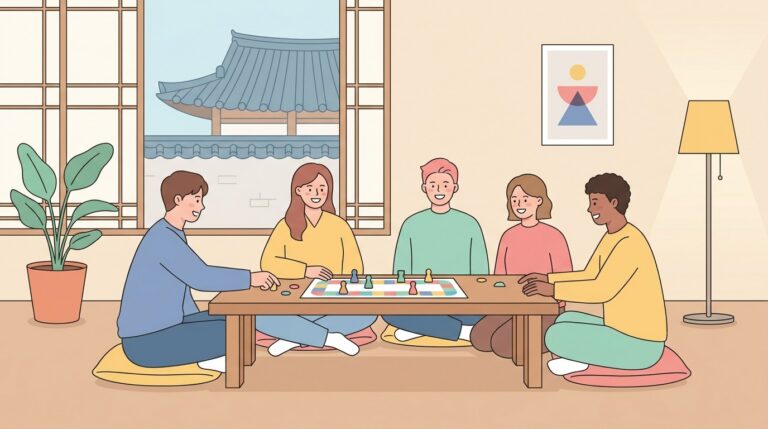
Picture this: You take off your shoes at the entryway, hand over a generous pack of toilet paper or laundry detergent—the classic Korean housewarming (집들이, jipdeuri) gifts—and enjoy delicious home-delivered fried chicken and tteokbokki. The vibe is cozy, warm, and relaxing. But suddenly, the host clears the low living room table, pulls out a set of cards or a bell, and shouts: “자, 게임 한 판 하자!” (Alright, let’s play a game!)
Instantly, your heart races. Everyone starts chanting rhythmic tongue-twisters, clapping their hands in sync, and pointing fingers across the table. When the turn swings toward you, your mind goes completely blank. You know your Korean textbook vocabulary, but what on earth do you say when you miss a turn, accidentally ring a bell, or want to beg for mercy?
Don’t worry! Korean housewarming games aren’t a test of fluency—they are a cultural invitation to connect and share warmth (정, jeong). Today, based on real feedback from fellow beginner learners, we’ll master the 3 golden phrases and insider social cues that will transform you from a nervous spectator into the life of the party.
Phase 2: Core Expressions Deep Dive (핵심 표현 3선)
1. 제 차례예요? (Je charyeyeyo?)
- Pronunciation: [Je cha-rye-ye-yo?] (Think of saying: “Jay cha-ree-ye-yo?” with a light rising tone at the end)
- Meaning: Literal: “Is it my turn?” | Real Nuance: “Wait, is it on me right now?”
- K-Culture Moment: Seen constantly on popular variety shows like Running Man or Going Seventeen whenever players lose track of the lightning-fast turn rotations!
- Editor’s Insight: Games move fast in Korea. If you freeze, blurting this out keeps the rhythm going and shows you are paying active attention without stalling the vibe.
- Situation Spectrum: Casual: ✅ (내 차례야?) | Semi-formal: ✅ (제 차례예요?) | Formal: ⚠️
- 🤔 Think About It: In many Western board games, turn order strictly follows clockwise rules without interruption. In Korean games, dynamic eye contact and quick call-outs often dictate turns. How does checking in verbally build collective excitement?
2. 한 번만 봐주세요! (Han beonman bwajuseyo!)
- Pronunciation: [Han beon-man bwa-ju-se-yo!] (Sounds like: “Hahn bun-mahn bwah-joo-seh-yo!”)
- Meaning: Literal: “Please look at me just once!” | Real Nuance: “Cut me some slack this once!” / “Give me a second chance!”
- K-Culture Moment: The iconic plea uttered right before receiving a playful forehead flick (딱밤, ttakbam) or when accidentally violating a party game rule.
- Editor’s Insight: Pair this phrase with hands clasped together in front of your chest and a playful, puppy-dog smile. It almost guarantees a laugh and instant forgiveness from the group!
- Situation Spectrum: Casual: ✅ (한 번만 봐줘!) | Semi-formal: ✅ (한 번만 봐주세요!) | Formal: 🚫
- 🤔 Think About It: Why does Korean party culture encourage pleading for mercy (애교, aegyo)? It shifts the mood from rigid competition to affectionate playfulness.
3. 벌칙이 뭐예요? (Beolchigi mwoyeyo?)
- Pronunciation: [Beol-chi-gi mwo-ye-yo?] (Sounds like: “Bowl-chee-gee mwo-yeh-yo?”)
- Meaning: Literal: “What is the penalty?” | Real Nuance: “Alright, who has to do what now?”
- K-Culture Moment: Said with nervous laughter when someone gets caught in Baskin Robbins 31 or The Strawberry Game (딸기 게임).
- Editor’s Insight: This uses the fundamental A2 grammar pattern
[Noun + 이/가 뭐예요?](What is [Noun]?). It shows you accept defeat like a good sport! - Situation Spectrum: Casual: ✅ (벌칙이 뭐야?) | Semi-formal: ✅ (벌칙이 뭐예요?) | Formal: ⚠️
- 🤔 Think About It: In Korean gatherings, penalties aren’t meant to embarrass; they are designed to give everyone a shared moment of comedy.
Phase 3: Textbook Korean vs. Real Korean
Scenario 1: Wanting to play one more round
- 📖 교과서 한국어: “다시 한 번 게임을 진행합시다.” (Dasi han beon geimeul jinhaenghapsida. / Let us proceed with the game once again.)
- 🗣️ 진짜 한국어: “한 판만 더 해요!” (Han panman deo haeyo! / Just one more round!)
- 💡 왜 다를까?: Native speakers use the counter 판 (pan) for rounds of games. The textbook verb 진행하다 sounds like a corporate project manager running a meeting!
Scenario 2: Getting eliminated or caught
- 📖 교과서 한국어: “제가 패배를 인정합니다.” (Jega paebaereul injeonghamnida. / I acknowledge my defeat.)
- 🗣️ 진짜 한국어: “아, 걸렸다!” (A, geollyeotta! / Ah, I got caught / I’m out!)
- 💡 왜 다를까?: Rather than saying “I lost,” Koreans use the passive verb 걸리다 (geollida), which playfully implies being trapped by the game’s trap.
Phase 4: K-Culture Deep Dive & Non-Verbal Manners
4-1. 눈치 (Nunchi) & Game Gestures
- Clapping to the Rhythm (박수 치기): Almost every Korean game begins with a synchronized rhythm clap on the table or knees (e.g., knee-clap-right snap-left snap). Even if you stumble on lyrics, matching the clap keeps you safely inside the group dynamic.
- The Forehead Guard: If you face a 딱밤 (finger flick penalty), hold your hair back with two hands willingly while scrunching your eyes. Taking it with humor is top-tier social etiquette!
4-2. Culture Code: Floor Culture (좌식 문화) and Bonding
Unlike Western parties where guests often stand around a kitchen island with drinks in hand, Korean housewarmings center on sitting knee-to-knee on a warm living room floor (온돌, ondol). This physical closeness lowers formal social barriers. Games like Halli Galli (할리갈리), Rummikub, or quick counting games break down the typical hierarchy of age and status, allowing everyone to laugh as equals.
Phase 5: Real Roleplay Scenario
Setting: Minho’s new cozy apartment in Mapo-gu. Four friends are gathered around the low wooden table after dinner.
Characters: Minho (Friendly Korean host), Sarah (You, energetic A2 Korean learner).
- Minho: 배부르니까 가볍게 게임 한 판 할까요? (Baebureunikka gabyeopge geim han pan halkkayo? / Since we’re full, shall we play a light round of a game?)
🎭 [웃으며 테이블 위에 카드와 종을 올려놓는다 – Smiling, places cards and a bell on the table] - Sarah: 좋아요! 무슨 게임이에요? (Joayo! Museun geimieyo? / Sounds great! What game is it?)
🎭 [호기심 어린 눈으로 종을 바라본다 – Looks at the bell with curious eyes] - Minho: 할리갈리예요! 같은 과일 다섯 개가 모이면 종을 치면 돼요. (Halli-galli-yeyo! Gateun gwail daseot gaega moimyeon jongeul chimyeon dwaeyo. / It’s Halli Galli! Ring the bell when five of the same fruits appear.)
🎭 [종을 ‘땡’ 하고 한 번 울려 시범을 보인다 – Dings the bell once to demonstrate] - Sarah: 아, 종을 빨리 쳐야 하는군요! 제 차례예요? (A, jongeul ppalli chyeoya haneungunyo! Je charyeyeyo? / Ah, I need to hit the bell quickly! Is it my turn?)
🎭 [손을 살짝 올리며 카드를 쥘 준비를 한다 – Hovers her hand ready to draw a card] - Minho: 네, 사라부터 뒤집어요! 자, 딸기 다섯 개 나왔다! (Ne, Sarabuteo dwijibeoyo! Ja, ttalgi daseot gae nawatda! / Yes, start from Sarah! Look, five strawberries are out!)
🎭 [빠르게 카드를 오픈한다 – Flips a card rapidly] - Sarah: 어? 아, 잘못 쳤어요! 걸렸다! (Eo? A, jalmot chyeosseoyo! Geollyeotta! / Huh? Ah, I hit it by mistake! I’m caught!)
🎭 [종을 잘못 치고 두 손으로 머리를 감싼다 – Hits the bell wrongly and holds her head] - Minho: 하하! 사라 탈락! 벌칙으로 노래 한 소절 불러야 해요! (Haha! Sara tallak! Beolchigeuro norae han sojeol bulleoya haeyo! / Haha! Sarah is eliminated! The penalty is singing one verse of a song!)
🎭 [신나게 박수를 치며 장난스럽게 웃는다 – Claps excitedly and grins teasingly] - Sarah: 으아, 한 번만 봐주세요! 다음 판에 잘할게요! (Eua, han beonman bwajuseyo! Daeum pane jalhalgeyo! / Ahh, please cut me some slack just once! I’ll do better next round!)
🎭 [두 손을 모아 애교 있게 부탁한다 – Clasps both hands together with playful charm]
🔀 Interactive Branching Moment
If you were Sarah at turn 8, how would you respond?
* Choice A: “벌칙 받을게요! 노래 부를게요!” (Beolchik badeulgeyo! Norae bureulgeyo! / I’ll take the penalty! I’ll sing!)
👉 Feedback [BEST]: Incredible sportspersonship! Everyone will cheer and sing along with you.
* Choice B: “재미없어요. 저 안 할래요.” (Jaemieopseoyo. Jeo an hallaeyo. / This is boring. I quit.)
👉 Feedback [BAD]: Instant party freeze. Korean social gatherings value harmony and shared mood (분위기).
* Choice C: “한 번만 봐주세요!” (Han beonman bwajuseyo!)
👉 Feedback [FUN RISK]: The classic cute move! They might give you a pass or demand a tiny dance instead.
Phase 6: 10-Second Emotional Shadowing Drill
Read these out loud, pausing at the slashes (/) and matching the emotional cues:
[😊 장난기 넘치고 신나게 - Playful & Excited]
“한 판만 / 더 해요! / 이번엔 / 진짜 / 안 질 거예요!”
(Han panman / deo haeyo! / Ibeonen / jinjja / an jil geoyeyo!)
(“Just one more round! This time, I really won’t lose!”)-
[🥺 불쌍한 척 애교 섞어서 - Pleading with puppy eyes]
“제발요~ / 딱 한 번만 / 봐주세요!”
(Jebaryo~ / ttak han beonman / bwajuseyo!)
(“Please~ cut me some slack just this once!”) -
[😲 깜짝 놀라며 억울하게 - Surprised & Feigning injustice]
“아! / 걸렸다! / 벌칙이 / 뭐예요?”
(A! / Geollyeotta! / Beolchigi / mwoyeyo?)
(“Ah! I got caught! What is the penalty?”)
Phase 7: K-Culture Mini Dictionary
- 딱밤 (Ttakbam) | Finger flick on the forehead
The timeless, zero-cost penalty in Korean games. Curling your middle finger against your thumb and snapping it against a friend’s forehead! - 인디언 밥 (Indian Bap) | Back-patting game penalty chant
When someone loses, they lean forward while everyone else taps their back rhythmically shouting “Indian Bap!” - 흑기사 / 흑장미 (Heukgisa / Heukjangmi) | Black Knight (Male savior) / Black Rose (Female savior)
Someone who steps in to take a penalty drink or forfeit on your behalf. Tradition dictates you must grant their wish later! - 텐션 (Tensyeon) | Energy / Vibe (Konglish from ‘Tension’)
In Korea, high tension (텐션이 높다) means having boundless fun energy, not anxiety. Keep your tensyeon high during game time!
Phase 8: Survival Kit for Travelers
Top 3 Survival Phrases
- “저 게임 룰 잘 몰라요.” (Je geim rul jal mollayo.)
Pro Tip: Say this early! Koreans love explaining game rules with passionate hand gestures. - “연습 게임 먼저 해요!” (Yeonseup geim meonjeo haeyo!)
Pro Tip: Asking for a “practice round” buys you time to understand the rhythm without penalty risk. - “진 사람이 치우기예요!” (Jin sarami chiugiyeyo!)
Pro Tip: The ultimate housewarming stake—”The loser cleans up the table!”
Editor’s Travel Note
Heading to a Korean friend’s new place? Pick up mini board games or funny penalty items at Daiso near any major subway station. To easily navigate to local housewarmings or shops, use the 네이버 지도 앱 다운로드 instead of international map apps, which often lack accurate pedestrian floor details in Korea.
Phase 9: 한 발 더 깊이 (A Deeper Cultural Reflection)
In daily Korean life, language is heavily structured by age, hierarchy, and honorifics (존댓말, jondaetmal). This can sometimes create polite emotional distance between people. Party games at a housewarming act as a sanctioned cultural playground where those rigid boundaries temporarily dissolve. When you tease an older friend or beg for mercy during a game, you build genuine intimacy (친밀감). Games are not just amusement in Korea; they are the fastest bridge to heartfelt community.
💬 Your Turn: What is the go-to party game in your home country when visiting a friend’s house? Let us know in the comments below!
Phase 10: FAQ & Common Mistakes
Q: What if I don’t drink alcohol during penalty games?
A: Simply state “저 술 못 마셔요, 음료수로 마실게요!” (I can’t drink alcohol, I’ll drink soda instead!). Modern Koreans respect personal choices and are happy to substitute drinks with funny physical forfeits or snacks.
Q: Is it considered rude to ask for mercy multiple times?
A: It is cute the first or second time! However, asking more than twice can slow down the momentum. After one plea, accept your fate with a bright smile.
Q: What games are easiest for beginners with limited Korean?
A: Focus on visual games like Halli Galli (할리갈리), Jenga (젠가), or simple finger games like Zero Game (제로 게임) which rely on numbers rather than complex vocabulary.
🚨 Common Mistakes Alert
- Mistake 1: Staying completely silent when confused.
Correct Action: Speak up immediately! Say “잠시만요!” (Just a moment!) or “다시 설명해 주세요!” (Please explain again!). - Mistake 2: Taking penalties too seriously.
Correct Action: Don’t treat a penalty as actual punishment. Laugh it off and cheer for the next round. - Mistake 3: Using ultra-formal textbook phrases.
Correct Action: Drop “게임을 시작합시다” and use the natural “게임 시작해요!”.
Phase 11: Action Missions
- 🥉 Bronze Mission (Solo Practice): Stand before a mirror and practice saying “한 번만 봐주세요!” with your hands clasped together and an adorable pleading expression.
- 🥈 Silver Mission (Social Share): Share your favorite Korean variety game clip on Instagram or Twitter and tag
@DailyHangulusing the hashtag#KoreanHousewarmingGames. - 🥇 Gold Mission (Real Life): Next time you play a game with Korean friends or language partners, shout “아, 걸렸다!” the exact moment you lose a round.
- 🎮 K-Culture Mission: Watch an episode of tvN’s Game Caterers (출장 십오야) and listen closely for the exclamation “걸렸다!”.
Phase 12: Interactive Quiz Challenge
1. [Situational Question] You accidentally knocked over the Jenga tower during a housewarming party. What is the most natural, light-hearted Korean phrase to say?
a) 제가 패배했습니다.
b) 아, 걸렸다! 한 번만 봐주세요!
c) 다시는 게임을 하지 않겠습니다.
2. [Fill in the Blank] Fill in the counter word for “game rounds”:
“재미있어요! 우리 한 ( )만 더 해요!”
3. [True or False] In Korean culture, pleading “한 번만 봐주세요!” is considered an insult to the host. (T/F)
👉 Click to view answers and explanations
- Answer: b) 아, 걸렸다! 한 번만 봐주세요!
Explanation: It acknowledges the loss playfully and asks for friendly mercy, keeping the mood lively. - Answer: 판 (pan)
Explanation: 판 is the native Korean counter used specifically for game rounds (한 판, 두 판). - Answer: False
Explanation: It is considered a charming and playful social gesture that enhances group bonding!







