

Phase 1: Empathy (Immersive Story Opening)
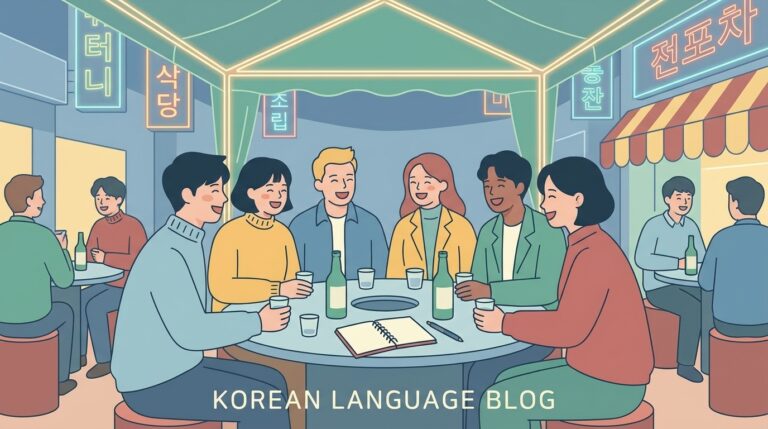
안녕하세요! 매일한글 에디터입니다. (Hello! This is your Daily Hangul editor.) Picture this: You are sitting at a bustling outdoor tent pocha in Sinchon. Green soju bottles crowd the metal table, the scent of sizzling spicy stir-fried pork fills the chilly evening air, and chopsticks are clattering in rhythm. Suddenly, someone pulls out wooden chopsticks numbered with markers and yells, “왕이다!” (Wang-ida! / I’m the King!). The infamous King’s Game—왕게임 (Wang-geim)—has begun.
At first, it’s innocent fun: “Number 2, give Number 4 a high-five!” But as the night progresses, the King gets bolder. A mischievous grin spreads across their face: “Number 1 and Number 3, do a love shot cheek-to-cheek!” You look down at your chopstick. You are Number 1. Your stomach drops. You don’t want to be a party pooper, but you definitely don’t want to do that dare.
Navigating boundary control—or 수위 조절 (suwi jojeol)—in Korean drinking culture can feel like walking an emotional tightrope. How do you speak up without breaking the communal harmony? As your cultural navigator, I have guided hundreds of international students and expats through this exact dilemma. With the right native phrases and a touch of nunchi, you can safeguard your comfort and still be the coolest, most respected person at the table.
Phase 2: Deep Dive into 3 Core Expressions
1. 수위 좀 낮추자 (Suwi jom natchuja)
- Pronunciation: [Su-wi jom nat-chu-ja] (Sounds like: “Sue-wee jom not-choo-jah”)
- Meaning: Literal: “Let’s lower the water level.” | Real Nuance: “Let’s tone it down a bit” or “Keep it PG-13, guys.”
- K-Culture Moment: In university membership training (MT) dramas or variety shows like Knowing Bros, when a cast member’s roast gets too personal or spicy, another member holds their hands palm-down, waving them gently to say, “수위 좀 낮추자!”
- Editor’s Insight: Suwi (수위) originally refers to water levels during a flood. In slang, it refers to the intensity or adult nature of jokes, games, or actions. Adding jom (a little) softens the demand into a friendly collective suggestion.
- Situation Spectrum: Casual: ✅ | Semi-formal: ⚠️ (수위 좀 낮춰요) | Formal: 🚫
- 🤔 Think About It: Instead of saying “You are making me uncomfortable,” Koreans frame it as an environmental adjustment (“Let’s lower the room’s temperature/water level”). Why does collective phrasing work better in group dynamics?
2. 아, 이건 좀 선 넘었다 (A, igeon jom seon neomeotda)
- Pronunciation: [A, i-geon jom seon neo-meot-da] (Sounds like: “Ah, ee-gwon jom sun nuh-mut-dah”)
- Meaning: Literal: “Ah, this crossed the line a bit.” | Real Nuance: “Okay, that’s going too far!”
- K-Culture Moment: Seen frequently on YouTube talk shows like Workman or No Prepare (차린건 쥐뿔도 없지만) when host Youngji playfully scolds guests who ask intrusive questions.
- Editor’s Insight: Seon (선) means line or boundary. Saying this with a half-smile turns a firm boundary into playful banter without sparking confrontation. It warns the other person that they are encroaching on taboo territory.
- Situation Spectrum: Casual: ✅ | Semi-formal: ⚠️ | Formal: 🚫
- 🤔 Think About It: In Western culture, boundaries are often stated as rights (“That’s my boundary”). In Korean, it’s visualized as a shared geographic border that someone stepped across. How does this spatial metaphor reduce defensiveness?
3. 그냥 벌주 마시고 패스할게요 (Geunyang beolju masigo paeseuhalgeyo)
- Pronunciation: [Geun-yang beol-ju ma-si-go pae-seu-hal-ge-yo] (Sounds like: “Goon-yahng buhl-joo mah-she-go pass-hal-geh-yo”)
- Meaning: Literal: “I will just drink the penalty shot and pass.” | Real Nuance: “I’d rather take the penalty drink than do that dare.”
- K-Culture Moment: In campus romance K-Dramas when the female lead gets paired for an awkward romantic dare with someone she doesn’t like, she gracefully grabs her glass, declares this phrase, and downs it.
- Editor’s Insight: This is the ultimate “get-out-of-jail-free card” in Korean drinking games. Korean game ethics strictly dictate that drinking a penalty shot absolves you of any dare without ruining the flow of the game.
- Situation Spectrum: Casual: ✅ (패스할게) | Semi-formal: ✅ (패스할게요) | Formal: ⚠️
- 🤔 Think About It: Notice the give-and-take: you don’t merely reject the community’s dare; you offer a sacrifice (the penalty drink) in exchange for maintaining personal autonomy. What does this tell you about reciprocity in Korean social life?
Phase 3: Textbook Korean vs. Real-World Korean
Situation 1: Calling out an extreme dare in the King’s Game
- 📖 교과서 한국어 (Textbook): 저는 그 명령을 거절하겠습니다. (Jeoneun geu myeongnyeong-eul geojeolhagetseumnida. – I will refuse that command.)
- 🗣️ 진짜 한국어 (Real-World): 에이, 그건 에바지! 딴 거 해! (Ei, geugeon ebaji! Ttan geo hae! – Hey, that’s way over the top! Pick something else!)
- 💡 왜 다를까? (Why is it different?): Textbook Korean sounds like you are standing in a military court. Real Koreans use playful slang like ebaji (에바지 – an exaggeration/overkill, from the English “over”) to reject the dare without being aggressive.
Situation 2: Telling someone who is taking the game too far to read the room
- 📖 교과서 한국어 (Textbook): 장난이 너무 지나치니 조심하세요. (Jangnani neomu jinachini josimhaseyo. – Your joke is excessive, so please be careful.)
- 🗣️ 진짜 한국어 (Real-World): 야, 분위기 보고 눈치 챙겨~ (Ya, bunwigi bogo nunchi chaenggyeo~ – Hey, read the room and get some sense~)
- 💡 왜 다를까? (Why is it different?): Real drinking gatherings rely heavily on implicit social checks. Using the idiom nunchi chaenggida (눈치 챙기다 – collect your wits/social radar) humorously curbs unwanted behavior.
Phase 4: K-Culture Deep Dive & Non-Verbal Etiquette
4-1. 눈치 (Nunchi) & Gestures
When setting boundaries in a Korean drinking game, how you say it matters just as much as what you say:
* The Playful “X” Sign: Cross your forearms into an “X” shape in front of your chest while scrunching your nose with a warm smile. This visual signal communicates an immediate, non-negotiable “No” without sounding harsh or confrontational.
* The Double-Palm Press: Push both palms downward toward the table (as if pressing down dough). This signals to the person acting as King to settle their adrenaline and suggest a milder dare.
* Eye Contact & Glass Reach: Don’t look away awkwardly. Look the King in the eyes, chuckle, reach directly for your shot glass, and say, “벌주 갈게요!” (Beolju galgeyo! – Going for the penalty drink!). This displays confidence and respect for game rules.
4-2. Cultural Code Analysis: The MT Culture & Variety TV
In Korea, the King’s Game evolved from college MT (Membership Training) trips in the 1990s and 2000s. Early on, excessive penalties were common. However, the MZ generation in Korea has radically transformed drinking culture into one centered on “safe fun” (안전한 유흥) and mutual consent.
Popular variety shows like Running Man frequently show cast members screaming, “선 넘지 마!” (Don’t cross the line!) for comedic relief. Setting a boundary is no longer seen as being a killjoy; when delivered with witty delivery, boundary-setting is celebrated as top-tier entertainment.
Phase 5: Real-World Roleplay Scenario
Setting: A pocha in Hongdae with 5 friends. Green bottles, neon signs, and laughter fill the room.
Characters:
* Minho (The King): An energetic, slightly hyper Korean friend holding the chopstick marked “왕”.
* Sarah (B2 Korean Learner): Confident, culturally savvy international student.
* Jiyoung: Minho’s sensible classmate.
Turn 1 (Minho): 👑 앗싸! 내가 왕이다! 다들 주목!
(Assa! Naega wang-ida! Dadeul jumok!)
🎭 [Stands up, waving his chopstick in the air proudly]
"Yes! I'm the King! Everyone pay attention!"
Turn 2 (Jiyoung): 🤦♀️ 아 또 시작이네. 살살해라, 민호야.
(A tto sijagine. Salsalhaera, Minhoya.)
🎭 [Shakes her head with a weary smile]
"Ah, here we go again. Take it easy, Minho."
Turn 3 (Minho): 😈 2번이랑 4번! 서로 손잡고 러브샷 원샷!
(I-beon-irang sa-beon! Seoro sonjapgo reobeusyat wonsyat!)
🎭 [Points aggressively at the table with a grin]
"Number 2 and Number 4! Hold hands and do a love shot in one gulp!"
Turn 4 (Sarah): 👀 어? 나 2번인데...
(Eo? Na i-beoninde...)
🎭 [Looks down at her chopstick, noticing quiet newcomer Junho is Number 4]
"Uh? I'm Number 2..."
Turn 5 (Minho): 👏 와! 사라랑 준호다! 빨리해! 빨리해!
(Wa! Sararang Junhoda! Ppallihae! Ppallihae!)
🎭 [Starts chanting the drinking rhythm and clapping]
"Wow! It's Sarah and Junho! Hurry up! Hurry up!"
Turn 6 (Sarah): 🙅♀️ 에이 민호야, 첫 판부터 너무 선 넘었다! 수위 좀 낮추자!
(Ei Minhoya, cheot panbuteo neomu seon neomeotda! Suwi jom natchuja!)
🎭 [Smiles warmly, forming a playful X with her arms]
"Hey Minho, you crossed the line right from the first round! Let's tone it down!"
Turn 7 (Minho): 😅 아 진짜? 재미있을 줄 알았는데... 그럼 어떡할래?
(A jinjja? Jaemiisseul jul aranneunde... Geureom eotteokalrae?)
🎭 [Scratches the back of his neck, realizing he pushed too far]
"Oh really? I thought it'd be fun... What do you want to do then?"
Turn 8 (Sarah): 🍻 깔끔하게 준호랑 나랑 벌주 한 잔씩 마시고 갈게! 짠!
(Kkalkkeumhage Junhorang narang beolju han janssik masigo galge! Jjan!)
🎭 [Pours a modest shot for herself and Junho, clinking glasses with everyone]
"To keep it clean, Junho and I will each take a penalty shot and move on! Cheers!"
🔀 Interactive Choice Point: If Minho still insists on the romantic dare…
- Choice A: “야, 싫다는데 왜 그래? 분위기 깨지 마.” (Ya, siltdaneunde wae geurae? Bunwigi kkaeji ma. – Hey, I said no, why are you doing this? Don’t ruin the mood.)
- Feedback: [Risk] While honest, attacking him directly can make the whole table freeze in awkward silence. It escalates tension rather than defusing it.
- Choice B: “왕의 명령이니까… 그냥 할게요.” (Wang-ui myeongnyeong-inikka… geunyang halgeyo. – Since it’s the King’s order… I’ll just do it.)
- Feedback: [Bad] Never compromise personal boundaries just to appease a game! You will feel resentful and uneasy for the rest of the night.
- Choice C: “왕님, 자비 좀 베풀어 주시죠! 벌주 원샷 때릴 테니까 다른 거 시켜주세요!” (Wang-nim, jabi jom bepulleo jusijyo! Beolju wonsyat ttaeril tenikka dareun geo sikyeojuseyo! – Your Majesty, show some mercy! I’ll down a penalty shot, so give us another dare!)
- Feedback: [Best] Playing along with the “King” roleplay (Wang-nim) while firmly refusing the dare strokes his ego, provides laughs, and maintains your boundary completely.
Phase 6: 10-Second Emotional Shadowing Drill
Practice reading these lines aloud with the emotional cues and pauses marked with /:
- [😏 Playful & Teasing]
에이~ / 첫 판부터 / 너무 선 넘었다! / 수위 좀 낮추자!
(Ei~ / cheot panbuteo / neomu seon neomeotda! / Suwi jom natchuja!) -
[😌 Firm yet Refreshingly Cool]
그건 좀 부담스러우니까, / 깔끔하게 벌주 마실게!
(Geugeon jom budamseureounikka, / kkalkkeumhage beolju masilge!) -
[🤝 Peacemaker Tone]
야야, 눈치 챙겨! / 다 같이 재밌게 놀아야지~
(Yaya, nunchi chaenggyeo! / Da gachi jaemitge norayaji~)
Phase 7: K-Culture Mini Dictionary
- 왕게임 (Wang-geim) | The King’s Game
- An iconic Korean group drinking game using numbered sticks or cards where whoever draws the “King” holds absolute authority to command specific numbers to perform tasks.
- 수위 (Suwi) | Level of intensity / racy content
- Commonly used in media ratings and social banter to discuss whether jokes or actions are becoming too explicit or inappropriate.
- 선 넘다 (Seon neomda) | To cross the line
- A vital modern colloquial idiom describing someone who violates social boundaries or good manners, whether in conversation, dating, or workplace banter.
- 벌주 (Beolju) | Penalty drink
- A drink taken as punishment for losing a game, refusing a dare, or arriving late to a gathering (jigak-ju).
Phase 8: Traveler’s Survival Kit
TOP 3 Survival Phrases for Late-Night Gatherings:
- 저 술 약해서 쉬어갈게요. (Jeo sul yakhaeseo swieogalgeyo.)
- Pronunciation: [Jeo sul yak-hae-seo swi-eo-gal-ge-yo]
- Pro Tip: Literally “I am weak with alcohol so I’ll rest a turn.” Perfect for pacing your alcohol intake politely.
- 물로 짠해도 되죠? (Mullo jjanhaedo doejo?)
- Pronunciation: [Mul-lo jjan-hae-do doe-jo?]
- Pro Tip: “Can I clink glasses with water?” Saves you from getting drunk while still actively participating in cheers (jjan).
- 오늘 여기까지 마실게요! (Oneul yeogikkaji masilgeyo!)
- Pronunciation: [O-neul yeo-gi-kka-ji ma-sil-ge-yo!]
- Pro Tip: Signals clearly that you have hit your limit for the evening.
Editor’s Travel Note:
When playing late-night drinking games in nightlife hubs like Hongdae, Itaewon, or Gangnam, subway lines stop running around midnight. Don’t be caught stranded! Prepare by learning how to use the Kakao T Taxi App guide for foreign travelers so you can call a designated driver or taxi directly to your location with set upfront fares.
Phase 9: A Step Deeper: Culture & Thought
In traditional Confucian-influenced Korean society, the cohesion of the jeong (정) collective often took precedence over the individual’s comfort. Drinking games originated as social lubricants designed to strip away rigid corporate and academic hierarchies, momentarily turning everyone into equals through shared vulnerability. However, modern Korean youth culture increasingly rejects coercive solidarity (gangyo munhwa). Today’s younger generation views true social charm as the ability to enjoy the group experience while respecting individual boundaries through unspoken nunchi. Boundaries are no longer a rebellion against the group; they are an essential component of sustained harmony.
💬 Your Turn: Have you ever experienced a drinking game dare that made you feel uncomfortable in your home country? How did you handle it compared to the Korean approach of drinking the beolju? Share your story in the comments below!
Phase 10: Frequently Asked Questions & Misconceptions
Q: Will people think I am boring or rude if I refuse a King’s Game command?
A: Not at all, provided you handle it according to drinking game etiquette! The secret is to take the penalty drink (beolju) cheerfully or substitute it with an entertaining alternative (like singing a song verse or telling a joke). Refusing both the dare AND the drink without explanation is what dampens the mood.
Q: What should I do if the penalty drink itself is too large or too strong?
A: You can request a heukgisa (흑기사 – Black Knight / male savior) or heukjangmi (흑장미 – Black Rose / female savior) to drink it for you, promising to grant them a wish later. Alternatively, ask with a smile: “반 잔만 마셔도 될까요?” (Can I drink just half a glass?).
Q: Is the King’s Game still common in Korea today?
A: Yes, but primarily among university students during MT trips or close friends at afterparties. It is rarely played in formal work gatherings (hoesik) nowadays due to strict social protocols against workplace harassment.
🚨 Common Mistakes (흔한 실수 TOP 3)
- Mistake 1: Scolding the King in front of everyone.
- Correct Action: Keep criticism collective and playful (“수위 좀 낮추자!”) rather than targeting the King personally (“너 왜 그래?”).
- Mistake 2: Leaving the table abruptly in anger.
- Correct Action: Express your boundary verbally with a smile and drink water. If someone continues pushing, excuse yourself smoothly to the restroom.
- Mistake 3: Silently enduring dares you hate.
- Correct Action: Remember that taking a beolju (penalty drink) is a fully recognized and respected right in the game. Use it proudly!
Phase 11: Action Missions
- 🥉 Bronze Mission (Solo Shadowing): Stand in front of your mirror and practice the phrase “에이, 그건 선 넘었지! 벌주 마실게!” 5 times with a bright, confident smile and the forearm “X” gesture.
- 🥈 Silver Mission (Social Media Sharing): Leave a comment on your favorite K-Drama clip featuring a drinking scene using the phrase: “수위 조절 필수!” (Boundary control is a must!).
- 🥇 Gold Mission (Real-life Execution): At your next gathering or language exchange, playfully use “선 넘지 마~” when a friend teases you or makes a silly demand.
- 🎮 K-Culture Mission: Watch an episode of a Korean variety show (such as Running Man or Sixth Sense) and listen for when members say “선 넘다” or “수위”. Note down the context!
Phase 12: Interactive Quiz Challenge
1. Situation Judgment Quiz:
You are playing the King’s Game, and the King orders you to do a dare that makes you uncomfortable. What is the most culturally savvy and respectful way to decline?
* A) Say nothing, cross your arms, and glare at the King.
* B) Smile, say “에이, 선 넘었다! 벌주 마시고 패스할게요!”, and take the penalty sip.
* C) Yell at the host for running an insensitive game.
👉 Click to reveal Answer & Explanation
Answer: B
Explanation: Declining the dare while cheerfully accepting the penalty drink (beolju) honors the game mechanics while firmly safeguarding your personal boundaries without awkwardness.
2. Fill-in-the-Blank Quiz:
Complete the natural Korean sentence used to suggest lowering the intensity of a wild game:
“우리 분위기 좋은데, _____ 좀 낮추자!”
* A) 수영 (Suyeong – Swimming)
* B) 수위 (Suwi – Water level / Intensity)
* C) 수업 (Sueop – Class)
👉 Click to reveal Answer & Explanation
Answer: B) 수위 (Suwi)
Explanation: Suwi jom natchuja (수위 좀 낮추자) is the exact native idiom for asking everyone to tone down the game’s intensity.
3. True or False Cultural Quiz:
In Korean drinking games, taking a penalty drink (beolju) is considered a sign of cowardice and disrespect toward the King.
* [ ] True
* [ ] False
👉 Click to reveal Answer & Explanation
Answer: False
Explanation: Taking the penalty drink is a completely legitimate and socially accepted rule of Korean drinking games. It demonstrates that you respect the group game while exercising your right to opt out of a specific dare.







