

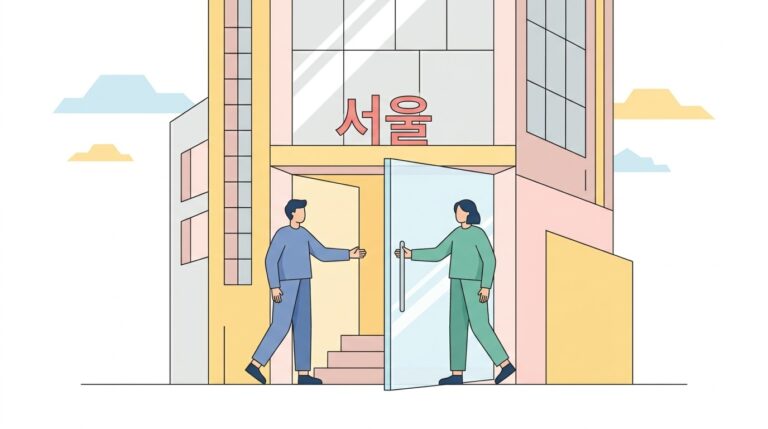
The Door Holding Dilemma in Korea: Why Ladies First Works Differently Than You Think
Phase 1: 공감 (Story-Driven Opening)
안녕하세요! 매일한글 에디터입니다.
Picture this: You are standing in the sleek lobby of an office tower in Yeouido, or perhaps entering an aesthetic cafe in Seongsu-dong. Channelling your instinctive Western etiquette, you grab the heavy glass door, step to the side, smile warmly, and wait for the woman walking behind you to enter first. But instead of an effortless nod of appreciation, you are met with a flustered hesitation. She pauses, blushes, frantically gestures back at you with both hands, and stutters an awkward apology before scuttling through like she just caused a minor traffic incident. Meanwhile, an elderly gentleman briskly breezes right past both of you without batting an eye.
If you have ever felt your gallant “Ladies First” impulse backfire in Seoul, you are not alone. As a 10-year cultural navigator, one of the most frequent dilemmas advanced learners confess to me is the sudden paralysis they feel around physical courtesy in Korea. Why did holding a door feel so transactional? Did you inadvertently make someone feel uncomfortable? Today, we are unpacking the intricate sociolinguistic layers of physical chivalry, Confucian seniority, and pragmatic public etiquette in modern South Korea. By mastering the high-context expressions and body language in this guide, you will transition from an awkward observer to an intuitive insider who reads the room with effortless grace.
Phase 2: 핵심 표현 3선 심층 분석 (Top 3 Essential Expressions)
1. 먼저 들어가세요 (Meonjeo deureogaseyo)
- Pronunciation: [Meon-jeo deu-reo-ga-se-yo] (Think of ‘meon’ like ‘money’ without the ‘y’, ‘jeo’ like ‘jug’ without the ‘g’, and ‘deureo-gaseyo’ flowing like a gentle wave).
- Meaning: Literal: “Please enter first.” | Nuance: “After you” / “Please, go ahead.” It dissolves awkward spatial stalemates with warm, proactive consideration.
- K-Culture Moment: Seen frequently in workplace K-dramas like Misaeng or Agency, where two professionals reach the elevator simultaneously. The junior or considerate colleague holds the door open, executing a precise 15-degree bow while saying this phrase to clear the social bottleneck.
- Editor’s Insight: In Korean interaction rituals, hesitation causes collective social friction (budaem, 부담). Saying this swiftly removes the pressure of indecision from the other person’s shoulders.
- Situation Spectrum: Casual ⚠️ | Semi-formal ✅ | Formal ✅
- 🤔 Think About It: In your culture, is yielding a threshold rooted in gender-based gallantry or general egalitarian courtesy? How does shifting the focus to social harmony alter your instinct?
2. 문 잡아주셔서 감사합니다 (Mun jab-ajusyeoseo gamsahamnida)
- Pronunciation: [Mun ja-ba-ju-syeo-seo gam-sa-ham-ni-da] (Pronounce ‘mun’ like ‘moon’, ‘jab-a’ like ‘Java’, and ‘gamsahamnida’ with crisp, rhythmic cadence).
- Meaning: Literal: “Thank you for holding the door for me.” | Nuance: A high-register, polished acknowledgment for someone who went out of their way to secure a door or elevator button.
- K-Culture Moment: The polished response exchanged between sophisticated characters in dramas like Crash Landing on You when entering an upscale venue or residential complex, conveying impeccable upbringing (gajeonggyoyuk, 가정교육).
- Editor’s Insight: While a simple “감사합니다” (Gamsahamnida) suffices in passing, explicitly stating “문 잡아주셔서” elevates your Korean to an elite, attentive level that acknowledges the specific labor of their kindness.
- Situation Spectrum: Casual 🚫 | Semi-formal ✅ | Formal ✅
- 🤔 Think About It: Why does acknowledging the specific physical action carry more warmth in collectivist contexts than a generic expression of gratitude?
3. 제가 잡고 있을게요 (Jega japgo isseulgeyo)
- Pronunciation: [Je-ga jap-go i-sseul-ge-yo] (Pronounce ‘jega’ like ‘Jenga’ without the ‘n’, and ‘japgo’ with a soft glottal stop on the ‘p’).
- Meaning: Literal: “I will be holding it.” | Nuance: “I’ve got it, don’t worry!” / “Go ahead, take your time.”
- K-Culture Moment: In bustling multi-floor cafes in Hongdae where someone is carrying a precarious tray of iced Americanos and pastries, a mindful bystander grips the door handle and offers this phrase to dispel any panic.
- Editor’s Insight: The suffix ~ㄹ게요 (~lgeyo) implies a gentle personal commitment for the benefit of the listener. It immediately relieves the other person of the urge to rush.
- Situation Spectrum: Casual ✅ | Semi-formal ✅ | Formal ⚠️
- 🤔 Think About It: How does taking verbal ownership of a physical task transform a brief public encounter into an experience of community care?
Phase 3: 교과서 한국어 vs 진짜 한국어 (Textbook vs. Real-World Korean)
Situation 1: Letting someone walk ahead at a revolving door or entrance
- 📖 교과서 한국어: 여성이 먼저 가셔야 합니다. (Yeoseongi meonjeo gasyeoya hamnida. – “The lady must go first.”)
- 🗣️ 진짜 한국어: 먼저 들어가세요, 천천히 오셔도 돼요. (Meonjeo deureogaseyo, cheoncheonhi osyeodo dwaeyo. – “Please, go right ahead; take your time.”)
- 💡 왜 다를까?: Directly translating Western chivalric maxims (“Ladies First”) into Korean can feel condescending, patronizing, or overly dramatic. Modern Koreans value fluid spatial consideration (baeryeo, 배려) rather than gendered posturing.
Situation 2: Catching an elevator door for an approaching stranger
- 📖 교과서 한국어: 제가 문을 열어 드리겠습니다. (Jega muneul yeoreo deurigessseumnida. – “I shall open the door for you.”)
- 🗣️ 진짜 한국어: 타세요! 몇 층 누를까요? (Taseyo! Myeot cheung nureulkkayo? – “Hop in! Which floor can I press for you?”)
- 💡 왜 다를까?: In fast-paced metropolitan hubs like Seoul, speed and efficiency are the ultimate forms of courtesy. Crisp, proactive offers trump lengthy, formal announcements every time.
Phase 4: K-Culture 딥다이브 & 비언어적 매너 (Deep Dive & Non-Verbal Nuance)
4-1. 눈치 (Nunchi) & Spatial Kinetics
In Western contexts, door-holding often looks like holding the door open at a full 90-degree angle while standing outside the threshold, waiting for someone 10 yards away. If you do this in Korea, you will trigger severe panic: the oncoming person will literally sprint toward you with an apologetic waddle because you have placed an emotional burden (budaem) on them.
- The “Korean Style” Door Hold: Don’t stand and hold like an aristocratic doorman. Instead, pass through the door first, then extend your arm backward to catch and hold the door firmly at shoulder level until the person behind you makes physical contact with the handle or frame.
- The Physical Bow: Accompany any doorway handover with a micro-nod (mokrye, 목례) and slightly lowered eye contact. Direct, unwavering eye contact during an act of courtesy can feel confrontational rather than charming.
4-2. Cultural Code Analysis: “Ladies First” vs. Confucian Seniority
South Korea did not inherit medieval European traditions of courtly chivalry. Traditionally, Confucian etiquette prioritized generational hierarchy (jangyuyuseo, 장유유서 — elders first) and relational hierarchy. When Western “Ladies First” culture entered Korea post-war, it was often filtered through romance media as a dating trope (maeneoson, 매너손, or jacket-draping) rather than an everyday civic doctrine.
In modern Korean public spaces, chivalry has largely modernized into universal urban consideration (baeryeo, 배려). If a young woman holds the door for an older man, or a young man holds it for a mother with a stroller, it is interpreted not through the lens of gender, but through harmonious collective flow. Insisting on stepping aside specifically because someone is a woman can inadvertently draw unwanted public attention to her in a culture that prizes self-effacing subtlety.
Phase 5: 실전 롤플레이 시나리오 (Interactive Roleplay Scenario)
Setting: The bustling ground-floor revolving glass doors of an office high-rise in Gwanghwamun during the morning rush. Rain is pouring, and people are folding wet umbrellas.
Characters: You and Min-woo (a sharp, observant Korean marketing director in his mid-30s holding an umbrella and a tablet).
Min-woo: 앗, 비가 갑자기 너무 많이 오네요. (At, biga gapjagi neomu mani oneyo.)
🎭 Shaking out his wet umbrella outside the heavy manual side door next to the revolving entrance.
“Ah, it suddenly started pouring so heavily.”
You: 네, 그러게요. 우산 접으시느라 힘드시죠? (Ne, geureogeyo. Usan jeobeusineura himdeusijo?)
🎭 Stepping up to the heavy door handle and grabbing it firmly.
“Yes, indeed. It’s tough dealing with wet umbrellas, right?”
Min-woo: 아이고, 무거운데… 제가 밀게요. (Aigo, mugeounde… jega milgeyo.)
🎭 Reaching out his hand to take over the heavy glass door.
“Oh goodness, that’s heavy… allow me to push it.”
You: 괜찮습니다. 제가 잡고 있을게요. 먼저 들어가세요. (Gwaenchansseumnida. Jega japgo isseulgeyo. Meonjeo deureogaseyo.)
🎭 Bracing the door with one firm hand and gesturing politely inside with the other open palm.
“It’s completely fine. I’ll hold it. Please, head on in first.”
Min-woo: 어휴, 감사합니다! 얼른 들어오세요, 문 진짜 무겁네요. (Eohyu, gamsahamnida! Eolleun deureooseyo, mun jinjja mugeomneyo.)
🎭 Bowing his head slightly at a 15-degree angle as he steps quickly past to relieve your burden.
“Whew, thank you! Come on in quickly, that door is genuinely heavy.”
You: 네! 엘리베이터 같이 타시죠. (Ne! Ellibeiteo gachi tasijo.)
🎭 Gliding in right behind him, ensuring the door doesn’t slam on the colleague following behind.
“Yes! Let’s catch the elevator together.”
Min-woo: 제가 열림 버튼 누르고 있을게요, 천천히 타세요. (Jega yeollim beoteon nureugo isseulgeyo, cheoncheonhi taseyo.)
🎭 Stepping into the elevator and holding down the ‘Open’ button with his body turned toward the door.
“I’ll keep the door-open button pressed, take your time getting in.”
You: 감사합니다. 14층 부탁드려도 될까요? (Gamsahamnida. Sipsacheung butakdeuryeodo doelkkayo?)
🎭 Nodding with a polite smile, standing toward the back.
“Thank you. Could I trouble you to press the 14th floor?”
🔀 Interactive Decision Point
As you reach the cafe on the 14th floor later that afternoon, an elderly female executive and a young male intern are both approaching the doorway behind you. What do you do?
- Choice A: Stand outside the door, sweep your arm theatrically, and loudly announce: “레이디 퍼스트! 먼저 들어가세요!” (Ladies First! Please enter first!)
- Choice B: Walk through first, hold the door firmly behind your back with one hand, make brief polite eye contact, and say quietly: “먼저 들어가세요.” (Please go ahead).
- Choice C: Look back, see them, drop the door immediately, and sprint ahead to order your coffee first to avoid any social interaction.
— Scenario Feedback —
* Choice A (Risk): Awkward disaster! The elder executive might feel embarrassed by the flamboyant Western mannerism, and the intern will freeze in utter confusion. Unnatural and high-burden.
* Choice B (Best): Perfection! You maintain seamless spatial kinetics, alleviate the physical weight of the door, respect communal presence without making a gendered spectacle, and display impeccable Korean social sensibility.
* Choice C (Bad): The dreaded “door slap” (mun-ppang). Leaving a heavy door to swing back into someone’s face is considered exceptionally rude in urban Korea.
Phase 6: 10초 감정 섀도잉 드릴 (10-Second Emotion Shadowing Drill)
Read these out loud, observing the rhythmic slashes / for brief pauses:
[😊 Warm and Relieving Tension]
괜찮으니까 / 천천히 들어오세요.
(Gwaen-chanh-eu-ni-kka / cheon-cheon-hi deu-reo-o-se-yo.)
“It’s totally fine, / please take your time coming in.”-
[🤝 Attentive and Respectful]
제가 잡고 있을 테니 / 편하게 먼저 타세요.
(Je-ga jap-go i-sseul te-ni / pyeon-ha-ge meon-jeo ta-se-yo.)
“I’ll hold this, / so please feel free to get on first.” -
[🙏 Quick, Polite Acknowledgment]
어머, / 문 잡아주셔서 정말 감사합니다!
(Eo-meo, / mun ja-ba-ju-syeo-seo jeong-mal gam-sa-ham-ni-da!)
“Oh my, / thank you so very much for holding the door!”
Phase 7: K-Culture 미니 사전 (Essential Mini-Dictionary)
-
배려 (Baeryeo) | Thoughtful consideration / Caring empathy
The foundational social virtue in South Korea. It is the art of anticipating someone’s discomfort before they express it and acting silently to remove it. -
매너손 (Manners-son / Manner Hands) | Courteous hand positioning
A ubiquitous media and real-life phenomenon where a person avoids placing their hands awkwardly on another’s body or holds an object (like a door, umbrella, or coat) in a way that minimizes physical contact and respects personal boundaries. -
부담 (Budaem) | Emotional or social burden / Feeling imposed upon
The feeling Koreans desperately try to avoid causing others. Exaggerated chivalry often triggers accidental budaem because it demands an equally theatrical display of gratitude. -
뒷사람 배려 (Dwitsaram Baeryeo) | Courtesy toward the person behind you
The civic ethic of looking back over your shoulder when exiting revolving doors, subways, or shops to ensure the swinging glass doesn’t hit the next commuter.
Phase 8: 여행자를 위한 생존 키트 (Traveler’s Survival Kit)
Top 3 Survival Phrases
- 먼저 타세요 (Meonjeo taseyo) | “Please get on first.” (Indispensable for crowded elevators and subways). Pro Tip: Pair this with an open palm gesture angled slightly downward.
- 잡아드릴게요 (Jaba-deurilgeyo) | “I’ll hold it for you.” Pro Tip: Use this when you notice someone pushing a stroller, carrying luggage, or balancing hot drinks.
- 감사합니다! (Gamsahamnida!) | “Thank you!” Pro Tip: Even a brisk, bright two-syllable delivery with a slight nod will make any commuter’s day.
Editor’s Travel Note
When navigating the bustling stations of the Seoul Metro, spatial awareness is your best friend. Instead of holding doors manually, the primary door etiquette takes place around screen doors (seukeurindo-eo). Never rush a closing door. If you are standing next to the elevator buttons inside metro stations or department stores, it is customary for the person closest to the console to hold down the “열림” (Open) button until everyone exits. To navigate these complex multi-floor transit hubs with ease, make sure to check out the Naver Map transit navigation guide to find barrier-free exits and elevator locations in advance.
Phase 9: 한 발 더 깊이 (One Step Deeper)
In Western chivalry, the act of holding a door for a woman historically emphasized protective masculine deference. In South Korea, however, public space is governed by relational interdependence and collective rhythm. When you step aside and make a grand theatrical gesture of “Ladies First,” you inadvertently pull an individual out of the collective flow and spotlight them, triggering that distinct social embarrassment known as minmang-ham (민망함). True high-level Korean courtesy is not about chivalric performance; it is about invisibility—holding the door so seamlessly that the person behind you passes through without breaking stride or feeling indebted to perform a dramatic display of gratitude.
💬 Your Turn: Have you ever experienced an awkward “door standoff” while traveling in Korea? How does physical politeness in your hometown compare to the rapid, seamless baeryeo of Seoul? Share your stories in the comments below!
Phase 10: FAQ & 오해 방지 (FAQ Schema)
Q: Is the concept of “Ladies First” considered outdated or offensive in modern Korea?
A: It is not seen as offensive, but when applied rigidly in public urban settings, it is perceived as an unfamiliar Western novelty. In romantic dating contexts, Korean women certainly appreciate attentive consideration (such as walking on the street side of the sidewalk or pulling out a chair), but in civic, professional, and everyday public spaces, gender-neutral spatial efficiency and consideration for the elderly (jangyuyuseo) take precedence.
Q: Why do Korean people sometimes not say “Thank you” when I hold the door for them?
A: Look closely at their body language! In many instances, especially among older generations or fast-moving office workers, verbal gratitude is replaced by a quick physical bow (mokrye), a brief dipping of the chin, or a soft hand gesture. In dense urban environments, this silent acknowledgment avoids vocal noise pollution while still conveying mutual respect.
Q: Should I hold the door if someone is more than a few steps behind me?
A: Generally, no. If they are more than 3 or 4 paces away, holding the door forces them into an uncomfortable half-jog because they don’t want to make you wait. The golden rule of Seoul door etiquette is simple: hold it if they can catch it within two strides; otherwise, let it close gently.
🚨 Common Mistakes Alert (흔한 실수 TOP 3)
- The Distant Stalker Hold: Holding a heavy glass door while staring intently at someone 15 feet away.
Correct Action: If they are far away, let the door go. If they are close, catch it behind you and let them take the handle. - The Gender-First Blunder: Cutting in front of an elderly person or a senior boss to open a door specifically for a young female colleague.
Correct Action: Seniority and physical need always trump Western gendered chivalry in Korean institutional etiquette. - The “No-Hands” Slip-Through: Assuming the door will stay open by itself and letting it snap back into the person behind you.
Correct Action: Always glance over your shoulder (dwitsaram hwagin) and give the door a steadying touch for the next person.
Phase 11: 액션 미션 & 참여 유도 (Action Missions)
- 🥉 Bronze Level (Solo Prep): Practice saying “먼저 들어가세요” (Meonjeo deureogaseyo) five times in front of the mirror while mastering a crisp 15-degree micro-nod without breaking eye posture.
- 🥈 Silver Level (Social Sharing): Film a short 15-second reel or note in your language diary describing the difference between Western “chivalry” and Korean “배려” (Baeryeo), tagging #DailyHangul and #KoreanEtiquette.
- 🥇 Gold Level (Real-World Mission): The next time you are entering a Korean restaurant, convenience store, or cafe, execute the “Korean catch-and-hold” for the person behind you and exchange a warm “먼저 들어가세요”!
🎮 K-Culture Mission: Watch an episode of a contemporary workplace drama (such as Hospital Playlist or Business Proposal). Count how many times colleagues enter an elevator together. Notice who holds the “열림” (Open) button, who enters first, and what micro-gestures they exchange!
Phase 12: 인터랙티브 퀴즈 챌린지 (Interactive Quiz Challenge)
1. Situational Judgment:
You are arriving at an elevator in a Seoul office building. An elderly vice-president and a female junior colleague are walking with you. Who should logically step in first according to authentic Korean workplace etiquette?
(a) The female junior colleague, because “Ladies First” is universal.
(b) The elderly vice-president, honoring generational and corporate hierarchy.
(c) You, sprinting in to grab the corner spot.
2. Fill-in-the-Blank:
When holding an elevator door for an oncoming neighbor in an apartment complex, you say:
“천천히 타세요, 제가 문 ________ 있을게요!” (Take your time, I will be holding the door!)
(a) 닫고 (closing)
(b) 잡고 (holding)
(c) 버리고 (abandoning)
3. True or False:
True or False: In Korea, holding the door for someone who is 20 steps away is considered an act of supreme politeness.
👉 Click to reveal answers & explanations!
- Answer: (b) — Generational and institutional hierarchy (jangyuyuseo) takes clear precedence over Western gendered etiquette. Yielding to the senior executive is standard professional decorum.
- Answer: (b) 잡고 — The compound structure “잡고 있을게요” means “I will keep holding it for you.”
- Answer: False! — Holding a door for someone far away induces social anxiety (budaem), forcing them to jog. Only hold it if they are within immediate catching distance!







