

Never Get Locked Out: How to Check Korean Public Holidays Like a Local
Phase 1: Empathy (Story-Driven Opening)
안녕하세요! 매일한글 에디터입니다. (Hello! I’m your Daily Hangul editor.)
Picture this: You wake up on a crisp Monday morning in Seoul, hyped to grab that viral iced Einspänner coffee and fresh salt bread at an aesthetic bakery in Seongsu-dong. You take the subway, walk through the picturesque alleys, and reach the shop front—only to find the steel shutters pulled all the way down. A small handwritten sign taped to the glass reads: 공휴일 정상 휴무 (Closed for Public Holiday).
Wait, what? Is today a holiday?! You check your international phone calendar—it looks like a completely normal weekday to you! But in Korea, you’ve just walked right into a surprise 대체공휴일 (daeche-gonghyuil / substitute holiday) or a national celebration.
Over the past ten years of coaching foreign learners and travelers, I cannot tell you how many eager foodies and K-drama pilgrims have lost precious vacation days simply because they didn’t know how to confirm whether a spot would be open on a Korean holiday. The good news? You only need a few simple, natural A2-level Korean phrases to ask anyone—from friendly baristas to convenience store clerks—about upcoming holiday hours. Let’s make sure you never get stuck staring at a locked cafe door again!
Phase 2: Key Expressions In-Depth Analysis
1. 내일 빨간 날이에요? (Naeil bpalgan narieyo?)
- Pronunciation: Nae-il bpal-gan na-ri-ye-yo? (Sounds like: “Nay-eel pahl-gahn nah-ree-ye-yo?” – the bpal is a crisp double ‘p’ sound!)
- Meaning: Literal: “Is tomorrow a red day?” vs. Real Nuance: “Is tomorrow a public holiday / day off?”
- K-Culture Moment: You’ll hear this constantly in office K-dramas (like Business Proposal or Misaeng) when colleagues huddle around water coolers on Friday afternoon, double-checking if they get a three-day weekend!
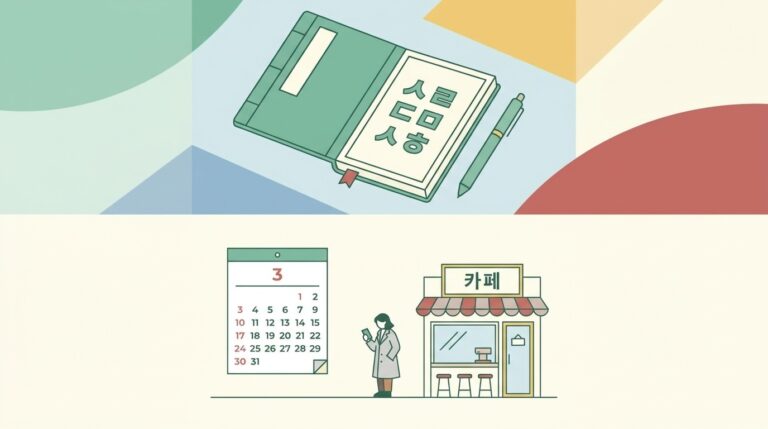
- Editor’s Insight: In Korean printed calendars, Sundays and legal holidays are printed in bold red ink. Because of this, native speakers colloquially call all official days off 빨간 날 (bpalgan nal / Red Day). It sounds infinitely more friendly and natural than using stiff government jargon.
- Situation Spectrum: Casual: ✅ | Semi-formal: ✅ | Formal: ⚠️ (Use 공휴일 in formal business documents)
- 🤔 Think About It: In English, we call them “bank holidays” or “national holidays.” Why do you think Korean society anchored the concept of rest to the visual color of calendar ink?
2. 공휴일에도 영업해요? (Gonghyu-ire-do yeongeop-haeyo?)
- Pronunciation: Gong-hyu-i-re-do yeong-eop-hae-yo? (Sounds like: “Gohng-hyoo-ee-reh-doh yung-up-hae-yo?” – connect the r into i smoothly!)
- Meaning: Literal: “Do you do business on public holidays too?” vs. Real Nuance: “Are you open on public holidays?”
- K-Culture Moment: A character calls a famous Gangnam hair salon or a trendy barbecue hotspot in Hongdae before dragging their friends all the way across town on Chuseok.
- Editor’s Insight: The word 영업 (yeongeop) refers to commercial business operations. Combining it with -해요 (-haeyo) creates a polite, respectful inquiry that shopkeepers love hearing from international guests.
- Situation Spectrum: Casual: ⚠️ | Semi-formal: ✅ | Formal: ✅
- 🤔 Think About It: Notice how polite Korean questions often center around the establishment’s operation rather than directly asking “Are you working?” It protects the staff’s personal boundary.
3. 이번 연휴에 계획 있어요? (Ibeon yeonhyue gyehoek isseoyo?)
- Pronunciation: I-beon yeon-hyu-e gye-hoek is-seo-yo? (Sounds like: “Ee-bun yun-hyoo-eh gyeh-hwek ee-ssuh-yo?”)
- Meaning: Literal: “Do you have plans during these consecutive holidays?” vs. Real Nuance: “Got any plans for the upcoming long weekend?”
- K-Culture Moment: The classic small-talk icebreaker used by your favorite K-pop idols during a live broadcast right before Lunar New Year (설날) or Chuseok (추석).
- Editor’s Insight: 연휴 (yeonhyu) means consecutive holidays (three or more days in a row). Asking this shows you are warm, socially attentive, and interested in your friend’s downtime.
- Situation Spectrum: Casual: ✅ | Semi-formal: ✅ | Formal: ✅
- 🤔 Think About It: In Korea, long weekends often mean traveling back to one’s hometown or taking a quick trip to Jeju Island. How does your culture treat extended weekends?
Phase 3: Textbook Korean vs. Real Korean
Situation 1: Asking if tomorrow is a holiday
- 📖 Textbook Korean: 내일은 국가 공휴일입니까? (Naeireun gukga gonghyuirimnikka? / Is tomorrow a national state holiday?)
- 🗣️ Real Korean: 내일 쉬는 날이에요? (Naeil swineun narieyo? / Is tomorrow a day off?)
- 💡 Why the difference? Nobody speaks like a legal constitution in daily life! Real Koreans naturally use the descriptive verb form 쉬는 날 (swineun nal / resting day) because it is effortless and warm.
Situation 2: Asking if a business is closed on the holiday
- 📖 Textbook Korean: 휴일에 휴업을 진행하십니까? (Hyuire hyueobeul jinhaenghasimnikka? / Do you carry out a business closure during the holiday?)
- 🗣️ Real Korean: 공휴일에는 문 닫아요? (Gonghyuireneun mun dadayo? / Do you close your doors on holidays?)
- 💡 Why the difference? The phrase 문 닫다 (mun datda / to close doors) is vivid, everyday Korean used by everyone from university students to grandmothers at traditional markets.
Phase 4: K-Culture Deep Dive & Non-Verbal Manners
4-1. 눈치 (Nunchi) & Body Gestures
When entering a shop to inquire about holiday schedules:
* The Soft Head Tilt: Slightly bow your head at roughly 15 degrees and hold your smartphone calendar outward if you feel nervous about pronunciation.
* The Two-Hand Cross (X sign): If the owner smiles awkwardly, shakes their head, and crosses their forearms or waves both open hands across their chest, that is the non-verbal universal Korean sign for: “No, we are closed!”
* Reading the Busy Hour: If the cafe is packed with a line out the door, exercise your 눈치 (nunchi / situational awareness)—ask quickly after ordering your drink rather than stalling the queue.
4-2. Cultural Code Analysis: The Substitute Holiday Boom
In South Korea, when a major national holiday (like National Liberation Day, Children’s Day, or Chuseok) overlaps with a Saturday or Sunday, the government designates the following Monday as a 대체공휴일 (daeche-gonghyuil / substitute holiday).
When this system expanded nationwide, office workers rejoiced! However, for foreign travelers, it means public offices, clinics, and banks remain shut on days you might assume are ordinary Mondays. Understanding the “Red Day mentality” will save you immense travel frustration!
Phase 5: Real-Life Roleplay Scenario
- Setting: A trendy hanok cafe in Ikseon-dong, Seoul. The aroma of roasted espresso fills the air.
- Characters: Alex (An excited traveler, A2 level) & Minho (A welcoming 20-something barista).
-
Turn 1 (Alex): 저기요, 주문 전에 하나 여쭤봐도 돼요? (Jeogiyo, jumun jeone hana yeojjwobwado dwaeyo? / Excuse me, may I ask one thing before ordering? 🎭 Smiles politely with palms together)
- Turn 2 (Minho): 네! 편하게 물어보세요. (Ne! Pyeonhage mureoboseyo. / Yes! Please ask freely. 🎭 Puts down a fresh coffee mug with a friendly grin)
- Turn 3 (Alex): 다음 주 월요일이 빨간 날이잖아요. (Daeum ju woryoiri bpalgan narijanayo. / Next Monday is a red day, right? 🎭 Points gently to the calendar widget on phone)
- Turn 4 (Minho): 아, 맞아요! 광복절 대체공휴일이에요. (A, majayo! Gwangbokjeol daeche-gonghyuirieyo. / Ah, that’s right! It’s the National Liberation substitute holiday. 🎭 Nods in agreement)
- Turn 5 (Alex): 혹시 월요일에도 카페 영업해요? (Hoksi woryoiredo kape yeongeop-haeyo? / By any chance, is the cafe open on Monday too? 🎭 Tilts head with an expectant smile)
- Turn 6 (Minho): 네, 저희는 공휴일에도 정상 영업해요! (Ne, jeohuineun gonghyuiredo jeongsang yeongeop-haeyo! / Yes, we operate regular business hours even on holidays! 🎭 Gives an encouraging thumbs-up)
- Turn 7 (Alex): 정말 다행이네요! 친구랑 꼭 올게요. (Jeongmal dahaengineyo! Chingurang kkok olgeyo. / What a relief! I’ll definitely come with my friend. 🎭 Exhales with a relieved smile)
- Turn 8 (Minho): 네, 월요일에 또 봬요! 시원하게 준비해 둘게요. (Ne, woryoire tto bwaeyo! Siwonhage junbihae deulgeyo. / Great, see you again on Monday! I’ll make sure it’s chilled and ready. 🎭 Hands over the vibrating order buzzer)
🔀 Interactive Choice Point
How would you conclude your conversation with Minho?
* Choice A: “감사합니다! 월요일에 꼭 다시 올게요!” (Gamsahamnida! Woryoire kkok dasi olgeyo! / Thank you! I will definitely come back on Monday!)
* Choice B: “빨간 날에 일해서 너무 불쌍해요.” (Bpalgan nare ilhaeseo neomu bulssanghaeyo. / You are so pitiful for working on a red day.)
* Choice C: “월요일에 문 닫으면 바로 신고할 거예요.” (Woryoire mun dad-eumyeon baro singohal geoyeyo. / If you close on Monday, I will report you immediately.)
- Feedback:
- Choice A (Best!): ⭐ Perfectly courteous, uplifting, and leaves a wonderful impression on the local staff!
- Choice B (Bad): ⚠️ Calling someone 불쌍해요 (pitiful) sounds condescending and causes immediate embarrassment, even if you meant well.
- Choice C (Risk!): 🚫 Threatening to report (신고) a coffee shop is aggressive and completely inappropriate for normal conversation!
Phase 6: 10-Second Emotion Shadowing Drill
Practice these lines aloud, paying attention to the pauses (/) and emotional tone indicators:
[😊 Curiously and playfully]
다음 주 월요일, / 혹시 빨간 날이에요?
(Daeum ju woryoil, / hoksi bpalgan narieyo? / Next Monday, / is it by chance a red day?)-
[🥺 Hesitantly and politely]
실례지만, / 공휴일에도 / 문 열어요?
(Sillyejiman, / gonghyuiredo / mun yeoreoyo? / Excuse me, / but on public holidays / are you open?) -
[🎉 Relieved and excited]
와, 다행이다! / 정상 영업하는구나!
(Wa, dahaeng-ida! / jeongsang yeongeophaneunguna! / Wow, what a relief! / You’re doing normal business!)
Phase 7: K-Culture Mini Dictionary
- 빨간 날 (Bpalgan nal) | Red Day (Public Holiday)
- Usage: The most common everyday spoken term for any legal holiday or Sunday when schools and corporate offices close.
- 대체공휴일 (Daeche-gonghyuil) | Substitute Holiday
- Usage: A designated makeup holiday (usually on Monday) when a major public holiday lands on a weekend.
- 징검다리 연휴 (Jing-geom-dari yeonhyu) | Stepping-Stone Holiday
- Usage: When a holiday falls on a Tuesday or Thursday, creating an isolated workday bridge. Koreans often use paid leave to bridge the “stones” into a 4-day vacation.
- 정상 영업 (Jeongsang yeongeop) | Normal Business Hours
- Usage: Frequently spotted on store door placards indicating that the establishment does not take the holiday off.
Phase 8: Survival Kit for Travelers
Survival Expressions TOP 3
- 내일 쉬어요? (Naeil swieoyo?)
- Pronunciation: Nae-il swi-eo-yo?
- Pro Tip: The shortest, most practical sentence to ask market vendors or solo restaurateurs if they are resting tomorrow.
- 연휴 언제까지예요? (Yeonhyu eonjekkajiyeyo?)
- Pronunciation: Yeon-hyu eon-je-kka-ji-ye-yo?
- Pro Tip: Invaluable during big holidays like Seollal or Chuseok to find out exactly when a neighborhood market reopens.
- 몇 시에 닫아요? (Myeot sie dadayo?)
- Pronunciation: Myeot si-e da-da-yo?
- Pro Tip: Many indie cafes stay open on holidays but close 2-3 hours earlier than usual. Always verify closing hours!
Editor’s Travel Note
- When traveling in Korea, don’t rely on global search engines for store schedules. Download the Naver Map navigation app and search for the shop name. Click on 영업 정보 (Business Hours) to view real-time holiday schedules.
- Be aware that Seoul subways and metropolitan buses switch to Sunday schedules during Red Days, and intercity train tickets (KTX) sell out weeks in advance for major holidays!
Phase 9: “One Step Deeper” (Reflective Essay)
In South Korea, taking a holiday is deeply tied to the collective social rhythm. Historically, during Korea’s era of rapid economic growth, rest was rarely individualistic; people worked fiercely together and rested collectively on designated days. That is why holiday migrations during Lunar New Year and Chuseok transform into massive family reunions where entire highways pause together.
When you ask someone about an upcoming 빨간 날 (Red Day), you are not just checking calendar logistics—you are taking part in a shared cultural breath of relief that everyone in the country takes at the exact same moment.
💬 Your Turn: Does your home country call holidays by a special color, or do you have a unique nickname for long weekend bridges? Let me know in the comments below!
Phase 10: FAQ & Avoiding Misunderstandings
Q: Can I use “빨간 날” in a professional business email?
A: It’s better to avoid it in formal contracts or professional company emails. Stick to 공휴일 (gonghyuil / public holiday) or 휴무일 (hyumu-il / closed business day) for formal correspondence, and save 빨간 날 for spoken chats with coworkers.
Q: What is the exact difference between “휴일” and “공휴일”?
A: 휴일 (hyuil) is a broad term meaning any rest day, including your personal day off or a Sunday. 공휴일 (gonghyuil) specifically denotes a legally mandated national public holiday established by presidential decree.
Q: Are banks and post offices open on substitute holidays (대체공휴일)?
A: No. All government offices, public post offices, and national banks treat substitute holidays as full national holidays and remain closed.
🚨 Common Mistakes Alert!
- Translating directly as “Red Day” in English: Saying “내일 레드 데이예요?” will confuse elderly shopkeepers. Always pronounce it in Korean: 빨간 날이에요? (bpalgan narieyo?).
- Assuming all tourist attractions close: Major shopping malls in Myeongdong, COEX, and large department store cinema complexes usually stay open on holidays! It is small independent boutiques and traditional street markets that often shut down.
- Using “너 내일 놀아?” with strangers: The verb 놀다 (nolda / to play) is solely for intimate peers. Never ask shopkeepers or older acquaintances if they are “playing tomorrow”; use 쉬세요? (swiseyo? / Are you resting?) instead.
Phase 11: Action Mission & Engagement
- 🥉 Bronze Mission (Solo Practice): Stand in front of your mirror and practice saying: “내일 빨간 날이에요?” (Naeil bpalgan narieyo?) three times with natural rising intonation.
- 🥈 Silver Mission (Social Connection): Check your smartphone calendar, find the nearest upcoming holiday, and write one sentence in your Korean study notebook: “[Day of the week]은 빨간 날이에요!”
- 🥇 Gold Mission (Real Life): The next time you visit a Korean restaurant, mart, or talk with your Korean language exchange partner, ask them: “이번 연휴에 뭐 해요?” (Ibeon yeonhyue mwo haeyo? / What are you doing this long weekend?)
🎮 K-Culture Mission: Watch an episode of a workplace drama like King the Land or Hospital Playlist. Watch for the scene where coworkers celebrate when an upcoming holiday lands on a Friday or Monday!
Phase 12: Interactive Quiz Challenge
Test what you’ve learned today!
- Situation Assessment: You want to know if a local bakery will operate on tomorrow’s national holiday. What is the most natural, polite question?
- A) 내일 왜 일해요? (Naeil wae ilhaeyo?)
- B) 내일 공휴일에도 영업해요? (Naeil gonghyuiredo yeongeop-haeyo?)
- C) 내일 쉬지 마세요. (Naeil swiji maseyo.)
- Fill in the Blank:
“한국 달력에서 공휴일은 글자가 빨간색이라서, 일상 대화에서는 공휴일을 ‘____ 날‘이라고 불러요.”
(Hints: 노란 / 빨간 / 파란) -
True or False Culture Quiz:
In South Korea, if a major national holiday falls on a Saturday, the upcoming Monday is often designated as a 대체공휴일 (substitute holiday). [ True / False ]
👉 Click here to reveal the answers and explanations!
- Answer: B — 공휴일에도 영업해요? is the gold-standard polite phrase for checking business hours.
- Answer: 빨간 — Korean holidays are universally nicknamed 빨간 날 (Red Day)!
- Answer: True — The substitute holiday system gives workers a makeup rest day on Monday when holidays land on weekends.







