

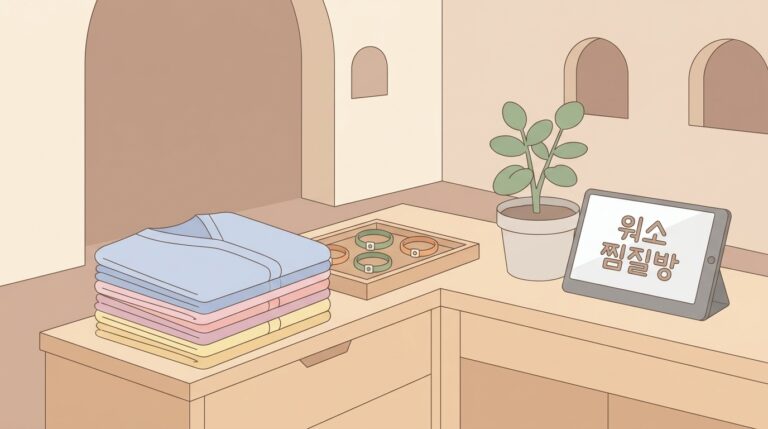
Phase 1: Empathy (Storytelling Opening)
안녕하세요! 매일한글 에디터입니다.
Picture this: It is 11:00 PM on a freezing winter evening in Seoul. You have been walking through Myeongdong all day, your legs feel like lead, and you finally spot that glowing neon sign: 찜질방 (Jjimjilbang – Korean Bathhouse & Sauna). You remember those iconic K-drama scenes—characters lounging happily on heated ondol floors, wearing cute sheep-head towels, crackling roasted eggs, and sipping chilled sikhye.
You pull open the heavy glass doors, ready for pure relaxation. But the moment you reach the counter, the front desk attendant greets you with lightning-fast Korean: “몇 분이세요? 목욕만 하세요, 찜질도 하세요?” Your mind goes totally blank. Panic sets in. Do you need sauna clothes? How do you ask for one adult ticket? What on earth is a key bracelet?
Don’t worry at all! Over the past decade coaching international learners at Daily Hangul, I have seen so many students freeze at this exact reception desk. Paying your entrance fee is the only hurdle standing between you and the coziest cultural experience in Korea. With just three core A2 phrases, you will walk in like a confident Seoulite. Let’s dive in together!
Phase 2: Top 3 Core Expressions Breakdown
1. 성인 한 명이요 (Seong-in han myeong-i-yo)
- Pronunciation: [Seong-in han myeong-i-yo] (Sounds like: sung-een hahn myung-ee-yo)
- Meaning: Literal: “Adult one person, please.” vs Nuance: “One adult ticket, please.”
- K-Culture Moment: Seen in almost every slice-of-life drama when a character runs away from home or misses the last subway and checks into an overnight spa.
- Editor’s Insight: Korean counters appreciate speed and clarity. Instead of building a complex sentence like “I want to buy one ticket,” simply stating the category (성인 = adult) and counter word (한 명 = one person) with the polite ending -이요 sounds completely natural and respectful.
- Situation Spectrum: Casual ⚠️ | Semi-formal ✅ | Formal ✅
- 🤔 Think About It: In English, we usually say “Just one for me, please.” Why do you think Korean ticket counters require you to specify age demographic categories right away?
2. 찜질복 포함해 주세요 (Jjimjilbok pohamhae juseyo)
- Pronunciation: [Jjim-jil-bok po-ham-hae ju-se-yo] (Sounds like: jeem-jeel-bohk poh-hahm-heh joo-seh-yo)
- Meaning: Literal: “Sauna clothes include please.” vs Nuance: “Please include the sauna uniform.”
- K-Culture Moment: When celebrities on variety shows like Running Man get given those signature oversized brown or pastel cotton shirts and shorts.
- Editor’s Insight: Crucial tip! A basic Jjimjilbang ticket often only gives you access to the gender-separated public bath (목욕탕). If you want to access the famous mixed-gender heated rooms, common lounge, and snack bar, you must rent the uniform (찜질복). This sentence guarantees you get the full experience!
- Situation Spectrum: Casual ⚠️ | Semi-formal ✅ | Formal ✅
- 🤔 Think About It: Korean spas require everyone to wear identical rental uniforms in common areas. How does this promote a sense of shared community and equality?
3. 카드로 계산할게요 (Kadeu-ro gyesanhalgeyo)
- Pronunciation: [Ka-deu-ro gye-san-hal-ge-yo] (Sounds like: kah-doo-roh gyeh-sahn-hahl-geh-yo)
- Meaning: Literal: “I will calculate with card.” vs Nuance: “I’ll pay with card.”
- K-Culture Moment: Tapping your card at the reception counter before receiving your numbered electronic locker key.
- Editor’s Insight: The grammar ending -(으)ㄹ게요 expresses your friendly intention. It creates a warm, collaborative transaction tone rather than a rigid command.
- Situation Spectrum: Casual 🚫 | Semi-formal ✅ | Formal ✅
- 🤔 Think About It: Notice the particle -로 (-ro), meaning “by means of.” Korean grammar explicitly flags the tool or method used for an action.
Phase 3: Textbook Korean vs Real Korean
Situation 1: Asking how much the admission costs
- 📖 교과서 한국어: 입장료는 얼마입니까? (Ipjangnyoneun eolma-imnikka? / How much is the entrance fee?)
- 🗣️ 진짜 한국어: 성인 얼마예요? (Seong-in eolmayeyo? / How much is it for an adult?)
- 💡 왜 다를까?: While “입장료” is grammatically impeccable, native speakers omit formal bureaucratic words in casual spoken speech. Pointing to yourself or stating “성인” (adult) paired with “얼마예요?” is crisp, friendly, and practical.
Situation 2: Requesting clothes and locker key
- 📖 교과서 한국어: 옷과 전자 열쇠를 주십시오. (Ot-gwa jeonja yeolsoereul jusipsio. / Please give me the clothes and electronic key.)
- 🗣️ 진짜 한국어: 찜질방도 이용할게요. (Jjimjilbang-do iyonghalgeyo. / I’ll use the sauna rooms too.)
- 💡 왜 다를까?: You never need to ask for keys or towels item by item. When you tell the counter attendant you want to use the common sauna lounge (찜질방 이용), they automatically hand you a packaged set: uniform, two towels, and your locker key!
Phase 4: K-Culture Deep Dive & Non-Verbal Manners
4-1. 눈치 (Nunchi) & Front Counter Etiquette
- The Two-Handed Handover: In Korea, handing over your payment card or receiving your locker key wristband with only one hand can look dismissive. Always use two hands, or support your right forearm lightly with your left hand. It radiates instant polite nunchi!
- The Threshold Boundary (신발장): The moment you enter the counter area, observe the floor. If you see a sunken tiled floor with shoe cubbies, never step onto the elevated shiny floor wearing outdoor shoes. Take them off immediately and slide them into the initial shoe locker.
4-2. Cultural Code: The Sacred Jjimjilbang Ritual
In Korean culture, the Jjimjilbang is not just a spa—it is Korea’s communal living room. Families come together on weekends, high school friends study together in heated salt rooms, and travelers take budget overnight rests. Entering the space symbolizes stripping away societal stress, rank, and work clothes to relax on common ground. Once you pay and change, everyone wears the same comfy clothes and relaxes under the same heated roof.
Phase 5: Real-Life Roleplay Scenario
- Setting: Front counter of Sinchon Forest Spa, 10:30 PM. Warm cedarwood fragrance fills the air.
- NPC: 이모님 (Imo-nim) — Auntie Sun-hee, a swift, friendly 55-year-old receptionist wearing a neat apron.
- 이모님: 어서 오세요! 몇 분이세요? (Eoseo oseyo! Myeot bun-iseyo? / Welcome! How many people?)
🎭 Smiling warmly while tapping the monitor - You: 안녕하세요! 성인 한 명이요. (Annyeonghaseyo! Seong-in han myeong-i-yo. / Hello! One adult, please.)
🎭 Bowing slightly at 15 degrees - 이모님: 목욕만 하세요, 아니면 찜질도 하세요? (Mogyongman haseyo, animyeon jjimjil-do haseyo? / Just the bath, or the sauna rooms too?)
🎭 Holding up two folded cotton sets - You: 찜질복 포함해 주세요. 찜질방도 갈게요. (Jjimjilbok pohamhae juseyo. Jjimjilbang-do galgeyo. / Please include the sauna clothes. I’ll go to the sauna too.)
🎭 Nodding with a clear, polite voice - 이모님: 네, 만 오천 원이에요. 계산 어떻게 하세요? (Ne, man ocheon won-ieyo. Gyesan eotteoke haseyo? / Alright, that’s 15,000 won. How are you paying?)
🎭 Pointing to the card terminal - You: 카드로 계산할게요. 여기요. (Kadeu-ro gyesanhalgeyo. Yeogiyo. / I’ll pay by card. Here you go.)
🎭 Handing card with both hands - 이모님: 네, 영수증이랑 키 72번이에요. 신발 넣고 올라가세요! (Ne, yeongsujeung-irang ki chilsip-i-beon-ieyo. Sinbal neoko ollagaseyo! / Okay, receipt and key #72. Put your shoes away and head upstairs!)
🎭 Handing wristband and clothes bundle - You: 감사합니다! 잘 쉬다 갈게요. (Gamsahamnida! Jal swida galgeyo. / Thank you! I’ll enjoy my rest.)
🎭 Accepting the key with both hands and smiling
🔀 Interactive Branching Choice
What if the clerk says: “야간 요금 적용돼서 3,000원 추가예요. 괜찮으세요?” (Late-night fee applies, so it’s 3,000 won extra. Is that okay?)
- Option A: “네, 괜찮아요. 결제해 주세요.” (Best) — Polite, clear, keeps the flow seamless. Attendant approves immediately.
- Option B: “왜요? 너무 비싸요, 깎아주세요!” (Bad) — Jjimjilbangs have fixed municipal rates. Demanding a discount causes immediate awkwardness (gapbunssa).
- Option C: “그냥 갈게요.” (Risk) — Means “I’ll just leave.” You will miss out on a warm bath and have to wander the cold streets!
Phase 6: 10-Second Emotion Shadowing Drill
Practice these 3 rhythmic sentences. Follow the / pause markers and match the emotional tags!
[😊 Cheerful & Confident]
성인 한 명 / 찜질복 포함해 주세요!
(Seong-in han myeong / jjimjilbok pohamhae juseyo!)-
[💳 Calm & Courteous]
카드로 / 계산할게요. / 여기요!
(Kadeu-ro / gyesanhalgeyo. / Yeogiyo!) -
[✨ Bright & Relaxed]
감사합니다! / 편하게 쉬다 갈게요!
(Gamsahamnida! / Pyeonhage swida galgeyo!)
Phase 7: K-Culture Mini Dictionary
- 찜질복 (Jjimjilbok) | Sauna Uniform Set
- The breathable, oversized cotton shirt and shorts provided at the entrance. In Korea, wearing this is your universal passport to access the shared co-ed relaxation floor.
- 전자키 / 락커키 (Jeonja-ki / Lakkeo-ki) | Electronic Locker Key Wristband
- The silicone wristband given at check-in. It matches your shoe locker and main clothes locker. Inside modern spas, it acts as a digital charge card for snacks, massage chairs, and drinks.
- 야간 요금 (Yagan Yogeum) | Late-Night Surcharge
- A standard price increase (usually 2,000–4,000 KRW) applied between 8:00 PM or 10:00 PM and 5:00 AM for overnight sanitation and hospitality.
- 식혜와 맥반석 계란 (Sikhye-wa Maekbanseok Gyeran) | Sweet Rice Punch & Baked Eggs
- The quintessential food combo bought at the internal snack bar after a hot sauna session.
Phase 8: Survival Kit for Travelers
Top 3 Counter Survival Phrases
- 수건 더 주실 수 있나요? (Su-geon deo jusil su innayo?)
- Meaning: Can I get extra towels?
- Pro Tip: Men’s locker rooms have unlimited towel stacks inside, but women’s counters give 2 towels at reception for laundering hygiene. Need an extra? Ask politely at the desk!
- 몇 시까지 하나요? (Myeot si-kkaji hanayo?)
- Meaning: Until what time are you open?
- Pro Tip: While most are 24-hours (24시), some suburban branches close their bath pools at midnight for water replacement.
- 와이파이 비밀번호가 뭐예요? (Wa-i-pa-i bimilbeonhoga mwoyeyo?)
- Meaning: What is the Wi-Fi password?
- Pro Tip: It is often printed right on your entrance receipt (영수증).
Editor’s Travel Note
Before heading out at night, always verify open locations through the 네이버 지도 앱 다운로드. Search for “24시 찜질방”. Remember: you do not carry physical cash or cards inside the baths. Everything is charged to your locker wristband, and you settle the tab at the counter when leaving!
Phase 9: “한 발 더 깊이” (Cultural Reflection)
In many Western cultures, public nudity and lounging with strangers in pajamas feels intensely private. Yet in Korea, the Jjimjilbang strips away outward signifiers of wealth and status. Executives and college students sit side-by-side in identical cotton shorts, sweating away fatigue on the same pine floor. Sharing warmth and vulnerability fosters an unspoken, comforting bond known as Jeong (정).
💬 Your Turn: Would you feel comfortable sleeping overnight in a communal hall with dozens of friendly locals? Share your thoughts or past experiences in the comments below!
Phase 10: FAQ & Common Mistakes
Q: Can I wear my own gym clothes or swimsuit into the Jjimjilbang?
A: No. For strict hygiene reasons, Korean spas prohibit outside athletic wear or swimsuits. You must wear the official rental uniform (찜질복) in the sauna rooms, and bathe without clothing in the gender-separated bathhouse.
Q: What if I lose my electronic locker wristband?
A: Inform the front desk immediately. Because the wristband can be used to purchase food and services inside, there is usually a replacement penalty fee of 10,000 to 30,000 KRW if lost.
Q: Do they accept foreign credit cards at the entrance?
A: Yes! Standard Visa and Mastercard travel cards work without issue at almost all Korean front counters.
🚨 Common Mistakes Alert Board
- Stepping onto the raised wooden floor with outdoor shoes on.
- Correct Action: Always slip off your sneakers at the designated shoe entryway (신발장) first.
- Declining the sauna uniform (찜질복) to save 2,000 KRW.
- Correct Action: If you say no, you will be locked out of the common heating rooms and delicious snack bar! Always say: “찜질복 포함해 주세요!”
- Taking heavy travel suitcases into the narrow locker rooms.
- Correct Action: Ask the front desk receptionist to hold large luggage behind the desk by saying: “캐리어 맡겨도 될까요? (Can I leave my suitcase here?)”.
Phase 11: Action Missions & Community Challenge
- 🥉 Bronze Mission (Solo): Stand in front of your mirror and practice saying: “안녕하세요! 성인 한 명이요. 찜질복 포함해 주세요!” with a bright smile 3 times.
- 🥈 Silver Mission (Social): Leave a comment below translating this phrase into Korean: “Two adults, card payment please!”
- 🥇 Gold Mission (Real-world): Visit a real Korean bathhouse or Korean spa in your local city, order your ticket completely in Korean, and collect your locker wristband!
- 🎮 K-Culture Quest: Watch an episode of a Korean variety show (like Infinite Challenge or Running Man) where the cast visits a Jjimjilbang. Spot what color their uniforms are and spot someone making the towel sheep-head!
Phase 12: Interactive Quiz Challenge
Q1. Situational Judgment: You arrive at the front counter. You want to access both the hot tubs and the common relaxation hall with your friend. What should you say?
* A) 목욕만 두 명이요. (Mogyongman du myeong-i-yo.)
* B) 성인 두 명, 찜질복 포함해 주세요. (Seong-in du myeong, jjimjilbok pohamhae juseyo.)
* C) 그냥 들어갈게요. (Geunyang deureogalgeyo.)
👉 Click to reveal Answer & Explanation
Correct Answer: B
Explanation: Option B clearly states the number of adults (성인 두 명) and asks for the sauna uniform (찜질복 포함해 주세요), giving you full access to both spaces!
Q2. Fill in the Blank: Complete the polite sentence to pay with your credit card:
“______로 계산할게요.” (I’ll pay with ______.)
👉 Click to reveal Answer & Explanation
Correct Answer: 카드 (Kadeu)
Full Sentence: 카드로 계산할게요. (Kadeu-ro gyesanhalgeyo. / I will pay by credit card.)
Q3. Cultural True or False: In Korea, you can keep your shoes on until you reach your clothes locker inside the changing room.
👉 Click to reveal Answer & Explanation
Correct Answer: False (X)
Explanation: You must remove your outdoor footwear right at the entrance threshold and store them in the shoe lockers before walking into the facility.







