

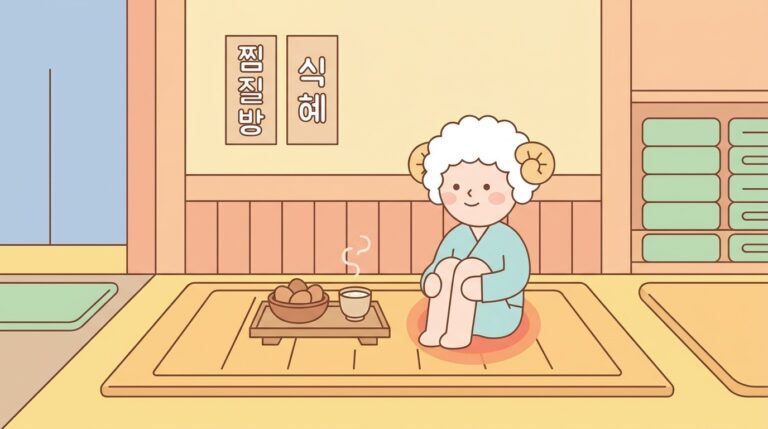
Phase 1: 공감 (Story-Driven Opening)
안녕하세요! 매일한글 에디터입니다.
Picture this: You step through the entrance of a bustling, multi-story Korean jjimjilbang (찜질방). After a soothing soak in hot mugwort baths, you throw on the signature oversized cotton lounge uniform and wander out into the expansive, heated communal hall (ondol). You smell the comforting aroma of cypress wood, roasted barley, and freshly baked eggs. But as you look around, you notice something delightful: almost everyone—from teenagers taking selfies to grandfathers napping on cedar wood pillows—is wearing an adorable towel folded into cute, rounded sheep horns (yangmeori / 양머리).
You grab the fresh, crisp towel given to you at the front desk and eagerly try to fold it into shape. You roll the edges, hoist it onto your head, and… plop. It immediately uncoils into an awkward headband, sliding straight over your nose. You try again, but your hands are warm, the towel is stubborn, and you feel self-conscious fumbling around while everyone else looks effortlessly iconic.
Don’t worry! This is hands down one of the most common moments of cultural freeze our intermediate learners share with us. That is why today, we are skipping the stiff grammar textbooks and diving into authentic, B2-level natural phrases that will not only help you get your towel folded like a local pro, but also break the ice with friendly sauna-goers around you.
Phase 2: 핵심 표현 3선 심층 분석
1. 양머리 어떻게 접어요? (Yangmeori eotteoke jeobeoyo?)
- Pronunciation:
[Yang-meo-ri eo-tteo-ke jeo-beo-yo](Pronounce yang like “young”, meori like “Murray”, eotteoke like “uh-ttoh-keh”, and jeobeoyo rhyming with “low”). - Meaning: Literal: “How do you fold sheep head?” | Actual Nuance: “Could you show me how to fold this sheep towel hat?”
- K-Culture Moment: An essential phrase seen across classic Korean variety shows like Running Man or reality shows where foreign guest idols visit a traditional bathhouse for the first time.
- Editor’s Insight: Notice the verb 접다 (jeopda – to fold). Beginners often default to 만들다 (to make), saying 양머리 어떻게 만들어요?. While understandable, using 접다 signals that you understand the origami-like rolling technique required for Korean bath towels. It instantly elevates your spoken Korean to an authentic intermediate tier.
- Situation Spectrum: Casual: ✅ (
양머리 어떻게 접어?) | Semi-formal: ✅ (양머리 어떻게 접어요?) | Formal: ⚠️ (양머리는 어떻게 접습니까?– Far too stiff for a relaxing bathhouse!) - 🤔 Think About It: In English, we typically say “How do you make this towel hat?” focusing on the end product. Korean zeroes in on the precise physical movement: 접다 (folding). How does your mother tongue conceptualize wearable crafts?
2. 한 번만 보여주실 수 있어요? (Han beonman boyeojusil su isseoyo?)
- Pronunciation:
[Han beon-man bo-yeo-ju-sil su i-sseo-yo](Rhymes with “Hahn bun-mahn boy-yuh-joo-sheel soo ee-so-yo”). - Meaning: Literal: “Could you show me just once?” | Actual Nuance: “Would you mind demonstrating that for me just one time?”
- K-Culture Moment: Gently asking the friendly Imo-nim (auntie) next to you who just effortlessly whipped up three towel hats in ten seconds.
- Editor’s Insight: The magic particle here is -만 (man – only/just). In Korean politeness pragmatics, specifying “just once” (한 번만) functions as a softening buffer. It minimizes the perceived imposition on the other person, turning a request into a modest, humble favor.
- Situation Spectrum: Casual: ⚠️ (too formal for close peers) | Semi-formal: ✅ | Formal: ✅
- 🤔 Think About It: Why does adding restrictive markers like “only” make a request sound polite rather than demanding in Korean society?
3. 자꾸 풀려요 (Jakku pullyeoyo)
- Pronunciation:
[Jak-kku pul-lyeo-yo](Stress the crisp double k: “Jah-kkoo pool-lyuh-yo”). - Meaning: Literal: “It keeps becoming untied/loosened.” | Actual Nuance: “It keeps unraveling / coming undone!”
- K-Culture Moment: Laughing with your travel buddies as your towel coils unravel and flop onto your shoulders the second you try cracking a hard-boiled sauna egg against your forehead.
- Editor’s Insight: Pay close attention to the verb choice: 풀리다 (passive/intransitive: to unravel on its own) instead of 풀다 (active/transitive: to untie deliberately). By using 풀려요, you playfully attribute agency to the towel itself—suggesting the towel is being mischievous rather than admitting you have clumsy fingers!
- Situation Spectrum: Casual: ✅ (
자꾸 풀려) | Semi-formal: ✅ (자꾸 풀려요) | Formal: ⚠️ (자꾸 풀립니다) - 🤔 Think About It: How does shifting responsibility to inanimate objects through passive verbs help save face in Korean social interactions?
Phase 3: 교과서 한국어 vs 진짜 한국어
Situation 1: Asking someone to help roll your towel
- 📖 교과서 한국어: “수건으로 양머리를 만들어 주시겠습니까?” (Su-geon-euro yang-meo-ri-reul man-deul-eo ju-si-get-seum-ni-kka? – “Would you make a sheep head with the towel for me?”)
- 🗣️ 진짜 한국어: “이것 좀 같이 말아주실래요? 제가 하면 자꾸 풀려서요.” (I-geot jom gat-i mar-a-ju-sil-lae-yo? Je-ga ha-myeon jak-ku pul-lyeo-seo-yo. – “Could you help me roll this up? Whenever I do it, it keeps unraveling.”)
- 💡 왜 다를까? Textbook Korean sounds like you are submitting an official business proposal to a bathhouse customer. Real native speakers use the verb 말다 (to roll tightly) and trail off with the explanatory ending -아서요/어서요 to soften the request naturally.
Situation 2: Praising someone’s perfectly folded towel
- 📖 교과서 한국어: “당신의 양머리는 매우 아름답습니다.” (Dang-sin-ui yang-meo-ri-neun mae-u a-reum-dap-seum-ni-da. – “Your sheep head is very beautiful.”)
- 🗣️ 진짜 한국어: “우와, 각이 완전 살아있네요!” (U-wa, gak-i wan-jeon sar-a-it-ne-yo! – “Whoa, the shape and angles are so crisp!”)
- 💡 왜 다를까? First, Koreans rarely use the second-person pronoun “당신” (dangsin) in casual conversations unless arguing. Second, the trendy idiomatic expression 각이 살아있다 (literally: “the angles are alive”) is the ultimate natural compliment for crisp edges, whether on folded laundry, military uniforms, or towel horns.
Phase 4: K-Culture 딥다이브 & 비언어적 매너
4-1. 눈치 (Nunchi) & Body Language
- The Modest Presentation: When approaching someone to ask for folding tips, keep the towel flat across your forearms or hold it with both hands at chest level. Waving an unfolded towel overhead in a quiet ondol hall disrupts the peaceful resting vibe.
- The Sheepish Smile (소심한 눈웃음): When saying 자꾸 풀려요, offer a self-deprecating chuckle and a gentle head tilt. In Korean communal spaces, showing that you don’t take yourself too seriously is an instant social bridge.
- Tub Etiquette: Never wear your folded yangmeori inside the communal hot soaking tubs! Keep your towel resting dry on top of your head or neatly on the tub ledge to avoid soaking soapy cotton in shared water.
4-2. Cultural Code: The Sauna Trinity
Popularized during the golden era of 2000s K-dramas (such as My Lovely Sam Soon and variety classics), the 양머리 isn’t just a quirky fashion statement. It functions as the unofficial uniform of total relaxation. Together with icy cold 식혜 (fermented sweet rice drink) and brown 맥반석 계란 (germanium-baked eggs), sporting the towel horns signals that you have shed your daily corporate stress and entered a world where everyone is delightfully equal.
Phase 5: 실전 롤플레이 시나리오
Setting: The warm jade-stone relaxation hall of a neighborhood jjimjilbang.
Characters: You (visiting after a long week of walking Seoul) and 선우 (Sunwoo), a friendly local regular resting against a wooden neck block.
- You: “저기 혹시… 양머리 어떻게 접는지 아세요?” (Jeogi hoksi… yangmeori eotteoke jeomneunji aseyo? / Excuse me… do you happen to know how to fold the sheep towel?)
🎭 Holding an unfolded brown towel with both hands, smiling sheepishly. -
선우: “아, 양머리요? 엄청 쉬워요! 수건 이리 줘보세요.” (A, yangmeoriyo? Eomcheong swiwoyo! Su-geon iri jwo-bo-seyeo. / Ah, the sheep towel? It’s super easy! Pass the towel over here.)
🎭 Sitting up cross-legged on the heated ondol floor with an welcoming grin. -
You: “제가 영상 보고 따라 했는데, 자꾸 풀려서요.” (Jega yeongsang bogo ttara haenneunde, jakku pullyeoseo-yo. / I tried copying a video, but it keeps unraveling.)
🎭 Pointing at your own loosely bunched, lopsided towel. -
선우: “이게 끝을 세게 말아야 돼요. 수건을 삼등분으로 접은 다음에… 이렇게 소매 걷듯이 세 번 뒤집어 까는 거예요.” (Ige kkeut-eul sege mar-a-ya dwae-yo. Su-geon-eul sam-deung-bun-euro jeobeun da-eume… i-reoh-ke so-mae geot-deu-si se beon dwi-jib-eo kka-neun geo-ye-yo. / You have to roll the ends tight. After folding it into thirds… flip and roll the cuffs outward three times like rolling up sleeves.)
🎭 Demonstrating the cuff-rolling motion firmly with nimble fingers. -
You: “아, 소매 걷듯이요? 한 번만 천천히 보여주실 수 있어요?” (A, so-mae geot-deu-si-yo? Han beonman cheon-cheon-hi boyeojusil su isseoyo? / Ah, like rolling up sleeves? Could you show me just once slowly?)
🎭 Leaning in with attentive, focused posture. -
선우: “자, 안쪽에서 바깥쪽으로 쏙! 반대쪽도 똑같이. 자, 이제 머리에 한번 써보세요.” (Ja, an-jjok-eseo ba-kkat-jjok-euro ssok! Ban-dae-jjok-do ttok-gat-i. Ja, i-je meo-ri-e han-beon sseo-bo-seyeo. / See, flip from inside to outside—snap! Same for the other side. Now, go ahead and put it on.)
🎭 Handing over the perfectly structured sheep towel with crisp round horns. -
You: “우와, 각이 완전 살아있네요! 진짜 감사합니다.” (U-wa, gak-i wan-jeon sar-a-it-ne-yo! Jin-jja gam-sa-ham-ni-da. / Whoa, the shape is so crisp and sturdy! Thank you so much.)
🎭 Putting it on and checking your reflection on the glass pillar with delight. -
선우: “완전 잘 어울려요! 온 김에 매점 가서 식혜나 한잔할래요?” (Wan-jeon jal eo-ul-lyeo-yo! On gim-e mae-jeom ga-seo sik-hye-na han-jan-hal-lae-yo? / It looks great on you! Since you’re here, want to grab a cup of sikhye at the snack counter?)
🎭 Giving two thumbs up while gesturing toward the glowing neon snack bar.
🔀 인터랙티브 분기점 (Interactive Decision Point)
How do you respond to Sunwoo’s invitation?
- Option A: “좋아요! 알려주셨으니까 식혜는 제가 살게요.” (Jo-a-yo! Al-lyeo-ju-syeot-seu-ni-kka sik-hye-neun je-ga sal-ge-yo.)
- Outcome: [BEST CHOICE!] Offering to buy the 3,000 KRW drink as a token of gratitude for the towel lesson is the pinnacle of Korean 정 (Jeong – relational warmth). You just earned a local bathhouse friend!
- Option B: “네, 그럼 구운 계란도 사주실래요?” (Ne, geu-reom gu-un gye-ran-do sa-ju-sil-lae-yo.)
- Outcome: [RISKY] Asking someone who just helped you to also buy you baked eggs sounds presumptuous unless you are already close buddies.
- Option C: “아니요, 저는 혼자 땀 뺄래요.” (A-ni-yo, jeo-neun hon-ja ttam ppael-lae-yo.)
- Outcome: [BAD CHOICE] While setting personal boundaries is fine, saying “No, I want to sweat alone” is too blunt and will make the interaction needlessly awkward.
Phase 6: 10초 감정 섀도잉 드릴
Repeat each line out loud, pausing at the / marks and channeling the assigned emotion!
[🥺 조금 쑥스럽고 간절하게 / Slightly shy & polite]
“저기요… / 이것 좀 / 같이 말아주실래요?”
(Jeo-gi-yo… / i-geot jom / gat-i mar-a-ju-sil-lae-yo?)-
[😅 어이없고 웃음기 섞여서 / Mildly amused & self-deprecating]
“제가 하면 / 왜 자꾸 / 풀릴까요?”
(Je-ga ha-myeon / wae jak-ku / pul-lil-kka-yo?) -
[🤩 감탄하며 뿌듯하게 / Amazed & visibly proud]
“대박! / 각이 / 완전 살아있어요!”
(Dae-bak! / gak-i / wan-jeon sar-a-it-eo-yo!)
Phase 7: K-Culture 미니 사전 (핵심 키워드 4개)
- 양머리 (Yang-meo-ri) | Noun: Sheep/Lamb Head Towel
The iconic dual-bun towel hat rolled from standard-issue bathhouse towels to keep hair up and forehead sweat-free. - 식혜 (Sik-hye) | Noun: Sweet Fermented Rice Drink
A cold, traditional malt-and-cooked-rice beverage served in oversized plastic cups with crushed ice—the ultimate thirst-quencher post-sauna. - 맥반석 계란 (Maek-ban-seok Gye-ran) | Noun: Germanium-Baked Brown Eggs
Eggs slow-baked over volcanic mineral stones for hours until the egg whites turn gelatinous brown with a nutty, smoky flavor. - 불가마 (Bul-ga-ma) | Noun: High-Heat Clay Kiln Dome
Domed traditional sauna rooms made of loess clay heated up to 70°C–90°C. Wearing a towel on your head inside is crucial to protect your scalp from direct radiant heat.
Phase 8: 여행자를 위한 생존 키트
Top 3 Survival Phrases for Jjimjilbang
- “식혜 하나랑 구운 계란 세 개 주세요.” (Sik-hye ha-na-rang gu-un gye-ran se gae ju-se-yo.)
Pro Tip: Eggs are almost always sold in bundles of three! Order with this exact rhythm. - “키로 찍으면 되나요?” (Ki-ro jji-geu-myeon doe-na-yo?)
Pro Tip: You never carry paper money or credit cards inside the hot rooms; simply tap your electronic wrist locker key at the snack stall. - “얼음방 어디예요?” (Eor-eum-bang eo-di-ye-yo?)
Pro Tip: After enduring the fiery Bulgama, asking for the “Ice Room” lets you rapidly cool down while preserving that invigorating endorphin rush.
Editor’s Travel Note
- Navigation: Download the [네이버 지도 앱 다운로드 (Naver Map App)] to easily filter 24-hour saunas (24시 찜질방) near subway exits.
- Billing: Remember that your locker key logs all snack and massage chair purchases. You pay the final consolidated balance at the front desk when returning your locker key at check-out.
Phase 9: “한 발 더 깊이” (생각 질문)
In a fast-paced society governed by strict professional honorifics, corporate titles, and designer dress codes, the Korean jjimjilbang acts as an extraordinary social equalizer. Stripped of suits and fancy jewelry, lounging in identical loose cotton pajamas with towels rolled into silly sheep ears, Koreans step into a communal zone where generational and social barriers evaporate. Making a yangmeori isn’t merely an Instagram photo-op; it is a shared invitation to shed one’s adult seriousness and partake in collective, lighthearted leisure.
💬 Your Turn: Does your culture have a public communal space where social hierarchies vanish and strangers easily bond over simple rituals? Share your thoughts below!
Phase 10: FAQ & 오해 방지
Q: Can I wear my yangmeori towel hat into the gender-segregated wet bath pools?
A: While it is not forbidden to wear it on dry land, towels must strictly never touch the water inside the communal tubs. Most Koreans wear the yangmeori exclusively in the co-ed, dry communal lounge area (jjimjil-guyeok).
Q: Why do my towel horns feel loose and keep slipping off my ears?
A: You didn’t cuff the rolled edges outward tightly enough! After folding the towel into horizontal thirds, roll each sleeve end inside-out at least 3 to 4 times with firm tension. That rolling tension is the secret anchor that hugs your skull.
Q: Do people really crack hard-boiled eggs against their friends’ heads?
A: Yes! It is an enduring playful bathhouse trope popularized by Korean variety shows. However, always test the density first with a gentle tap—sauna-baked shells can sometimes be surprisingly firm!
🚨 흔한 실수 (Common Mistakes) 경고판
- Mistake: Rolling the towel ends inward instead of flipping them inside-out (뒤집어 말기).
- Correct Action: Flip the cuffs outward like folding up denim jeans sleeves to lock the tension.
- Mistake: Using stiff business endings like “이것을 만들어 주십시오” with sauna regulars.
- Correct Action: Use friendly intermediate request grammar: “이것 좀 말아주실래요?”.
- Mistake: Leaving wet soaked towels on the wooden heating floors.
- Correct Action: Use the yellow laundry collection bins scattered near the dressing rooms.
Phase 11: 액션 미션 & 참여 유도
- 🥉 Bronze Mission: Grab a clean bath towel at home right now and practice folding the three-fold base in under 30 seconds.
- 🥈 Silver Mission: Snap a mirror selfie wearing your completed yangmeori and post it to your social media or study journal with the caption: “각이 살아있네!”.
- 🥇 Gold Mission: On your next trip to Korea, walk up to a fellow lounge-goer and use: “제가 하면 자꾸 풀리는데 한 번만 보여주실 수 있어요?”.
🎮 K-Culture Mission: Watch an episode of a Korean variety show (such as Running Man or 2 Days & 1 Night) featuring a sauna special, and count how many different styles of towel folding you spot!
Phase 12: 인터랙티브 퀴즈 챌린지
1. Situational Choice: Your towel hat keeps falling apart while resting in the salt room. What is the most natural way to say “It keeps unraveling” to your Korean study buddy?
* A) 자꾸 풀려요 (Jakku pullyeoyo)
* B) 자꾸 풀어요 (Jakku pureoyo)
* C) 자꾸 닫혀요 (Jakku dachyeoyo)
2. Fill-in-the-Blank: Praise someone’s sturdy, stylish towel hat using contemporary Korean slang:
* “우와, ___이 완전 살아있네요!” (*U-wa, ___ -i wan-jeon sar-a-it-ne-yo!*)
3. True or False: In a Korean Jjimjilbang, you must carry cash in your pocket to purchase sikhye and sauna eggs at the snack stall.
* [ True / False ]
👉 Click here to check the answers & explanations!
- Answer: A) 자꾸 풀려요
Explanation: 풀리다 is the passive verb meaning “to become undone on its own,” making it the most natural and native way to describe unraveling towels. - Answer: 각 (Gak)
Explanation: 각이 살아있다 means the angles and structure are crisp and perfectly defined. - Answer: False
Explanation: All transactions inside the lounge area are recorded electronically via your locker wristband key (락커키) and settled at check-out!







